apron strings, tied to

Cover page of sheet music for “Your Mother’s Apron String,” a song by John Hogarth Lozier, 1891

Cover page of sheet music for “Your Mother’s Apron String,” a song by John Hogarth Lozier, 1891

9 May 2020

To be tied to someone’s apron strings is a metaphor for being unduly attached to or dominated by a woman, and it connotes immaturity, foolishness, and impotence. The metaphor is rather obvious, since traditionally it would be a woman who wore an apron.

The phrase dates to at least 1791 when it appears in George Colman’s play The Jealous Wife. In the opening scene, the character of Mrs. Oakly accuses her husband of being unfaithful with a number of women, and he replies:

Oons! madam, the grand Turk himself has not half so many mistresses.— You throw me out of all patience— Do I know any body but our common friends?— Am I visited by any body that does not visit you?— Do I ever go out, unless you go with me?— And am I not as constantly by your side as if I was tied to your apron-strings?

Colman’s use is in the sense of literal proximity. But by 1823 the sense of the phrase we’re familiar with today was in place. From the Edinburgh Magazine and Literary Miscellany of July of that year:

The doating gowk, aye seen to hing
Tied to his dearie’s apron string.

There are, however, some older uses of apron-string to refer to women and that hint at their dominance over some men. An apron-string hold/tenure is when a man controls a property owned by his wife but only during her lifetime. Nathaniel Ward in his 1647 The Simple Cobler of Aggawam in America writes:

I have observed men to have two kindes of Wills, a Free-hold will, such as men hold in Capite of themselves; or a Copy-hold will, held at the will of other Lords or Ladies. [...] And I am sure, a King cannot hold by Copy, at the will of other Lords; the Law calls that base tenure, inconsistent with Royalty; much more base is it, to hold at the will of Ladies: Apron-string tenure is very weak, tyed but of a slipping knot, which a childe may undoe, much more a King. It stands not with our Queens honour to weare an Apron, much lesse her Husband, in the strings; that were to insnare both him and her self in many unsafeties. I never heard our King was Effeminate: to be a little Uxorious personally, is a vertuous vice in Oeconomicks; but Royally, a vitious vertue in Politicks.

And there is William Ellis’s use of the term in his 1744 Modern Husbandman which equates having an apron-string tenure with foolishness:

There may happen some particular Cases, which may oblige a Person to transplant Trees even in Summer-time; as when he is forced to remove them in that Season, or must destroy his Fruit-Trees, if he cannot carry them away, and transplant them safely in another place; which very likely would answer better than what one of my Neighbours did, who, being possessed of a House and large Orchard by Apron-string-hold, felled almost all his Fruit-Trees, because he every Day expected the Death of his sick Wife.

Richard Brathwaite in his 1640 Ar’t asleepe husband? writes:

For a kind natur'd wench will see light thorow a small hole; yea, and with twirling of their Apron-string, have as ready an answer, if at any time taken napping.

And there is this, from the anonymous 1649 play The Rebellion of Naples or the Tragedy of Massenello, in which the main character Tomaso is speaking to his wife:

Now the hand of providence hath cal'd me to hold the Scales of Justice; now, to be President of a Councel of State; by and by, President of a Councel of War: Do you think Women are sit Creatures to be consulted with? Must the affairs of State hang upon an apron-string? Look to your dishes, and see that your rooms be well swept, and never think to teach Tomaso what he hath to do.

And a century earlier, Nicholas Udall in his 1542 translation of Erasmus’s Apophthegmes, includes a note in which he equates a mother’s apron string with foolishness and stupidity, perhaps a metaphor of an immature child:

euen of old antiquitee dawcockes, lowtes, cockescombes & blockheaded fooles, were in a prouerbial speaking said: Betizare, to be werishe & vnsauery as Beetes. Plautus in his comedie entitled Truculentes, saith: Blitea est meretrix, it is a pekish [i.e., foolish] whore, & as we say in english, As wise as a gooce, or as wise as her mothers aperen string. So a feloe that hath in him no witte, no quickenesse, but is euen as one hauing neither life ne soule, Laberius calleth Bliteam belluam, a best made of Beetes.

So. the phrase tied to apron strings dates to at least the eighteenth century, although it may be older in oral use. And the association of apron strings with female power is much older.

Discuss this post


Sources:

Early English Books Online (EEBO).

Green’s Dictionary of Slang, 2020, s.v. apron-strings, n.

Oxford English Dictionary, second edition, 1989, s.v. apron-string, n.

Photo credit: New York Public Library.
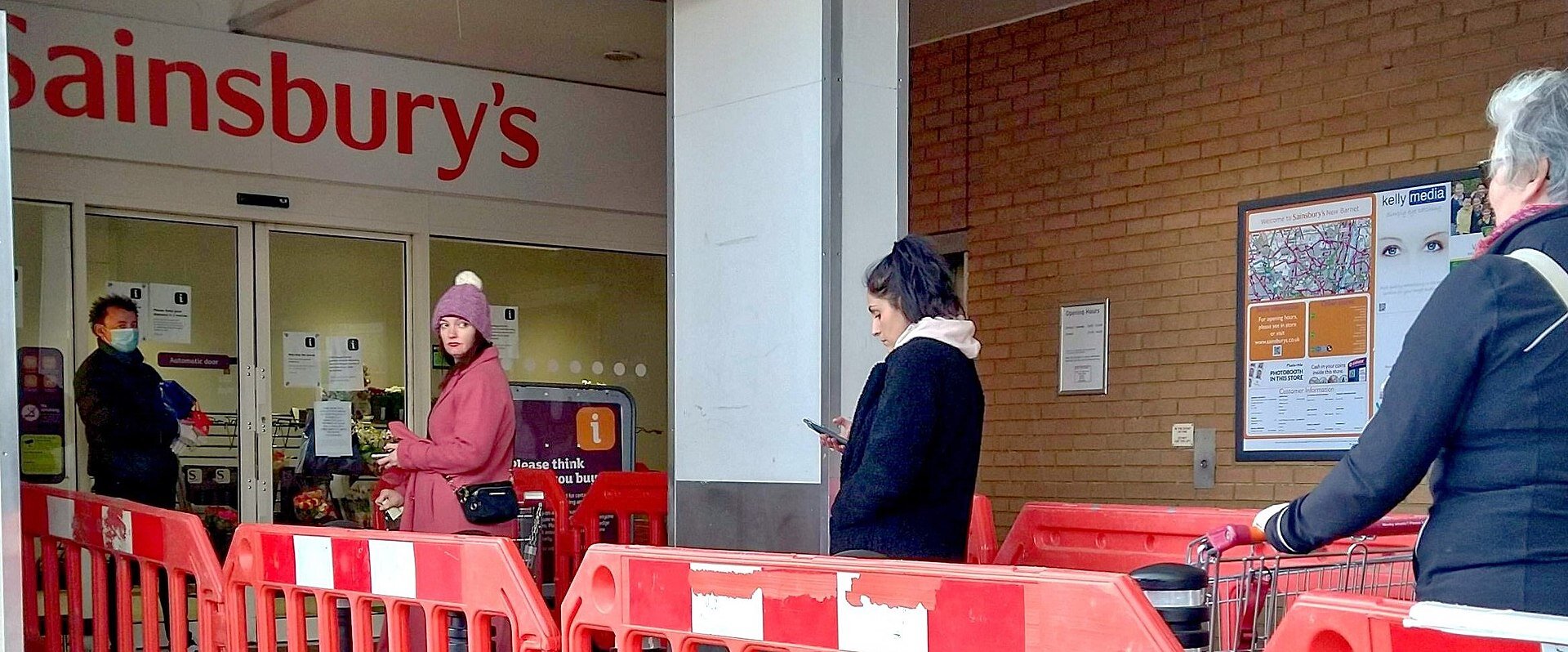
social distance

Social distancing at a London supermarket, 30 March 2020.

Social distancing at a London supermarket, 30 March 2020.

8 May 2020

The phrase social distance has three distinct meanings. The oldest is used today mainly in the social sciences to refer to differences in social class; the distance here is metaphorical. This sense dates to the early nineteenth century, with the oldest citation in the Oxford English Dictionary being in an 1830 translation of L. A. F. De Bourrienne’s Private Memoirs of Napoleon Bonaparte:

Here terminated my connexion with Bonaparte as a comrade and equal [...] His position placed too great a social distance between him and me, not to make me feel the necessity of fashioning my demeanor accordingly.

About a century later, the phrase began to be used to denote a measure of literal distance, in this case the separation typically maintained between people in person-to-person interactions. This sense is often used in psychological and etiquettical contexts. From the 4 November 1935 theater review in the Times (London):

Miss Tempest at a bridge table significantly watches her husband's embarrassed attempts to maintain a safe social distance between himself and his possessive admirer.

The third sense is also one of physical separation, but it is used in the context of controlling the spread of a contagious disease. The earliest citation of this sense that I can find is from November 2004 in the journal Emerging Infectious Diseases. There may be antedatings to be found, but the quotation marks around the phrase indicate that the use in this context is new or unfamiliar to the author and editors:

The 2003 outbreak of severe acute respiratory syndrome (SARS) is a modern example of containing a global epidemic through traditional or nonmedical public health interventions. The interventions included finding and isolating patients; quarantining contacts; measures to “increase social distance,” such as canceling mass gatherings and closing schools; recommending that the public augment personal hygiene and wear masks; and limiting the spread of infection by domestic and international travelers, by issuing travel advisories and screening travelers at borders.

And the next month there is social distancing from the December 2004 issue of Biosecurity and Bioterrorism: Biodefense Strategy, Practice, and Science:

The emotional reactions to social distancing were reported as fear, isolation, loneliness, depression, insomnia, and anxiety, but boredom was specifically cited as the greatest emotional disincentive to compliance with quarantine.

This sense of social distance appears outside of the public health community about a year later on 30 October 2005 in the New York Times.

Dr. Matthew Cartter [sic], the epidemiology program coordinator for the public health department, said his agency has actually been preparing for a pandemic since the 1990's. He said there are not enough hospital beds in the state should a pandemic occur. If officials instead call quarantines "increasing social distance" or "community shielding," will residents be more willing to participate in them? Probably, he said.

So while most English-speakers became familiar with social distancing during the 2020 COVID-19 pandemic, the use of the term in public health circles is much older.

Discuss this post


Sources:

Bell, David M., et al. “Public Health Interventions and SARS Spread, 2003.” Emerging Infectious Diseases, 10.11, November 2004, 1900–06.

DiGiovanni, Clete, et al. “Factors Influencing Compliance with Quarantine in Toronto During the 2003 SARS Outbreak. Biosecurity and Bioterrorism: Biodefense Strategy, Practice, and Science, 2.4, December 2004, 265–72.

Gordon, Jane. “Just in Case: Planning for an Avian Flu Outbreak.” New York Times, 30 October 2005, Q3.

Oxford English Dictionary, third edition, September 2009, s.v. social distance, n.

Photo credit: Philafrenzy, 2020, used under CC BY-SA 4.0.

bug (computer)

16 June 2020

Errors in computer code are known as bugs, but why? We can’t know for sure, but it is likely that the metaphor of an insect contaminating and gumming up the works of a mechanical or electric device is at its core. This particular use of the term arose in the United States in the latter half of the nineteenth century.

The ordinary sense of bug is of an insect, or to entomologists an insect of the order Hemiptera. This sense appears in the closing years of the sixteenth century. From John Hester’s 1594 medical text, The Pearle of Practise:

This medecine caused many times, a certain blacke bugge, or worme to come forth which had many legs, & was quicke: & after that the cancker would heale quicklie, with any conuenient medecine.

The origin of the standard sense of bug is unknown, but it may be from the sense of bug meaning a monster or evil spirit. (See bogey.)

The word moved into the world of invention by 1875, when it appears in the pages of the 15 August issue of The Operator, The Journal of Scientific Telegraphy:

The biggest “bug” yet has been discovered in the U.S. Hotel Electric Annunciator.

Some sources ascribe this sense to Thomas Edison. He did use the term, as evidenced by this 18 November 1878 letter to Theodore Puskas:

It has been just so in all my inventions. The first step is an intuition—and comes with a burst, then difficulties arise. This thing gives out and then that —“Bugs”—as such little faults and difficulties are called—show themselves and months of anxious watching, study and labor are requisite before commercial success—or failure—is certainly reached.

But as the earlier citation shows, Edison did not coin the term. He was just using a term that was current in the technological slang of the day. And while I do not know if Edison read The Operator, it’s just the sort of thing he would read.

In the first half of the twentieth century, the sense moved out of technical circles and into more widespread use, as witnessed by this statement by New York City Mayor Fiorella LaGuardia in the 22 July 1937 New York Times:

“No building code or any code of that kind can be drawn up without bugs, defects or jokers,” [La Guardia] commented. “The only thing to do with this code is to try it and be ready to amend it as soon as the bugs, defects and jokers appear. It is exactly like the airplane motor which looked perfect on the drafting board and which will not fly.”

9 September 1945 page from the logbook of the Harvard Mark II computer with a moth taped to it

9 September 1945 page from the logbook of the Harvard Mark II computer with a moth taped to it

And of course, it moved into the world of computing as soon as that world was created. The earliest reference to bugs in computers that I’m aware of dates to 9 September 1945. At 3:45 pm on that date computer workers on the Harvard Mark II machine at the Naval Surface Warfare Center in Dahlgren, Virginia found a moth in a relay of the machine. They taped the insect into their logbook and recorded it as:

1545 Relay #70 Panel F (moth) in relay. First actual case of bug being found.

Computer pioneer Grace Hopper, who worked on the Harvard Mark II, was fond of telling this story, and many have understood that fact to mean that she coined the term. But as with the case of Edison, the Mark II workers were just using a term they already knew, and the first actual case is a joke. It’s the first actual bug (i.e., insect), not the first defect in the machine or its code.

Discuss this post


Sources:

Green’s Dictionary of Slang, 2020, s.v. bug n.4.

Hester, John. The Pearle of Practise, or Practisers Pearle, for Phisicke and Chirugerie. London: Richard Field, 1594, 14.

Hopper, Grace Murray. “Anecdotes: The First Bug.” Annals of the History of Computing, 3.3, July–September 1981: 285-86

“La Guardia to Sign New Building Code.” New York Times, 22 July 1937, 27.

Oxford English Dictionary, third edition, March 2017, s.v. bug, n.2.

Shapiro, Fred R. The Yale Book of Quotations. Yale University Press, 2006, 226.

Photo credit: 9 September 1945, U.S. Naval History and Heritage Command photograph.