bailiwick

11 May 2020

In the United States today, a bailiff is an official who is charged with keeping order in a courtroom and who often acts as crier, announcing the opening of proceedings. But in England the title is used for any number of administrative magistrates or officials. The English word comes to us from the Old French, one of the administrative terms introduced to England by the Normans, and that in turn is from the medieval Latin bajulus, meaning carrier or supporter, and by extension governor or minister. The English word is in place by about 1300, as in this example from the life of Thomas Becket contained in the South English Legendary (Oxford, Bodleian MS Laud Misc. 108):

Al-þei it þoruȝ treuþe were: þe playdinge scholde beon i-brouȝt
bi-fore þe kinge and is baillifs: and to holi churche nouȝt.

(Although it was the thorough truth, the pleading should have been brought before the king and his bailiffs, and not to the holy church.)

A bailiwick is originally the area of jurisdiction of a bailiff, and by extension it has generalized to mean a person’s area of expertise, skill, or authority. It’s a compounding of bailie, a form of bailiff, and -wick, an Old English word for town. So, a bailiwick is literally a bailiff’s district. The word is in place by 1431 when it appears in the chronicles of Durham Cathedral Priory (York Minster Library, MS XVI.i.12):

Ye shall doo all your payne and diligence to destroye and make to cese all maner of heresyes and erroures commonly called Lollardnes with in your baillifwyke.

(You shall make all effort and do all diligence to destroy and cease all manner of heresies and errors that are commonly called Lollardy within your bailiwick.)

The generalized sense of bailiwick is an Americanism that is in place by at least 1837, when the New England Farmer and Horticultural Register of 13 December includes:

“Let every one keep within his own Bailiwick.”

We like above motto, and believe the observance of it would be wholesome and profitable to farmers. We are fond of seeing a man stick to his own occupation; keeping on “his own side of the hedge.” If we all were to follow this good rule, surely agriculture would be no loser by it. Time was, when a farmer was obliged to be “jack at all trades.” But this was when mechanics were few, compared to the present times.

Discuss this post


Sources:

American Heritage Dictionary, fifth edition, 2020, bailiwick, n.

Anglo-Norman Dictionary, 2017, s.v. bailliff.

Dictionary of Medieval Latin from British Sources, 2013, s.v. bajulus.

Garner, Bryan A. ed. Black’s Law Dictionary, 11th edition, 2019, s.v. bailiff, bailiwick.

Historiae Dunelmensis Scriptore Tres, by Geoffrey of Coldingham, Robert Greystones, and William de Chambre. London: J.B. Nichols and Son, 1839.

Middle English Dictionary, 2018, s.v. bailif, n. and bailif-wik, n.

Oxford English Dictionary, second edition, 1989, s.v. bailiff, n. and bailiwick, n.

quarantine

U.S. President Nixon greeting the crew of Apollo 11 in quarantine upon their return from the moon, 24 July 1969

U.S. President Nixon greeting the crew of Apollo 11 in quarantine upon their return from the moon, 24 July 1969

10 May 2020

A quarantine is a period of isolation, especially one necessitated to stop or slow the transmission of a disease. The U.S. Centers for Disease Control and Prevention (CDC) differentiates the word from isolation:

Isolation and quarantine help protect the public by preventing exposure to people who have or may have a contagious disease.

Isolation separates sick people with a contagious disease from people who are not sick.

Quarantine separates and restricts the movement of people who were exposed to a contagious disease to see if they become sick.

Quarantine comes to English from medieval Latin, both directly and via French and Italian. The medieval Latin quarentena is a variation of the classical Latin quadraginta, meaning the number forty. Quarentena had a number of senses dating from the twelfth century in Anglo-Latin texts, all relating to measurements involving the number forty. It could mean a furlong (i.e., 40 rods) in length or an area measuring a furlong on all four sides (roughly ten acres). Or in could refer to a period of forty days in various religious, legal, or diplomatic contexts. It could also refer to the location in the wilderness where Christ fasted for forty days and nights.

This last sense is the one used in quarantine’s first appearance in English that is recorded by the Oxford English Dictionary and the Middle English Dictionary. From the description of Jerusalem in the Itineraries of William Wey, c. 1470, found in Oxford, Bodleian Library, Bodl 565:

By yonde ys a wyldernys of quaren tyne,
Wher Cryst wyth fastyng hys body dyd pyne.

(Beyond is a wilderness of quarantine,
Where Christ with fasting his body did pine.)

Quarantine’s connection with disease probably comes to us via Italian, specifically from Venice, where, in the early fourteenth century, ships from plague-ridden ports were required to ride at anchor for forty days before putting into the port. This sense appears in English by 1649, when the newspaper the Moderate Intelligencer published this report from Toulon:

Our Gallyes which were upon the point of finishing their Quarantaine, and entering into this Port, have been hindred from it by th'arrival of three others that were out a roaming.

In less than fifteen years, the word had lost its specific association with forty days, as recorded by Samuel Pepys in his Diary of 26 November 1663:

The plague, it seems, grows more and more at Amsterdam; and we are going upon making of all ships coming from thence and Hambrough, or any other infected places, to perform their Quarantine (for 30 days as Sir Rd. Browne expressed it in the order of the Council, contrary to the import of the word; though in the general acceptation, it signifies now the thing, not the time spent in doing it) in Holehaven, a thing never done by us before.

The verb to quarantine appears in the early nineteenth century.

In current use, quarantine is also used in politics to refer to a diplomatic or economic isolation of a country. This sense appears as early as 1891, when France severed diplomatic ties with Bulgaria, as reported by the New York Times on 16 December of that year:

The future will throw light on the question of how the rupture will affect Bulgaria and those in power at Sofia. When a great power establishes diplomatic quarantine against them it is well not to go too far on a course on which they appear to be embarking with a light heart.

More famously, US President Franklin D. Roosevelt delivered his “Quarantine Speech” on 5 October 1937 in which he advocated for strong but unspecified, presumably economic, action against unspecified aggressor nations, presumably Germany, Italy, and Japan. Roosevelt did not specifically label those actions as a quarantine, instead he used a medical metaphor:

It seems to be unfortunately true that the epidemic of world lawlessness is spreading. And mark this well: When an epidemic of physical disease starts to spread, the community approves and joins in a quarantine of the patients in order to protect the health of the community against the spread of the disease. It is my determination to pursue a policy of peace and to adopt every practicable measure to avoid involvement in war.

As reported by the New York Times the following day:

Nobody at the State Department today professed to know what the President meant in his Chicago speech by suggesting an isolation of the world’s treaty-breakers by “quarantine,” or by his offer to join “positive efforts to preserve peace.”

On 22 October 1962 during the Cuban Missile Crisis, President John F. Kennedy used the word with more specificity in his announcement of a naval blockade of Cuba:

To halt this offensive buildup, a strict quarantine on all offensive military equipment under shipment to Cuba is being initiated. All ships of any kind bound for Cuba from whatever nation or port will, if found to contain cargoes of offensive weapons, be turned back. This quarantine will be extended, if needed, to other types of cargo and carriers. We are not at this time, however, denying the necessities of life as the Soviets attempted to do in their Berlin blockade of 1948.

The word is also used in computing to refer to isolating a computer virus, as in this 21 March 1988 use in the journal InfoWorld:

Also included is Canary, a “quarantine” program for use as a sample to test for a virus by pairing it with new or suspect programs.

Discuss this post


Sources:

Dictionary of Medieval Latin from British Sources, 2013, s.v. quarentena.

Middle English Dictionary, 2018, s.v. quarentine.

Oxford English Dictionary, third edition, December 2007, s.v. quarantine, n. and quarantine, v.

Centers for Disease Control and Prevention (CDC). “Quarantine and Isolation.”29 September 2017.

Photo credit: NASA.

apron strings, tied to

Cover page of sheet music for “Your Mother’s Apron String,” a song by John Hogarth Lozier, 1891

Cover page of sheet music for “Your Mother’s Apron String,” a song by John Hogarth Lozier, 1891

9 May 2020

To be tied to someone’s apron strings is a metaphor for being unduly attached to or dominated by a woman, and it connotes immaturity, foolishness, and impotence. The metaphor is rather obvious, since traditionally it would be a woman who wore an apron.

The phrase dates to at least 1791 when it appears in George Colman’s play The Jealous Wife. In the opening scene, the character of Mrs. Oakly accuses her husband of being unfaithful with a number of women, and he replies:

Oons! madam, the grand Turk himself has not half so many mistresses.— You throw me out of all patience— Do I know any body but our common friends?— Am I visited by any body that does not visit you?— Do I ever go out, unless you go with me?— And am I not as constantly by your side as if I was tied to your apron-strings?

Colman’s use is in the sense of literal proximity. But by 1823 the sense of the phrase we’re familiar with today was in place. From the Edinburgh Magazine and Literary Miscellany of July of that year:

The doating gowk, aye seen to hing
Tied to his dearie’s apron string.

There are, however, some older uses of apron-string to refer to women and that hint at their dominance over some men. An apron-string hold/tenure is when a man controls a property owned by his wife but only during her lifetime. Nathaniel Ward in his 1647 The Simple Cobler of Aggawam in America writes:

I have observed men to have two kindes of Wills, a Free-hold will, such as men hold in Capite of themselves; or a Copy-hold will, held at the will of other Lords or Ladies. [...] And I am sure, a King cannot hold by Copy, at the will of other Lords; the Law calls that base tenure, inconsistent with Royalty; much more base is it, to hold at the will of Ladies: Apron-string tenure is very weak, tyed but of a slipping knot, which a childe may undoe, much more a King. It stands not with our Queens honour to weare an Apron, much lesse her Husband, in the strings; that were to insnare both him and her self in many unsafeties. I never heard our King was Effeminate: to be a little Uxorious personally, is a vertuous vice in Oeconomicks; but Royally, a vitious vertue in Politicks.

And there is William Ellis’s use of the term in his 1744 Modern Husbandman which equates having an apron-string tenure with foolishness:

There may happen some particular Cases, which may oblige a Person to transplant Trees even in Summer-time; as when he is forced to remove them in that Season, or must destroy his Fruit-Trees, if he cannot carry them away, and transplant them safely in another place; which very likely would answer better than what one of my Neighbours did, who, being possessed of a House and large Orchard by Apron-string-hold, felled almost all his Fruit-Trees, because he every Day expected the Death of his sick Wife.

Richard Brathwaite in his 1640 Ar’t asleepe husband? writes:

For a kind natur'd wench will see light thorow a small hole; yea, and with twirling of their Apron-string, have as ready an answer, if at any time taken napping.

And there is this, from the anonymous 1649 play The Rebellion of Naples or the Tragedy of Massenello, in which the main character Tomaso is speaking to his wife:

Now the hand of providence hath cal'd me to hold the Scales of Justice; now, to be President of a Councel of State; by and by, President of a Councel of War: Do you think Women are sit Creatures to be consulted with? Must the affairs of State hang upon an apron-string? Look to your dishes, and see that your rooms be well swept, and never think to teach Tomaso what he hath to do.

And a century earlier, Nicholas Udall in his 1542 translation of Erasmus’s Apophthegmes, includes a note in which he equates a mother’s apron string with foolishness and stupidity, perhaps a metaphor of an immature child:

euen of old antiquitee dawcockes, lowtes, cockescombes & blockheaded fooles, were in a prouerbial speaking said: Betizare, to be werishe & vnsauery as Beetes. Plautus in his comedie entitled Truculentes, saith: Blitea est meretrix, it is a pekish [i.e., foolish] whore, & as we say in english, As wise as a gooce, or as wise as her mothers aperen string. So a feloe that hath in him no witte, no quickenesse, but is euen as one hauing neither life ne soule, Laberius calleth Bliteam belluam, a best made of Beetes.

So. the phrase tied to apron strings dates to at least the eighteenth century, although it may be older in oral use. And the association of apron strings with female power is much older.

Discuss this post


Sources:

Early English Books Online (EEBO).

Green’s Dictionary of Slang, 2020, s.v. apron-strings, n.

Oxford English Dictionary, second edition, 1989, s.v. apron-string, n.

Photo credit: New York Public Library.

social distance

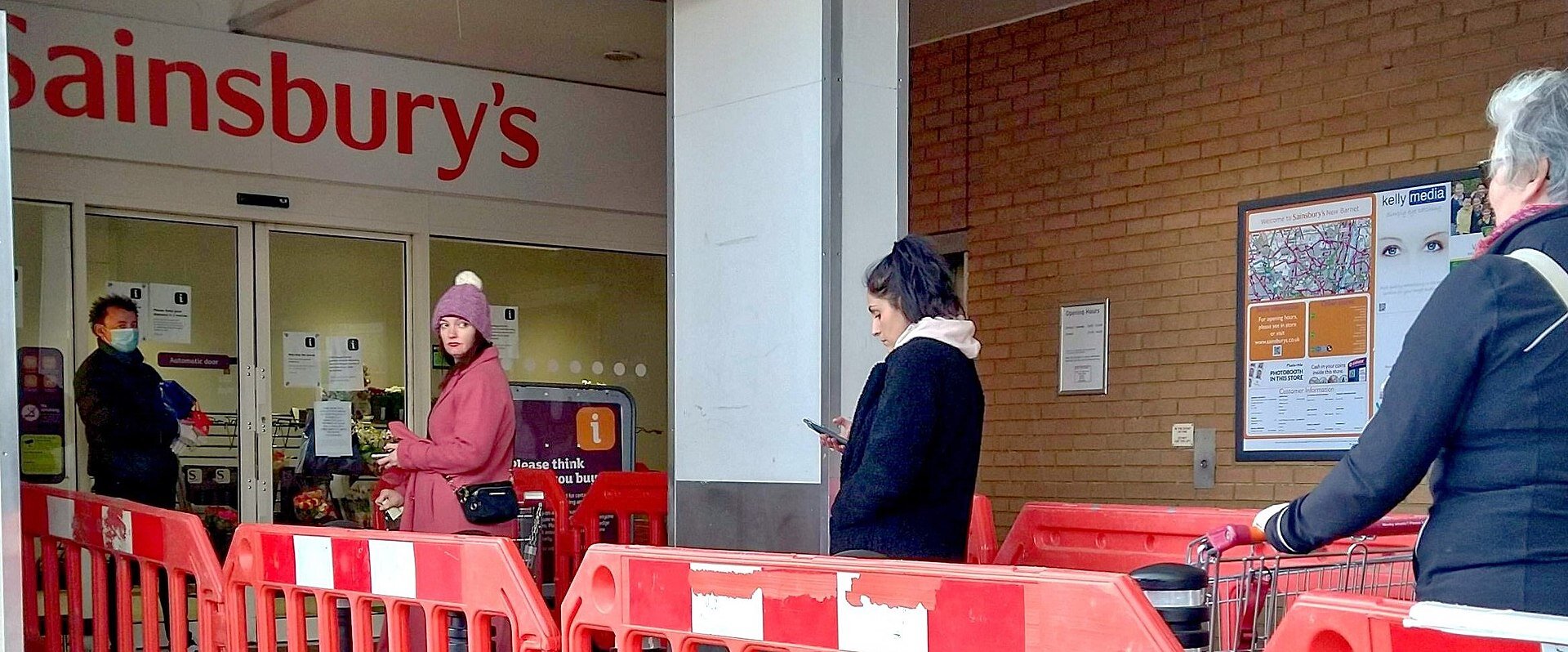
Social distancing at a London supermarket, 30 March 2020.

Social distancing at a London supermarket, 30 March 2020.

8 May 2020

The phrase social distance has three distinct meanings. The oldest is used today mainly in the social sciences to refer to differences in social class; the distance here is metaphorical. This sense dates to the early nineteenth century, with the oldest citation in the Oxford English Dictionary being in an 1830 translation of L. A. F. De Bourrienne’s Private Memoirs of Napoleon Bonaparte:

Here terminated my connexion with Bonaparte as a comrade and equal [...] His position placed too great a social distance between him and me, not to make me feel the necessity of fashioning my demeanor accordingly.

About a century later, the phrase began to be used to denote a measure of literal distance, in this case the separation typically maintained between people in person-to-person interactions. This sense is often used in psychological and etiquettical contexts. From the 4 November 1935 theater review in the Times (London):

Miss Tempest at a bridge table significantly watches her husband's embarrassed attempts to maintain a safe social distance between himself and his possessive admirer.

The third sense is also one of physical separation, but it is used in the context of controlling the spread of a contagious disease. The earliest citation of this sense that I can find is from November 2004 in the journal Emerging Infectious Diseases. There may be antedatings to be found, but the quotation marks around the phrase indicate that the use in this context is new or unfamiliar to the author and editors:

The 2003 outbreak of severe acute respiratory syndrome (SARS) is a modern example of containing a global epidemic through traditional or nonmedical public health interventions. The interventions included finding and isolating patients; quarantining contacts; measures to “increase social distance,” such as canceling mass gatherings and closing schools; recommending that the public augment personal hygiene and wear masks; and limiting the spread of infection by domestic and international travelers, by issuing travel advisories and screening travelers at borders.

And the next month there is social distancing from the December 2004 issue of Biosecurity and Bioterrorism: Biodefense Strategy, Practice, and Science:

The emotional reactions to social distancing were reported as fear, isolation, loneliness, depression, insomnia, and anxiety, but boredom was specifically cited as the greatest emotional disincentive to compliance with quarantine.

This sense of social distance appears outside of the public health community about a year later on 30 October 2005 in the New York Times.

Dr. Matthew Cartter [sic], the epidemiology program coordinator for the public health department, said his agency has actually been preparing for a pandemic since the 1990's. He said there are not enough hospital beds in the state should a pandemic occur. If officials instead call quarantines "increasing social distance" or "community shielding," will residents be more willing to participate in them? Probably, he said.

So while most English-speakers became familiar with social distancing during the 2020 COVID-19 pandemic, the use of the term in public health circles is much older.

Discuss this post


Sources:

Bell, David M., et al. “Public Health Interventions and SARS Spread, 2003.” Emerging Infectious Diseases, 10.11, November 2004, 1900–06.

DiGiovanni, Clete, et al. “Factors Influencing Compliance with Quarantine in Toronto During the 2003 SARS Outbreak. Biosecurity and Bioterrorism: Biodefense Strategy, Practice, and Science, 2.4, December 2004, 265–72.

Gordon, Jane. “Just in Case: Planning for an Avian Flu Outbreak.” New York Times, 30 October 2005, Q3.

Oxford English Dictionary, third edition, September 2009, s.v. social distance, n.

Photo credit: Philafrenzy, 2020, used under CC BY-SA 4.0.

Tommy / Tommy Atkins

12 January 2016

The great joy of running this website is that now and again you discover a term that simultaneously connects with great historical figures and events and reveals how language, the most human of inventions, works. The British slang term for a soldier, Tommy, is just such a word. It is short for Tommy Atkins, and the word’s history, both purported and real, pulls in both the great, i.e., the Duke of Wellington, and the small, i.e., an example of how to fill out a government form correctly.

As mentioned, Tommy is slang for a British private soldier. Today, the word is chiefly associated with those who fought in the First World War, but its origins are at least a hundred years older, in the Napoleonic wars. Today it’s primarily found in British usage, but North Americans may be familiar with Tommy from movies about the two World Wars and from the Kipling poem. And the oldest among us will remember its use during the first half of the twentieth century, when the word had some currency on this side of the pond.

Who is the Tommy Atkins who lent his name as a sobriquet for the British soldier? Most likely there is no real person behind the term’s use. While there have been a number of British soldiers with that name over the centuries, the name was probably picked because its only remarkable feature is its lack of remarkability, like John Smith. The first documented use of the term is in the form Thomas Atkins. And not only is it in that form, it is quite literally on a form, the 1815 Collection of Orders, Regulations, &c., a book that was issued to every British soldier and that contained a record of his pay and allowances. Like all good bureaucratic documents, that book provides an example of how to properly fill out a form for a soldier’s pay:

Description, Service, &c. of Thomas Atkins, Private, No. 6 Troop, 6th Regt. of Dragoons. Where Born… Parish of Odiham, Hants. When ditto… 1st January 1784. [...] Bounty, £7, 7s. Received, Thomas Atkins, his x mark.

The beauty of this specific use is that it would be seen by thousands of officers and soldiers all across the British Empire, permanently cementing the name’s use as a soldier’s sobriquet. In fact, this book was so closely associated with the name that soldiers took to calling the book itself The Tommy Atkins. We tend to look to Shakespeare and great literary works for linguistic innovation, but more often it’s things like humble bureaucratic documents, texts that we see on a daily basis but don’t take conscious note of, that are more powerful.

It is likely that by the time this document was issued in 1815 Thomas Atkins was already a generic slang term for a soldier and it’s appearance in that document is an attestation, rather than a coinage. One clue to this is that soldiers and sailors were already calling bread tommy, often soft tommywhite tommy, or brown tommy to differentiate various types. Grose’s 1796 A Classical Dictionary of the Vulgar Tongue has this:

TOMMY. Soft Tommy, or white tommy; bread is so called by sailors, to distinguish it from biscuit.

The 1811 revision of Grose’s dictionary, known as the Lexicon Balatronicum, adds to the above:

Brown Tommy; ammunition bread for soldiers; or brown bread given to convicts at the hulks.

While these citations aren’t in the same sense as the name for a soldier, they show the name Tommy was in slang use by British soldiers, and it’s not hard to imagine a jump from the bread to the person who ate it.

By 1850 Thomas Atkins had been familiarized to Tommy Atkins, and by 1881 it had become simply Tommy.

There is a popular story that the name was coined by the Duke of Wellington in honor of a soldier who had died bravely at the Battle of Boxtel in 1794, Wellington’s first major battle. The story says that the war office consulted the duke on an appropriate name for a soldier to use in its 1815 pay book and that Wellington recalled the battle where Atkins, as he lay dying, told the young duke-to-be that the multiple wounds he had received were “all a day’s work.” Wellington allegedly chose the name to honor the brave lad. But the biographical details in the pay book don’t match those of the alleged namesake, and most tellingly, it is unlikely that the War Office would have bothered Wellington with such bureaucratic minutiae in 1815, given that the duke was busy with other things at the time, such minor concerns as the Battle of Waterloo and exiling Napoleon to St. Helena.

If this tale has no evidence behind it, what evidence would it take to convince us that it were true? Well, if someone produced a draft manuscript of the 1815 pay book with Wellington’s emendation or a letter from the Duke instructing the change be made, that would clinch it. Failing that, an after-the-fact letter or memoir of Wellington’s telling the story of his directing the change would be almost as good. A documented, second-hand account by someone who knew Wellington would be strong evidence, but not in-and-of-itself convincing. Even evidence from muster rolls that a soldier named Thomas Atkins of the 33rd Regiment of Foot (Wellington’s regiment) died at Boxtel would be something. But we have none of these or anything like them.

Furthermore, the Wellington story doesn’t appear until many decades after the fact—the earliest version I know of that connects Wellington to Tommy Atkins only dates to 1908, and that one that is demonstrably false because it gives the date of Wellington’s coinage as 1843. I have found no versions of the tale, even those told by professional historians, that reference any source material that would support the tale as being true. The tale is simply repeated and everyone, even historians who should know better, take that repetition as evidence. If the Iron Duke ever related the Atkins story to someone, we have no record of him doing so. And if he did, the actual incident may well have involved a soldier with a different name that Wellington conflated with the then-current slang name Thomas Atkins; such conflation is a very common form of memory error. But more likely this is another example of a famous name over time becoming associated with a myth. We have a tendency to ascribe events and phenomenon to famous people.

There are also several claimed citations of Tommy Atkins from the eighteenth century, which if true would put the kibosh on the Wellington story, but these claims also appear to be false. One is allegedly from a 1743 letter that was quoted in the Spectator magazine in 1938, but no one has been able to find the original. A second, even sketchier, account has Atkins captured by the Americans at Yorktown in 1781; again, no supporting evidence has been adduced.

Perhaps it is fitting that the archetype of the British soldier be named for someone who exists only in myth. Better that than one that can be labeled as false or incorrect.


Sources:

Carter, Philip. “Atkins, Thomas (d. 1794),” Oxford Dictionary of National Biography, Oxford University Press, 2004, online ed, May 2006.

Clode, Charles M. The Military Forces of the Crown: Their Administration and Government, vol 1 of 2. London: John Murray, 1869. 59

Laffin, John. Tommy Atkins: The Story of the English Soldier. London: Cassell, 1966. xi–xiii.

“Notices to Correspondents.” Notes and Queries. 25 April 1885. 340.

Oxford English Dictionary Online, second edition, 1989, s. v. Tommy, n.1.

Oxford English Dictionary Online, third edition, June 2014, s. v. Thomas Atkins, n.; Tommy Atkins, n.