Molotov cocktail

1940 charcoal drawing of two Spanish Republican soldiers using Molotov cocktails against a Nationalist tank during the Spanish Civil War. Image of a burning tank in an urban setting, with an infantryman who has just thrown a Molotov cocktail and another about to throw a second.

1940 charcoal drawing of two Spanish Republican soldiers using Molotov cocktails against a Nationalist tank during the Spanish Civil War. Image of a burning tank in an urban setting, with an infantryman who has just thrown a Molotov cocktail and another about to throw a second.

13 May 2021

A Molotov cocktail is a makeshift gasoline bomb, what we called a flame field expedient when I was in the U.S. Army. While there are many variations on the design, typically a Molotov cocktail is a bottle filled with gasoline with a cloth stopper that also serves as a fuse. It is named after Vjacehslav Mihajlovich Skrjabin (1890–1986), who took the revolutionary name of Molotov—молот (molot) is Russian for the hammer. Molotov was the Soviet premier and foreign minister during the Winter War between the Soviet Union and Finland (November 1939–March 1940). (Joseph Stalin was the general secretary of the Communist Party and the person actually in charge of the Soviet Union at the time, but Molotov was technically the head of government and its face to the outside world.) Many of the earliest English uses have the spelling Molotoff, which uses an older transcription system from the Russian Cyrillic.

The phrase Molotov cocktail is most likely a calque of the Finnish molotovin koktaili, although the English term is found in print before the Finnish one—and the Finnish term is a borrowing from two languages, the Russian proper name and the English cocktail. The idea behind naming the device after Molotov is that it is a bomb to be made for and used against his soldiers, not a device that was invented by the man.

The Finns may have coined the name, but they did not invent the device, which had been used before. Ethiopians used a similar weapon against Italian tanks in 1935, but they would break a bottle of gasoline against the tank and then ignite the spilled liquid. Both sides in the Spanish Civil War (1936–39) used the incendiary devices as we know them today. And the Chinese used them against the Japanese from 1937 onward. A description of their use in Spain appears in the 15 June 1940 issue of the Picture Post, an issue devoted to informing Britons what they might expect during a German invasion. This article calls them petrol bombs rather than Molotov cocktails:

There is no reason whatever why a great industrial nation such as ours should not make plenty of these grenades in a week or two. We in Spain had not always enough, so we used “petrol bombs.” I do not recommend these, and I mention them only with a serious warning. At least ten per cent. of those who try these nasty things are likely to burn themselves quite badly.

A detailed description of how to make petrol bombs follows. Despite ending with the warning, “Do not play with these things. They are highly dangerous,” the article is clearly hinting that British civilians should know how to make them in case of German invasion.

Finnish soldier with a Molotov cocktail, c.1940. Man’s torso, wearing a white coat and military equipment belt, into which is tucked a liquid-filled bottle with a long match tied to it.

Finnish soldier with a Molotov cocktail, c.1940. Man’s torso, wearing a white coat and military equipment belt, into which is tucked a liquid-filled bottle with a long match tied to it.

A description of Finnish Molotov cocktails, but not the term itself, appears somewhat earlier in an article in the Times of London with a dateline of 28 December 1939 and published the next day:

Thirty-six young Finns were resting inside a deep dug-out we visited last night, while enemy artillery continued intermittent firing. These 36, with three officers, were part of the forces which had repelled the most recent attack on the [Mannerheim] Line and their resting might be a mere interval, the prelude to a new clash. They were all fully dressed, therefore, with their weapons handy.

Among these were some curiously stringed bottles with a firestick attached longitudinally; they are primitive homemade tank-bombs, which proved again effective in the fighting on Boxing Day, when the enemy attempted once more to force a gap with the help of tanks, but failed after a loss of eight.

Within a hundred yards of the dug-out we could make out five derelict tanks scattered on the battlefield between opposing positions, which the failure of the Russian attempt had left unaltered. On Christmas Day officers had informed me that the Russians had abandoned the use of tanks for some days, in an endeavour to press their infantry forward after vigorous artillery preparation here and there; but on Boxing Day they resumed their earlier tactics.

WAITING IN MANHOLES

The cool audacity of these young Finns defies description. Singly they occupy small manholes, 6ft. deep, preferably under cover of darkness—though brilliant moonlight has lately hampered these operations. There they wait hour after hour with the top of the hole lightly camouflaged. If an advancing tank survives Finnish artillery, mines, and tank-traps nearer the enemy lines and crosses one of these holes, a hand emerges behind the tail and hurls one or two bottles, which are smashed and catch fire, causing sufficient confusion to enable the Finns to capture and demolish the tank.

A captain, describing the process to me, explained that they had now had deliveries of less primitive incendiary missiles, and led me to a dump where the supplies were buried in snow. Each missile was composed of a metal case with a handle and a fuse, which ignited the contents five seconds after the missile had been thrown. But bottles are still used as well, and the manhole method is unchanged.

The English term is first found in a 10 February 1940 article that was widely syndicated among U.S. newspapers. This version, which uses the spelling Molotoff cocktail, is from the Atlanta Constitution. Other papers edited the piece to use the Molotov transcription of the name:

These purely Finnish methods are effective only if the tank-hunter is willing to get close enough to his quarry to endanger himself, and the Finns appear to have been willing to accept that hazard.

Method No. 1 is to tie six or seven hand grenades together, get within easy pegging distance of the tank and smash them up against its sides. This weapon is known as “a bunch of grapes.”

Method No. 2 is an improvement on No. 1. You include bottles of gasoline among the grenades. The explosion ignites the gasoline and the tank crew either crawls out and surrenders or is burned to death. This weapon is called the “Molotoff cocktail” in honor of the Soviet Premier Molotoff.

There is an earlier English use of Molotoff cocktail to refer to the fuel mixture used in Russian tanks, which proved inadequate in the cold of the Finnish winter. Whether this is yet another Finnish play on Molotov’s name—it’s not unusual for a slang term in its early days to have more than one meaning—or a misunderstanding on the part of the English war correspondent is not known. In any case, this sense of Molotoff cocktail did not survive for long. From the London Times, dateline 26 January 1940:

“Molotoff Cocktail”
One of the Russian tanks had been destroyed by only one direct hit from a 3in. gun. The tanks often get stuck on the road, as the petrol mixture used —the so-called Molotoff cocktail—seems to be unsuitable for these temperatures. It is absolutely impossible to drive the tanks anywhere off the roadway, as the snowdrifts are in places more than 30ft. deep.

While it is most likely that English got Molotov cocktail from Finnish, the Finnish term is not found in print until 1941, a year after the phrase is recorded in English. But there are a plethora of Finnish terms from that war that are plays on Molotov’s name, which would make Molotov cocktail only the most famous of more than two dozen that have been recorded. A handful of examples:

  • molotovi — a Soviet person

  • Molotovin ilma and Molotovin sää — Molotov weather (suitable for air operations)

  • Molotovin muna — an aerial bomb, literally Molotov egg

  • Molotovin leipäkori — an early form of a cluster bomb used by the Soviets, literally Molotov breadbasket

Additionally, in order for the term to move from English to Finnish there would need to be a vector or channel for the transmission. It’s possible that Finnish soldiers might have picked up the word from British or American war correspondents, but that is highly unlikely. It is far more likely that the war correspondents learned the term from the Finns.

Discuss this post


Sources:

“A Deadlock in the Arctic” (26 January 1940). Times (London), 27 January 1940, 6. Gale Primary Sources: The Times Digital Archive.

Gold, David L. “Etymology and Etiology in the Study of Eponymous Lexemes: the Case of English Molotov Cocktail and Finnish Molotovin Koktaili.” In Studies in Etymology and Etiology. San Vincente del Raspeig: Publicaciones de la Universidad de Alicante, 2009, 193–235.

———. “Etymology and Etiology in the Study of Proper Nouns, Eponymous Lexemes, and Possibly Eponymous Lexemes.” Onomastica, 41, 1996, 109–38.

Oxford English Dictionary, third edition, December 2020, s.v. Molotov, n.

Uexkuell, Hubert. “‘How to Kill Tank’ Lesson—Use ‘Grapes’ and ‘Cocktails’” (10 February 1940). Atlanta Constitution, 19A. ProQuest Historical Newspapers.

Wintringham, Tom. “Against Invasion: The Lessons of Spain.” Picture Post, 7.11, 15 June 1940, 14 –17. Gale Primary Sources: Picture Post.

“Young Men’s Daring” (28 December 1939). Times (London), 29 December 1940, 6. Gale Primary Sources: The Times Digital Archive.

Image credits: Bryan de Grineau, appearing in Picture Post, 15 June 1940, fair use of a copyrighted image to illustrate the topic under discussion; unknown photographer, c.1940. Public domain image.
moll

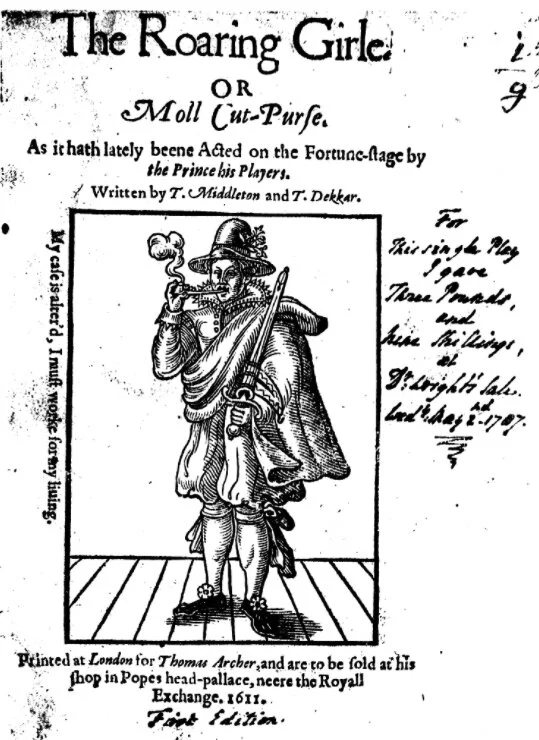
Cover of Middleton and Dekker’s 1611 play The Roaring Girle. An image of a woman in men’s clothing, carrying a sword and smoking a pipe.

Cover of Middleton and Dekker’s 1611 play The Roaring Girle. An image of a woman in men’s clothing, carrying a sword and smoking a pipe.

12 May 2021

It’s not the image most of us have of her, but Bonnie Parker (1910–34), of Bonnie and Clyde fame, penned several poems. One, titled “The Story of Suicide Sal,” is semi-autobiographical. She wrote it in 1932 while in jail awaiting a grand jury verdict for an attempted robbery—the grand jury eventually failed to indict her, and she was released. But Clyde Barrow had eluded capture, and she was afraid that he had abandoned her. One passage from that poem reads:

But not long ago I discovered
From a gal in the joint named Lyle,
That Jack and his “moll” had “got over”
And were living in true “gangster style.”
If he had returned to me sometime,
Though he hadn’t a cent to give,
I’d forget all this hell that he's caused me,
And love him as long as I live.
But there’s no chance of his ever coming,
For he and his moll have no fears
But that I will die in this prison,
Or “flatten” this fifty years.

But why did Parker refer to the woman who had replaced Sal in Jack’s affections as a moll? It’s a term meaning the female companion of a criminal, but where does the term come from?

Moll is a hypocoristic form of (i.e., pet name for) Mary. The connection between Moll and Mary doesn’t seem obvious on its face, but such shifts between the liquid consonants / l / and / r / are quite common. We see similar shifts in the pairs Dolly/Dorothy, Sally/Sarah, and Hal/Harry.

The association of the name Moll with women of low character is most likely a result of the common belief, unsupported by any scriptural evidence, that Mary Magdalene had been a prostitute. But we first see the association between low character and the name Mary in the hypocoristic Malekin, a diminutive of Matilda or Maud, which was later conflated with Moll and Mary. The use of Malekin to refer to a woman with sexual agency appears in the late thirteenth-century poem A Lutel Soth Sermon (A Short, True Sermon):

Þes persones ich wene;
   ne beoþ heo noȝt for-bore
Ne þeos prude ȝungemen
   þat luuieþ malekin,
And þeos prude maidenes
   þat luuieþ Ianekin.
At chirche and at cheping
   hwanne heo to-gadere come
Heo runeþ to-gaderes
   and spekeþ of derne luue.

(These people I know;
   They do not restrain themselves
Not these proud young men
   that love Malekin
And these proud maidens
   that love Johnny
At church and at market
   when they come together
They whisper together
   and speak of secret love.)

And in the late fourteenth century Chaucer has the host speak these words in the introduction to the Man of Law’s Tale:

Wel kan Senec and many a philosophre
Biwaillen tyme moore than gold in cofre;
For “Los of catel may recovered be,
But los of tyme shendeth us,” quod he.
It wol nat come agayn, withouten drede,
Nomoore than wole Malkynes maydenhede,
Whan she hath lost it in hir wantownesse.
Lat us nat mowlen thus in ydelnesse.

(Well can Seneca and many a philosopher
Bewail time more than gold in a coffer;
For “loss of property may be recovered,
But loss of time ruins us,” said he.
It will not come again, without doubt,
No more than will Malkin’s maidenhead,
When she has lost it in her wantoness.
Let us not grow moldy thus in idleness.)

The link between a Moll with sexual agency and Mary Magdalene is made explicit in Lewis Wager’s 1566 The Life and Repentaunce of Marie Magdalene:

Let me fele your poulses mistresse Mary be you sick
By my trouth in as good te[m]pre as any woman can be
Your vaines are full of bloud, lusty and quicke,
In better taking truly I did you neuer see.

The body is whole, but sick is the conscience,
Which neither the law nor man is able to heale,
It is the word of God receyued with penitence,
Like as the boke of wisedome doth plainly reueale.

Conscience? how doth thy conscience litle Mall?
Was thy conscience sicked, alas little foole?

And in his 1604 Father Hubbards Tales: or the Ant and the Nightingale, Thomas Middleton writes:

[He] would not stick to be a Bawd, or Pander to such young Gallants as our young Gentleman, either to acquaint them with Harlots, or Harlots with them, to bring them a whole dozen of Taffeta Punkes at a supper, and they should be none of these common Molls neither, but discontented and vnfortunate Gentlewoman, whose Parents being lately deceased, the brother ranne away with all the land, and the poore Squalles with a litle mony, which cannot hold out long without some commings in, but they will rather venture a Maidenhead then want a Head tyre

But the association of the name Moll with prostitution and pandering would be given a boost by the exploits of Mary Frith, a.k.a. Moll Cutpurse (c.1584–1659). Frith was a cross-dressing thief, fence, and pimp who became notorious in her day. It does not appear that Frith was a prostitute herself, although we can’t rule that out. Her sexuality cannot be known now, but she might identify as a lesbian or trans-man were she alive today. We do know, however, that she was quite famous in her day. Two plays inspired by her life were written during her lifetime. One, the 1610 The Madde Prankes of Mery Mall by John Day, has been lost, but the other, the 1611 The Roaring Girle by the aforementioned Thomas Middleton and Thomas Dekker, survives. In the play, a young man named Sebastian wishes to marry a girl named Mary, but their fathers disapprove of the match, so Sebastian pretends to court Moll Cutpurse in order to make Mary seem more appealing to his father. In this passage, Sebastian and his father, Alexander, discuss the objection to Sebastian’s choice in women:

Seb.   Why is the name of Mol so fatall sir.

Alex.   Many one sir, where suspect is entred,
For seeke all London from one end to t'other,
More whoores of that name, then of any ten other.

Thieves and other criminals are known, or at least thought, to associate with prostitutes, and by the nineteenth century Moll had come to refer to a criminal’s female companion, whether or not she was actually a sex worker. From an 1823 dictionary of slang written by John Badcock under the pseudonym of John Bee:

Molls—are the female companions of low thieves, at bed, board, and business.

From Mary Magdalene to Mary Frith to Bonnie Parker, that’s how the name Moll became associated with criminality.

Discuss this post


Sources:

Bee, John (pseudonym of John Badcock). Slang: A Dictionary of the Turf, the Ring, the Chase, the Pit, of Bon-Ton, and the Varieties of Life. London: T. Hughes, 1823, 120. HathiTrust Digital Archive.

Chaucer, Geoffrey. “Introduction to the Man of Law’s Tale” (c.1390). The Canterbury Tales. Harvard’s Geoffrey Chaucer’s Website.

Green’s Dictionary of Slang, 2021, s.v. moll, n.

“A Lutel Soth Sermon” (c.1275). An Old English Miscellany. Richard Morris, ed. Old English Text Society 49. London: N. Trübner, 1872, lines 51–60, 188. HathiTrust Digital Library. London, British Library, Cotton Caligula A.9.

Middleton, Thomas. Father Hubbards Tales: or the Ant and the Nightingale. London: T. Creede for William Cotton, 1604, sig. D1r.

Middleton, Thomas and Thomas Dekker. The Roaring Girle, or Moll Cut-Purse. London: Thomas Archer, 1611, sig. E2v.

Oxford English Dictionary, third edition, December 2020, s.v. moll, n.2.

Parker, Bonnie. “The Story of Suicide Sal.” Emma Parker and Nell Barrow Cohen. Fugitives: The Story of Clyde Barrow and Bonnie Parker. Jan I. Fortune, ed. Dallas: Ranger Press, 1934, 101. HathiTrust Digital Archive.

Wager, Lewis. A New Enterlude, Never Before This Tyme Imprinted, Entreating of the Life and Repentaunce of Marie Magdalene. London: John Charlewood, 1566, sig. f.2.r–v.

Minnesota

Detail of 1755 “Mitchell Map” of French and British dominions in North America showing the Minnesota River, labeled on the map as Ouadebamenissouté or R. St. PeterWhatever it is, the way you tell your story online can make all the difference.

Detail of 1755 “Mitchell Map” of French and British dominions in North America showing the Minnesota River, labeled on the map as Ouadebamenissouté or R. St. PeterWhatever it is, the way you tell your story online can make all the difference.

11 May 2021

The name Minnesota originally applied to the Minnesota River and only later was used by white settlers as the name for the territory and later the state. The name is from the Dakota name for the river: mnísóta. While there is no doubt that this Dakota word is the origin, the literal meaning of that word is in question. The first element, mní, means water, but the second element, sóta, is translated as either clear or as cloudy. The distinction is one pronunciation, either an /s/ or a /ʃ/ (an < ṡ > or sh sound). The University of Minnesota’s Dakota Dictionary Online, which translates the word as “clear water,” says this about the word:

There are a variety of opinions about the Dakota word for Minnesota. Some Dakota speakers pronounce the word Mnisota, which can be translated as clear water, referring to the Minnesota River. Others say it Mniṡota, or cloudy water, describing the morning mist that rises over the lakes and valleys in Southern Minnesota during the warmer months.

White explorers and settlers originally dubbed the river the St. Peter River but started to revert to the indigenous name in the mid nineteenth century. The 1755 Mitchell map of French and British dominions in North America shows the river and labels it as Ouadebamenissouté or R. St. Peter. The present-day spelling of Minnesota appears in English writing by the mid nineteenth century. This article from the New-York Commercial Advertiser of 16 September 1841 describes a treaty between the United States and the Dakota nation that was rejected by the United States Senate, presumably because it was too generous in offering the possibility of citizenship to Dakota people. The language of the article, which is racist and condescending, represented the more liberal and “enlightened” views of nineteenth-century white people:

The treaty was concluded by Governor Doty with the Western bands of the Dakota nations, on the 31st of July, at a place called Oeyoowora, 120 miles West of the Falls of St. Anthony, for a district of country which is hereafter to compose an Indian territory, to be occupied by the Indians now in the Eastern and Northern states and territories. The purchase embraces the valley of the Minnesota river (St. Peters) and its tributaries; and there is not a better tract of land or a more healthy climate in the West. The country acquired is sufficiently large to accommodate fifty thousand settlers, with farms of one hundred acres each. Besides advantages are secured to them which never have been granted heretofore. Among others is the fulfillment of the promise that the Indian, when civilized, may hold the title to real estate, and become a citizen of the United States. Unless these privileges are granted to the Indian, every effort which is made to civilize him but teaches him that he is of a degenerate race, without civil or political privileges.

By 1846, there were efforts to create a territory of Minnesota, and the name was transferred from the river to the surrounding territory. Here is an announcement of the introduction of a bill to create the territory that was introduced in the U.S. House of Representatives on 23 December 1846:

Among other bills presented were the following:

By Mr. Martin of Wisconsin, to establish the territorial government of Minnesota.

The Minnesota Territory would finally be organized in 1849, and it was admitted to the union on 11 May 1858.

Discuss this post


Sources:

Bright, William. Native American Placenames of the United States. Norman: U of Oklahoma Press, 2004, s.v. Minnesota.

Dakota Dictionary Online. University of Minnesota, Department of American Indian Studies, 2010, s.v. Mnisota.

Everett-Heath, John. Concise Oxford Dictionary of World Place Names, sixth ed. Oxford: Oxford UP, 2020, s.v. Minnesota. Oxfordreference.com.

“House of Representatives.” American Republican and Baltimore Daily Clipper, 24 December 1846, 4. Library of Congress. Chronicling America: Historic American Newspapers.

“The Rejected Treaty.” New-York Commercial Advertiser, 16 September 1841, 2. Readex: Historical American Newspapers.

Image credit: Mitchell, John, 1755. Library of Congress. Public domain image.

Eskimo

Inuit family, 1917. A man, a woman, and child, dressed in furs, sitting on a log. A second child is in a pack on the back of the woman. The woman is sewing, the man carving a bone.

Inuit family, 1917. A man, a woman, and child, dressed in furs, sitting on a log. A second child is in a pack on the back of the woman. The woman is sewing, the man carving a bone.

10 May 2021

The English word Eskimo is a borrowing from Spanish and French and ultimately comes from the Cree ayaskīmēw. The literal meaning of the Cree word is uncertain, but it seems to be related to a verb meaning to make the rawhide webbing of snowshoes (the morpheme ask means raw). In Cree, the word could refer to a variety of peoples: the Inuit, the Mi’kmaq, the Huron, among others. In English, Eskimo is used to refer to the Inuit (Alaska, Canada, Greenland) and the Yupik (Siberia and Alaska) and is sometimes taken to include the Tlingit, Athabaskan, and Aleut peoples.

But use of Eskimo is considered to be offensive by many, especially in Canada. The offense arises, in part, because of the widely believed, but false, etymology of the word as meaning an eater of raw flesh, and in part, because it is a label outsiders have given them rather than their own name for themselves. As with most names for indigenous peoples, it’s polite to refer to them by their preferred name, which is often a more specific ethnic affiliation, in this case Inuit, Yupik, or Iñupiat (another name for the Inuit), which is usually more accurate and precise as well. But Eskimo persists in some corners because there is no other word that refers generally to the indigenous people of the Arctic and some, particularly in Alaska, prefer that name.

Eskimo starts appearing in English by 1584, and this first known use mirrors the present-day confusion over who exactly the word is supposed to represent. It appears in a manuscript by Richard Hakluyt, one of the foremost advocates of English colonization of North America. Not only does he apply the word to a different indigenous people, he does so in the context of exploiting those people for profit:

To leave them and to comme to our nation I say that amonge other meanes to encrease her Maiesties customes this shalbe one, especially that by plantinge and fortifienge nere Cape Briton, what by the strengthe of our shipps beinge harde at hande & bearinge the sway already amongest all nations that fishe at Newfounde lande, and what by the fortes that there may be erected and helde by our people, wee shall be able to inforce them havinge no place els to repaire vnto so convenient, to pay vs suche a continuall customme as shall please vs to lay vpon them: which Imposition of twoo or three hundred shippes laden yerely with sondry sortes of fishe, trane oyle, and many kyndes offurres and hides, cannot choose but amounte to a greate matter beinge all to be levied vpon straungers: And this not onely wee may exacte of the Spaniardes and Portingales but also of the frenche men our olde and auncient enemyes: what shoulde I speake of the customes of the greate multitudes of course clothes, welshe frise, and Irishe ruggs that may be vttered in the more northerly partes of the Lande amonge the Esquimawes of the graunde Bay and amonge them of Canada, Saguynay, and Hochelaga which are subiecte to sharpe and nippinge winters, albeit their Sommers be hotter moche then oures. Againe the multitudes of smallyron and copper workes wherewith they are excedingly delighted, will not a little encrease the custommes beinge transported oute of the lande: I omitt the rehersall of a Thowsande other triflinge wares, which besides they may sett many women, children, and ympotent persons on worke in makinge of them woulde also helpe to the encreasinge of the custommes: Lastly whatsoeuer kinde of commodities shoulde be broughte from thence by her Maiesties subiectes into the Realme, or be thither transported oute of the Realme, cannot choose but inlarge the Revenewes of the Crowne very mightely and inriche all sortes of subiectes ingenerally

When he writes of the graunde Bay, Hakluyt is referring to the Gulf of St. Lawrence, and the region he is referring to are the modern-bay Maritime provinces of Canada. As such, he is probably not referring to Inuit, who did not live in the region, but rather is using it in the original Cree sense in reference to the Innu or Mi’kmaq. Despite being a staunch advocate for English colonization of North America, Hakluyt never visited the New World himself, and he undoubtedly acquired the word Esquimawes while in France, where he had been living immediately prior to writing this tract.

A century later, Eskimo is being used to refer to the Inuit. From the 5 July 1689 entry in the journal of Henry Kelsey, a fur trader and explorer for the Hudson’s Bay Company:

Now we intended to go to ye sea side for better going but found ye same & foggy by reason of ye Ice toward night came to ye Boy not suffering me to speak aloud in pretence ye Eskemoes would hear us dist 16 Miles.

And again in the summer of 1719 (the crossed-out portion is in the original):

In 1719 June 22nd the trade being ov[e]r I sailed w[i]th ye prosprs. for churchill[;] ariv’d ye 30th[;] ye 2d July I sailed w[i]t[h] ye success in compny. Jno Handcock master[;] ye 5th traded two of your slaves for 2 Eskemoes w[i]th Eskemoes[;] ye 20th I changed two of your slaves for 2 Eskemoes in order to gett interpeters of their Language & to know w[ha]t their Cuntry afforded[;] so I proceeded to ye no[rth]ward seeing & trading w[i]th several parcels of Eskemoes till ye 28th[;] then I return’d & ye 9th of Augst. gott to york fort.

Discuss this post


Sources:

Hakluyt, Richard. Discourse of Western Planting (1584). David B. Quinn and Alison M. Quinn, eds. London: Hakluyt Society, 1993, 66–67, 169. HathiTrust Digital Archive.

Kelsey, Henry. The Kelsey Papers. Ottawa: Public Archives of Canada, 1929, 27, 114. HathiTrust Digital Archive.

Oxford English Dictionary, third edition, March 2021, s.v. Eskimo, n. and adj.

Photo credit: George R. King, 1917. National Geographic, June 1917, 564. Public domain image.

mojo

Still image from the 1997 film Austin Powers: International Man of Mystery transformed into a meme with the words “I found my mojo, baby. YEAH!”

Still image from the 1997 film Austin Powers: International Man of Mystery transformed into a meme with the words “I found my mojo, baby. YEAH!”

7 May 2021

Mojo first appears in Black English, associated with voodoo and other folkloric beliefs. The word’s origins are obscure, but it is likely of African origin. Cognates appear to be the Gullah moco, meaning witchcraft or magic, and the Fula moco’o, meaning medicine man. Mojo first appears in print in the 1920s but is certainly older in oral use.

Early print appearances of mojo in English tend to fall into two categories, that of Black confidence men selling magical charms to the gullible elements of the Black community (in this, the Black community is no different than any other ethnic group; only the terminology and branding of the fake nostrums and woo changes with the ethnic group), and in the titles of jazz songs, where it acquires the sense of life force, good luck, and sexual prowess.

I found this appearance of Mojo in the name of a horse in the Cleveland Plain Dealer from 17 September 1921. Given the context, a white, upper-class horse show, it is may be unconnected to the Black term and the similarity coincidental. But one never knows; while the owners of the horse are indisputably white, Black men and women were commonly employed in stables and as trainers, and the name could have come from a Black stable hand:

Mr. F. R. White on his own pony, Leap Year, was presented with the trophy in the Gentleman’s Hack event, his horse showing the best style in a free open walk, square trot and easy canter. Mr. E. S. Nichols on Russell Alger’s Fairchild and Mr. Woods King with his horse, Mojo, were second and third.

(The 1973 movie The Sting, set in the 1930s, had a horse named Mojo running in one of the races.)

An unambiguous use appears in the St. Louis Post-Dispatch of 24 October 1923 in an article about the trial of a confidence man:

SELLING LOVE CHARM NOT THEFT
So Negro Is Freed, Despite Failure of $85 Mojo Bag to Work.

William Gassway, 49 years old, a negro, was freed today when Circuit Judge Grimm held that he had not committed grand larceny when he sold to John Rogers, another negro, a Mojo bag for $85 on July 26.

The Mojo bag was guaranteed to be a charm strong enough to soften the heart of John’s wife, Amelia, who had fled to Wisconsin after renouncing her husband. John took it to Wisconsin and said, “Amelia, come back home.” Despite the Mojo bag, Amelia shouted “No!” John testified today. The Judge sustained a demurrer by counsel for Gassway, who contended that he had been wrongfully charged. Selling Rogers a bag with a lump of coal in it was a business transaction of questionable nature possibly, but not grand larceny, it was held.

Another early use is in an academic text, Newbell Puckett’s 1926 Folk Beliefs of the Southern Negro:

Many other strange terms have come to have an American Negro meaning, but were, I suspect, used once in Africa in the same or different sense. The term mojo is often used by the Mississippi Negroes to mean “charms, amulets, or tricks,” as “to work mojo” on a person or “to carry a mojo.”

And later on in the same book:

One “mojo” worn for good luck by an old Negro cook in the Mississippi Delta, included among other things such ingredients as a lizard’s tail, a rabbit’s foot, a fish eye, snake skins, a beetle, and dime with a hole in it. Other Negroes use a piece of moss wrapped in red flannel or a rusty nail wrapped in the same flaming material.

This 1926 appearance in an academic text on Black folklore demonstrates that mojo was definitely in circulation for some time in oral use, probably decades if not longer, before appearing in print.

And there is this 26 February 1927 advertisement selling incense that appeared in the Black newspaper the Pittsburgh Courier:

Mojo Lucky Incense

Health, Wealth, and Happiness

Are you unlucky? Burn Mojo Good Luck Incense and see the change. Be rich, be happy, influence your loved ones. Change your whole life. Results guaranteed or money back.

Send $2.00 At Once. With C.O.D. Orders Send 25c.

Mojo Science Studio

528 So. 19th Street, Philadelphia, Pa.

One also occasionally finds the syllables of mojo reversed, that is jomo, as in this 4 July 1925 article in in the Baltimore Afro-American:

Birmingham, Ala.—(A.N.P.)—Will Hollins is to spend six months in jail as a result of his failure to work and spell with his famous “jomo” bags on the judge of the police court here. It is claimed that Hollins had been taking money from his customers for ills which he said were curable with his bags.

The “jomo” bag happened to be, when examined, a plain cloth bag, filled with ordinary steel fillings [sic], picked up in a blacksmith shop. Hollins carried a steel bar magnet with him and when making a sale, is supposed to have impressed the sick and the halt by passing the bar over the bag so as to attract the latter. He almost invariably made a good impression. Many of his dupes appeared in court to attest his success with them.

But early print appearances of mojo are predominately in the titles of jazz songs, such as:

  • Mojo Blues, by Lovie Austin and Her Blues Serenaders (1925)

  • My Daddy’s Got The Mojo, But, I Got the Say So, by Butterbeans and Susie (1926)

  • Barrel House Mojo, by Iva Smith (1927)

  • Mojo Hand Blues, by Ida Cox (1927)

Mojo would remain primarily in Black American and in jazz/musical circles (e.g., “Mr. Mojo Risin” by the Doors and “He one mojo filter” by the Beatles) until the Austin Powers series of films, starring Mike Myers, debuted in 1997, when the word started being widely used by white Americans.

Discuss this post


Sources:

“Butterbeans and Susie” (Display Ad). New York Amsterdam News, 24 November 1926, 11. ProQuest Historical Newspapers.

Curtiss, Cornelia. “Vassar Body Gives Party to Children. Cleveland Plain Dealer (Ohio), 17 September 1921, 13. Readex: America’s Historical Newspapers.

Davies, Mark. The Corpus of Historical American English (COHA), 2010.

“Goldman & Wolf” (Display Ad). Pittsburgh Courier, city edition, 5 November 1927, Section 2, Page 2. ProQuest Historical Newspapers.

Green’s Dictionary of Slang, 2021, s.v. mojo, n.

“Jinx Blues” (Display Ad). Chicago Defender, 28 May 1927, 7, ProQuest Historical Newspapers.

“‘Jomo’ Bags Fail.” The Afro-American (Baltimore), 4 July 1925, A8. ProQuest Historical Newspapers.

“Mojo Lucky Incense” (Display Ad). Pittsburgh Courier, 26 February 1927, 11. ProQuest Historical Newspapers.

“The New July Paramount Records” (Display Ad). Chicago Defender, national edition, 27 June 1925, 7. ProQuest Historical Newspapers.

Oxford English Dictionary, third edition, December 2019, s.v. mojo, n.1.

Puckett, Newbell Niles. Folk Beliefs of the Southern Negro. New York: Negro UP, 1926, 19, 234–235. HathiTrust Digital Archive.

“Selling Love Charm Not Theft.” St. Louis Post-Dispatch (Missouri), 24 October 1923, 28. ProQuest Historical Newspapers.

Photo credit: Mike Myers, writer, Jay Roach, dir. Austin Powers: International Man of Mystery (film). New Line Cinema, 1997. Fair use of an altered image to illustrate a point under discussion.