nova / supernova

Photo of a spiral galaxy with an arrow superimposed that is pointing to a bright “star”

Supernova SN 2023IXF in the Pinwheel Galaxy (M101), 25 May 2023

2 September 2024

Today, novas and supernovas (or supernovae) are considered to be distinct phenomenon. But prior to the 1930s, the term nova was applied to both. In current usage, a nova occurs in binary star systems consisting of a white dwarf star and a larger star where the white dwarf is accreting material, mostly hydrogen, from its larger companion. When the white dwarf reaches a critical mass, it blows off the excess material in a violent explosion. When this results in the destruction of the white dwarf, it is classified as a Type 1a supermova.

A regular supernova, on the other hand, is the last stage in the life of massive star. When the star is no longer able to sustain a fusion reaction sufficient to counteract its own gravity, it implodes. This gravitational collapse triggers a sudden outburst of fusion reactions that result in a tremendous explosion, destroying the star.

The term nova is from the Latin meaning new because either of these two phenomena appear, from the perspective of an observer on earth, to be a new star.

The coining of nova to refer to an exploding star is often credited to the astronomer Tycho Brahe, but this is not quite correct. Brahe was one of many around the world who observed what we now know to have been a Type 1a supernova in the constellation of Cassiopeia in the year 1572 (SN 1572). Many commentaries and histories conflate two different texts by Brahe. The following year, Brahe published his observations in a text titled is De nova et nullius ævi memoria prius visa stella (Concerning the New, and Never Before Seen in the Memory of Anyone, Star). Many commentaries refer to this 1573 text as De stella nova (Concerning the New Star), but this is not Brahe’s original title and the phrase stella nova does not appear in Brahe’s 1573 text.

But as a coda to Brahe’s text, the 1573 publication includes a poem by Brahe’s friend Anders Sørensen Vedel that does use the phrase:

IN MATHEMATICAM
NOVAE STELLAE CONTEMPLATI
onem, factam a Iuuene Nobilium Doctissimo & Doctorum Nobilissimo, Thycone Brahe Otthonide.

Coellorum illustre augmentum, NOVA STELLA, quid affert?

[…]

Exite, exite, Aegyptum, Babylona, Sodmam;
Promittat CANAAN, haec noua Stella, nouam.

(WITH MATHEMATICS
NEW STARS OBSERVED
One, made by the Younger of the Most Noble Scholars and the Most Noble of Doctors, Tycho Brahe.

The glorious increase of the heavens, the NEW STAR, what does it bring?

[…]

Escape, escape, Egypt, Babylon, Sodom;
It promises CANAAN, this new Star, a new one.)

Brahe, however, would pen another treatise on the celestial event, which would be posthumously published in 1602 under the title De stella nova, as the first volume (actually published second) of his Astronomiae instauratae progymnasmata, and Brahe does use the phrase stella nova in this later text.

So while Brahe did not coin the phrase, at least in publication, the association of stella nova with him is appropriate.

By the early nineteenth century, astronomers writing in English would be using nova to designate observations of a previously unrecorded celestial object, not limited to exploding stars. Beginning in 1824, astronomers John Herschel, the son of astronomer William Herschel, and James South would start using the designation nova in their observations published in the Philosophical Transactions of the Royal Society of London.

And we see the noun nova applied to exploding stars by the end of that century. An article in the St. Louis Republic of 17 January 1899 that includes this description of looking through the thirty-six-inch refractor telescope at Lick Observatory in California:

The nebula in Orion was another object of great interest, but it baffles all description. The six stars of the Trapezium were separated, and the “Nova,” Alvan Clark’s star, was barely visible.

Astronomers Walter Baade and Fritz Zwicky coined the term supernova in lectures at Caltech in 1931. Zwicky would go on to use super-novae at a meeting of the American Physical Society in December 1933, and this use would be picked up by newspapers. From an International News Service article of 9 December 1933:

Strange temporary stars known as “Super-Novae,” composed entirely of neutrons occur in the earth’s star system about once every 1,000 years, producing the cosmic rays, he said. The stars are seen only when they explode, Dr. Zwicky declared.

The phrase “earth’s star system” probably refers to our galaxy, the Milky Way. And astronomers now estimate that a supernova appears in our galaxy every century or so. We haven’t seen one in our galaxy since 1604, which means either that we’re overdue for one or that others have occurred on the other side of the galactic center from Earth, where they have been obscured from our view by intervening dust.

Astronomer Knut Lundmark was another early user of the term supernova and may have independently coined it. He used it in an article written in 1932 and published the following year.

Earlier terms to describe the phenomenon were giant nova, exceptional nova, and the German Hauptnova (main nova). But these did not catch on.

The verb phrases to go nova and to go supernova have their origins in science fiction. In the February 1942 issue of Astounding Science Fiction, editor John W. Campbell wrote:

We’ve considered what might happen if Sol itself went nova. If it should go supernova, no worse could happen; Earth and all life on it would be fused and volatilized in either case.

But there is a very different kind of nova with a very different origin. Nova, a description and term for smoked salmon, often in the form nova lox, appears by 1955. This sense is a clipping of Nova Scotia, through which much of the product was once imported into the United States and assumed to be its origin.

Discuss this post


Sources:

Advertisement. Evening Star (Washington, DC), 30 November 1955, A-44/1. Readex: America’s Historical Newspapers.

Brahe, Tycho. Astronomiae instauratæ progymnasmata. Uraniborg, Denmark: 1602. ProQuest Early European Books.

Campbell, John W. “Supernova Centaurus.” Astounding Science Fiction, 28.6, February 1942, n.p. Archive.org.

Herschel, John Frederick and James South. “Observations of the Apparent Distances and Positions of 380 Double and Triple Stars, Made in the Years 1821, 1822, and 1823” (15 January 1824). Philosophical Transactions of the Royal Society of London, part 3. London: W. Nicol, 1824, 82. Gale Primary Sources: Nineteenth Century Collections Online.

Historical Dictionary of Science Fiction, 11 Marcy 2021, s.v. nova, n.

International News Service. “Star Explosions Form Cosmic Rays, Scientist Asserts.” Denver Post (Colorado), 9 December 1933, 6/1. Readex: America’s Historical Newspapers.

Osterbrock, D. E. “Who Really Coined the Word Supernova? Who First Predicted Neutron Stars?” (conference presentation). 199th Annual Meeting of the American Astronomical Society, 6–10 January 2002. Bulletin of the American Astronomical Society, 33, 1330–31. SAO/NASA Astrophysics Data System (ADS).

Oxford English Dictionary, third edition, December 2003, s.v. nova, n.1, nova, n.2; June 2012, s.v. supernova, n.

Vedel, Anders Sørensen (Andreas Velleius). “In mathematicam novae stellae contemplati.” In Brahe, Tycho. De nova et nullius ævi memoria prius visa stella. Copenhagen: 1573. ProQuest: Early European Books.

“Vulcan No Myth. That Intermercurial Planet Seen by Prof. Pritchett.” St. Louis Republic (Missouri), 17 January 1899, 3/3–4. Readex: America’s Historical Newspapers.

Photo credit: David Wilton, 2023, licensable under a Creative Commons Attribution-NonCommercial-ShareAlike 4.0 International License.

sulfur

Clouds of sulfur in a portion of the North America Nebula (NGC 7000) in the constellation Cygnus

30 August 2024

Sulfur is a chemical element with atomic number 16 and the symbol S. It is a yellow, crystalline solid at room temperature. By mass, it is the tenth most abundant element in the universe and the fifth most abundant on earth. It has been known since antiquity but only recognized as an element with advent of modern chemistry in the late eighteenth century. It has a wide variety of commercial applications, including in making matches, gunpowder fertilizer, fungicides and pesticides, pharmaceuticals, and as a precursor for other chemicals.

The word is borrowed into English from French, specifically the Anglo-Norman sulfre, which in turn comes from the Latin sulfur. It is recorded in Anglo-Norman texts from the early twelfth century.

Sulfur makes its English-language appearance by the end of the fourteenth century. Here is a passage from John Gower’s Confessio Amantis, written prior to 1393, in which Medea is casting a spell upon Jason’s father Aeson:

Tho lay ther certein wode cleft,
Of which the pieces nou and eft
Sche made hem in the pettes wete,
And put hem in the fyri hete,
And tok the brond with al the blase,
And thries sche began to rase
Aboute Eson, ther as he slepte;
And eft with water, which sche kepte,
Sche made a cercle aboute him thries,
And eft with fyr of sulphre twyes.

(Then lay there certain hewn wood,
Of which the pieces now and again
She placed them in the wet pits,
And put them in the hot fire.
And took the brand with all its blaze,
And thrice she began to run
Around Aeson, there as he slept;
And also with water, which she had kept,
She made a circle about him thrice,
And also with fire of sulfur twice.)

The spellings sulfur and sulphur have coexisted since the word appeared in Middle English, with sulphur being the more common spelling for most of the word’s history. The distinction is often thought to be a difference in American and British spelling, but that geographic distinction is quite recent. Sulfur only became the dominant U.S. spelling c. 1940. In 1990, the International Union of Pure and Applied Chemistry (IUPAC) adopted the sulfur spelling as the official one, and British research publications quickly began to adopt that spelling as well. The sulfur spelling eclipsed the sulphur one in British English c. 2015.

Timeline of American spelling of sulfur / sulphur, showing the sulfur spelling becoming the more common one c. 1940

Timeline of American spelling of sulfur / sulphur

Timeline of British spelling of sulfur / sulphur, showing the sulfur spelling becoming the more common one c. 2015

Timeline of British spelling of sulfur / sulphur


Sources:

Anglo-Norman Dictionary, 2021, s.v. sulfre, n.

Gower, John. Confessio Amantis. In Confessio Amantis, Volume 3, Russell A. Peck ed. and Andrew Galloway, trans. lines 5:4085–94. TEAMS Middle English Texts.

Middle English Dictionary, 2019, s.v. sulphur, n.

Miśkowiec, Pawel. “Name Game: The Naming History of the Chemical Elements—Part 1—From Antiquity till the End of 18th Century.” Foundations of Chemistry. 1 November 2022. DOI: 10.1007/s10698-022-09448-5.

Oxford English Dictionary, second edition, 1989, s.v. sulfur | sulphur, n.

Image credits: NGC 7000, David Wilton, 2024, licensable under a Creative Commons Attribution-NonCommercial-ShareAlike 4.0 International License; Google Books Ngram Viewer, 28 July 2024, American spelling, British spelling.

troop / troops / trooper

Black-and-white photo of a group of late 19th-century African-American cavalrymen

A troop of Buffalo Soldiers from the U.S. 10th Cavalry Regiment, c. 1898

28 August 2024

A troop is a unit of people, most often soldiers, especially a unit of cavalry, but it is also used for other groups of people collected in bands, such as entertainers (in which case it is usually spelled troupe). It is also used for a group of animals, especially apes or monkeys. The plural troops is used to refer to soldiers generally, and colloquially the singular troop is sometimes used to refer to a single soldier, although trooper would be more common.

The word is borrowed from the French trope or troupe, which in turn is from the Latin troppus (flock). The word appears in English in a letter written by Viscount John Lisle to King Henry VIII in 1545:

The maner wherof, with allso our mercheng by lande towardes Treportt, styll in the face of your enymyes, who assemblyd more and more in gret troupes, and now and then, with some horsemen, sceirmished with us, as they dyrste.

And it appears as a verb in a 1565 thesaurus:

Agglomero, ágglómeras, pen. cor. agglomerâre, Ex Ad & Glomero. To make vppe on a heape: to folde vp in a botome: as threed: to prease or gather thicke to gether, as souldiours doe: to trowpe.

By 1590, it is being used specifically to refer to a unit of cavalry, a sense that is still in use in the U.S. Army today, although nowadays the horses have been exchanged for tanks and helicopters. From John Smythe’s Certain Discourses of that year:

By reason, that through the lacke of certaine pay, and no hope of reward for extraordinary deserts, it hath come to passe, that the souldiors thereby being made voluntary, haue obeyed their Captaines no otherwise than hath pleased themselues, altering and changing their weapons, as also themselues out of one band into an other, and sometimes horsemen to become footemen, and footemen to become horsemen; besides their forraging and stragling from their Ensignes without order; as also their negligence and lacke of vigilancie in their watches, bodies of watches and centinels, and by disordering themselues vpon euery light occasion both in battallion, squadron and troupe.

And the plural form, used to denote soldiers generally, is in place by the end of the sixteenth century. From Robert Barret’s 1598 The Theorike and Practike of Moderne Warres, writing of the soldiers serving the Spanish crown:

In his brables in Britayn; besides the incredible nu[m]ber of his pistolets continually flying in (almost) euery nation, to infect, corrupt, and pierce the mindes, hearts, and soules of good Princes subiectes, to their Princes annoyance, and their owne confusion in fine. Italy, Fraunce, and Flanders, too full of his pencionary troupes: I pray God, that other nations tast not of his infection.

Trooper, referring to a single cavalry soldier, is in place by the middle of the seventeenth century. Here we see it in a record of what cavalry soldiers in the Scottish Covenanters Army of 1640 should be paid:

The quhilk day the Committie ordaines, that, the troupe horss to be leviat furth of the Stewartrie for the service of the publict. That, the worste horss be worthe jc. lib. Monie, and whar horss are better to be apprysed be the Committie according to thair worthe, and the siller peyit thairon, aither in monie or security. And ordaines, that ilk trouper have for the twa pairt of the 40 dayes lone appoyntit be the Committie of Estaites xviij libs., conforme to the general order; and that ilk horsman have for arms, at the leist, ane steill cape and sworde, ane paire of pistolles, and ane lance, and for fornishing thairof, ordaines to be given xx rex dollares.

And by the mid twentieth century, trooper had also come to be used to refer to any stalwart person. Here is an example from poet Roy Campbell’s 1952 autobiography:

I always liked Stuart because he was generous with money, tough and independent. He trusted one and one trusted him. We were all like that, Nina Hammet (she was a find trouper), Rowley Smart, Betty May, Joseph Kramer, and all the other penniless bohemians of whom I as the only one ever to raise any spare cash—by working at sea, or from my indulgent parents at home who always spoilt me.

And the singular troop, referring to a single soldier, makes its appearance in the nineteenth century. From a passage in Basil Hall’s 1832 Fragments of Voyages and Travels in which the author describes an incident when a naval ship’s pet monkey took revenge upon a marine who had been abusing it:

Next morning the monkey stowed himself away behind the pumps, till the same marine passed; he then sprung out, and laid hold of him by the calf of the leg; and, in spite of sundry kicks and cuffs, never once relaxed his jaws till the teeth met amongst what the loblolly boy, in the pride of his anatomical knowledge, called the “gastrocnemii muscles” of his enemy's leg. The cries of murder! from the soldier brought the marines, and many of the sailors, under the half-deck to the poor fellow's rescue, while the author of the mischief scuttled off amongst the men's feet, chattering and screaming all the way. He was not again seen during two or three days; at the end of which, as the wounded “troop” was not much hurt, a sort of truce was proclaimed between the red and the blue factions of the ship.


Sources:

Barret, Robert. The Theorike and Practike of Moderne Warres. London: William Posonby, 1598, 136. ProQuest: Early English Books Online.

Campbell, Roy. Light on a Dark Horse: An Autobiography. Chicago: Henry Regnery, 1952, 208. Archive.org.

Cooper, Thomas. Thesaurus Linguae Romanæ and Britannicæ. London: Berthelet, 1565,  sig. F2r., s.v. agglomero. ProQuest: Early English Books Online.

Hall, Basil. Fragments of Voyages and Travels, second series, vol. 2 of 3. Edinburgh: Robert Cadell, 1832, 124–25. HathiTrust Digital Archive.

Lisle, John (later styled John Dudley, Earl of Warwick). Letter to Henry VIII (1545). State Papers (Henry VIII), vol. 1. Commission for Printing and Publishing State Papers, 829. 1830. Google Books.

Minute Book Kept by the War Committee of the Covenanters in the Stewartry of Kirkcudbright, in the Years 1640 and 1641. Kirkcudbright, Scotland: J. Nicholson, 1855, 1–2. HathiTrust Digital Archive.

Oxford English Dictionary, second edition, 1989, s.v. trooper, n., troop, v.; additions series, 1993, s.v. troop, n.

Smythe, John. Certain Discourses. London: Richard Johnes, 1590, 2r. ProQuest: Early English Books Online.

nepotism / nepo baby

Oil-on-canvas painting of a seated pope with a younger man in a cardinal’s hat standing next to him

Pope Gregory XV and nepo baby Cardinal Ludovico Ludovisi, Domenichino, c. 1621

26 August 2024

Nepo baby is slang for a child of a famous person who achieves professional success based on who their parents are. The term is from nepo[tism] + baby, and nepotism is from the Latin nepos (nephew) + -ism (cf. Bob’s your uncle) The word nepotism begins to appear in English in 1669 with the publication of an English translation of the 1667 Il nepotismo di Roma, a book about the practice of popes elevating their nephews (often alleged to actually be their illegitimate sons) to the rank of cardinal. In his diary for 27 April 1669, Samuel Pepys makes reference to the work, which seems to have been something of a bestseller:

Up and to the office, where all the morning. At noon home to dinner, and then to the office again, where all the afternoon busy until late; and then home and got my wife to read to me again in The Nepotisme, which is very pleasant, and so to supper and to bed.

The slang nepo baby is much more recent, however, and, rather than to the Vatican, was originally applied in the context of the entertainment industry. The earliest use of this term that I can find is a 9 December 2020 tweet:

just realized jack quaid is a nepo baby omg

Jack Quaid, one the stars of the streaming TV series The Boys (2019– ), is the child of actors Dennis Quaid and Meg Ryan.

There are undoubtedly earlier examples out there, but searching Twitter/X is difficult not only because X.com’s infrastructure is falling apart, but also because there are a number of extremely prolific posters who use nepo baby in their screen names, and when a user changes their screen name, all their older posts are updated with that name. So the search results are flooded with thousands of false hits that obscure the true hits. It does, however, seem that the term came into widespread use on Twitter around July 2021, with relatively few uses before that.

And nepo baby made it into Urbandictionary.com that month, on 28 July 2021:

nepo baby

a child of a famous actor/celebrity who got famous due to nepotism.

“Did you hear about Jamie? She’s such a nepo baby.”

The mainstream press picked up on the term a few months later, albeit in the web edition of London’s Evening Standard of 29 September 2021. By this time the term had moved beyond the entertainment industry, encompassing the children of politicians:

The billionaire Blair: how did the former PM’s son Euan win the backing of America’s richest family?—The Yale graduate’s apprenticeship startup Multiverse has just secured the backing of the Walmart owners in a deal that values his fortune at £345 million. Katie Strick charts the making of the nepo baby tipped to become a billionaire.

And it was appearing in print by 22 December 2022 when a pair of London papers ran articles about the phrase. This ran in the Evening Standard’s print edition:

Lily Rose Depp doesn’t want to be called a “nepo baby”

The fascination and frustration at “nepo babies”—celebrity progeny, basically—has been a characterising trend of 2022. From Brooklyn Beckham’s outrageous wedding to billionaire heiress Nicola Peltz, to Zoe Kravitz admitting she feels “insecure” about being the daughter of musician Lenny Kravitz and actor Lisa Bonet ahead of her Batman starring role, TikTokers are exhausted by the firm grasp nepotism has over the entertainment industry.

And the following ran in the Guardian on the same day:

Alyx, I keep seeing TikToks about “nepo babies”. What is a nepo baby and why do we hate them?

The answer to your first question is easy: nepo is short for “nepotism”. And a baby, in this instance, means the child of someone who’s already successful. You don’t have to be a baby to be a nepo baby. It is an all-ages phrase.

The Guardian article incorrectly credits a 20 February 2022 tweet about Maude Apatow, a star of the TV series Euphoria and child of director Judd Apatow and actor Leslie Mann, with kicking off the trend of using the phrase, but not only was the term, as we have seen above, already well established by then, that particular tweet doesn’t even use the term nepo baby; it uses nepotism baby.

Discuss this post


Sources:

@bardverse. X.com, 9 December 2020.

@MeriemIsTired. X.com, 20 February 2022.

Gorman, Alyx and Calla Wahlquist. “Nepo Babies: What Are They and Why Is Gen Z Only Just Discovering Them?” Guardian, 22 December 2022.

“Lily Rose Depp Doesn’t Want to Be Called a ‘Nepo Baby.’” Evening Standard (London), 22 December 2022, 9/4. ProQuest Historical Newspapers.

Oxford English Dictionary, third edition, September 2003, s.v. nepotism, n.

Pepys, Samuel. Diary entry for 27 April 1669. The Diary of Samuel Pepys, vol 9 of 10 (1971). Robert Latham and William Matthews, eds. Berkeley, California: U of California Press, 2000, 535.

Strick, Katie. “The Billionaire Blair” (headline). Evening Standard (London), 29 September 2021, web edition. NewsBank.

Urbandictionary.com, 28 July 2021, s.v. nepo baby.

Image credit: Domenichino, c. 1621. Wikimedia Commons, Musée des Beaux-Arts de Béziers, Public domain image as a mechanical reproduction of a public domain work.

rubidium

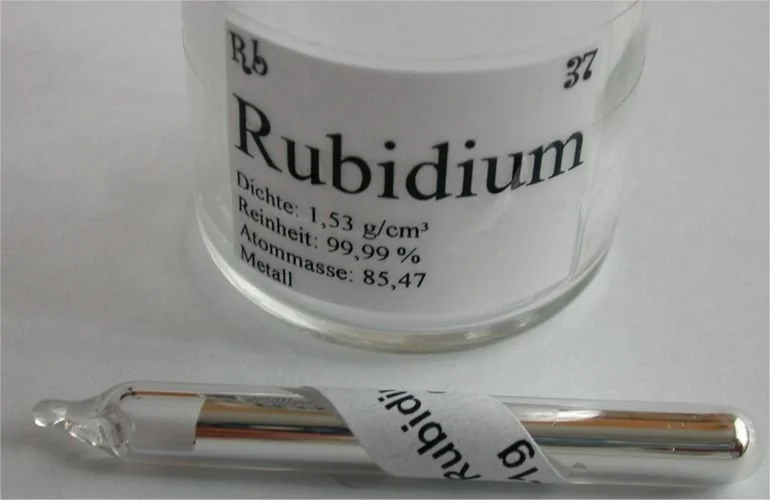
A glass ampule containing a silvery metal with a label detailing the sample’s properties

1 gram of high-purity rubidium in an ampule under argon gas

23 August 2024

Rubidium is a chemical element with atomic number 37 and the symbol Rb. It is a soft, ductile, whitish-gray alkali metal. Rubidium had few applications until the 1920s, but since then the element has had wide variety of uses, from giving fireworks a purple color to a component of atomic clocks. Rubidium-87 was used to produce a Bose-Einstein condensate in 1996, which earned the scientists a Nobel Prize in 2001.

Rubidium was discovered in 1860 by Gustav Kirchhoff and Robert Bunsen. It was discovered simultaneously with cesium. These two elements were the first ones discovered through spectrography. The pair took the name from the Latin rubidus (red), due to the two distinct lines in the red portion of the visual spectrum. The pair wrote in their 1861 announcement of their discovery:

Unter denselben sind besonders zwei rothe dadurch merkwürdig, dass sic tiorh jenseits der Fraunhofer'schen Linie A oder der mit dieser zusammenfallenden Linie Ka ɑ, also im alleräufsersten Hoth des Sonnenspetrums liegen. Wir schlagen daher für dieses Alkalimetall, mit Beziehung auf jene besonders merkwürdigen dunkelrothen Spectrallinien die Benennung Rubidium vor mit dem Symbol Rb, von rubidus, welches von den Alten für das dunkelste Roth gebraucht wird.

(Among them, two red ones are particularly remarkable in that they lie far beyond Fraunhofer's line A or the line Ka ɑ that coincides with it, and thus in the very outermost region of the solar spectrum. We therefore propose the name rubidium for this alkali metal, with reference to those particularly remarkable dark red spectral lines, with the symbol Rb, from rubidus, which is used by the ancients for the darkest red.)


Sources:

Kirchhoff, G. and R. Bunsen. “Chemische Analyse durch Spectralbeobachtungen” (June 1861). Annalen der Physik, 189.7, 1861, 337–81 at 339. DOI: 10.1002/andp.18611890702.

Miśkowiec, Pawel. “Name Game: The Naming History of the Chemical Elements: Part 2—Turbulent Nineteenth Century.” Foundations of Chemistry, 8 December 2022. DOI: 10.1007/s10698-022-09451-w.

Oxford English Dictionary, third edition, March 2011, s.v. rubidium, n.

Photo credit: Tomihahndorf, 2006. Wikimedia Commons. Public domain photo.