Boston marriage / Wellesley marriage

Two women in 19th-century men’s attire sitting in a library

Lithograph of “the Ladies of Llangollen,” Eleanor Butler (1739–1829), right, and Sarah Ponsonby (1755–1831), left. Butler and Ponsonby, both born of upper-class, Anglo-Irish families, lived openly as a couple in North Wales.

23 September 2024

A Boston marriage is term for a long-term cohabitation of two women that dates to the late nineteenth century. The term allows for the possibility of the relationship being a sexual one, but it does not require it. As such it not only gave women more freedom in structuring their economic and familial arrangements, it also gave a respectable social cover for a lesbian relationship, allowing the women to be public as a couple without being scandalous.

The earliest use of the term that I know of is in a 5 January 1893 letter to the journal The Open Court by Ednah Cheney (1824–1904), a Boston writer and social reformer. I quote the letter at length because it is an excellent example of how the term’s euphemism operates:

This seems very strange to one, who for many years has been accustomed to the existence of ties between women so intimate and persistent, that they are fully recognised by their friends, and of late have acquired, if not a local habitation, at least a name, for they have been christened “Boston Marriages.” This institution deserves to be recognised as a really valuable one for women in our present state of civilisation. With the great number of women in our state, in excess of the men, and with the present independence of women, which renders marriage, merely for a home, no longer acceptable, the proportion of those who can enter into that relation is diminished, and the “glorious phalanx of old maids” must find some substitute for the joys of family life. These relations so far as I have known, and I have known many of them, are not usually planned for convenience or economy, but grow out of a constantly increasing attachment, favored by circumstances, which make such a marriage the best refuge against the solitude of growing age.

In some cases women of the medical or other professions form a partnership at once social and professional; or frequently a physician finds comfort for her leisure hours in the society of one of literary tastes or possessing the fine art of housekeeping. Sometimes a wealthy but solitary woman is delighted to share heart and home with one less favored by fortune.

In some cases where family ties still have their claims, the parties do not live together, but are constant companions in the summer excursions or the winter studies and engagements, in which they are mutually interested. As far as I have known, these “Marriages” are of long continuance, and I can hardly recall an instance where a decided rupture has occurred. Of course I do not include in this statement those girlish intimacies which are only what flirtations are to serious matrimonial attachments. Naturally these relations are generally between women of middle age, who have learned much from the duties and sorrows of life, and perchance have known the pleasure, or more often the pains and disappointments of love. To such the tie affords a home for the heart, intellectual companionship, and often help in the pecuniary support, which gives value and worth to a period of life, too often very sad and lonely. As such I must look upon them as a great blessing which should not be interfered with or unduly fostered, but recognised in all simplicity and friendliness.

There is one danger attending such unions, when they are entered into by those who are not destitute of family ties, and the married woman and the mother, even sometimes the aunt and sister should be cautious of assuming a relation which may make her less faithful to the natural ties of family life. I rejoice to say that instances of such mistakes are rare, and that in many cases the friend becomes also one of the family, and helps to preserve and deepen the family affection.

I do not propose that we should formally adopt the Boston Marriage into our civil code, and celebrate it with ceremonies and festivities, for simplicity and privacy especially become it, but I do think it is good to think of it with respect, and welcome it as one of the helps to human welfare, and not let any jealous feelings mar the happiness of those concerned in it.

The term may have been inspired by Henry James’s 1886 novel (serialized 1885–86) The Bostonians, whose primary plot arc concerns a triangle between Basil Ransom, his cousin Olive Chancellor, a feminist living in Boston, and Verena Tarrant, Olive’s young protégée. Olive and Verena live together, and Olive is training Verena to become a leader of the women’s suffrage movement. Basil wishes to marry Verena, who in turn is ambivalent about her feelings—she cares for both Olive and Basil. In the end, Verena elopes with Basil, but the narration indicates that their marriage will not be a happy one. The subtext that Olive is a lesbian who has sexual and romantic feelings for Verena is obvious, but the novel is less clear about whether or not a sexual relationship between Olive and Verena exists. The novel does not, of course, contain any explicit references to same-sex attraction. The book was not well received by critics upon its publication because of its negative portrayal of the suffrage movement as well as the lesbian subtext, which many considered indecent (but which probably helped its sales).

One often sees the claim that the term Wellesley marriage was used for such a cohabitation among female professors at Wellesley College (outside Boston) and other women’s colleges in the late nineteenth century. But the only primary source evidence that I have found for this term existing is a footnote remarking that Dorothy Walcott Weeks, a 1916 graduate of Wellesley, said in a 1978 interview with Patricia Palmieri that Wellesley marriage had been in use at the college during Week’s matriculation there. Recollections of usages like this one should be viewed skeptically, as memories are malleable and anachronistic language is often inserted into them, but in this case Weeks may very well have remembered accurately. The Wikipedia articles that discuss the term invariably point to Lillian Faderman’s 1999 book To Believe in Women as evidence for the term, but Faderman provides no primary source evidence for her claim that the term existed. But, given its slang nature and its subject being limited to the faculty of women’s colleges, the fact that Wellesley marriage does not appear in published sources from the period is not surprising. If more evidence for Wellesley marriage is to be found, it will likely be in archived letters and papers of professors and students at women’s colleges.

Discuss this post


Sources:

Cheney, Ednah D. “Correspondence: Letter to ‘The Open Court.’” Open Court, 7.1, 5 January 1893, 3517–18. HathiTrust Digital Archive.

Faderman, Lillian. To Believe in Women: What Lesbians Have Done for America—A History. Boston: Houghton Mifflin, 1999. Archive.org.

Oxford English Dictionary, third edition, June 2017, s.v. Boston marriage, n.

Palmieri, Patricia A. “Here Was Fellowship: A Social Portrait of Academic Women at Wellesley College, 1895–1920.” In Nancy F. Cott, ed., History of Women in the United States, 12: Education, Munich: K. G. Saur, 1993, 314–333 at 332, n.36. ProQuest Ebook Central.

Image credit: Richard James Lane, c. 1832, based on a drawing by Mary Leighton. Wellcome Collection. Public domain image as a mechanical reproduction of a public domain work.

tellurium

Photo of jagged pieces of a silvery-white metal

Chunks of pure tellurium

20 September 2024

Tellurium is a chemical element with atomic number 52 and the symbol Te. It is a brittle, silver-white metalloid. It is rather rare on earth, but more abundant in the cosmos as a whole. Tellurium is chiefly used in copper and steel alloys to improve machineability and in solar panels and thermoelectric devices. The name was coined in German from the Latin tellus (earth).

The metal we now call tellurium was first discovered and described in 1782 by minerologist Franz-Joseph Müller von Reichenstein, but he was unable to fully identify it, at first confusing it with antimony before deciding that it wasn’t that metal. He gave it the labels auram paradoxum (paradoxical gold), metallum problematicum (problem metal), and aurum album (white gold). In 1798, after being reminded of von Reichenstein’s discovery, chemist Martin Klaproth successfully isolated the metal, gave credit to von Reichenstein for its discovery, and named it tellurium:

Und welchem ich hiermit den, von der alten Muttererde entlehnten, Namen Tellurium beylege.

(And to which I hereby give the name tellurium, taken from the ancient Mother Earth.)

Klaproth had previously discovered uranium, which he had named after the recently discovered planet Uranus, and his naming this metal tellurium may have been inspired by another planetary namesake.

Discuss this post


Sources:

Klaproth, M. H. “Ueber die siebenbürgischen Golderze, und das in selbigen enthaltene neue Metall.” Chemische Annalen Fur Die Freunde Der Naturlehre Arzneygelahrtheit, Haushaltungskunst Und Manufacturen, vol. 1, 1798, 91–104 at 100. Google Books.

Miśkowiec, Pawel. “Name Game: The Naming History of the Chemical Elements—Part 1—From Antiquity till the End of 18th Century.” Foundations of Chemistry. 1 November 2022. DOI: 10.1007/s10698-022-09448-5.

Oxford English Dictionary, third edition, September 2015, s.v. tellurium, n.

Weeks, Mary Elvira. “The Discovery of the Elements. IV. Tellurium and Selenium.” Journal of Chemical Education, 9.3, March 1932, 474–485. DOI: 10.1021/ed009p474.

Photo credit: Jan Anskeit, 2019. Wikimedia Commons. Licensed under the Creative Commons Attribution-Share Alike 4.0 International license.

holy mackerel

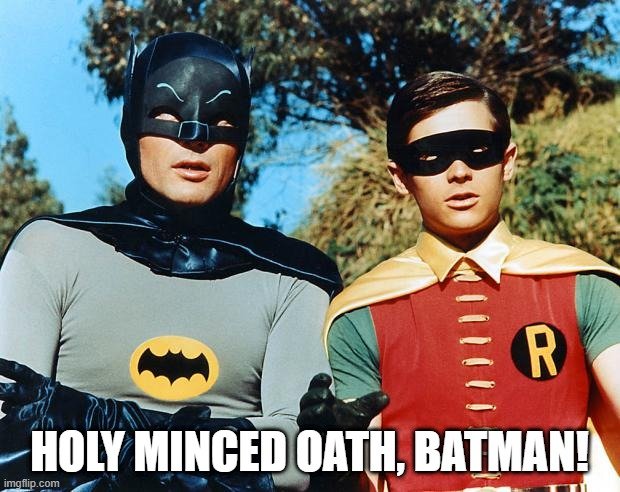
Meme featuring a photo of Batman and Robin from the 1960s TV series with the caption “Holy minced oath, Batman!”

18 September 2024

“Holy mackerel” is what is called a minced oath, a phrase where an offensive term is replaced with a non-offensive one. In this case, turning a potentially blasphemous utterance into a silly or humorous one. There are a number of “holy X” ones: holy cow, holy Moses, and holy smoke being common. Most of these holy oaths date originate in nineteenth-century America.

I recall the Batman television series from the 1960s (the best Batman) where Robin, played by Burt Ward would utter at least one holy X phrase in each episode. Once when stuck in a vat of glue he uttered, “Holy mucilage, Batman!” And Holy X, Batman! has become something of an internet meme.

In the case of holy mackerel, the mackerel has no significance. Like cow, smoke, or mucilage, it’s just a word that defuses a blasphemous phrase. The choice of mackerel has nothing to do with Lenten diets or the slang word for pimp. Although the latter is related to April Fool’s Day as practiced in France, see April fool. And, by the way, slang use of mackerel for pimp has been part of English slang too, borrowed from the French, since the fifteenth century, although it's not very common in English use.

As to why holy mackerel came into use, it’s probably just a random formulation playing off its absurdity. Someone said it, people laughed, and it caught on. There are many such examples in slang. Language does not follow logical rules; it’s just what people make of it.

The earliest example of holy mackerel that I’ve been able to find is from New York’s Atlas newspaper of 30 January 1853; there are probably earlier ones:

“Holy mackerel!” wouldn’t we like to be a collector of assessments in the Street Department? If our friends, who have supplanted the old collectors, just in time to take this big pool, have many more such jobs to come, won’t they be rich, in three years!

Examples of holy oaths in Green’s Dictionary of Slang include holy balls, holy biddy, holy bones, holy catfish, holy cats, holy Christmas, Holy Christopher, holy cow, holy crap, holy cripes, holy crow, holy cuss, holy dooley (Australian), holy Egypt, holy fly, holy frost (Australian), holy fuck, holy fuckballs, (these last two stretch the definition of minced, but they’re not blasphemous, so I guess they count), holy gee, holy guacamole, holy hailstones, holy hell, holy James Street (Irish), holy Joe, holy mac, holy mackerel, holy mackinaw, holy moly (this one is also reduplicative), holy monkey, holy Moses, holy Peoria, holy poker, holy pretzel, holy shit (see holy fuck), holy smoke(s), holy snakes, holy sneaking Moses, and holy wars.

I’m sure this list just scratches the surface.

Discuss this post


Sources:

Green’s Dictionary of Slang, n.d., s.v. holy…! excl., holy mackerel!, excl.

Oxford English Dictionary, second edition, 1989, s.v. holy, adj. & n.

“Street Department—Fat Jobs—Boring the Treasury with a Big Anger!” The Atlas (New York), 30 January 1853. 2/2. Readex: America’s Historical Newspapers.

Image credit: Dave Wilton, 2024, generated by imgflip.com.

technetium

Photo of a strip of gray metal in a sealed glass tube

A sample of technetium in a glass ampule

13 September 2024

Technetium is a chemical element with atomic number 43 and the symbol Tc. It is the lightest element with no stable isotopes and the first element to be artificially produced. The name comes from the Greek τεχνητός (technetos), meaning artificial.

Technetium is used as a tracer chemical in medical testing and as a standard for beta radiation emissions in equipment calibration. It is also used as a catalyst in some chemical reactions, but radiation safety limits this use.

A number of researchers in the nineteenth century claimed to have discovered element 43, but all were found to have been other elements. In 1908, Masataka Ogawa mistook element 75, now known as rhenium, for element 43. In 1925, Walter Noddack, Ida Noddack (née Tacke), and Otto Berg thought they had discovered it, dubbing it masurium, but were subsequently shown to be mistaken.

Finally, in 1937 Carlo Perrier and Emilio Segré definitively discovered element 43 by bombarding a sample of molybdenum with deuterium and neutrons. They announced their discovery in both an Italian journal and in a letter to the journal Nature but did not propose a name at the time. The naming would wait for some ten years. Segré, a Jew, was visiting the University of California, Berkeley in 1938 when Mussolini’s government passed antisemitic laws that barred him from university positions in his native Italy. He remained in the United States, eventually working on the Manhattan Project and becoming a U.S. citizen. Segré would share the award of the 1959 Nobel Prize in Physics for the discovery of the antiproton.

Following the war, Perrier and Segré proposed the name technetium in a 1946 letter to Nature, that was published the following January:

It seems appropriate now to give a name to this element, as suggested by Paneth, and we would like to propose the name of “technetium,” from the Greek τεχνητός, artificial, in recognition of the fact that technetium is the first artificially made element. The corresponding chemical symbol should be “Tc.”

Naturally occurring technetium, a product of fission of uranium ore, was discovered in 1961. But virtually all technetium in use today is artificially created.

Discuss this post


Sources:

Miśkowiec, Pawel. “Name Game: The Naming History of the Chemical Elements—Part 3—Rivalry of Scientists in the Twentieth and Twenty-First Centuries.” Foundations of Chemistry, 12 November 2022. DOI: 10.1007/s10698-022-09452-9.

Oxford English Dictionary, third edition, September 2009, s.v. technetium, n.

Perrier, C., Segré, E. “Alcune proprieta chimiche dell’elemento 43.” Rendiconti, Reale Accademia Nazionale dei Lincei, 25, 1937, 723–730.

———. “Radioactive Isotopes of Element 43” (13 June 1937). Nature, 140, 31 July 1937, 193–94. DOI: 10.1038/140193b0.

———. “Technetium: the Element of Atomic Number 43” (29 November 1946). Nature, 159, 4 January 1947, 24. DOI: 10.1038/159024a0.

Photo credit: Marco Cardin, 2020, Wikimedia Commons, licensed under a Creative Commons Attribution-Share Alike 4.0 International license.