luxury

“Beware of Luxury” / “In Weelde Sie Toe” (In Luxury, Be Careful) or “The Upside Down World,” Jan Steen c. 1663, oil on canvas

6 January 2025

Today, we associate luxury with wealth, opulence, and indulgence, but the word originally meant lust, sexual intercourse, or just more generally sensual pleasure. The word was imported into English by the Normans, coming from the Old French luxure (lust, lechery), which in turn is from the Latin luxuria, which meant riotous living or extravagance, in classical Latin. But in medieval Latin the word had also come to mean lust or sexual license. This sexual sense is reflected in both the early English use of the word as well as in the Anglo-Norman noun and in the verb luxurier (to fornicate) and the adjective luxurius (lustful, lecherous).

Luxury is first recorded in English in the Ayenbite of Inwyt, a confessional text copied by a Kentish monk in 1340. It’s a translation of the French Somme le Roi, a very popular book in its day:

Þet uerste heaued of þe beste of helle: ys prede. Þet oþer is enuie. þe þridde wreþe. þe uerþe sleauþe þet me clepeþ ine clergie: accidye. þe vifte icinge. in clergie auarice. oþer couaytise. þe zixte glotounye. þe zeuende lecherie oþer luxurie.

(The first head of the beast of hell is pride. The next is envy. The third wrath. The fourth sloth, that we in the clergy call accidie. The fifth greed, in the clergy avarice or covetousness. The sixth is gluttony. The seventh lechery or luxury.)

The sense of luxury meaning wealth, splendor, opulence doesn’t appear until the early seventeenth century. Phineas Fletcher uses the word in both the lust and opulence senses in two different poems, both published in 1633. The sexual sense appears in his poem The Purple Island, canto 3, stanza 25:

Where Venus and her wanton have their being:
For nothing is produc't of two in all agreeing.

But though some few in these hid parts would see
Their Makers glory, and their justest shame;
Yet for the most would turn to luxurie.

And the modern sense of opulence appears in the poem Elisa, canto 25:

I never knew or want or luxurie,
Much lesse their followers; or cares tormenting,
Or ranging lust, or base-bred flatterie.

Since this modern English sense is closer to the original Latin meaning, it is probably the result of people reinterpreting the word to reflect the old meaning. Most literate people of the time also knew Latin and would have been familiar with how classical writers used the word. It is this sense that survives today, and luxury has lost whatever sexual connotations it once had.

Discuss this post


Sources:

Anglo-Norman Dictionary, 2012, s.v. luxure, n.

Dan Michel’s Ayenbite of Inwyt, vol. 1. Pamela Gradon, ed. Richard Morris, transcription (1866). London: Oxford UP, 1965, Early English Text Society O.S. 23. 16. HathiTrust Digital Archive.

Dictionary of Medieval Latin from British Sources. Ronald E. Latham, David R. Howlett, and Richard K. Ashdown, eds. Oxford: British Academy, 2013. Brepolis: Database of Latin Dictionaries.

Fletcher, Phineas. The Purple Island, or, The Isle of Man, Together with Piscatorie Eclogs and Other Poeticall Miscellanies.. Cambridge: Printers to the University of Cambridge, 1633, 34–35 and 111. ProQuest: Early English Books Online (EEBO).

Lewis, Charlon T. and Charles Short. A Latin Dictionary (1879). Oxford: Oxford UP, 1933, s.v. luxuria. Brepolis: Database of Latin Dictionaries.

Middle English Dictionary, 2024, s.v. luxuri(e, n.

Oxford English Dictionary, second edition, 1989, s.v. luxury, n.

Image credit: Jan Steen, c. 1663. Kunsthistorisches Museum (Vienna). Wikimedia Commons. Public domain image as a mechanical reproduction of a public domain work.

gold

Photo of two one-kilogram gold ingots

3 January 2025

Gold is a chemical element with atomic number 79 and the symbol Au. It is a bright, orange-yellowish, malleable, and ductile metal. It is also one of the least reactive of the elements, which, in addition to its use in jewelry and as an item of monetary value, makes it extremely useful in a variety of applications, especially in the manufacture of corrosion-free electrical wires and connectors.

The metal has, of course, been known since antiquity. The English word gold has its roots in Proto-Germanic and has survived unchanged in form since Old English. Here is the word used in the poem Beowulf, in a passage describing the treasures bestowed on the titular hero for killing the monster Grendel:

Him wæs ful boren,    ond freondlaþu
wordum bewægned,    ond wunden gold
estum geeawed,    earmreade twa,
hrægl ond hringas, healsbeaga mæst
þara þe ic on foldan    gefrægen hæbbe.
Nænigne ic under swegle    selran hyrde
hordmaððum hæleþa    syþan Hama ætwæg
to þære byrhtan byrig    Brosinga mene,
sigle ond sincfæt.

(A cup was brought, and friendship offered with speeches, and wrought gold generously presented to him: two armbands, a mail coat and rings, the greatest necklace on earth. I have never of a finer hoard-treasure of heroes under heaven since Hama carried off the necklace of the Brosings—gems and a precious setting—to his magnificent stronghold.)

The symbol Au comes from the Latin word for the metal, aurum.

In antiquity and in the Middle Ages, seven of the elemental metals were each associated with a god and with a planet, with tin associated with Jupiter. We see this association in a variety of alchemical writings, including Chaucer’s The Canon’s Yeoman’s Tale:

I wol yow telle, as was me taught also,
The foure spirites and the bodies sevene,
By ordre, as ofte I herde my lord hem nevene.

The firste spirit quyksilver called is,
The seconde orpyment, the thridde, ywis,
Sal armonyak, and the ferthe brymstoon.
The bodyes sevene eek, lo, hem heere anoon:
Sol gold is, and Luna silver we threpe,
Mars iren, Mercurie quyksilver we clepe,
Saturnus leed, and Juppiter is tyn,
And Venus coper, by my fader kyn!

(I will tell you, as it was taught also to me,
The four spirits and the seven metals,
In the order as I often heard my lord name them.

The first spirit is called quicksilver,
The second orpiment, the third, indeed,
Sal ammoniac, and the fourth brimstone.
The seven metals also, lo, hear them now:
The Sun is gold, and the Moon we assert silver,
Mars iron, Mercury we call quicksilver,
Saturn lead, and Jupiter is tin,
And Venus copper, by my father’s kin!)


Sources:

Chaucer, Geoffrey. “The Canon’s Yeoman’s Tale.” The Canterbury Tales. In Larry D. Benson, ed. The Riverside Chaucer, 8.819–29, 273. Also, with minor variation in wording, at https://chaucer.fas.harvard.edu/pages/canons-yeomans-prologue-and-tale .

Dictionary of Old English: A to Le, 2024, s.v. gold, n.

Fulk, R.D., Robert E. Bjork, and John D. Niles. Klaeber’s Beowulf, fourth edition. Toronto: Toronto UP, 2008, lines 1192–1200a, 42.

Middle English Dictionary, 2024, s.v. gold, n.

Miśkowiec, Pawel. “Name Game: The Naming History of the Chemical Elements—Part 1—From Antiquity till the End of 18th Century.” Foundations of Chemistry. 1 November 2022. DOI: 10.1007/s10698-022-09448-5.

Oxford English Dictionary, third edition, December 2018, s.v., gold, n.1 & adj.

Photo credit: Slav4|Ariel Palmon, 2014. Wikimedia Commons. Licensed under a Creative Commons Attribution-Share Alike 3.0 Unported license.

Epiphany / Twelfth Night

Painting of the three Magi worshipping the infant Jesus, one is kissing his feet, surrounded by people and animals

“Adoration of the Magi,” Gentile De Fabriano, 1423, tempera on panel

30 December 2024

The Christian festival of Epiphany celebrates the visit of the Magi to worship the newborn Jesus. It falls on the sixth of January. According to tradition, Christ’s baptism and the wedding at Cana, where he turned water into wine, fell on the anniversary of the Magi’s visit. Doctrinally, all three of these events signify the manifestation of the divine Christ to the wider world. And the word epiphany is from the Latin epiphania, which in turn is from the Greek adjective ἐπιϕάνια (epiphania) and the verb ἐπιϕαίνειν (epiphainein, to manifest). Use of epiphany in English can be traced to Old English, but later use, from Middle English onward, is influenced by the borrowing of epiphanie from Old French, which also comes from the Latin and Greek.

In addition to the borrowed Epiphany, the festival was also called by the native Twelfth Day, because it falls twelve days after Christmas. And Twelfth Night is used to refer to celebrations on the eve of Epiphany. We see both Epiphany and Twelfth Day in the first law code of King Cnut (r. 1016–35), written c. 1018:

And na þearf man na fæstan fram Eastran oð Pentecosten, butan hwa gescrifen sig oððe he elles fæstan wylle; eallswa of middanwintra oð octabas Epiphanige (þæt is seofen niht ofer Twelftan mæssedæge)

(And no one needs to fast from Easter to Pentecost, except he who is shriven [i.e., fasting due to penance] or if he otherwise desires to fast; likewise from Christmas to the eighth day of Epiphany (that is seven nights after the Twelfth Day.)

Cnut’s first law code dealt primarily with ecclesiastical matters, the second primarily with secular ones. Both are thought to have been penned by Wulfstan, the archbishop of York (d. 1023).

And we see Twelfth Night in the Peterborough Chronicle for the year 878 C.E. This entry describes the defeat of King Alfred’s army by the Danes and his fleeing into the swamp to hide, although there is no mention of him burning any cakes:

Her hine bestæl se here on midne winter ofer twelftan niht to Cippanhamme & geridan Westseaxna land & gesetton & mycel þæs folces ofer sæ adræfdon & þæs oðres þone mæstan dæl hi geridon butan þam cynge Ælfrede; litle werede unyðelice æfter wudum for & on morfestenum.

(Here the Danish army stole away from Christmas until Twelfth Night to Chippenham and overran and occupied Wessex and drove many of the people across the sea, and the greatest part of the others they overran, except King Alfred, [who] with a small band went with difficulty through the woods and into moor-fastnesses.)

Epiphany is also used generically to refer to any revelation or discovery. This sense dates to the early modern period. We see it a sermon written by Bishop Jeremy Taylor (d. 1667) that was preached on the anniversary of the Gunpowder Plot. The text for the sermon is Luke 9:54, in which James and John ask Jesus if they should call God’s fire down on Samaritans who have rejected him. Taylor writes:

It would have disturbed an excellent patience to see him, whom but just before they beheld transfigured, and in a glorious epiphany on the mount, to be so neglected by a company of hated Samaritans, as to be forced to keep his vigils where nothing but the welkin should have been his roof, not any thing to shelter his precious head from the descending dew of heaven.

An appropriate text to mark a failed plot to detonate a bomb in order to kill a king.

Discuss this post


Sources:

Dictionary of Old English: A to Le, 2024, s.v. epiphanie, n.

Irvine, Susan, ed. The Anglo-Saxon Chronicle: A Collaborative Edition. Volume 7, MS E. Cambridge, UK: D. S. Brewer, 2004, 50. JSTOR.

Liebermann, Felix. Die Gesetze der Angelsachsen, vol. 1 of 3. Halle: Max Niemeyer, 1903, 1 Cnut 16.1 (c. 1018), 1.296.

Middle English Dictionary, 2024, s.v. epiphanie, n.

Oxford English Dictionary, second edition, 1989, s.v. Epiphany, n.1, epiphany, n.2, Twelfth-day, n. Twelfth-night, n.

Taylor, Jeremy. “A Sermon.” In The Works of Jeremy Taylor, vol. 4 of 5. T. S. Hughes, ed. London: A. J. Valpy, 1831, 238–39. HathiTrust Digital Archive.

Image credit: Gentile de Fabriano, 1423; Uffizi Gallery. Wikimedia Commons. Public domain image as a mechanical reproduction of a public domain work.
calcium

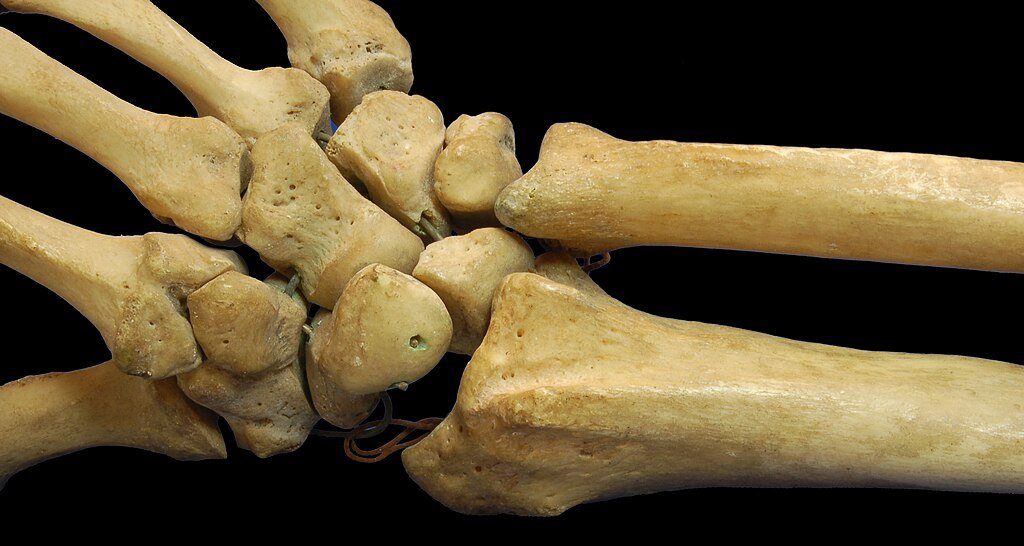
Photograph of human wrist and forearm bones

27 December 2024

Calcium is a chemical element with atomic number 20 and the symbol Ca. It is a reactive, alkaline earth metal, dull gray or silver in color with a yellow tint. When exposed to air it forms a dark oxide layer on the surface. Calcium is essential for life as we know it, used to build bones and teeth and in the muscular, circulatory, and digestive systems. It is also widely used in industry.

Calcium compounds were known to the ancients, but the element was first isolated and named by Humphry Davy in 1808. The name has a straightforward etymology, from the Latin calx (limestone) + -ium; limestone being calcium carbonate. Davy proposed the name in a lecture to the Royal Society of London on 30 June 1808:

These new substances will demand names; and on the same principles as I have named the bases of the fixed alkalies, potassium and sodium, I shall venture to denominate the metals from the alkaline earths barium, strontium, calcium, and magnium.


Sources:

Davy, Humphry. “Electro-Chemical Researches, on the Decomposition of the Earths; with Observations on the Metals obtained from the Alkaline Earths, and on the Amalgam Procured from Ammonia” (30 June 1808). Philosophical Transactions of the Royal Society of London, 1808, 333–370 at 346. HathiTrust Digital Archive.

Miśkowiec, Pawel. “Name Game: The Naming History of the Chemical Elements—Part 1—From Antiquity till the End of 18th Century.” Foundations of Chemistry. 1 November 2022. DOI: 10.1007/s10698-022-09448-5.

Oxford English Dictionary, second edition, 1989, s.v. calcium, n.

Photo credit: Brian C. Goss, 2006. Wikimedia Commons. Public domain image.

poinsettia

Drawing of a red flower with green leaves coming off the stem

A poinsettia plant, Curtis’s Botanical Magazine, 1836

23 December 2024

This flower (Euphorbia pulcherrima), native to Mexico and associated with Christmas, has a rather straightforward etymology. It is named after Joel Roberts Poinsett, who served as the U.S. minister (i.e., ambassador) to Mexico from 1825–30. An amateur botanist, Poinsett sent samples of the flower back to the States, and the name poinsettia had become attached to the plant by 1836. The original Latin designation was Poinsettia pulcherrima, but by the 1860s it was classified in the genus Euphorbia.

The association with Christmas began in Mexico. In Mexican Spanish the poinsettia is called flor de Noche Buena (Christmas Eve flower).

I have found a description of the plant that includes the name Poinsettia pulcherima in an article dated 10 March 1836 in the Edinburgh New Philosophical Journal.

And there is this description of the plant from later in 1836 that appeared in London’s Curtis’s Botanical Magazine:

Poinsettia Pulcherrima. Showy Poinsettia

[…]

By whom this truly splendid plant was communicated to Willdenow’s Herbarium, I am not informed, but it was discovered by Mr. Poinsette in Mexico, and sent by him to Charleston in 1828, and afterwards to Mr. Buist of Philadelphia, who has within a very few years brought together a choice collection of plants.

There are probably earlier examples of the name to be found.

Discuss this post


Sources:

Graham, Dr. “Description of Several New or Rare Plants Which Have Lately Flowered in the Neighbourhood of Edinburgh, Chiefly in the Royal Botanic Garden” (10 March 1836). Edinburgh New Philosophical Journal, 20.40, April 1836, 412. HathiTrust Digital Archive.

Oxford English Dictionary, third edition, September 2006, s.v. poinsettia, n.

“Poinsettia pulcherrima. Showy Poinsettia.” Curtis’s Botanical Magazine (London), Vol. 10 New Series, 1836, 109–111 at 110. Gale Primary Sources: Nineteenth Century UK Periodicals.

Image credit: Curtis’s Botanical Magazine, 1836. Public domain Image.