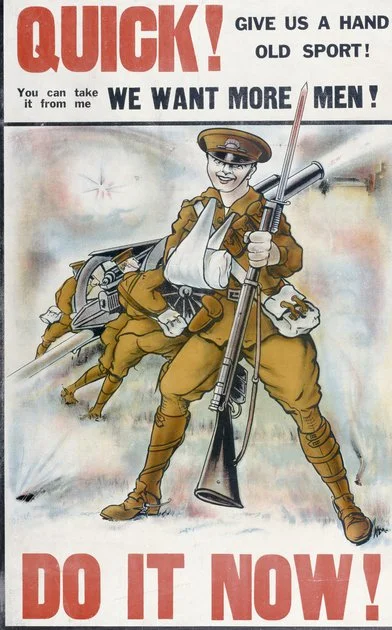
quick

WWI recruiting poster that reads, “Quick! Give us a hand old sport!” with an image of a wounded soldier holding out a rifle

Australian recruiting poster, c. 1915

3 March 2025

The meanings of words change over time. But when a particular sense of a word falls out of general use, sometimes the old meaning sticks around in idiomatic and stock phrases. Such is the case with quick, which did not always mean fast, rapid.

The word comes from the Old English cwic, meaning alive. This original sense of the word is still occasionally used, but outside of the stock phrases the quick and the dead (the living and the dead) and cut to the quick (seriously wound, a reference to living flesh and the cutting a nail down to the living tissue) it is pretty rare nowadays. And the rarity of the original meaning is demonstrated by how often these stock phrases are reanalyzed to use the “fast” meaning. The quick and the dead is often taken to mean be fast or you will die, as in the title of Sam Raimi’s 1995 gunslinger film. And cut to the quick is often erroneously used to mean stop delaying get to the heart of the matter, stop beating around the bush.

The original sense appears in a few other contexts, like the phrase quick with child, meaning pregnant. This is an inversion of the original with quick child. The word quickening, once common but now pretty rare, refers to the first movements of a fetus in the womb, and it was also featured in the title of the 1991 sci-fi film Highlander II: The Quickening. What is it about quick and schlock film titles?

We see the original sense in this passage from Beowulf, lines 791–794a, in which the eponymous hero intends to fight the monster Grendel to its death:

Nolde eorla hleo    ænige þinga
þone cwealm-cuman    cwicne forlætan,
ne his lif-dagas    leod ængum
nytte tealde.

(The protector of men did not want the murderous visitor to depart quick [i.e., alive] by any means, nor did he reckon the days of his life of use to anyone)

The original sense also survives in quicksilver, another name for mercury, a word that goes back to the Old English cwicseolfor and is a reference to the fact that drops of liquid mercury move as if they were alive (cf. mercury).

Around the year 1300, quick acquired the sense of moving, shifting and also fast, swift—only things that are alive move. The first gives us quicksand, or moving sand, and the latter is the dominant sense of the word today. The sense of quick meaning mentally agile or smart appears around 1450, although there is a single use of cwices modes or “quick mind” in surviving Old English texts, specifically in the Old English translation of Bede’s Ecclesiastical History, where the phrase corresponds to the Latin adulescens animi uiuacis (a youth of lively mind).

In a way, you can say that language is quick. It is metaphorically alive and constantly moving and changing. And quick itself is an example of this.

Discuss this post


Sources:

Dictionary of Old English: A to Le, 2024, s.v. cwic, cucu.

Fulk, R. D., Robert E. Bjork, and John D. Niles, eds. Klaeber’s Beowulf, fourth edition. Toronto: U of Toronto Press, 2008, lines 791–794a, 29.

Oxford English Dictionary, third edition, December 2007, s.v. quick, adj., n.1, & adv.

Image credit: Queensland Recruiting Committee, c. 1915. Australian War Memorial, ARTV00139. Wikimedia Commons. Public domain work.
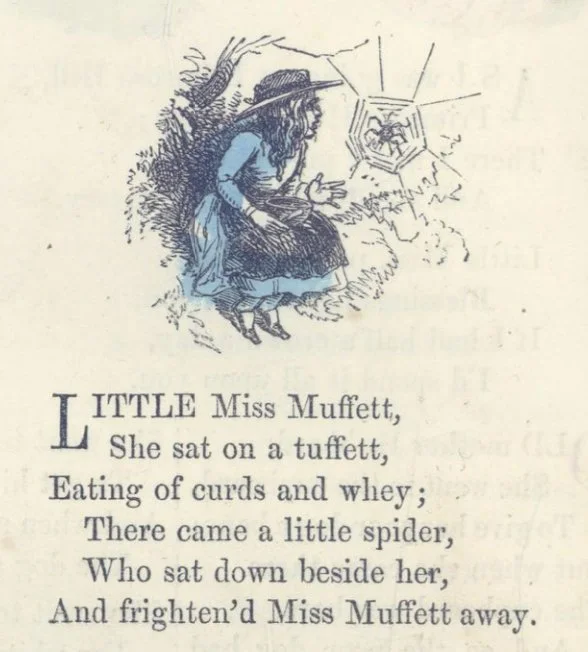
curd / crud / cruddy

Clip from a mid 19th-century book with the text of “Little Miss Muffet” and a drawing of a sitting girl looking at a spider

28 February 2025

Most Americans today only see curd in descriptions of cottage cheese, in the nursery rhyme Little Miss Muffet, or in the verb form to curdle. The word in its original sense referred to the soft, white solid formed when milk or cream coagulates, but it has acquired additional senses over the centuries. First recorded in the form crud, by the late fifteenth century we start seeing the form curd, formed by metathesis, the transposition of phonemes in a word.

Its origin is obscure, first appearing in the late fourteenth century, probably from a Germanic root. It may be from an unattested Old English noun or it could be borrowing from Old Norse; Norwegian has the regional terms krodda, boiled cheese, and krodde, dregs or curds, which are undoubtedly related to the English word, but exactly how is uncertain.

One of the earliest attested uses of curd, or in this case crud, is in William Langland’s late fourteenth-century poem Piers Plowman:

“Y behote the,” quod Hunger, “that hennes ne wol Y wende
Ar Y haue ydyned be this day and ydronke bothe.”
“Y haue no peny,’ quod Peres, “polettes for to begge,
Ne nother goos ne gries but two grene cheses
And a fewe croddes and craym and a cake of otes
And bred for my barnes of benes and of peses.”

(“I assure you,” said Hunger, “that hence I will not go
Before I have both dined and drunk this very day.”
“I have no penny,” said Piers, “with which to buy pullets,
Neither geese nor suckling pigs, but two green cheeses
And a few curds and cream and a cake of oats
And bread of beans and peas for my children.”)

By the early fifteenth century curd was being used to refer to any coagulated substance, not just milk. From a cookbook written c. 1425:

Jussel enforsed.

Take brothe of capons withoute herbes, and breke eyren, and cast into the pot, and make a crudde thereof, and colour hit with saffron, and then presse oute the brothe and kerve it on leches.

The adjective cruddy appears toward the end of the fourteenth century in the sense of curd-like. We see it John Trevisa’s translation of Bartholomæus Anglicus’s De proprietatibus rerum (On the Properties of Things) in a description of testicles and how semen was thought to be formed within the body:

Constantinus seiþ þat þe substaunce of þe stones is imade of vddry and cruddy fleisch, white, neische, and nouȝt ful sad and hard, and þat is for kepinge and sauynge of hete and for chaunginge of blood into whitenes. And þat is by strong hete in here substauns þat seþith þe blood and turneþ it and makeþ it white.

(Constantinus says that the substance of the stones [i.e., testicles] is made of spongy [lit. like an udder] and cruddy flesh, white, pliant, and not at all fixed and hard, and that is for the keeping and saving of heat and for the changing of blood into whiteness. And it is by strong heat in their substance that seethes the blood and turns it and makes it white.)

Cruddy would continue to be associated with bodily fluids. In Book 1 of his 1590 Faerie Queene, Edmund Spenser uses the adjective to describe coagulated blood:

So well they sped, that they be come at length
Vnto the place, whereas the Paynim lay,
Deuoid of outward sence, and natiue strength,
Couerd with charmed cloud from vew of day
And sight of men, since his late luckelesse fray.
His cruell wounds with cruddy bloud congeald
They binden vp so wisely, as they may,
And handle softly, till they can be healed:
So lay him in her charet close in night concealed.

Our current sense of cruddy meaning something filthy or unpleasant appears in American slang in the late nineteenth century. We see it in Allan Pinkerton’s 1877 The Molly Maguires and the Detectives in an attempt to replicate the speech of an Irish-American. Here Pinkerton uses it to mean filthy:

“Tell me, thrue and honest now,” said McKenna, “how this thing happened. It is plain enough that it wor your own hand that did it.”

“Why the d—1 do you say that?”

“Sure an’ you needn’t take me for a gomersal, cruddy from the bogs! I kin see, wid half an eye, that nobody could iver shoot ye like this, exceptin’ Mike Lawler himself!”

And in this passage, he uses it to describe a person:

Mike, meanwhile, took occasion once more to caution the operative against saying anything about their talk of the forenoon. He was reassured when McParlan suggested that he was no cruddy idiot, and reiterated his promise to observe great care over his lips. “Trust me to know better than to blather over what is tould me in confidence!” were his concluding words.

Crud, referring to an unspecified illness, is first seen in college slang in 1930s. The journal American Speech records it being in use on the Stanford University campus in California in 1932:

Crud means illness. “I’ve got the crud, means “I’m ill.”

This illness sense of crud would become widespread in the American military during the Second World War.

Discuss this post


Sources:

Bartholomæus Anglicus. On the Properties of Things (De proprietatibus rerum), vol 1 of 3. John Trevisa, trans. M. C. Seymour, ed. Oxford: Clarendon Press, 1975, 5.48, 261.

Green’s Dictionary of Slang, n.d., s.v. crud, n. cruddy, adj.

J. D. “Jottings.” American Speech, 7.3 (February 1932), 232. JSTOR.

Langland, William. Piers Plowman (C-text). Derek Pearsall, ed. Liverpool: Liverpool UP, 2008, lines 8.300–205, 167–68.

Middle English Dictionary, 13 January 2025, s.v crud, n.

Oxford English Dictionary, third edition, June 2019, s.v. curd, n.

Pinkerton, Allan. The Molly Maguires and the Detectives. Allan Pinkerton’s Detective Stories 6. New York: G. W. Carleton, 1877, 157 & 385. HathiTrust Digital Archive.

“Receipts in Ancient Cookery” (c. 1425). In A Collection of Ordinances and Regulations for the Government of the Royal Household, Made in Divers Reigns. London: John Nichols for the Society of Antiquaries, 1790, 463. Gale Primary Sources: Nineteenth Century Collections Online. London, British Library, MS Arundel 334.

“Little Miss Muffet.” Songs for the Nursery. London: Tabart, 1806, 23. (The 1806 text is identical to that of the 1856(?) edition shown in the above image. There is an 1805 edition which I don’t have access to, which is, I believe, the earliest printed version of the rhyme.)

Spenser, Edmund. The Faerie Qveene, London: William Ponsonbie, 1590, 1.5.29, 68. Project Gutenberg.

Image credit: “Little Miss Muffet.” Songs for the Nursery. London: Darton & Co., 1856(?), 8/2. Gale Primary Sources: Nineteenth Century Collections Online. Public domain image.

pork / pork barrel

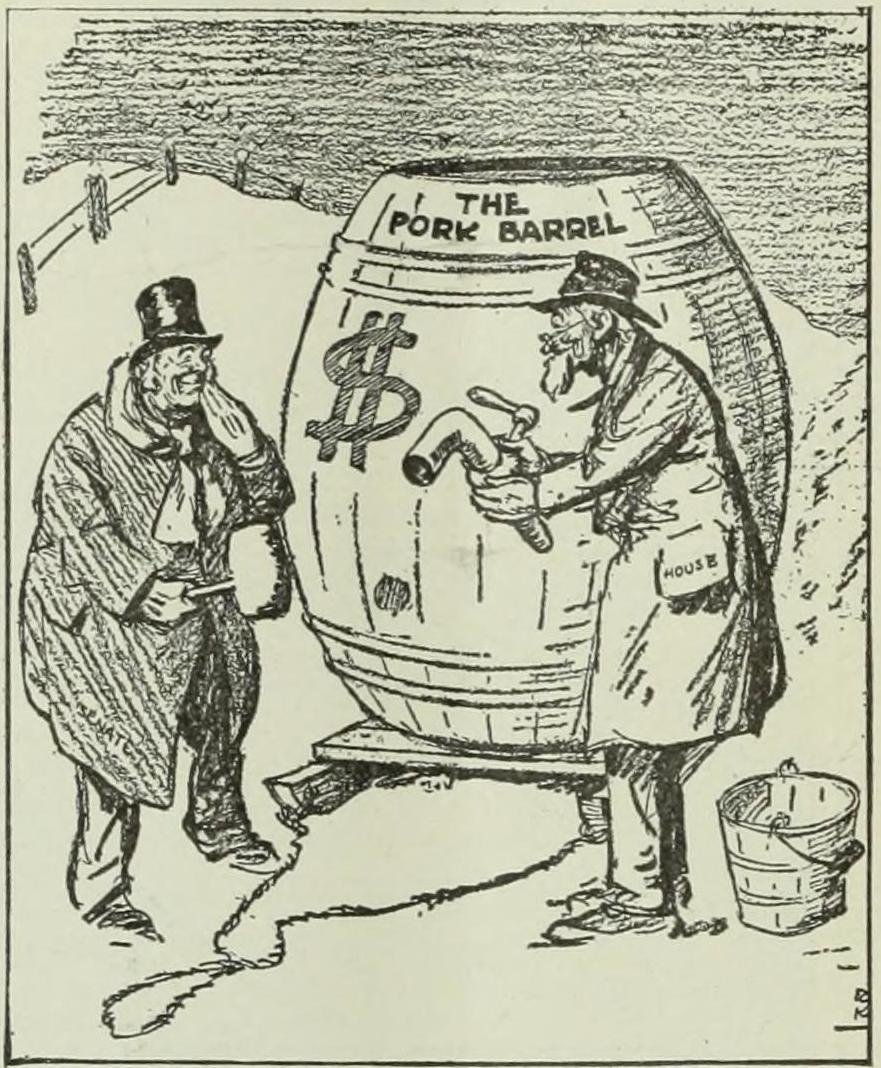
Cartoon of two men, labeled “House” and “Senate” preparing to tap a barrel labeled “The Pork Barrel $”

1917 political cartoon from the New York World

26 February 2025

It’s something of a cliché to say that English words for domesticated animals come from Old English while the words for various types of meat come from Norman French, as the English-speaking commoners cared for the animals and the French-speaking nobility ate the meat. It’s a gross simplification, with all the inaccuracies and exceptions that entails, but it’s generally true. And our present-day word pork does indeed come from the Anglo-Norman porc. The Anglo-Norman (i.e., the dialect of French spoken in England following the Norman Conquest) comes from the Latin porcus, meaning pig.

The Anglo-Norman porc could refer to either the animal or its meat, and English use adopted this dual meaning, although use of the word to refer to the animal became increasingly rare after the Middle Ages.

English use of pork is recorded c. 1300 in a life of Mary Magdalene in the South English Legendary:

huy nomen with heom into heore schip : bred i-novȝ and wyn,
Venesun of heort and hynd : and of wilde swyn,
huy nomen with heom in heore schip : al þat hem was leof,
Gies and hennes, crannes and swannes : and porc, motoun and beof

(He took with him onto their ship enough bread and wine, venison of hart and hind, and of wild swine. He took with him on their ship all that he liked, geese and hens, cranes and swans, and pork, mutton, and beef.)

Note that venison originally referred to the flesh of any animal killed in the hunt, not just to deer meat. So the meat of wild boars was also venison.

Much more recently, pork and pork barrel have acquired a metaphorical meaning in American politics, that of government money doled out by legislators to local projects in their districts, with the implication of being unseemly if not downright corrupt. There are several popular misconceptions about how this sense came about, which I will address below, but it seems to have developed from a common expression, too much pork for a shilling, referring to anything that is excessive or over the top. And when applied to politics, early uses were just as likely to refer to politicians lining their own pockets rather than distributing goodies to constituents.

Too much pork for a shilling appears by 1834, and it was first used to describe purple prose or overly sentimental writing. We see it in a piece in the Nantucket Inquirer of 15 January 1834, and while the context is politics, the specific reference is to over-the-top oratory:

The New York Standard cruelly pokes fun at Mr. Polk’s polyacoustic hocupocus [sic], in the following strain of extravagant mockery:—“It is the most powerful and triumphant vindication that was ever delivered to a deliberative body in this or any other country. The declamations of Clay and M’Duffie are as fables to history when compared with the arguments of Col. Polk. He is one of the ablest men in the house or in the [c]ount[ry] &c.

M[r.] Hone! this is cutting a leetle too fat. Even Polk himself will say “there is too much pork for a shilling.”

And we get this from the Knickerbocker magazine of November 1841 from a letter to writer from his publisher:

Some folks like what’s pathetic—some do n’t; and I am one of them. Do n’t take it hard; but it’s high time you should know you are going too strong in that line. As for your heroine, she has done nothing but snivel and weep from first to last. We found her at it, and left her at it. It’s too much pork for a shilling. Now do give us something jolly—there’s a good fellow!

We see the phrase deployed to mean political favors in a statement by John W. Boyd, a newspaper editor who declined to run for mayor of Hagerstown, Maryland. The statement was printed many times over the decades as an example of political integrity, the earliest that I’ve found is in Philadelphia’s Sunday Dispatch of 14 May 1854:

But to put myself in a position in which every wretch entitled to a vote would feel himself privileged to hold me under special obligations, would be giving rather “too much pork for a shilling.” I, therefore, most emphatically decline the intended dishonor.

And two years later there is this from Lancaster, Pennsylvania’s Inland Weekly and Campaign Banner of 1 November 1856 using the term to refer to money wastefully donated to a political campaign:

In copying the foregoing, the N. Y. Times adds the following:

“This explains the recent quasi Democratic success in Pennsylvania. We have it from good authority that not less than $150,000 was sent into the State by the slaveholding States,—in addition to the $50,000 contributed by the Rothschilds, through Mr. Belmont and the $100,000 raised from the bankers and brokers of Wall street. It is probable that very nearly $500,000 was expended by the Democratic party in carrying out the late State election. How much of it went into the pockets of the wire-pullers of the Fillmore party, probably those whom they deluded into aiding the triumph would be gald [sic] to know.”

We imagine they have by this time concluded that they gave “too much pork for a shilling.” They have elected their Canal Commissioner by less than 3,000: one branch of the Legislature is hopelessly against them—and on the Congressional vote their majority is whittled down to almost nothing. They will have to draw their draft for another half a million.

But ten years later the phrase was being used to denote political favors bestowed by officeholders. The following is from Camden, New Jersey’s West Jersey Press of 29 August 1866. James Scovel was a state legislator from Camden and a rare example of a New Jersey politician who was not corrupt, or who at least wasn’t cheap (I’m New Jersey born and bred, so I can get away with snide criticism of the state, but outsiders dare not try):

The best reason Scovel has yet given for going back on the copperheads he gave to a Democratic friend last week. He said they wanted “too much pork for a shilling.” Satisfactory very.

(During the US Civil War, the copperheads were northern Democrats who sympathized with the Confederacy and advocated an immediate end to the war.)

We finally see a political use of pork and pork barrel, divorced from the phrase too much pork for a shilling, by 1873, but this piece links those terms to an old joke about a Jew (sometimes it’s a Muslim) eating pork. And again, this use of pork and pork barrel is in the context of congressional salaries, not disbursement of funds. From the Springfield Daily Republican of 14 July 1873:

Once upon a time, as tradition reports, there lived a worthy Israelite who was tormented by a hankering after the forbidden food. At last, his curiosity and appetite got the better of his religious principles; he ordered a pork-chop for dinner. Absorbed in the sinful, delightful repast, he did not notice the approach of a thunderstorm. Suddenly a loud clap set the windows rattling. Dropping his knife and fork in panic—“Holy Abraham,” he exclaimed, “what a fuss about a little piece of pork!”

A good many honorable senators and representatives regard the storm of popular indignation now blowing with very much the same feeling. They are scared, but they are also aggrieved. They find it quite uncalled for and out of proportion to the exciting cause. Recollecting their many previous visits to the public pork-barrel, the much bigger loads lugged away on those occasions, the utter indifference displayed by the people, this hue-and-cry over the salary grab, actually seeming to grow louder from month to month, puzzles quite as much as it alarms them. They had not counted on it all, and they find it very unreasonable and absurd. “What a fuss about a little piece of pork!” says Gen Butler in his famous postage-stamp letter. “What a fuss about a little piece of pork!” echoes Senator Carpenter in his Janesville speech. In all the published apologies and defenses, we detect this sense of injury, this accent of complaint and remonstrance.

We see the phrase congressional pork barrel in Boston’s Sunday Herald of 31 May 1896, but this is a brief snippet, a line included to fill out a column, so exactly what is meant by it is unclear:

The congressional pork barrel seems quite likely to be re-coopered.

We see both pork and pork barrel used in the sense we’re familiar with today in Overland Monthly and Out West Magazine of September 1896:

Another illustration represents Mr. Ford in the act of hooking out a chunk of River and Harbor Pork out of a Congressional Pork Barrel valued at two hundred and fifty thousand dollars, “which,” to quote the author, “the Miner’s Association of California wanted, but which really belonged to Boston."

And finally, there is this from Trenton Sunday Advertiser of 11 December 1904:

Speaker Cannon is evidently girding up his loins to put up a fight against the treasury raiders at this session. The widening gap between the revenues and expenditures of the government is giving the administration grave concern. As “Uncle Joe” states the proposition in his blunt and breezy manner of speech, “there’s a gap of about $30,000,000 between the vest and the pants.” Under such circumstances the congressional “pork barrel” is likely to be of smaller dimensions than usual this time; but it is sincerely hoped that the appropriation desired for the enlargement of the Trenton Post Office will be granted. The necessity for the improvement exists, and is urgent, and neither “graft” nor “pork” is involved in the application for the needed money.

It is commonly claimed that the political sense of pork and pork barrel comes out of chattel slavery in the American antebellum South, where enslavers would distribute barrels of pork to feed their enslaved workers. But there is no evidence linking the terms to slavery. Instead we see a gradual development starting with the catchphrase too much pork for a shilling being used in a variety of contexts, including politics, and it is not until well after the Civil War and the end of chattel slavery that either pork or pork barrel are used in the political sense. And the present-day sense of political favors dispensed to constituents is not cemented until the turn of the twentieth century.

Discuss this post


Sources:

Anglo-Norman Dictionary, 2013–17, porc, n.

“Ford’s Life in Washington.” Overland Monthly and Out West Magazine, September 1896, 370. ProQuest Magazines.

“Freemen of Pennsylvania, Read the Following and Learn.” Inland Weekly and Campaign Banner (Lancaster, Pennsylvania), 1 November 1856, 8/1. Readex: America’s Historical Newspapers.

Green’s Dictionary of Slang, n.d., s.v. pork, n.

“Magdelena.” The Early South-English Legendary. Carl Horstmann, ed. Early English Text Society. London: N. Trübner, 1887, lines 341–44, 472. Oxford, Bodleian Library, MS Laud 108, fol. 193v–194r. Middle English Compendium.

Middle English Dictionary, 2025, s.v. pork(e, n.

Oxford English Dictionary, third edition, December 2006, s.v. pork, n.1, pork barrel, n.2.

“The Quod Correspondence, Number Six.” The Knickerbocker, 18.5, November 1841, 420. HathiTrust Digital Archive.

“The Real Significance of It.” Springfield Daily Republican (Massachusetts), 14 July 1873, 4/3. Readex: America’s Historical Newspapers.

“Shearings and Clippings.” Sunday Dispatch (Philadelphia), 14 May 1854, 4/6. Readex: America’s Historical Newspapers.

Sunday Herald (Boston, Massachusetts), 31 May 1896, 12/8. Readex: America’s Historical Newspapers.

“Too Much Pork for a Shilling.” West Jersey Press (Camden, New Jersey), 29 August 1866, 2/3. Readex: America’s Historical Newspapers.

Trenton Sunday Advertiser (New Jersey), 11 December 1904, 4/1. Readex: America’s Historical Newspapers.

“Una voce Poco fa.” Nantucket Inquirer (Massachusetts), 15 January 1834, 3/1. Readex: America’s Historical Newspapers.

Image credit: Unknown artist, New York World, 1917. Wikimedia Commons. Public domain image.

artificial intelligence / AI

An android with hand on chin appears to be pondering a series of equations

24 February 2025

Artificial intelligence, or AI, is the capacity of computers to perform tasks that were previously thought impossible for machines, that is to mimic human thought processing either for specific tasks or in general. The term appears in the 1950s. More recently, the term generative artificial intelligence has come in to use to refer to AI that is “trained” on large sets of data and used to produce intelligible text and images in response to prompts by users.

As is the case with many technical concepts, artificial intelligence first appears in science fiction, only the initial appearances there were in a somewhat different sense, that of robot’s mental capabilities. Edmond Hamilton writes in his 1951 novella Moon of the Forgotten:

Grag, the towering manlike giant who bore in his metal frame the strength of an army and an artificial intelligence equal to the human, rumbled a question in his deep booming voice. But Curt Newton only vaguely heard him.

The term artificial intelligence as we know it today in the real world dates to at least 1955 when a group of computer scientists, John McCarthy, Marvin. L. Minsky, Nathaniel Rochester, and Claude E. Shannon proposed a research project to be conducted at Dartmouth College:

We propose that a 2 month, 10 man study of artificial intelligence be carried out during the summer of 1956 at Dartmouth College in Hanover, New Hampshire. The study is to proceed on the basis of the conjecture that every aspect of learning or any other feature of intelligence can in principle be so precisely described that a machine can be made to simulate it. An attempt will be made to find how to make machines use language, form abstractions and concepts, solve kinds of problems now reserved for humans, and improve themselves.

By 1958, artificial intelligence was starting to appear in general audience publications. On 16 April 1958 Lansing, Michigan’s State Journal had an article on technical predictions for the future and included this prediction for the year 2000, one that is rather accurate and only off by about twenty-five years:

“And if you think some of those things are out of this world,” Mr. Davis told the writers, “your grandchildren will enjoy artificial intelligence machines which will do things people do now—write letters, do bookkeeping, translate languages, file and retrieve information, teach students individually, plan and operate factories, cook, serve meals, clean houses, drive automobiles, and fly airplanes.”

The abbreviation A.I. appears by 1963, when Marvin Lee Minsky used it to shorten the title of MIT’s Artificial Intelligence Project Memo 61.

And we see generative artificial intelligence by the turn of the twenty-first century, when it appears in a 2001 technical report published by the US Air Force Research Laboratory:

The core component of the Suggestions Module/Server is a generative artificial intelligence (AI) planner, developed by Carnegie Mellon University (CMU) called Prodigy. Prodigy [9] is a multi-strategy planning and learning architecture that can solve planning problems in a number of different ways. Simply stated, Prodigy searches for a sequence of actions that transform an initial state (the current state) into a final state (the goal state).

That’s the history of the terms. Whether or not AI has fulfilled its promises is a mixed bag. Some AIs created for specific tasks perform as well, if not better, than humans do. AIs trained to examine medical imagery for signs of cancer, for instance, have been shown to perform better than human radiologists. And AIs powering self-driving cars perform remarkably well, although they may not yet be safe enough for city streets. But the generative AIs, at best, merely produce mediocre and inaccurate text and images and show no signs of improving because they are not truly “intelligent.” They possess no actual knowledge of the real world, nor can they, as the scientists in 1955 hoped, “form abstractions and concepts.” They merely output what their training data tells them is the statistically most likely response. They can form a grammatically correct sentence, but they cannot form an insightful, original, or stylistically innovative one.

Discuss this post


Sources:

Hamilton, Edmond. “Moon of the Forgotten.” Startling Stories, 22.3, January 1951, 118–34 at 121/1. Archive.org.

Historical Dictionary of Science Fiction, 17 November 2024, s.v. artificial intelligence, n.; 16 December 2020, s.v. AI, n.

McCarthy, John., Marvin. L. Minsky, Nathaniel Rochester, and Claude E. Shannon. “A Proposal for the Dartmouth Summer Research Project on Artificial Intelligence” (31 August 1955). AI Magazine, 27.4, Winter 2006, 12–14 at 12. DOI: 10.1609/aimag.v27i4.1904.

Minsky, M. L. A.I. Memo 61: Mathscope Part 1. A Proposal for Mathematical Manipulation-Display System (typescript). Cambridge: Massachusetts Institute of Technology, 18 November 1963.

Mulvehill, Alice M., Clinton Hyde, and Dave Rager. Joint Assistant for Deployment and Execution (JADE). Air Force Research Laboratory, AFRL-IF-RS-TR-2001-171, August 2001, 8. Defense Technical Information Center (DTIC).

“New Cures Predicted.” State Journal (Lansing, Michigan), 16 April 1958, 64/2. ProQuest Historical Newspapers.

Oxford English Dictionary, third edition, December 2023, s.v. artificial intelligence, n., AI, n.2., generative artificial intelligence, n.

Image credit: Mike MacKenzie, 2018. Wikimedia Commons. Licensed under a Creative Commons Attribution 2.0 Generic license.

silver

Photo of silver cup with images of warriors in battle and hunters killing animals on display in a museum

Bronze Age (c. 2300 BCE) silver goblet found at Karashamb, Armenia

21 February 2025

Silver is a chemical element with atomic number 47 and the symbol Ag. It is a soft, white, lustrous metal with the highest electrical and thermal conductivity of any metal. It has, of course, been known since antiquity. Besides its use in coinage and in jewelry and other decorative items, it has a wide variety of industrial uses, many coming from its conductivity.

Our present-day word silver is from the Old English seolfor or siolfor, which in turn is from a proto-Germanic root *silubra-. It has cognates in Celtic and Slavic languages, but interestingly, it does not come from a Proto-Indo-European root; it is a wanderwort, borrowed into these Indo-European languages from another source, probably via Bronze Age trade networks. The corresponding Proto-Indo-European root is *arg-, with a meaning of shining or white, which gives us the Latin argentum, and hence the chemical symbol Ag.

Here is an example of silver in the late ninth-century Old English translation of Pope Gregory the Great’s Cura pastoralis (Pastoral Care):

Witodlice ðæt ar, ðonne hit mon slihð, hit bið hludre ðonne ænig oðer ondweorc. Sua bið ðæm þe suiðe gnornað on ðære godcundan suingellan; he bið on middum ðæm ofne gecirred to are. Ðæt tin ðonne, ðonne hit mon mid sumum cræfte gemengð, ond to tine gewyrcð, ðonne bit hit swiðe leaslice on siolufres hiewe. Sua hwa ðonne sua licet on ðære swingellan, he bið ðæm tine gelic inne on ðæm ofne.

(Indeed brass, when one strikes it, is louder than any other material. So it is for one who complains a lot about divine chastisement; in the midst of the furnace he is turned to brass. Tin, then, when it is with a certain art alloyed and worked into pewter, then it is very deceptively in the likeness of silver. So then whoever is like that under chastisement, he is like tin in the furnace.)

So silver is as mysterious as it is beautiful.

Discuss this post


Sources:

Etymological Dictionary of Proto-Germanic Online, 2010, s.v. *silubra-. Brill: Indo-European Etymological Dictionaries Online.

Fulk, R. D, ed. & trans. The Old English Pastoral Care. Dumbarton Oaks Medieval Library 72. Cambridge: Harvard UP, 2021, chapter 37, 282–85. Oxford, Bodleian Library, MS Hatton 20.

Miśkowiec, Pawel. “Name Game: The Naming History of the Chemical Elements—Part 1—From Antiquity till the End of 18th Century.” Foundations of Chemistry. 1 November 2022. DOI: 10.1007/s10698-022-09448-5. https://doi.org/10.1007/s10698-022-09448-5

Oxford English Dictionary, second edition, 1989, s.v. silver, n. & adj.

Sweet, Henry, ed. King Alfred’s West-Saxon Version of Gregory’s Pastoral Care, vol. 1 of 2. Early English Text Society. London: N. Trübner, 1871, chapter 37, 266–69. Oxford, Bodleian Library, MS Hatton 20. HathiTrust Digital Archive. https://babel.hathitrust.org/cgi/pt?id=hvd.hngdrs&seq=274

Photo credit: Yerevantsi, 2024. History Museum of Armenia, Yerevan. Wikimedia Commons. Licensed under a Creative Commons Attribution 4.0 International license.