tweak

Photo of a man leaning over an electronics work bench and adjusting the equipment

A radio operator tweaking the oscillator of a transceiver

26 May 2025

Tweak is both a verb and a noun with a base meaning of pinch, twist, or pull. From this, it has developed a number of other senses. The word, in the form twick, can be traced back to Old English. (The Oxford English Dictionary says this is only “perhaps,” but to my mind it is as certain as anything in this business.) We see this form in Bald’s Leechbook, a mid tenth-century medical text:

Wiþ ormætum hungre þonne scealt þu sona þæs mannes tilian: bind his ytmestan limo mid byndellum, teoh him þa loccas & wringe þa earan & þone wangbeard twiccige.

(For intense hunger, then you must soon treat the man, bind the ends of his limbs with bandages, pull from him the locks & wring the ears & twick the whiskers.)

Twick has been in use in various dialects through to the present day.

The form tweak appears at the beginning of the seventeenth century. We see it in a translation of Pliny’s Natural History:

These Spiders hunt also after the yong Lizards: first they enfold and wrap the head within their web: then, they catch hold and tweake both their lips together, and so bite and pinch them. A worthy sight and spectacle to behold, fit for a king, even from the stately Amphitheatres, when such a combat chanceth.

The translator, Philemon Holland, was known for using colloquial English in his translations of classical texts, so it seems likely that he was using a variant of the older twick. Holland's use of tweake here translates the Latin apprehendentes.

By the early eighteenth century, tweak had developed a figurative sense meaning to trouble, arouse, or spark. Nathan Bailey’s 1721 Universal Etymological English Dictionary records this sense:

A TWEAG, A TWEAK, [of Twaken, Teut.] Perplexity, Trouble.
To TWEAG  To TWEAK, [Twacken, Du. To pinch] to put into a fret.

And by the end of the nineteenth century in American speech tweak had also come to mean to bother, afflict, tease, make fun of. From Thomas Jerome’s 1895 novel Ku-Klux Klan No. 40:

“Oh, no; I did not mean to say that you should refrain from a prosecution for any reason,” answered Tinklepaugh. “I only thought to tease the Captain a little.”

And yet Tinklepaugh was tortured with a vague apprehension that an indictment of innocent persons for the murder of Old Stingy Jap might lead to the detection of the guilty slayers.

“Well I must confess that it does kinder stick a pin in my gizzard to tweak me about that little skirmish at the court-house,” answered Cross-eyed Telf; “but I’ll bet you next time I meet the Sheriff I’ll have my spurs on, and he won’t be allowed to snatch a bloodless victory, either.”

In the early twentieth century, cricketers started using tweak to refer to imparting spin on a ball. And a bowler who delivered tweaked balls was a tweaker. From the Times of London, 18 July 1935:

The score was 13 when Sims, a tweaker with possibilities, came on in place of Bowes, and Langridge was tried at the other end.

And in the latter half of the century, tweak was being used to mean to make small adjustments to something. From Omaha’s Sunday World-Herald Magazine of 20 April 1958 in an article about missile engineers:

“Otto,” somebody yelled, and out came Otto who marched up to the V-2, opened a small trap door, tweaked a gadget inside with a screwdriver, and the countdown proceeded. The V-2 worked like a charm.

This particular sense of tweak was especially common among automobile mechanics and could be found on both sides of the Atlantic. From London’s Sunday Telegraph of 14 July 1963:

After driving it for hundreds of miles I find its impressive record in rallies and races easy to understand. It is not a “hot rod” as you and I know the term, but a four-door, five-seat family saloon costing only £767—including tax—which has had its engine “tweaked” sufficiently at the factory to give a power-output of 78½ brake horse-power compared with 59½ in the ordinary £688 model.

And by the 1980s, tweak had become a slang term among drug, especially methamphetamine, users, also known as tweakers. The earliest drug-related use that I’m aware of is found in Ralph De Sola’s 1982 Crime Dictionary:

Tweak: (motorcycle-gang slang) inject heroin

Despite this early citation, use of tweak in relation to heroin is relatively rare.

(The OED has a 1981 citation of tweeked out, but the context has nothing to do with drugs, instead referring to the emotional state of a woman who had been raped.)

And we see tweak used in relation to methamphetamine by 1985. From Jennifer Blowdryer’s Modern English of that year:

TWEAK (v): When everybody is on speed, they are tweakin’ out on speed. One day turns into a week.

When we were living in the vats in San Francisco, everybody was always tweakin’, Animal was freakin’ out, me and Crystal had to get outta there. We took all these wires they were playin’ with, and made bracelets, and decided it would be anti-tweak, and we all took the fun bus, and we went to China Beach, and we had a big Barb que and everyone got drunk when they usually took speed and it was neat, it was  big anti-tweak campaign.


Sources:

Bailey, Nathan. An Universal Etymological English Dictionary. London: E. Bell, et al. 1721. Gale Primary Sources: Eighteenth Century Collections Online.

Blowdryer, Jennifer (Jennifer Waters). Modern English: A Trendy Slang Dictionary. Berkeley: Last Gasp, 1985, 81. Archive.org.

Cockayne, Oswald, ed. Leechdoms, Wortcunning and Starcraft of Early England, vol. 2. London: Longman, et al., 1865, 2.16, 196. Archive.org.

“Cricket: Gentlemen v. Players.” Times (London), 18 July 1935, 6/1. Gale Primary Sources: Times Digital Archive.

De Sola, Ralph. Crime Dictionary. New York: Facts On File, 1982, 155. Archive.org.

Edwards, Courtenay. “Plenty of Spirit in Cortina G.T.” Sunday Telegraph (London), 14 July 1963, 20/2. Gale Primary Sources: Telegraph Historical Archive.

Green’s Dictionary of Slang, accessed 24 April 2025, s.v. tweak, n.2, tweak, v.2, tweaked, adj., tweaker, n.2, tweaking, adj., tweaky, adj.

Jerome, Thomas J. Ku-Klux Klan No. 40 A Novel. Raleigh, North Carolina: Edwards & Broughton, 1895, 205. Google Books.

Lutz, William W. “Typical of Missilemen Is . . . ‘Mr. Redstone.’” Sunday World-Herald Magazine (Omaha), 20 April 1958, 22-G/3. Readex: America’s Historical Newspapers.

Middle English Dictionary, 4 March 2025, s.v. twikken, v.

Oxford English Dictionary, third edition, March 2022, s.v. tweak, v., tweak, n.1, tweaker, n.; June 2019, s.v. twick, v.

Pliny the Elder. The Historie of the World. Philemon Holland, trans. London: Impensis G.B., 1601, vol. 1, book 11, chap. 24, 324. ProQuest: Early English Books Online.

Photo credit: Giorgio Brida, 2009. Wikimedia Commons. Licensed under a Creative Commons Attribution 2.0 Generic license.

fascism / fascist

B&W photo of Benito Mussolini and Adolf Hitler, both in uniform and stone-faced, standing next to one another

Mussolini and Hitler, 19 June 1940

23 May 2025

By strict definition, Fascism is an autocratic and ultranationalist political ideology, characterized by centralized authority focused on a dictatorial leader and militarism, use of force to suppress opposition, national or racial supremacy, and regimentation of society and the economy that subordinates the individual to the collective. It is most closely associated with Mussolini’s Partito Nazionale Fascista (National Fascist Party) in Italy and Hitler’s Nationalsozialistische Deutsche Arbeiterpartei (National Socialist German Worker’s (Nazi) Party). But Vladimir Putin’s Russia also fits this strict definition, as do Donald Trump’s aspirations in the United States. Beyond this strict definition, fascism and fascist are often used more broadly to refer to authoritarianism in general.

The term arose in Italy following World War I as a label for various ultranationalist groups vying for power, and Mussolini formed his Partito Nazionale Fascista in 1921. It comes from the Latin fasces, a symbol of power and authority in the Roman Empire consisting of a sheaf of rods bound around an ax. Fasces appears in the 1538 Latin-English Dictionary of Syr Thomas Eliot Knyght:

Fascis, is a burdeyn or knytche of wodde, or any other thyng. Also Fascis sagittarum is taken for a sheffe of arrowes.

Fasces, roddes bounden togyther, and an axe in the myddell, whiche were borne before the chiefe offycers of Rome, in declarynge their authoritie, whereof some had syxe, and some mo.

And it appears in English prose by 1591, but in italics, marking it as foreign word. In Henry Savile’s translation of Tacitus str is used in the English translation of a marginal note in Greek elaborating on <i>Consulare autority</i> (<i>Consulare imperium</i>)

To haue 12. fasces alwaies and in euery place borne before him, and to sit betweene the present Consuls in a chaire of estate.

And in Philemon Holland’s 1609 translation of Ammianus Marcellinus fasces appears to be fully anglicized:

Severo: who being Legatus Proconsulis in Africke, when one of his old acquaintance met with him going in state with his Fasces and Lictors before, and embraced him familiarly, without due respect of his high place, caused him to be scourged, sub elogio [praeconis] LEGATƲM P. R. homo plebeius temerè amplecti noli, i. Take heed another time how you, a commoner, seeme rudely to embrace a Lieutenant of the people of Rome.

Fasces continue to be used in iconography to this day to symbolize power and authority. For instance, fasces decorate the walls on either side of the rostrum in the US House of Representatives.

But modern use of fasces to represent power were taken to another level in twentieth-century Italy. The term Fascist, usually capitalized, appeared shortly after the end of World War I as a label for various ultranationalist political groups. By 1919, this label was appearing in English-language newspapers in articles about Italian politics. From London’s the Observer of 19 October 1919:

Among the parties we have the Moderates, the Clericals, the Liberals-Radicals, the Republicans, the Socialists, the Nationalists, and the “Fascists”—a group, this, of political opportunists which, beyond expressing ultra-patriotic doctrines, seems to have no more definite policy than that of attaining to power.

And we see Fascism in a book review for Sisley Huddleston’s Europe in Zigzags in the 8 December 1920 Providence Journal:

In his characteristically successful fashion he has so blended his material as to answer many questions about reparations, security, dictatorship and democracy, about Fascism and the youth movement.

[…]

With his memories of Italy are recalled interesting facts connected with the most noted authors and poets. Fascism, Mussolini and his relations with the church, the policy of Pope Pius CI, and the relations between France and Italy.

Mussolini would formally create his political party the following year.

But fascist and fascism, usually lower case, would soon come to be used more generally to refer to authoritarianism writ large. Poet Dylan Thomas used fascism in this general sense, not in direct reference to Italian Fascists or German Nazis, in a July 1939 letter:

But the result of a consciously-made intelligentsia may be to narrow, not to widen, the, if you’ll excuse me, individual outlook, and instead of a lonely man—and writing, again, is the result, as somebody said, of certain favourable bad conditions—working in face of an invisible opposition, (the crude opposition, of family, finance, etc. that says “writing is a waste of time” & “why don’t you do something worth-while” has always, surely, had to be disregarded) there may be just a group of condoling, sympathy-patting, “I was always bullied at school,” “So was I,” “Down with the philistines,” “They don’t understand a poet,” mutually acknowledging, ism and isting, uniformed grumblers making a communal opposition to a society in which, individually, they feel alone and unimportant. I’m selfish enough not to feel worried very much about the writer in his miserable artistic loneliness, whether it’s in Wales or Paris or London; I don’t see why it should be miserable anyway. I think that to fight, for instance, the fascism of bad ideas by uniforming & regimenting good ones will be found, eventually, to be bad tactics.

This general use would become much more common once Germany and Italy were defeated in World War II, but with the passing of the generation that fought that war, the stricter, more narrow sense is unfortunately becoming more relevant to present-day politics once again.

Discuss this post


Sources:

Elyot, Thomas. The Dictionary of Syr Thomas Eliot Knyght. London: Thomas Berthelet, 1538, sig. H.3. ProQuest: Early English Books Online (EEBO).

“The Italian Elections” (11 October 1919). Observer (London), 19 October 1919, 14/2. ProQuest Historical Newspapers.

Marcellinus, Ammianus. “Annotations and Conjectures Upon the 14. Booke of Ammianus Marcellinus.” The Roman Historie. Philemon Holland, trans. London: Adam Islip, 1609, sig.a.ii.v. ProQuest: Early English Books Online (EEBO).

Oxford English Dictionary, second edition, 1989, s.v. fasces, n.; third edition, June 2014, s.v. fascism, n., fascist, n. & adj.

“Sisley Huddleston Looks at Europe” (book review). Providence Journal (Rhode Island), 8 December 1920, 28/1–2. Readex America’s Historical Newspapers.

Tacitus. The Ende of Nero and Beginning of Galba. Fower Bookes of the Histories of Cornelius Tacitus. Henry Savile, trans. Oxford: Joseph Barnes and R. Robinson for Richard Wright, 1591, 171, Annotations 79. ProQuest: Early English Books Online (EEBO).

Thomas, Dylan. Letter to W. T. Davies, July, 1939. Dylan Thomas: The Collected Letters. Paul Ferris, ed. London: Paladin, 1987, 388–89. Archive.org.

Photo credit: Unknown photographer, 1940. Wikimedia Commons. Public domain photo.

leech

Photo of a leech attached to human skin

A leech (Hirudo medicinalis) drawing blood

21 May 2025

Leeches are a type of parasitic worm that suck blood from larger animals. But the word also has an obsolescent meaning of physician or healer. These two meanings may be related—because physicians used to use leeches for bloodletting—or they may come from separate roots. If they are related, they come from the Proto-Germanic root *lekan-, meaning to leak or drip. But the physician sense may not be etymologically related to the worm sense, coming instead from the Proto-Celtic *legio-, which gives us the Old Irish liaig or doctor. If that is the case, the two words only later became popularly associated through the practice of doctors using leeches.

(Note that present-day medicine still uses leeches in skin grafts and limb reattachment, where the anticoagulant secretions of leeches promote the reconstruction and growth of veins and capillaries. Of course, the leeches used today are specially bred for the purpose and are free of pathogenic bacteria.)

The Old English læce, meaning the blood-sucking worm, appears only a handful of times in the extant Old English corpus and then only in glosses of the Latin sanguisuga or hirudo. But the word meaning physician or healer appears some 225 times.

One use of læce to mean physician appears in an interlinear gloss of the Latin hirudo, demonstrating that the association of physicians with the worms was already in place by the late ninth century. The gloss is of Abbo of Saint-Germain-des-Prés’s De bellis Parisiacæ urbis (About the Wars of the City of Paris), a poem about the spiritual and practical implications of the Viking siege of the city in 885–86.

Sy gelomlic læce mid syðegod þær þær bið untrum hiwræden.

(Let the leech often be near the infirmary.)

A more typical Old English use of the word to mean physician can be seen in another ninth-century text, the Old English translation of Pope Gregory the Great’s Cura pastoralis:

Forðæm nan mon ne bitt oðerne ðæt he hine rære, gif he self nat ðæt he afeallen bið; ne eac se, se his wunde sar ne gefret, ne wilnað he nanes læces.

(Because no one asks another that he be lifted up, if he does not know himself that he has fallen; nor does one how does not feel the pain of his wound desire a leech.)

The verb to leech, meaning to heal, appears in the late twelfth century. But the metaphorical extension of the verb, meaning to act like a parasite or to drain someone of money, energy, etc. doesn’t come until much later. Here is a transitional use that directly alludes to the bloodsucking creature. From Columbia, South Carolina’s The State of 9 January 1920:

The bankers, the merchants, and the manufacturers, the preachers and the teachers of the South, indeed every other man who is not a cotton gambling bear leeching the life blood of the cotton grower should be interested in the organization and its work.

And here is one that dispenses with the direct reference to the worm: From a letter published in the Dallas Morning News of 11 August 1925:

As proof there now exists a heavy differential rate on top of the common rate collected by the railroads from Quanah to Roaring Springs, from Plainview to Floydada, from Lubbock to Crosbyton, for long years borne and paid by the people. There was differential for Spur on the Stamford & Northwestern Railroad, which leeched the people for twelve years.


Sources:

Dictionary of Old English: A to Le, 2024, s.v. læce, n.1, læce, n.2.

“Edmonds Praises Work of Body.” The State (Columbia, South Carolina), 8 January 1920, 5/5. Readex: America’s Historical Newspapers.

Fulk, R. D., ed. The Old English Pastoral Care. Dumbarton Oaks Medieval Library 72, Cambridge: Harvard UP, 2021, chap.58, 490.

Kroonen, Guus, ed. Etymological Dictionary of Proto-Germanic Online, Brill, 2009, s.v. *lekja-, *lekan-.

Middle English Dictionary, 4 March 2025, s.v. lechen, v.(2).

Oliver F. N. “Thinks Differentials Should be Removed” (letter). Dallas Morning News (Texas), 11 August 1925, 12/7. Readex: America’s Historical Newspapers.

Oxford English Dictionary, second edition, 1989, s.v. leech, n.1, leech, n.2, leech, v.1; Additions Series 1997, s.v. leech, v.2.

Stevenson, W. H. “Liber Abbonis Anglice Interpretatus.” Early Scholastic Colloquies. Anecdota Oxoniensia: Mediaeval and Modern Series, Part 15. Oxford: Clarendon Press, 1929, 108. Archive.org.

Photo credit: GlebK, 2011. Wikimedia Commons. Licensed under a Creative Commons Attribution-Share Alike 3.0 Unported license.

trouble at (the/t’) mill

Opening of the “Spanish Inquisition” sketch, Monty Python’s Flying Circus (1970) in which a man announces “trouble at t’ mill” before being interrupted by men in priestly garb claiming to be the Spanish Inquisition

19 May 2025

Trouble at t’ mill (or trouble at mill / trouble at the mill) is a British cliché used to refer to any kind of problem or disagreement. It evokes, in Lancashire dialect, some kind of accident or labor dispute at a factory. It arises out of a trope in literature and drama where a worker announces that there has been some kind of difficulty at the local factory. Through overuse by bad writers, the phrase became something of a joke.

The earliest use of the phrase that I have found in literature is actually from the United States. From a story that appeared in the December 1868 issue of Arthur’s Home Magazine:

“What’s the matter?” I asked, hurriedly.

“Why, there’s been trouble at the mill,” he said, cautiously, as if he feared to hurt me, “and I’ve brought Horace home, for he’s hurt pretty bad. Could you call Jonathan to help the men lift him out?”

I was round the back of the wagon before he had finished speaking, and gazing eagerly inside. Horace lay there with his head upon his arm, and his eyes shut, looking very pale; but I could not see that he was very much hurt, until suddenly, as the men lifted him, and in doing so loosened the blanket they had thrown over him, I saw that both limbs were fearfully crushed and mangled.

Of course, here the phrase is used quite literally and without irony.

Here’s an example in Lancashire dialect, from a story that appeared in the 1 August 1931 issue of the British Picturegoer Weekly, again a literal and unironic use:

Aitchison’s broad shoulders slumped.

“Afraid for my job,” he confessed. “Times is terrible hard oop here in Handle, Mister Kennedy. Mr. Jason is houndin’ t’ hands t’ breaking point.” His passion mounted. “T’ owed skinflint. He’s sacked more hands this mornin’ an’ let t’ rest of us know that wages is cut again.”

He pointed out towards the yard.

“T’ hands is holdin’ a meetin’ about it this minute. Mark my words, mister, there’s goin’ to’ be trouble in t’ mill!”

But by the 1950s, the phrase was widely recognized as a cliché. The following notice for the film Hindle Wakes appeared in the 15 December 1952 issue of Torquay’s Herald Express. IMDB describes the film as follows: “A cotton mill worker in Lancashire falls for her boss's son while on a Wakes Week holiday in Blackpool but enlists the aid of her girlfriend to keep it a secret to hide it from her interfering parents.” The newspaper notice of the film being shown in local theaters uses trouble a’ t’ mill to throw shade on the movie:

—And On The Other South Devon Screens

Odeons (Torquay, Paignton and Newton Abbot)—“HINDLE WAKES.” Another version of the Lancashire drama—there’s trouble a’ t’ Mill. Also “The Raiders.”

Electric—“LOST IN ALASKA.” Bud and Lou on the loose again, no reward offered. Also—“Duel At Silver Creek.”

Tudor—“DOUBLE DYNAMITE.” Medium fare for Sinatra and Jane Russell fans. For others a damp squib. Also: “Riders Of The Range.”


Sources:

“And On The Other South Devon Screens.” Herald Express (Torquay, UK), 15 December 1952, 4/3. British Newspaper Archive.

Holiday Week (Original title: Hindle Wakes).” IMDB.com, accessed 21 April 2025.

Mitchell, A. M. “After the Victory.” Arthur’s Home Magazine (Philadelphia), December 1868, 328/1. Gale Primary Sources: American Historical Periodicals from the American Antiquarian Society.

Oxford English Dictionary, second edition, 1989, s.v. trouble, n.

St. John, Val. “Screen Fever!” Picturegoer Weekly, 1 August 1931, 20. British Newspaper Archive.

Tréguer, Pascal. “A British Phrase: ‘(There’s) Trouble at T’Mill.’” Wordhistories.net, 15 May 2020.

Video credit: British Broadcasting Company (BBC) and Python (Monty) Pictures, 1970. Fair use of a brief, low-resolution clip to illustrate the topic under discussion.

grit / grits / Grits / hominy

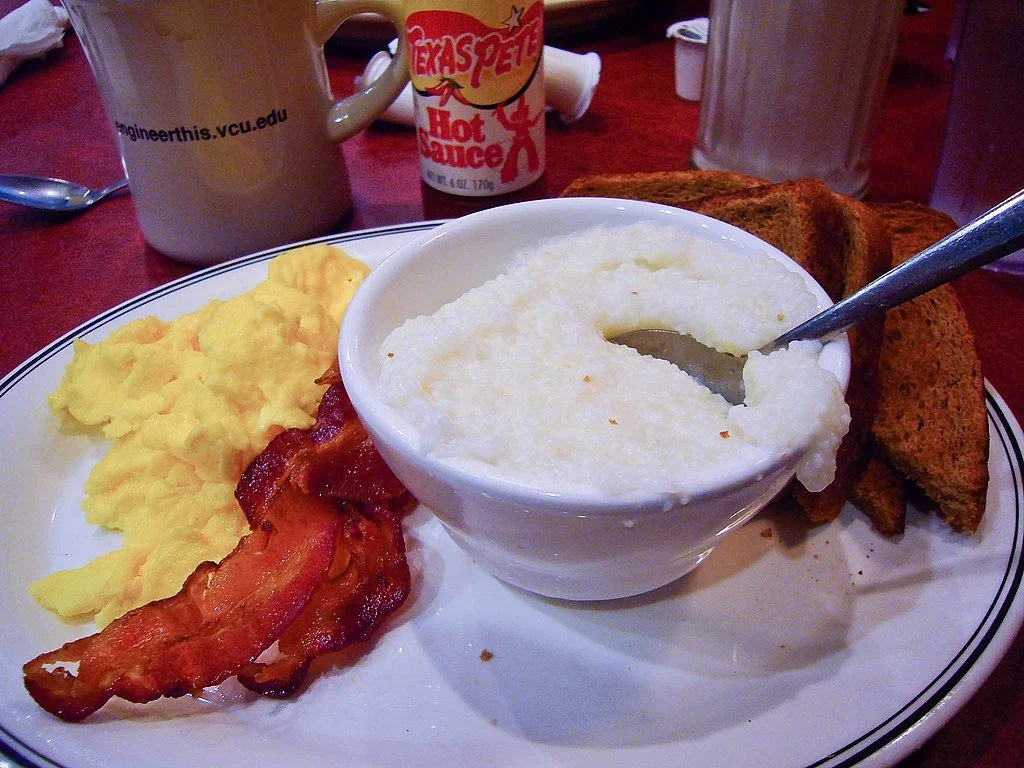
Photo of a bowl of hominy grits beside servings of scrambled eggs, bacon, and toast

16 May 2025

Grit can refer to sand, ground grain, moral fortitude, or a Canadian political party. As a verb, it can refer to grinding or gnashing, especially of one’s teeth. The history of this rather small word takes us on a journey encompassing Beowulf, John Smith’s seventeenth-century travel narratives, Thomas Jefferson’s feud with John Adams, Canadian politics, P. T. Barnum’s showmanship, and, of course, the cuisine of the American South.

Grit comes to us from the Old English, greot meaning sand, gravel, dirt, or earth. We can see it used to mean sand in one of the riddles in the Exeter Book, which was copied in the late tenth century. The answer to the riddle is “ship”:

Siþum sellic    ic seah searo hweorfan,
grindan wið greote,    giellende faran.

(On occasions I saw a strange device make its way, grind against the grit, travel screeching.)

The Old English word could also be used a bit more generally to mean dirt or earth. Here we have a passage in Beowulf, about the dragon’s hoard being left buried as it was cursed:

Forleton eorla gestreon    eorðan healdan,
gold on greote,    þær hit nu gen lifað,
eldum swa unnyt    swa hyt [æro]r wæs.

(They left the earth holding the warriors’ treasure, gold in the grit, where it now resides, useless to men as it was before.)

The verb, meaning to make a grinding or grating noise, doesn’t appear until centuries later. Here is an early use from Oliver Goldsmith’s 1762 The Citizen of the World:

The muse found Scroggen stretch’d beneath a rug;
A window patch’d with paper, lent a ray,
That dimly shew’d the state in which he lay;
The sanded floor that grits beneath the tread,
The humid wall with paltry pictures spread.

And the verb is frequently used in the context of gritting one’s teeth. Here is Thomas Jefferson using it in this context in a journal entry:

December the 26th, 1797. Langdon tells me, that at the second election of President and Vice-President of the United States, when there was a considerable vote given to Clinton in opposition to Mr. Adams, he took occasion to remark it in conversation in the Senate chamber with Mr. Adams, who gritting his teeth, said, “damn ’em, damn ’em, damn ’em, you see that an elective government will not do.”

Gritting one’s teeth would eventually lead to grit meaning moral fortitude, a sense that is in place by 1825 when it appears in John Neal’s novel Brother Jonathan, the character of Brother Jonathan being a representation of the people of New England. Early uses of this sense are often in the phrase clear grit:

Old Bob, I mean; proper feller, he was, too; ’cute enough, I tell you! sharp's a razor—clear grit; one o’ them air half blooded Mohawks, ’od rot ’em!

A bit north of New England, clear grit became a nickname for a reformist political faction, one that would eventually merge with the Liberal Party. We see this nickname by the mid nineteenth century, for which the Dictionary of Canadianisms on Historical Principles (DCHP) has a citation from the 9 August 1849 issue of the Dundas Warder:

Though it is highly desirable to carry some of the objects of the “clear grits” into effect, the circumstances of their coquetting with the ULTRA TORY party is sufficient to excite suspicion, and to put real Reformers on their guard.

The next year the Boston Daily Atlas printed a letter of 15 February 1850 that reports on the Canadian political scene:

The Annexation Association, as you will perceive by the manifesto from which I sent you extracts in my last letter, will still continue the constitutional agitation of its cause, and it will be supported by the “clear grits.”

The clear grits soon became clipped and capitalized to Grits. Another example from the DCHP is from the United Empire Loyalist of 16 September 1852:

Will the Grits desert him in this; and allow him to be accused by the government “of leaving his slime upon everything that he crawled over?”

And one still sees Grits being used as a nickname for the Liberal Party. From Toronto’s Globe and Mail of 29 April 2025:

The list of neophyte Grit MPs also includes a former Quebec finance minister, a veteran diplomat, a former president of IBM Canada and an internationally trained lawyer with an Oxford MBA.

But the noun doesn’t just refer to sand, fortitude, or a Canadian political party. It can refer to ground grain. The first grain to be so named was oats, and we have oat grits and groats from at least 1584 when it appears in Thomas Cogan’s The Hauen of Health:

For of the greates or grotes as they call them, that is to say of Otes first dried and after lighlty shaled, being boyled in water with salt they make a kinde of meate which they call water potage.

Of course, today grits are most commonly associated with hominy, and we see hominy grits by the mid nineteenth century. Here is a use of the term in an account of General Tom Thumb, a.k.a. Charles Sherwood Stratton, a dwarf who performed for P. T. Barnum, visiting Queen Victoria and her family in 1847. Stratton would have been a child of nine at the time. The account was probably written by Thomas Chandler Haliburton, who wrote in the voice of one Sam Slick:

Whereupon I clears my throat, as if I was goin to speak in Congress, and stretchin out my right hand—for an Honour Maid near me run for my cup and saucer—and said—“Get a pint of small Hominy grits; a pint of sifted Indian meal; a tea-spoonful of salt; three table-spoonfuls of fresh butter; three eggs; three table-spoonfuls of strong yeast; a quart of milk; a salt-spoonful of pearl-ash salaratus”—and there I stopt short.

Hominy is taken from the concluding morphemes in the Virginia Algonquian uskatahomen, meaning that which is ground by a pestle while uncooked. It appears in English in the writings of John Smith in 1630:

Their servants commonly feed upon Milke Homini, which is bruized Indian corne pounded, and boiled thicke, and milke for the sauce.

That’s quite a whirlwind tour of the varied history of a rather small word.

Discuss this post


Sources:

Berkow, Jameson. “These Newly Elected Liberal MPs from the Business World Are Contenders for Cabinet.” Globe and Mail (Toronto), 29 April 2025. ProQuest

“Canadian Correspondence of the Atlas” (15 February 1850). Boston Daily Atlas (Massachusetts), 25 February 1850, 1/7. Gale Primary Sources: Nineteenth Century U.S. Newspapers.

Cogan, Thomas. The Hauen of Health. London: Henrie Midleton for William Norton, 1584, 28–29. ProQuest: Early English Books Online (EEBO).

Dictionary of Canadianisms on Historical Principles, first edition, 1967, s.v. Grit, n., Clear Grit, n., Clear Grit Party, n.

Dictionary of Old English: A to Le, 2024, s.v. greot, n.

Fulk, R. D., Robert E. Bjork, and John D. Niles, eds. Klaeber’s Beowulf, fourth edition, Toronto: Toronto UP, 2008, lines 3166–68, 108.

“General Tom Thumb’s Visit to the Queen: Letter the Third.” The Albion (New York), 16 January 1847, 32/3. Readex: America’s Historical Newspapers.

Goldsmith, Oliver. The Citizen of the World, vol. 1. Dublin: George and Alexander Ewing, 1762, 127. Archive.org.

Jefferson, Thomas. The Writings of Thomas Jefferson, vol. 1. Andrew A. Lipscomb, ed. Washington, D.C.: The Thomas Jefferson Memorial Association, 1904, 416–417. Archive.org.

Muir, Bernard J., ed. “Riddle 32.” The Exeter Anthology of Old English Poetry, second edition, vol. 1 of 2. Exeter: Exeter UP, 2000, lines 3–4, 308. Exeter, Cathedral Library, MS 3501.

Neal, John. Brother Jonathan, vol. 3 of 3. Edinburgh: William Blackwood, 1825, 386. HathiTrust Digital Archive.

Oxford English Dictionary, second edition, 1989, s.v., grit, n.1, grit, v., grit, n.2; third edition, March 2019, s.v., hominy, n., hominy grits, n.

Smith, John. True Travels. London: John Haviland for Thomas Slater, 1630, 43. ProQuest: Early English Books Online (EEBO).

Photo credit: sashafatcat, 2009. Wikimedia Commons. Licensed under a Creative Commons Attribution 2.0 Generic license.