zeppelin

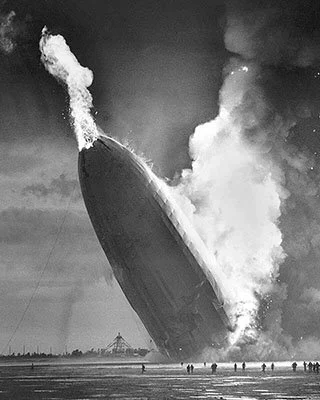
B&W photo of a burning dirigible crashing into the ground

Crash of the Hindenburg at Lakehurst, New Jersey, 6 May 1937

23 July 2025

Zeppelin, meaning a dirigible airship, comes, of course, from the name of Ferdinand Adolf Heinrich August Graf von Zeppelin (1838–1917), who designed such airships. Ironically, the word appears in English before it does in German. English use as an adjective referring to such airships dates to 1896, while the German Luftschiff Zeppelin isn’t recorded until 1904.

Ferdinand Zeppelin published the designs for his airship in 1893 and patented them two years later. His first airship took flight in 1900. But there was considerable pre-launch hype. The earliest use of the adjective zeppelin that I’m aware of appears in the Boston Daily Advertiser on 12 February 1896, a reference to the count’s proposed flying machine:

Dr. Helmholtz had already pronounced favorably upon the Zeppelin flying machine some time before the specialist’s death; and even the Kaiser, it is reported, has now begun to take an interest in the device submitted by the Wurtemburg [sic] inventor.

As yet the accounts of the new flying machine are not very explicit. It is stated, however, that the Zeppelin air-ship is a cigar-shaped vessel, which can be steered upward and downward, right and left, forward and backward, under practically every condition presented by the atmosphere within a distance of three and a half miles from the surface of the earth.

The noun zeppelin is in place in the opening years of the next century when it appears in the pages of the Baltimore American on 6 August 1908:

Walter Wellman, who planned recently about going to the North Pole in a dirigible balloon, said last night that he was planning to make the attempt next year. He said his airship, the America, built for polar atmospheric conditions, could easily travel from New York to Buffalo, Detroit, or even Chicago. It is, Mr. Wellman said, the second largest airship ever built. Its 200,000 cubic feet being exceeded only by the Zeppelin.

“But in fuel-carrying capacity and radius of action the America exceeds the Zeppelin,” continued Mr. Wellman.

The Oxford English Dictionary also has a 1908 quotation for the noun zeppelin from H. G. Wells’s novel The War in the Air, but Wells is using it as a proper name for a particular airship, the Graf Zeppelin. (Wells’s airship is fictional; the first real airship named Graf Zeppelin took to the air in 1927.)

Cf. airship, blimp, dirigible.

Discuss this post


Sources:

“An Air Ship.” Boston Daily Advertiser (Massachusetts), 12 February 1896, 4/4. Readex: America’s Historical Newspapers.

“By Balloon to the Pole” (5 August 1908). Baltimore American (Maryland), 6 August 1908, 9/4. Readex: America’s Historical Newspapers.

Oxford English Dictionary Online, June 2014, s.v. Zeppelin, n.

Wells, H. G. The War in the Air. London: George Bell and Sons, 1908, 235, 258. HathiTrust Digital Archive.

Photo credit: Murray Becker / Associated Press, 1937. Wikimedia Commons. Public domain photo.

Cajun / Acadian / Arcadian

Highway sign reading “Welcome to Louisiana / Bienvenue en Louisiane” with a fleur-de-lis

21 July 2025

A Cajun is a member of the community of descendants of French Canadians who colonized the Bayou Teche region of Louisiana after 1755, the dialect spoken by them—a variety of English with strong influence from Louisiana French—or a style of cuisine, a mix of French and African influences, popular among them that includes gumbo, jambalaya, and crawfish as primary features.

Cajun is a variant of the French Acadian, which in turn is from the Greek Ἀρκαδία (Arcadia), a mountainous region of the Peloponnesus in Greece which became a metaphor of an ideal, rustic life, such as that lived in the mythical Golden Age.

We see this metaphorical sense of Arcadia being used in English by the late sixteenth century. Here is an example from Thomas Watson’s poem Eglogve Vpon the Death of the Right Honorable Sir Francis Walsingham (also known as Meliboeus), which Watson produced in two versions, Latin and English. It’s inspired by Virgil’s Eclogue 1. Watson writes in the preface:

A third fault (haply) will bee found, that my pastorall discourse to the vnlearned may seeme obscure: which to preuent, I haue thought good, here to aduertise you, that I figure Englande in Arcadia; Her Maiestie in Diana; Sir Francis Walsingham in Meliboeus, and his Ladie in Dryas; Sir Phillippe Sidney in Astrophill, and his Ladie in Hyale, Master Thomas Walsingham in Tyterus, and my selfe in Corydon.

And early in the poem the character Corydon (Watson himself) opines on the death of Meliboeus (Walsingham):

Let deadly sorrow with a sable wing,
throughout the world go brute this tragedie:
And let Arcadians altogether sing
a woefull song agenst heauns tirannie.
     Alas too soone by Destins fatall knife
     Sweet
 Meliboeus is depriu'd of life.

The French colony of Acadia, named for the mythical rustic paradise modeled on the Greek Arcadia, was established in the seventeenth century in what are now the Maritime provinces of Canada (Nova Scotia, New Brunswick, Prince Edward Island). The colony was not a formal colony of France, rather an independent settlement of French colonists that had a politically tenuous existence between the French colony of Quebec and British North America. Acadia was conquered by the British in 1710, and in 1755, the British began the “Great Expulsion” of French colonists from the region. The Acadians were initially scattered along the eastern seaboard of North America with many returning to France, but a substantial number eventually settling in what is now Louisiana.

We see a reference to Acadian refugees in South Carolina being offered transport somewhere else in the Boston Weekly News-Letter of 3 June 1756:

CHARLES-TOWN (in South-Carolina,) May 1.

We hear, that an Offer has been made to the Acadians here, to supply them with Vessels &c. at the Public Charge, for transporting themselves elsewhere, as they have frequently solicited (or rather demanded.)

Aversion to “the wrong kind of” immigrants is nothing new in American history.

And a reference to Acadians arriving in New Orleans can be found in the 12 June 1765 edition of the New-Hampshire Gazette and Historical Chronicle:

It was reported that 400 Acadians were lately arrived at New Orleans, and the West-Floridians began to doubt whether the Spaniards would come to take possession of the said city and island.

France had ceded the colony of Louisiana to Spain in 1763 following its defeat in the Seven Years’ War, but the French colonists there rebelled, and Spain had difficulty in establishing its rule over the city of New Orleans and the surrounding area.

The form Cajun begins to appear in print in the 1860s, during the US Civil War. Ohio’s Delaware Gazette of 12 December 1862 gives this racist and extremely unflattering—to say the least—portrait of Cajuns that also revises the history to place the blame for their expulsion from Canada on their own heads rather than that of the British:

THE LOUISIANA CAJUNS.

A correspondent of the Cincinnati Commercial, who was captured by the rebels in lower Louisiana and confined at Camp Pratt thus describes the singular race of “natives” who inhabit the swamps in the south-western part of that State:

“Camp Pratt was filled with Cajun conscripts. You don’t know what a Cajun is? Of course you don’t, but I will try and tell you. A Cajun is a half-savage creature, of mixed French and Indian blood. They live in swamps, and subsist by fishing and hunting and cultivating a small patch of corn and sweet potatoes.

[…]

Nova Scotia was settled by the French, and by them called Acadia. When the territory passed to the dominion of England, many of the people refused to live under British rule, and emigrated to Louisiana. They settled along the Mississippi, but were driven back further and further by the advancing tide of civilization into the swamps, where the lived like savages and bred like rabbits. They were called ’Cadians by the better settlers, and looked upon in something of the same light as the sandhillers and dirt-eaters of the Carolinas—poor white trash. The rebel authorities do not expect much service from them, but distribute them about to fill up old regiments.

Unfortunately, the popular conception of Cajuns today is not all that different from this 1862 newspaper account. They do traditionally dwell in bayou country, which is rural and economically depressed, but economic circumstances and a long history of exclusion and oppression are to blame for their status, not any inherent characteristics of the people.

Discuss this post


Sources:

“Advices by Wednesday’s Mail (5 June 1765). New-Hampshire Gazette and Historical Chronicle (Portsmouth), 12 July 1765, 2/1. Readex: America’s Historical Newspapers.

Dictionary of American Regional English Online, 2013, s.v. Cajun, n.1.

“The Louisiana Cajuns.” Delaware Gazette (Ohio), 12 December 1862, 1/6. NewspaperArchive.com.

Oxford English Dictionary, third edition, June 2025, s.v. Cajun, n. & adj.; December 2011, s.v. Acadian, n. & adj.; second edition, 1989, s.v. Arcadian, adj.1 & n.

“Postscript.” Boston Weekly News-Letter (Massachusetts), 3 June 1756, 1/1. Readex: America’s Historical Newspapers. [The pages are not numbered; this is the first page of the postscript, not of the newsletter itself. There is further confusion in that two versions of the postscript were published, one dated Thursday, 3 June and the other Thursday [sic], 4 June. The third was a Thursday and the date the newsletter itself was published. So this postscript apparently was published after the regular publication, on the same or the next day.]

Watson, Thomas. An Eglogve Vpon the Death of the Right Honorable Sir Francis Walsingham (Meliboeus). London: Robert Robinson, 1590, sig. A2v and B2r. ProQuest: Early English Books Online (EEBO).

Photo credit: Hypersite, 2010. Wikimedia Commons. Licensed under a Creative Commons Attribution-Share Alike 3.0 Unported license.

confabulation / confab / fable

Photo of a marble bust of a bearded, curly-haired man

Roman bust (1st–4th-century C.E.) thought to represent Aesop

18 July 2025

Confabulation is a neat study of how a word can acquire an additional sense. It was borrowed into English in the fifteenth century from the Latin confabulatio, meaning a conversation or discussion. The word appears in Anglo-Latin by the late ninth century

English-language use, in the same sense, is in place by c. 1450 when it appears in a translation of Thomas à Kempis’s De imitatione Christi (The Imitation of Christ):

But þou, graciose & merciful lorde, þat wolt not þat þi workes shulde perisshe, to shewe þe richesses of þi godenes into þe vessels of mercy, ouere al propre merite vouche saf to comforte þi seruaunt aboue al mannes mesure; for þi consolacions are not as mannes talkinges or confabulacions. What haue I done, lorde, þat þou shuldist yeue me eny  heuenly consolacion?

(But you, gracious & merciful lord, so that your works should not perish, to mete out the richness of your goodness into the vessels of mercy, over all proper merit grant to comfort your servant above all man’s measure; for your consolations are not a man’s discussions or confabulations. What have I done, lord, that you should give me any heavenly consolation?)

Kempis’s original Latin is confabulationes.

The verb to confabulate, meaning to converse, appears by the beginning of the seventeenth century when it is in included in Robert Cawdry’s 1604 Table Alphabeticall, widely considered to be the first monolingual English dictionary (although it really is better categorized as a glossary of hard words). Cawdry defines the verb as “to talk together.”

The word is clipped to confab by the beginning of the eighteenth century.

But starting at the beginning of the twentieth century the word, both noun and verb, would begin to acquire a sense meaning a false narrative or to create such a false narrative. This sense, influenced by the word fable, got its start in the field of psychiatry as a term for how amnesia patients would compensate for their memory loss by filling in the gaps with imaginary memories. A 1907 translation of E. Mendel’s Text-Book of Psychiatry (originally in German) has this:

Others, on the contrary, fill up the time where this defect [i.e., amnesia] of memory occurs, with all sorts of events which never took place, they confabulate without their confabulation reaching the phantastic heights of paramnesias.

Here the noun and verb are actually being used in the original sense of conversing or creating utterances, but the context is that of creating a false narrative. But within a couple of decades, the words had acquired the new sense. From a book review in March 1925 issue of the Archives of Neurology and Psychiatry:

From this point, the authors pass naturally to the consideration of important mental symptoms and syndromes as deviations from the normal psychologic processes. In this section are treated disturbances of sleep, of speech, of the emotions, of movement and of memory, including a satisfactory explanation of amnesia. Illusions and hallucinations, apprehensiveness, confusion, confabulation and romancing are taken up in turn, and their interrelationships discussed.

For its part fable, meaning a fictitious narrative, is borrowed from Anglo-Norman French. It appears in English in the late fourteenth century. Geoffrey Chaucer uses it in his Physician’s Tale:

This false juge, that highte Apius,
(So was his name, for this is no fable,
But knowen for historial thyng notable;
The sentence of it sooth is, out of doute),
This false juge gooth now faste aboute
To hasten his delit al that he may.

(This false judge, who is called Apius,
[Such was his name, for this is no fable,
But known to be a notable historical fact;
The substance of it is true, beyond doubt],
This false judge goes now fast about
To hasten his delight as much as he can.)


Sources:

Anglo-Norman Dictionary, AND2 Phase 2, 2006–08, fable1, n.

Cawdry, Robert. A Table Alphabeticall. London: I. Roberts for Edmund Weaver, 1604. ProQuest: Early English Books Online.

Chaucer, Geoffrey. “The Physician’s Tale” (c. 1387). The Canterbury Tales, lines 6.154–59. Harvard’s Geoffrey Chaucer Website.

Ingram, John K. ed. The Earliest English Translation of the First Three Books of the De Imitatione Christi (c. 1450). Early English Text Society, Extra Series 58. London: Kegan Paul, Trench Trübner, 1893, 3.57, 134. HathiTrust Digital Archive.

Kempis, Thomas. De imitatione Christi. Paris: 1889, 3.52, 252. HathiTrust Digital Library.

Latham, Ronald E., David R. Howlett, and Richard K. Ashdowne. Dictionary of Medieval Sources from British Sources. Oxford: British Academy: 2013, s.v. confabulatio, n. Brepolis: Database of Latin Dictionaries.

Lewis, Charlton T. and Charles Short. A Latin Dictionary. Oxford: Clarendon Press, 1879, s.v. confabulatio, n. Brepolis: Database of Latin Dictionaries.

Mendel E. Text-Book of Psychiatry. William C. Krauss, trans. Philadelphia: F. A. Davis, 1907, 45. HathiTrust Digital Archive.

Middle English Dictionary, 4 March 2025, s.v. confabulation, n., fable, n.

Oxford English Dictionary, second edition, 1989, s.v. confabulation, n., confabulate, v., confab, n., confab, v., fable, n., fable, v.

“Pratique Semilogique des Maladies Mentales” (book review). Archives of Neurology and Psychiatry, 13.3, March 1925, 419. HathiTrust Digital Archive.

Image credit: Wikimedia Commons. Public domain work as a mechanical reproduction of a public domain work.

vet / veteran / veterinarian

Photo of a small dog (a Shih-Tzu) sitting on an examination table in a veterinarian’s office

16 July 2025

Vet has three distinct meanings. It can be a verb meaning to examine thoroughly, especially of a person slated for a position of responsibility; it can be a noun meaning a doctor who treats animals; and it can be a noun meaning an experienced person, especially a soldier or a former soldier.

The soldier sense of vet is a clipping of veteran, an Early Modern (or perhaps very late medieval) borrowing from classical Latin veteranus, meaning experienced, mature, and especially applied to soldiers. An early use of veteran is in Stephen Hawes 1504 Example of Vertu, where it refers to a knight who has killed a dragon:

Than came dame fayth that lady gloryous
Welcome she sayd with wordes amyable
I am ryght glad ye ar so vyctoryous
Of that foule dragon so abhomynable
She sayd that I was euermore stable
In her in dede eke worde and thought
Or elles my labour had ben to nought

Than spake the lady fayre dame charyte
Welcome vertue the noble veteran
Sythens that ye alway haue loued me
From the fyrst season that ye began
Bothe in your youth & syth ye were man
Ye haue had me in humble reuerence
And haue ben ruled by my preemynence

The clipping of veteran to vet was in place by the mid nineteenth century.

The animal doctor sense of vet is a clipping of veterinarian and veterinary. These words are also Early Modern borrowings from the classical Latin veterinarius, which was used as an adjective related to livestock and as a noun to a person who treated sick animals. We see the Latin words in Thomas Cooper’s 1578 Thesaurus linguæ, hinting that they were starting to appear in English usage:

Veterinàrius, veterenarij, m.g. Col. He that letteth horses or mules to hyre: a muletter: an horsecourser: an hackney man. Veterinárius. Col. An horseleach, or ferrour.

Veterinârius, Adiect. vt Veterinaria medicina. Col. The craft or science of an horseleache.

But we see veterinarian fully anglicized, with an English ending, in Thomas Browne’s 1646 Pseudodoxia epidemica:

The gall of an horse was accounted poyson, and therefore at the sacrifices of horses in Rome, it was unlawfull for the Flamen but to touch it; but with more difficulty, or hardly at all is that reconcilable which is delivered by our Countreyman, and received veterinarian, whose words in his master-piece, and Chapter of diseases from the gall, are somewhat too strict, and scarce admit a Reconciliation.

Veterinarian is the term used in North America, but in Britain one will also see veterinary used as a noun, a clipping of veterinary surgeon.

The clipping vet in this sense dates to at least the mid nineteenth century. (The OED marks this clipping as “chiefly British,” which is incorrect and inexplicable. It’s extremely common in North America, with the abbreviated form being perhaps more common even than the full veterinarian.)

The verb to vet was initially used to mean subjecting an animal to an examination by a veterinarian. We see this sense in Annie Thomas’s 1891 novel The Roll of Honor, where it is used in reference to a racehorse before a competition:

Have you seen Culverfield? The beast is going about saying that Beau is shaky in his fore legs. I shall have him vetted before the races, or they will hang back and won't plunge on him.

But it quickly acquired a more general sense of subjecting a person to examination prior to approval, and this sense carries with it a connotation of being treated with less than the respect one normally accords fellow humans, as one might a piece of livestock. We see this sense in B. M. Croker’s 1898 Peggy of the Bartons, in which the titular character, newly married to a soldier and stationed in India, is to be subjected to examination and approval by the other wives in the regiment:

The married people in this regiment are a desperately slow set, very different to the Blunderbores; they never entertain, or ask you to put your legs under their mahogany; but we will make a new departure. You will be having them round to “vet” you—at least, Mother Vallancy, I don't know about Mrs. Hesketh and Mrs. Timmins, as I never left a pasteboard on either of them. Life is too short and too pleasant to bother about calling on stupid, dowdy frumps.

Today, the verb to vet is commonly used in the context of investigation prior to the issuance of a government security clearance or elevation to some position of responsibility.

Discuss this post


Sources:

Browne, Thomas. Pseudodoxia epidemica. London, T. H. for Edward. Dod, 1646, 3.2, 108–109. ProQuest: Early English Books Online.

Cooper, Thomas. Thesaurus linguæ, London: Henry Denham, 1578, s.v. veterinarius, sig. Qqqqqq.1. ProQuest: Early English Books Online.

Croker, B. M. Peggy of the Bartons. New York: R. F. Fenno, 1898, 138. HathiTrust Digital Archive.

Hawes, Stephen. Example of Vertu. London: Wynkyn de Worde, 1504, sig. ff.3v. ProQuest: Early English Books Online.

Oxford English Dictionary, third edition, June 2017, s.v. vet, v., vet, n.2, veterinarian, n. & adj., veterinary, adj. & n., vet, n.1 & adj.2, veteran, n. & adj.

Lewis, Charlton T. and Charles Short. A Latin Dictionary. Oxford: Clarendon Press, 1879, s.v. veteranus, veterinarius.

Thomas, Annie (Annie Hall Cudlip). The Roll of Honor. New York: John W. Lovell, 1891, 130. HathiTrust Digital Archive.

Image credit: Mark Buckawicki, 2014. Wikimedia Commons. Public domain photo.

nuclear option

Photo of a nuclear mushroom cloud

The “Ivy King” US nuclear test, Enewetak Atoll, 1952; at 500 kilotons it was the largest fission bomb ever detonated

14 July 2025

The term nuclear option is used figuratively, especially in politics, to refer to a response that threatens “mutual assured destruction.” It is, as the Oxford English Dictionary defines it, “the most drastic of the possible responses to a situation.” But of course, it does have a more literal original sense. 

It first appears in the early 1960s referring to the choice of a country to develop nuclear weapons. It appears in an article in the March 1962 issue of the American Political Science Review in reference to Britain’s decision to acquire a nuclear arsenal ten years earlier:

Nuclear forces were also thought to increase positive British influence over the United States by undertaking a share in the task of deterrence and demonstrating technological skill. Moreover the strategic nuclear option was a policy for which both the weapons and a doctrine existed.

That same year, it was used to refer to India’s potential for nuclear weapons in the title of a book review, “The Nuclear Option,” in the New Left Review. The review was of Leonard Beaton and John Maddox’s The Spread of Nuclear Weapons. The phrase does not appear in the review itself, only the title, but the following explains what the title refers to

Thus it emerges that India has an extensive nuclear programme designed to give it an option on nuclear weapons in about 1963. Very little is known about this in India, and Mr. Nehru, who is Minister of Atomic Energy as well as Prime Minister, seldom speaks about it: but from the analysis the book provides, it seems probable that India will go ahead and make nuclear weapons if the Chinese “menace” is considered to warrant it.

Beaton and Maddox’s book does not use the phrase either but makes extensive use of option in the context of the decision to acquire nuclear weapons. India demonstrated it had the capability to build a nuclear arsenal in 1974 with its detonation of a “peaceful” nuclear explosion, and it formally took the nuclear option in 1989, establishing an arsenal of the weapons probably by 1994 and openly testing one in 1998.

Literal use of nuclear option would also come to be used to refer the decision to use nuclear weapons in a war and also, less menacingly, in respect to the choice to use nuclear power for the generation of electricity.

The figurative sense of nuclear option was in place by the early 1990s. The earliest use I’m aware of is in 1993 in the context of UK Prime Minister John Major threatening a general election if a rebellious group of backbenchers in his party did not back him on the decision not to join the social aspects of the European Union. As recorded in The Independent on 23 July 1993:

Today John Major binds his own future as Prime Minister to the policy that lies at the heart of his Government’s meaning. He has detonated what one of his close friends called “the nuclear option”: back the social chapter opt-out or I’ll blow the party apart at a general election. Given the question, it seems certain he will win.

This incident and the phrase appeared in the American press in the same context. From the Washington Post, dateline also of 23 July 1993, an article that was syndicated widely in other papers:

To win the support of rebels within his own Conservative Party, Major had to threaten them with what became known as the “nuclear option”—he would resign as prime minister, dissolve Parliament and call a general election if they voted against him Friday. With the Conservatives lagging far behind in the polls, for the rebels to defy Major would have been, in the words of one Tory, “like turkeys voting for Christmas.”

Nuclear option would come to be used in American politics in the twenty-first century, most notably in reference to threats to end the filibuster in the US Senate.

Discuss this post


Sources:

Beaton, Leonard and John Maddox. The Spread of Nuclear Weapons. New York: Praeger, 1962. Archive.org.

Marr, Andrew. “The Haunting Resonance of a Beaten Leader’s Last Show. Independent (London), 23 July 1993, 1/1. Gale Primary Sources: The Independent Historical Archive.

Martin, Laurence W. “The Market for Strategic Ideas in Britain: the ‘Sandys Era.’” American Political Science Review, 56.1, March 1962, 26–41 at 27/2. JSTOR.

Oxford English Dictionary, third edition, 2003, nuclear option, n.

Roberts, Adam. “The Nuclear Option.” New Left Review, Winter 1962, 124–25 at 125. ProQuest: Scholarly Journals.

Robinson, Eugene. “Major Survives Vote of Confidence; Europe Pact Approved” (23 July 1963) Washington Post, 24 July 1963, A12/2–3. ProQuest: Newspapers.

Image credit: US Department of Energy, 1952. Wikimedia Commons. Public domain photo.