Groyper

Stylized image of a 1940s newspaper newsroom with the words “Wordorigins.org: Words in the News”

13 September 2025

This is free issue of the monthly “Words in the News” feature.

Groypers are a loose association of white-nationalist, antisemitic homophobes who follow neo-Nazi Nick Fuentes. They are known for targeting conservatives whom they deem aren’t fascist and antisemitic enough. One of their primary targets was right-wing political activist Charlie Kirk and his group Turning Point USA. Speculation on social media has associated the man suspected of assassinating Kirk with the Groyper movement, but as of this writing we don't know the assassin’s motives.

The followers of Fuentes began to be known as Groypers in 2019, although the name dates to several years earlier. The original Groyper was a cartoon variation of the Pepe the Frog meme used as an alt-right meme and icon. The Groyper cartoon started to appear in 2015 and depicts a corpulent version of Pepe the Frog, usually depicted as sitting with his chin resting on his interlocked fingers.

Crudely drawn cartoon of a green, corpulent frog, sitting with his chin resting on his interlocked fingers

A Groyper cartoon

The etymology of Groyper is unknown. It may simply be a nonsense name. It is sometimes claimed to by a blend of goy (gentile) + groper (sexual assaulter), but this seems to be an etymythology arising from the term’s later association with Fuentes and his followers. (Fuentes has been accused of supporting and covering for men accused of soliciting sex from underage boys.)  

In November 2016, a person joined Twitter with the handle @groyper. There are a few earlier tweets that use groyper starting in 2013, but it’s unclear what the word refers to in these tweets. Some sources claim uses of the word started to appear in 2015, but none provide actual citations of the term prior to the 2016 Twitter handle. The 2015 date may be a conflation of the cartoon with the word.

Groyper, referring to the cartoon, starts to make its way into print media by 11 December 2017, when it appears in the Colorado Springs Gazette in an article about then-Republican Congressman Mike Coffman tweeting in Spanish in favor of legislation to legalize the status of immigrants brought to the United States as minors, Deferred Action for Childhood Arrivals, or DACA:

"Do you speak English?" roars a dapper blonde youngster into a bullhorn in front of a chalkboard, in one.

It was among several replies to Coffman's tweet posted by a prolific Twitter user going by the name Dangerous Groyper, who uses an avatar depicting a grotesque smiling toad dubbed a Groyper—what's been described as an even more racist counterpart of Pepe the Frog, the cartoon character adopted as a mascot in recent years by white supremacists and members of the alt-right.

Coffman has been tweeting for some time—in both English and Spanish—about a DACA fix and his support for pending legislation, including the DREAM Act of 2017, which would provide a pathway to citizenship for some immigrants brought to the country illegally as minors. But none of those tweets attracted the kind of vituperative scolding Friday's tweet drew.

In 2018, conspiracy-theorist Shiva Ayyadurai unsuccessfully ran for the Republican nomination for US senator from Massachusetts. During the campaign, he distributed campaign pins featuring a brown-skinned version of the Groyper cartoon. This was picked up by the Israeli newspaper Haaretz when Ayyadurai was included in a list of neo-Nazi politicians running for office in the United States:

Ayyadurai issued campaign pins featuring the white nationalist symbol Groyper, a cartoon toad. He’s also friends with Matt Colligan, who marched in the white supremacist rally in Charlottesville and once said “Hitler did nothing wrong.” Ayyadurai appeared in a live video broadcast with Colligan and called him “one of our greatest supporters.”

Several definitions of Groyper appear in Urbandictionary on 30 October 2019. Two of these are as follows. The first:

A groyper is a smug toad used as an avatar by trolls online. His often refashioned face seems to entice a penchant for chaos and perhaps even a little comfiness.

Why do these groypers in my mentions keep telling me to Google the U.S.S. Liberty and Dancing Israelis?

The USS Liberty was a US Navy surveillance ship that was attacked in international waters by the Israeli forces during the 1967 Six-Day War. 34 crew members were killed and 171 wounded in the attack. Dancing Israelis is a reference to the conspiracy theory that Israel was behind the 9/11 attacks.

The second definition in Urbandictionary on that date refers to Kirk as a target for Groypers:

A friendly individual who prefers to relax, read and drink tea. Groypers can be characterized by loving their frens, their country, animals and God. Groypers are very well versed in history and have no trouble questioning established historical or political sentiments when the logic/facts behind them are proven to be false. They are easily identified by their obese frame and green skin. Groypers are closely related to Pepe.

“Congratulations to the Groypers for crushing Charlie Kirk.”

“Hey groypers, what's the deal with the USS Liberty and the Dancing Israelis anyway?”

And a 11 November 2019 article in London’s Independent associates the Groyper meme with Fuentes and his followers:

Charlie Kirk, TPUSA’s leader and a pro-Trump activist, was denounced as a “political liability” running a group that “SMEARS socially conservative Christians and supporters of President Trump’s agenda” by far-right figures on Twitter. “Our problem is not with @DonaldJTrumpJr who is a patriot—We are supporters of his father!” tweeted one, Nicholas Fuentes.

Another said: “THIS IS A REVOLUTION among the conservative youth in this country . . . WE WILL NOT STOP until the sanctioned invasion of our country through mass legal immigration comes to an end.”

“Congrats, Charlie Kirk. You just made the Groyper Army more powerful than before. All you had to do was just take a few questions . . .” tweeted a third.

Discuss this post

You can receive future posts of “Words in the News” by becoming a paid subscriber to Wordorigins.org.


Sources:

Luning, Ernest. “Mike Coffman’s DACA Tweet in Spanish Draws Heated Response.” Gazette (Colorado Springs), 11 December 2017. ProQuest Newspapers.

“A MAGA Groyper? Charlie Kirk Shooter Tyler Robinson’s Political Leaning Unclear; Nick Fuentes Reacts to ‘Pure Evil.’” Times of India, 13 September 2025.

Miller-Idriss, Cynthia. “Grooming and Recruiting: Cultivating Intellectual Leadership. In Hate in the Homeland. Princeton: Princeton UP, 2020, 116. JSTOR.

“Record Breaking Number of Neo-Nazis and White Nationalists Running for Office in the U.S.” Haaretz (Tel Aviv), 15 July 2018. ProQuest Newspapers.

Rivera, Joshua. “Groypers, Helldivers 2, Furries: What Do the Messages Left by Charlie Kirk’s Alleged Killer Actually Mean?” Vanity Fair (online), 12 September 2025.

Sherman, Jon. “Trump Jr Abandons ‘Triggered’ Book Event in Just 30 Minutes after Being Heckled.” Independent (Online) (London), 11 November 2019. ProQuest.

Urbandictionary.com, 30 October 2019, s.v. groyper.

Wiktionary, 4 August 2025, s.v. groyper.

Image credit: Groyper cartoon, unknown artist, 2015. Wikipedia. Fair use of a low-resolution copy of a copyrighted image to illustrate the topic under discussion.
saved by the bell

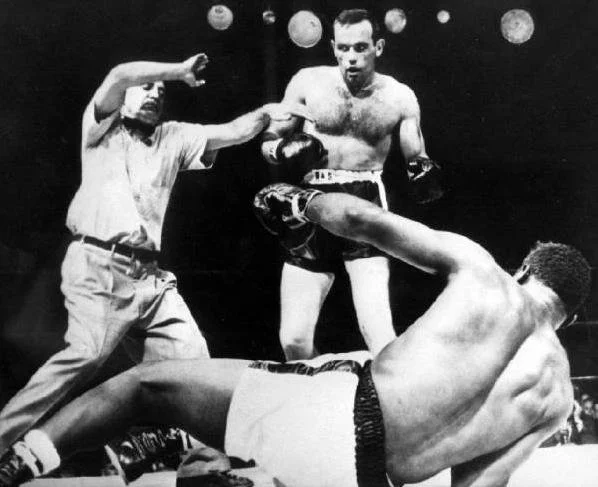
B&W photo of a referee intervening between two boxers, one of whom is lying on the ring floor

Ingemar Johansson knocks out Floyd Patterson for the world heavyweight boxing championship on 26 June 1959. Patterson was not “saved by the bell.”

12 September 2025

Saved by the bell, which the OED defines as “to be rescued from a difficult situation,” comes to us, as should be no surprise, from the world of boxing. It originally and quite literally referred to a boxer who was about to be beaten into submission only to have the bell ring, signaling the end of round. The origin is so obvious that it shouldn’t merit an entry on the term, but there is an absurd-on-its-face explanation for the phrase that has currency on the interwebs that needs to be countered with evidence.

I found a non-boxing use of the phrase from 1890 that hints that the phrase was already in common use by that date, undoubtedly in boxing contexts, even if we don’t have a boxing example in print until the next year. Saved by the bell appears in an advertisement for a Toronto clothing store in The Globe on 12 December 1890. The ad, for a store named The Bell, plays on save to refer to reduced prices:

ALMOST A SMASH,
BUT SAVED BY
"THE BELL”

“The Bell” has not only saved from bankruptcy one of the largest clothing manufacturers in Canada, but it has come like a boon to the ready-made clothing buyers of Toronto. A thousand times since we opened here, just 30 days ago, have we been asked the question., How is “The Bell” able to sell the identical same goods at just one-half the price charged by the other older establishments? We give it up. Perhaps just at present we are selling at absurdly low prices, but then we bought at just such rates. TO-MORROW MORNING, AT 9.30 O’CLOCK, we continue what we believe has been the Greatest Clothing Sale ever held in Canada.

One of the regulars on this website, Richard Hershberger, turned up the oldest boxing use of the phrase that I’m aware of. It’s from the Seattle Post-Intelligencer of 30 January 1891:

ARM BROKEN IN A PRIZEFIGHT. Colored Pugilist Severely Injured in Contest at Missoula.

MISSOULA, Jan. 29.—(Special.)—A fight tonight between Ramsey, colored, and Hennessy, two pugilists of reputation in the West, from the start was hard and lively. In the fourth round Ramsey nearly knocked out Hennessey, who was very groggy, but was saved by the bell, and came up well for the fifth, in which Ramsey had the best of it. In the sixth Hennessey got in good work, and when the bell sounded for the seventh Ramsey claimed that his arm was broken. The doctor examined him and pronounced that a severe fracture had been sustained. The fight was given to Hennessey.

There are many uses of the phrase in boxing writing in the closing decade of the nineteenth century and the early ones of the twentieth.

Other than the 1890 nonce usage quoted above, the earliest non-boxing use of the phrase that I have found is still in the context of sports, in this case baseball, where the use is figurative; the “bell” is a rainstorm that ends the game and saves Yankee pitcher Waite Hoyt from ignominy after being shelled by Connie Mack’s Philadelphia Athletics in the first two innings. It’s from the New York Times of 22 June 1928:

With the aid of old Jupe Pluve, a rugged lad with a punch in either hand, the Yankees gained a full game on the merry Mackmen of Cornelius McGullicuddy yesterday.

After a young Hank Johnson had hung a 4–0 thrashing on the eminent Robert Moss Grove in the first in the first encounter, the Athletics sallied forth and began to hit Waite Hoyt with everything but the kitchen stove. One run was in, men were on third and second with one out and the visiting firemen were a tally to the good when Jupe Pluve charged to the rescue of the hapless champions.

Old Jupe turned on a fancy brand of wet goods and Mr. Hoyt staggered gratefully to the bench when Umpire George Hildebrand suspended hostilities. After waiting a reasonable length of time the umpires called the game. Mr. Hoyt was saved by the bell.

As an aside, the quote is also notable because you don’t get many references to Jupiter Pluvius in today’s sports writing. (Jupiter Pluvius, or Jupiter Bringer of Rain, is reference to the Roman god being the god of storms.)

The earliest non-sports use of the phrase that I’ve found is from a Los Angeles Times gossip column from 31 July 1932:

Saved by the Bell Echo from Chaplin’s English tour. Whenever Charlie Chaplin and Michael Arlen meet, they have an agreement whereby each is permitted to talk about himself without interruption for five minutes by the clock. This had to be agreed upon, it appears, after the first meeting.

I did find a British, non-boxing use of saved by the bell from 1885, but it’s a literal collocation of words that is unrelated to the later American catchphrase. It’s from a piece offering commentary on a poem titled Spectre’s Bride:

The analytical notes expounding the poem and its musical setting are of so remarkable a nature that we make no excuse for quoting a few specimens of what threatens to become a new branch of literature:—“Trembling with horror and dismay [thus the librettist], From the horse the maiden fell.”—The sorry condition of the hapless girl is next related, and with the self- same breath her marvellous escape by a beneficient (sic) intervention at a supreme moment is tacked on to the phrase:—“Fainting: but in her fall she caught The rope of the lychgate bell.” With the clang of the bell the spectre knight vanishes, and Gudrun remained alone, “Saved by the bell that rang out well, saved by the holy bell.”

The absurd-on-its-face explanation mentioned above is that the phrase comes from devices rigged onto coffins so that those buried alive could ring if they woke up after having been buried. This myth is silly but pernicious and is repeated by many who should know better.

Discuss this post


Sources:

“Arm Broken in a Prizefight.” Seattle Post-Intelligencer (Washington), 30 January 1891, 2/5. Washington Digital Newspapers.

“The Birmingham Festival.” Spectator (London), 5 September 1885, 1165/1. ProQuest Magazine.

“Display Ad 6 – No Title.” The Globe (Toronto), 12 December 1890, 5. ProQuest Newspapers.

Green’s Dictionary of Slang, accessed 12 August 2025, s.v. bell, n.1.

Harrison, James R. “Yanks Take First, Rain Stops Second.” New York Times, 22 June 1928, 16/1. ProQuest Newspapers.

Oxford English Dictionary Online, December 2012, s.v. save, v.

“Don’t Quote Me. Chatter by Tip Poff.” Los Angeles Times, 31 July 1932, B24/5. ProQuest Historical Newspapers.

Photo credit: Unknown photographer, 26 June 1959. Wikimedia Commons. Public domain photo.

Red Baron

B&W drawing of a WWI dogfight with a British Sopwith Camel chasing and firing upon a German Fokker triplane

“The End of the Red Baron,” Joseph Simpson, 1918

10 September 2025

Freiherr Manfred von Richthofen is the most famous aviator of World War I, if not of all time. Credited with eighty air-to-air victories, he shot down more planes than any other flyer in the war. And he is popularly known as the Red Baron, because as commander of Jagdgeschwader (fighter wing) 1, known as the Flying Circus, he flew in a bright-red Fokker triplane. But researcher Brett Holman has discovered something quite interesting about the nickname Red Baron: until the mid-1960s, almost fifty years after his death in 1918, Richthofen was rarely called the Red Baron. Instead, the popularity of that nickname derives from the Peanuts comic strip, which often featured the beagle Snoopy engaging in imaginary dog fights with the German nemesis.

The nickname Red Baron did exist during the war but was apparently restricted to oral use among allied soldiers, not appearing in print until his death. This is the announcement of his death in the British newspaper Graphic, 25 May 1918:

The End of the Red Baron

Cavalry Captain Baron von Richthofen was shot down in aerial combat on the day when the German papers announced his 79th and 80th victories. Boyd Cable writes: “The Red Baron, with his famous ‘circus,’ discovered two of our artillery observing machines, and with a few followers attacked, the greater part of the ‘circus’ drawing off to allow the Baron go in and down the two. They put up a fight, and, while the Baron manœuvred for position, a number of our fighting scout machines appeared and attacked the ‘circus.’ The Baron joined the mêlée, which, scattering into groups, developed into what our men call ‘a dog fight.’ In the course of this the Baron dropped on the tail of a fighting scout, which dived, with the Baron in close pursuit. Another of our scouts seeing this dived after the German, opening fire on him. All three machines came near enough to the ground to be engaged by infantry machine-gun fire, and the Baron was seen to swerve, continue his dive headlong and crash in our lines. His body and famous blood-red Fokker triplane were afterwards brought in by the infantry, and the Baron was buried with full military honours. He was hit by one bullet, and the position of the wound showed clearly that he had been killed by the pilot who dived after him.”

The Royal Air Force officially credited Canadian Captain Arthur Roy Brown, pilot of the Sopwith Camel that was pursuing him with Richthofen’s death. But more recent analysis by historians has concluded that he was killed by machinegun fire from Australian infantry in the trenches below.

For decades following this first appearance in print, the moniker Red Baron only appeared sporadically in print.

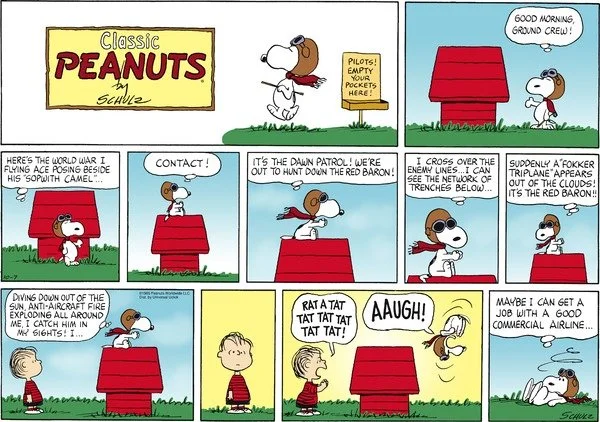
Then on Sunday, 10 October 1965, the comic strip Peanuts, by Charles Schulz, ran this strip:

Color Peanuts Sunday comic featuring Snoopy flying his doghouse against the Red Baron with the text “It’s the Red Baron.”

The first mention of the Red Baron in Peanuts, 10 October 1965

References to Richthofen as the Red Baron began to become more and more common after this date. The novelty song “Snoopy vs. the Red Baron,” written by Phil Gernhard and Dick Holler, was released by the Royal Guardsmen in November 1966, which further contributed to the nickname’s popularity.

Here is an example from Time magazine of 24 March 1967 that shows how the term had become somewhat genericized by that date:

Students in Paris and London have been ransacking secondhand stores for old uniforms dating back to the Crimean and FrancoPrussian [sic] wars. But in the U.S., uniforms are generally out in favor of the Frank Nitti gangster look, including palm tree-studded ties and double-breasted pinstripe jackets. At Dartmouth, the particular “drinking uni” (for uniform) at the moment is the “blow-lunch look” (so called, one student explains, because “when you look at one of those ties you want to blow your lunch”) topped off with a Red Baron Flying Ace helmet, complete with ear flaps and shrapnel holes.

Red Baron is a good example of why one should be careful in ascribing a date to a word or phrase without actual evidence of its use. The occurrence of an event, the coining of a word associated with that event, and when that word enters into the general parlance are not always the same.

Discuss this post


Sources:

“The End of the Red Baron.” Graphic (London), 25 May 1918, 631. British Newspaper Archive.

“Fads: The Follies that Come with Spring.” Time, 24 March 1967, 52/2. Time Vault.

Holman, Brett. “When Was the Red Baron?” Airminded (blog), 20 August 2018.

Image credits:

“The End of the Red Baron,” Joseph Simpson, 1918. The Graphic, 25 May 1918, 631. British Newspaper Archive. Public domain image.

Peanuts, Charles Schulz, 1965. Fair use of a copyrighted image to illustrate the topic under discussion.
gaffe

Banner reading “Mission Accomplished” against US flag background hanging from the superstructure of an aircraft carrier

Banner heralding the supposed end of the Iraq War on 2 May 2003 during a visit of President George W. Bush to the USS Abraham Lincoln; the war would not end for another eight years

8 September 2018

A “gaffe” is the opposite of a “lie”; it’s when a politician inadvertently tells the truth.

—Michael Kinsley, 1984

gaffe is a mistake, a blunder, especially a social faux pas or a verbal error made by a politician. The word is a borrowing from the French in the nineteenth century, but its English use may been influenced by a Scots word as well as by a Vaudeville method of removing a floundering performer from the stage. So the origin is a bit more complex than a straightforward borrowing.

The French gaffe can mean both a mistake and a pole with a hook or barb at the end, and English borrowed both of these senses, although the English gaff or hook is a much earlier borrowing, from the thirteenth century.

The earliest use of the mistake sense of gaffe in English that I’m aware of is in a 27 May 1883 letter by Mary King Waddington. She was the American wife of a French diplomat and former prime minister, and her letter describes the events at the coronation of Tsar Alexander III. She is thus a direct conduit from French into English, and her use of quotation marks indicates that she thought the word would be unusual to an anglophone reader, although the meaning is clear from the context:

They told us that when the Emperor raised his glass and asked for wine that was the signal for us to retire; and that it would be after the roast. (All our instructions were most carefully given to us by Benckendorff, who felt his responsibility.) Think what his position would have been if any member of his Embassy had made a “gaffe.”

While French is clearly the proximate source of the English word, the adoption of gaffe was probably aided by two other senses. The Scots gawf or gaff started out as an echoic word for a loud laugh, giving us the English guffaw. The Scots word came to mean to chatter or talk boisterously, by the beginning of the nineteenth century, and as it worked its way into English slang in the mid century came also to mean rumor or humbug. The phrase to blow the gaff meant to reveal a secret or rat out a fellow conspirator.

Another influence is that of the hook sense of gaff and comes out of vaudeville. Around the turn of the twentieth century it was an occasional practice on the Vaudeville circuit to remove an act that was bombing by using a giant hook to yank the performer from the stage. The practice went on to become a staple gag in early television comedies, so it’s familiar to later generations. While not the origin of the word gaffe, the metaphor may have helped boost its present-day use.

Discuss this post


Sources:

Dictionary of the Older Scottish Tongue, 1951, s.v. gawf(e, gaff, n. Dictionaries of the Scots Language | Dictionars o the Scots Leid (DSL).

Kinsley, Michael. “Mondale Tries Demagoguery on Mortgage Interest Issue.” Los Angeles Times, 15 May 1984, C5/4. ProQuest Historical Newspapers.

Green’s Dictionary of Slang, accessed 9 August 2025, s.v. gaff, n.2.

Oxford English Dictionary Online, 1933, s.v. gaffe, n.; 1900, s.v. guffaw, n., guffaw, v.; 1898, s.v. gaff, n.1, gaff, n.2.

Scottish National Dictionary, 1956, s.v. gaff, n., v. Dictionaries of the Scots Language | Dictionars o the Scots Leid (DSL).

Waddington, Mary King. Letter, 27 May 1883. Letters of a Diplomat’s Wife, 1883–1900. New York: Charles Scribner’s Sons, 1903, 69–70. HathiTrust Digital Library.

Photo credit: Juan E. Diaz / US Navy, 2003. Wikimedia Commons. Public domain photo.

crisis actor

5 September 2025

The term crisis actor originated in the emergency preparedness community and originally referred to professional actors available for hire to participate in disaster and mass casualty drills as victims, witnesses, criminals, etc. Hiring trained actors is thought to increase the realism and effectiveness of such drills. But after the December 2012 mass shooting at Sandy Hook Elementary School in Connecticut, the term took a darker, conspiratorial turn.

The earliest citation for the phrase that I have found is from the blog Crisisactors.org from 31 October 2012. This blog is no longer available on the internet (except via the Internet Archive Wayback Machine) for reasons that will become obvious. The blog post in question opens: 

Active Shooter Crisis Actors Target Mall Shootings via Visionbox

DENVER, CO, October 31, 2012 — A new group of actors is now available nationwide for active shooter drills and mall shooting full-scale exercises, announced Visionbox, Denver’s leading professional actors studio.

Visionbox Crisis Actors are trained in criminal and victim behavior, and bring intense realism to simulated mass casualty incidents in public places.

After the 14 December 2012 mass shooting at the Sandy Hook Elementary School in Newtown, Connecticut, in which twenty children, aged six and seven, and six adult staff members were murdered, crisis actor took on a more sinister meaning. Conspiracy theorists began claiming that the shooting was staged, and that the family members of the dead children who appeared on television advocating for gun control were actually “crisis actors.”

Use of this conspiratorial sense of crisis actor was popularized by Alex Jones and his InfoWars fake news website. On 22 December 2012, just over a week after the shooting, Jones, using the Twitter handle @planetInfowars, tweeted “Active shooter crisis actors target malls,” a paraphrase of the Crisisactors.org headline from the previous October. When read in the context of Jones’s other work, it is clear that he was using the tweet to promote the conspiracy theory that the Sandy Hook shooting never happened and that the victims were just “crisis actors.”

Other conspiracy theorists picked up on Jones’s deranged ramblings and amplified his message. On 8 January 2013, the McClatchy news service reported on one such conspiracy theorist, one who, on paper at least, had credentials:

A communication professor known for conspiracy theories has stirred controversy at Florida Atlantic University with claims that last month's Newtown, Conn., school shootings did not happen as reported—or may not have happened at all.

Moreover, James Tracy asserts in radio interviews and on his memoryholeblog.com. that trained “crisis actors” may have been employed by the Obama administration in an effort to shape public opinion in favor of the event's true purpose: gun control.

The article is referencing a 1 January 2013 (revised on 4 January) blog post by Tracy that repeats the idea that the victims and their families are crisis actors and mentions Visionbox as a possible source for such actors.

A hint of the damage the conspiracy theory did can be seen in a 16 January 2013 article in the Christian Science Monitor. The article quotes Gene Rosen, who lived near the school and had given aid to several students on the day of the shooting, about the harassment he received by people who believed he was paid to give false accounts to the media:

“I don’t know what to do,” Rosen, a retired psychologist, told Salon. “I’m getting hang-up calls, I’m getting some calls, I’m getting e-mails with, not direct threats, but accusations that I’m lying, that I’m a crisis actor, ‘How much am I being paid?’”

In 2022, Jones was ordered to pay over $1.4 billion in damages to plaintiffs in a defamation lawsuit brought by victims of the shooting and their families. He lost control of his InfoWars media outlet and brand.

So the history of crisis actor is that of twisting a term denoting a useful function, that of performers who portray people in disaster situations in order to train first responders, to one designating participants in a fictional conspiracy.

There is an older, unremarkable sense of crisis actor that is unrelated to the above. It comes from the world of political science, where it refers to a decision-maker in an international crisis. This sense dates to at least 1968, when it appears in the Proceedings of the International Peace Research Association Second Conference:

McClelland argues that performance characteristics of crisis actors, both in crisis and non-crisis behavior, can be identified, and that phase characteristics of particular crises and of crises in general as one type of international behavior, can be distinguished.

While this sense is etymologically unrelated to the other, one cannot help but think its use has been skunked by the conspiracy theorists.

Discuss this post


Sources:

@planetInfowars. Twitter.com (now X.com), 22 December 2012.

“Active Shooter Crisis Actors Target Mall Shootings via Visionbox.” Crisisactors.org. 31 October 2012. Archive.org.

Clary, Mike. “FAU Prof Stirs Controversy by Disputing Newtown Massacre.” McClatchy—Tribune Business News, 8 January 2013. ProQuest Wire Feed.

Edwins, Laura. “Sandy Hook ‘Truthers’ Harass Newtown Man, Conspiracy Theories Go Viral.” Christian Science Monitor, 16 January 2013, 7. ProQuest Newspapers.

Minix, Dean Alan. The Role of the Small Group in Foreign Policy Decision-Making: A Potential Pathology in Crisis Decisions? PhD dissertation, University of Cincinnati, 1979.

Oxford English Dictionary Online, 2022, s.v. crisis actor, n.

Smoker, Paul. “A Time Series Analysis of Sino-Indian Relations.” In Proceedings of the International Peace Research Association Second Conference, vol. 1. Assen, Netherlands: Van Gorcum, 1968, 250–74 at 254. Archive.org.

Tracy, James. “Sandy Hook Massacre Part II.” Memoryholeblog.com, 1 January 2013 (revised 4 January 2013). Archive.org.