unicorn

Fresco of a woman sitting in a verdant setting with a white unicorn climbing onto her lap

Domenichino, “Virgin and Unicorn,” fresco, c. 1602. The woman depicted is, ironically, Giulia Farnese (1474–1524), mistress to Pope Alexander IV (and sister of Pope Paul III).

17 September 2025

We all know a unicorn is a mythical creature resembling a horse with a single horn projecting from its forehead, but the term has some quite interesting slang uses. The word comes to English via Anglo-Norman, the variety of French spoken in England after the Norman conquest, and ultimately from the Latin unicornisuni- (one) + cornu (horn).

The earliest appearance of unicorn in English is in the text Ancren Riwle, a monastic manual for female anchorites, written c. 1230:

Wreaððe is a forschuppilt, as me teleð I spelles, for ha reueð mon his wit ant changeð al his chere, ant forshuppeð him from mon into beastes cunde. Wummon wrað is wuluene; Mon wulf oðer liun oðer unicorne.

(Wrath is a shape-shifter, as it is depicted in tales, for it takes from a man his reason and changes his countenance, and transforms him from a man into the nature of a beast. A woman’s wrath is wolf-like; man’s is wolf, or lion, or unicorn.)

Common medieval typology had the unicorn representing anger or wrath, especially the wrath of God, which was tamed by Christ, represented as a virgin. Hence the myths about maidens taming unicorns. Medieval texts almost invariably represented unicorns as male; evidently there were no female unicorns. The unicorn’s horn and the spears that penetrate the beast’s flesh during a unicorn hunt are phallic and a commentary on virginity and temptation.

Middle English translations of the Bible and various bestiaries used the word unicorn as the name for the rhinoceros, not a mythical or symbolic beast at all. These were translations of either the Latin unicornis, the Greek μονόκερως (monoceros). From a 1382 Wycliffite translation of Numbers 23:22:

The Lord God hath ladde hym out of Egipte, whos strengthe is lijk to an vnycorn.

The translator here was working from Jerome's Vulgate text which uses the word rinocerotis. Modern translations tend to render the term in this passage, the Hebrew רְאֵם (rĕ’ēm), as “wild ox.”

But in present-day slang, unicorn is used to refer to something that is highly sought after but extremely rare and perhaps non-existent—not unlike the medieval unicorn. For instance, this sense appeared in the Los Angeles Times in April 1987 about the search for extra-terrestrial life:

[Robert] Rood, professor of astronomy at the University of Virginia, was giving the people what they presumably wanted. Speaking Friday at the annual conference of the Committee for the Scientific Investigation of Claims of the Paranormal, a national organization of skeptics, he sought to “cast some sees of doubt” regarding the international network of Search for Extraterrestrial Intelligence, which is listening for intergalactic radio transmissions.

[…]

Two scientists who have participated in the activities, sometimes wincing at Rood’s jabs, defended their beliefs in extraterrestrial life. It is a matter of overwhelming probabilities, they said, that other planets in the universe have life forms as advanced as ours.

“We’re not looking for unicorns but something we know very well exists—evidence of another technology,” said Jill Tartar, research astronomer at University of California, Berkeley.

This general slang sense has spawned several specific applications of the word. One such comes to us out of Silicon Valley, where a unicorn is a software startup that is valued at over $1 billion dollars, what every venture capitalist wants to find. Unlike most slang usages, we can pinpoint an exact origin for this particular definition. Venture capitalist Aileen Lee used this sense in a blog post in November 2013:

We found 39 companies belong to what we call the “Unicorn Club” (by our definition, U.S.-based software companies started since 2003 and valued at over $1 billion by public or private market investors).

An older and very different slang sense is sexual in nature. The word has been used to refer to bisexual men, a mythical creature in the eyes of those who think men must be either straight or gay. This sense appears in The Advocate as early as 2007:

“I’m a unicorn.” That’s what I may as well have said to the handsome man sitting across the table from me. We were on our first date, having “met” on MySpace. Thanks to his online profile, I already knew he was competing for the title Mr. Gay Universe, that he often frequented pool parties wearing nothing but purple paint and a few strategically placed sequins, that the wrote poems a first-grader would call puerile. Even so, it was he who regarded me as a potential embarrassment.

“I’m bisexual” is what I actually said.

His response, i.e., repulsion barely masked as fascination, was one I've become accustomed to. I'm not alone. Other members of society—alcoholics, ex-convicts, cast members of Diff'rent Strokes—all face similar skepticism when revealing personal information to new acquaintances. People simply don't trust us.

Or they claim that, like a unicorn, we don't exist. Were I to include an online poll with this article, I'm willing to bet most of you believe we're more likely to suddenly find weapons of mass destruction in Iraq than a true bisexual.

The term is also used to refer to a bisexual person, and unlike the medieval unicorn usually female, who is willing to have sex with a couple with no strings attached. Urban Dictionary records this sense from 16 February 2004:

Young girls that have three ways with couples (woman and a man)

Hubbie and I are still looking for our Unicorn.

The word has come a long way from referring to a creature that only a virgin can tame.

Discuss this post


Sources:

Brother, Job. “Fairy Tales.” The Advocate, 1 October 2007.

Forshall, Josiah and Frederic Madden, eds. The Holy Bible, Containing the Old and New Testaments, with the Apocryphal Books, in the Earliest English Versions Made from the Latin Vulgate by John Wycliffe and his Followers, vol. 1. Oxford: Oxford UP, 1850, Numbers 23:22, 430. Archive.org.

Green’s Dictionary of Slang, accessed 15 August 2025, s.v. unicorn, n.

Lee, Aileen. “Welcome to the Unicorn Club: Learning from Billion-Dollar Startups.” TechCrunch, 2 November 2013.

Middle English Dictionary, 4 March 2025, s.v. unicorn(e, n.

Millett, Bella, ed. Ancrene Wisse. A Corrected Edition of the Text in Cambridge, Corpus Christi College, MS 401, with Variants from Other Manuscripts. Early English Text Society 325. Oxford: Oxford UP, 2005, 48. Cambridge, Corpus Christi College, MS 402, fol. 32v. Archive.org.

Newton, Edmund. “Skeptics Spar with Scientists Seeking ETs.” Los Angeles Times, 5 April 1987, Part II-AR 11/1–2. ProQuest Historical Newspapers.

Oxford English Dictionary Online, 1924, s.v. unicorn, n.

Urbandictionary.com, 16 February 2004, s. v. unicorn.
testilying

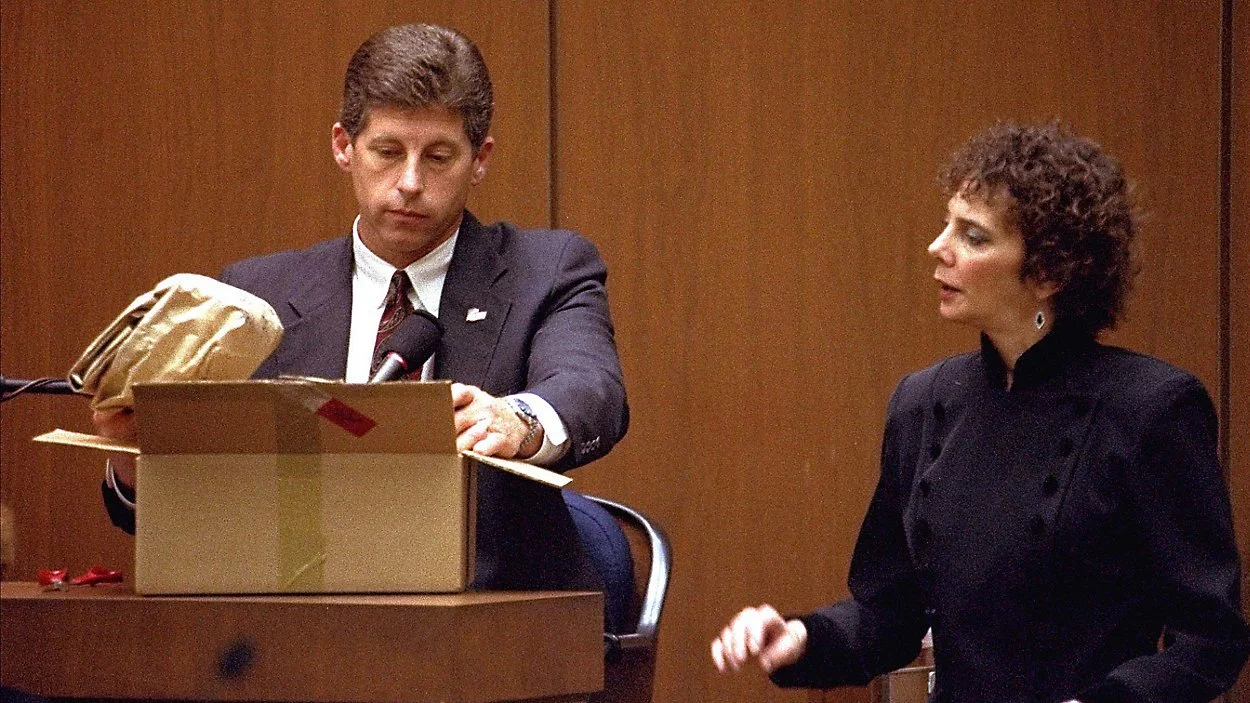
Photo of a man in a suit in a witness stand examining the contents of a box; a woman next to him is speaking to him

Los Angeles police detective Mark Furhman being examined by prosecutor Marcia Clark during the O. J. Simpson trial, 10 March 1995. Fuhrman was later convicted of perjury for his testimony.

15 September 2025

That police officers often lie when giving sworn testimony has long been a truism in legal circles. Irving Younger, law professor and former Assistant US Attorney for the Southern District of New York, observed in 1967: “Every lawyer who practices in the criminal courts knows that police perjury is commonplace.” The practice was so common that it spawned its own label in police slang, testilying, a blend of testify and lying.

Testilying appears to have been coined in New York City Police Department, although it may be that the term originated elsewhere and only came to the public’s attention via use by the NYPD. It first appears in print in the New York Times on 22 April 1994:

New York City police officers often make false arrests, tamper with evidence and commit perjury on the witness stand, according to a draft report of the mayoral commission investigating police corruption.

The practice—by officers legitimately interested in clearing the streets of criminals or simply eager to inflate statistics—has at times been condoned by superiors, the report says. And it is prevalent enough in the department that it has its own nickname: “testilying.”

The Times report was picked up by the Associated Press and the term appeared in papers across the United States that same day.

Discuss this post


Sources:

Sexton, Joe. “New York Police Often Lie Under Oath, Report Says.” New York Times, 22 April 1994, A1/1. ProQuest Historical Newspapers.

Younger, Irving. “The Perjury Routine.” The Nation, 8 May 1967, 596–97 at 596/1. EBSCOhost The Nation Archive.

Photo credit: Nick Ut/Associated Press, 1995. Fair use of a low-resolution copy of a copyrighted image used to illustrate the topic under discussion.

Groyper

Stylized image of a 1940s newspaper newsroom with the words “Wordorigins.org: Words in the News”

13 September 2025

This is free issue of the monthly “Words in the News” feature.

Groypers are a loose association of white-nationalist, antisemitic homophobes who follow neo-Nazi Nick Fuentes. They are known for targeting conservatives whom they deem aren’t fascist and antisemitic enough. One of their primary targets was right-wing political activist Charlie Kirk and his group Turning Point USA. Speculation on social media has associated the man suspected of assassinating Kirk with the Groyper movement, but as of this writing we don't know the assassin’s motives.

The followers of Fuentes began to be known as Groypers in 2019, although the name dates to several years earlier. The original Groyper was a cartoon variation of the Pepe the Frog meme used as an alt-right meme and icon. The Groyper cartoon started to appear in 2015 and depicts a corpulent version of Pepe the Frog, usually depicted as sitting with his chin resting on his interlocked fingers.

Crudely drawn cartoon of a green, corpulent frog, sitting with his chin resting on his interlocked fingers

A Groyper cartoon

The etymology of Groyper is unknown. It may simply be a nonsense name. It is sometimes claimed to by a blend of goy (gentile) + groper (sexual assaulter), but this seems to be an etymythology arising from the term’s later association with Fuentes and his followers. (Fuentes has been accused of supporting and covering for men accused of soliciting sex from underage boys.)  

In November 2016, a person joined Twitter with the handle @groyper. There are a few earlier tweets that use groyper starting in 2013, but it’s unclear what the word refers to in these tweets. Some sources claim uses of the word started to appear in 2015, but none provide actual citations of the term prior to the 2016 Twitter handle. The 2015 date may be a conflation of the cartoon with the word.

Groyper, referring to the cartoon, starts to make its way into print media by 11 December 2017, when it appears in the Colorado Springs Gazette in an article about then-Republican Congressman Mike Coffman tweeting in Spanish in favor of legislation to legalize the status of immigrants brought to the United States as minors, Deferred Action for Childhood Arrivals, or DACA:

"Do you speak English?" roars a dapper blonde youngster into a bullhorn in front of a chalkboard, in one.

It was among several replies to Coffman's tweet posted by a prolific Twitter user going by the name Dangerous Groyper, who uses an avatar depicting a grotesque smiling toad dubbed a Groyper—what's been described as an even more racist counterpart of Pepe the Frog, the cartoon character adopted as a mascot in recent years by white supremacists and members of the alt-right.

Coffman has been tweeting for some time—in both English and Spanish—about a DACA fix and his support for pending legislation, including the DREAM Act of 2017, which would provide a pathway to citizenship for some immigrants brought to the country illegally as minors. But none of those tweets attracted the kind of vituperative scolding Friday's tweet drew.

In 2018, conspiracy-theorist Shiva Ayyadurai unsuccessfully ran for the Republican nomination for US senator from Massachusetts. During the campaign, he distributed campaign pins featuring a brown-skinned version of the Groyper cartoon. This was picked up by the Israeli newspaper Haaretz when Ayyadurai was included in a list of neo-Nazi politicians running for office in the United States:

Ayyadurai issued campaign pins featuring the white nationalist symbol Groyper, a cartoon toad. He’s also friends with Matt Colligan, who marched in the white supremacist rally in Charlottesville and once said “Hitler did nothing wrong.” Ayyadurai appeared in a live video broadcast with Colligan and called him “one of our greatest supporters.”

Several definitions of Groyper appear in Urbandictionary on 30 October 2019. Two of these are as follows. The first:

A groyper is a smug toad used as an avatar by trolls online. His often refashioned face seems to entice a penchant for chaos and perhaps even a little comfiness.

Why do these groypers in my mentions keep telling me to Google the U.S.S. Liberty and Dancing Israelis?

The USS Liberty was a US Navy surveillance ship that was attacked in international waters by the Israeli forces during the 1967 Six-Day War. 34 crew members were killed and 171 wounded in the attack. Dancing Israelis is a reference to the conspiracy theory that Israel was behind the 9/11 attacks.

The second definition in Urbandictionary on that date refers to Kirk as a target for Groypers:

A friendly individual who prefers to relax, read and drink tea. Groypers can be characterized by loving their frens, their country, animals and God. Groypers are very well versed in history and have no trouble questioning established historical or political sentiments when the logic/facts behind them are proven to be false. They are easily identified by their obese frame and green skin. Groypers are closely related to Pepe.

“Congratulations to the Groypers for crushing Charlie Kirk.”

“Hey groypers, what's the deal with the USS Liberty and the Dancing Israelis anyway?”

And a 11 November 2019 article in London’s Independent associates the Groyper meme with Fuentes and his followers:

Charlie Kirk, TPUSA’s leader and a pro-Trump activist, was denounced as a “political liability” running a group that “SMEARS socially conservative Christians and supporters of President Trump’s agenda” by far-right figures on Twitter. “Our problem is not with @DonaldJTrumpJr who is a patriot—We are supporters of his father!” tweeted one, Nicholas Fuentes.

Another said: “THIS IS A REVOLUTION among the conservative youth in this country . . . WE WILL NOT STOP until the sanctioned invasion of our country through mass legal immigration comes to an end.”

“Congrats, Charlie Kirk. You just made the Groyper Army more powerful than before. All you had to do was just take a few questions . . .” tweeted a third.

Discuss this post

You can receive future posts of “Words in the News” by becoming a paid subscriber to Wordorigins.org.


Sources:

Luning, Ernest. “Mike Coffman’s DACA Tweet in Spanish Draws Heated Response.” Gazette (Colorado Springs), 11 December 2017. ProQuest Newspapers.

“A MAGA Groyper? Charlie Kirk Shooter Tyler Robinson’s Political Leaning Unclear; Nick Fuentes Reacts to ‘Pure Evil.’” Times of India, 13 September 2025.

Miller-Idriss, Cynthia. “Grooming and Recruiting: Cultivating Intellectual Leadership. In Hate in the Homeland. Princeton: Princeton UP, 2020, 116. JSTOR.

“Record Breaking Number of Neo-Nazis and White Nationalists Running for Office in the U.S.” Haaretz (Tel Aviv), 15 July 2018. ProQuest Newspapers.

Rivera, Joshua. “Groypers, Helldivers 2, Furries: What Do the Messages Left by Charlie Kirk’s Alleged Killer Actually Mean?” Vanity Fair (online), 12 September 2025.

Sherman, Jon. “Trump Jr Abandons ‘Triggered’ Book Event in Just 30 Minutes after Being Heckled.” Independent (Online) (London), 11 November 2019. ProQuest.

Urbandictionary.com, 30 October 2019, s.v. groyper.

Wiktionary, 4 August 2025, s.v. groyper.

Image credit: Groyper cartoon, unknown artist, 2015. Wikipedia. Fair use of a low-resolution copy of a copyrighted image to illustrate the topic under discussion.

saved by the bell

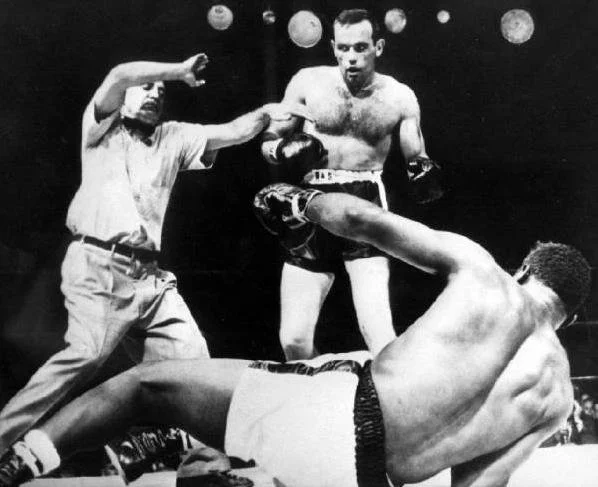
B&W photo of a referee intervening between two boxers, one of whom is lying on the ring floor

Ingemar Johansson knocks out Floyd Patterson for the world heavyweight boxing championship on 26 June 1959. Patterson was not “saved by the bell.”

12 September 2025

Saved by the bell, which the OED defines as “to be rescued from a difficult situation,” comes to us, as should be no surprise, from the world of boxing. It originally and quite literally referred to a boxer who was about to be beaten into submission only to have the bell ring, signaling the end of round. The origin is so obvious that it shouldn’t merit an entry on the term, but there is an absurd-on-its-face explanation for the phrase that has currency on the interwebs that needs to be countered with evidence.

I found a non-boxing use of the phrase from 1890 that hints that the phrase was already in common use by that date, undoubtedly in boxing contexts, even if we don’t have a boxing example in print until the next year. Saved by the bell appears in an advertisement for a Toronto clothing store in The Globe on 12 December 1890. The ad, for a store named The Bell, plays on save to refer to reduced prices:

ALMOST A SMASH,
BUT SAVED BY
"THE BELL”

“The Bell” has not only saved from bankruptcy one of the largest clothing manufacturers in Canada, but it has come like a boon to the ready-made clothing buyers of Toronto. A thousand times since we opened here, just 30 days ago, have we been asked the question., How is “The Bell” able to sell the identical same goods at just one-half the price charged by the other older establishments? We give it up. Perhaps just at present we are selling at absurdly low prices, but then we bought at just such rates. TO-MORROW MORNING, AT 9.30 O’CLOCK, we continue what we believe has been the Greatest Clothing Sale ever held in Canada.

One of the regulars on this website, Richard Hershberger, turned up the oldest boxing use of the phrase that I’m aware of. It’s from the Seattle Post-Intelligencer of 30 January 1891:

ARM BROKEN IN A PRIZEFIGHT. Colored Pugilist Severely Injured in Contest at Missoula.

MISSOULA, Jan. 29.—(Special.)—A fight tonight between Ramsey, colored, and Hennessy, two pugilists of reputation in the West, from the start was hard and lively. In the fourth round Ramsey nearly knocked out Hennessey, who was very groggy, but was saved by the bell, and came up well for the fifth, in which Ramsey had the best of it. In the sixth Hennessey got in good work, and when the bell sounded for the seventh Ramsey claimed that his arm was broken. The doctor examined him and pronounced that a severe fracture had been sustained. The fight was given to Hennessey.

There are many uses of the phrase in boxing writing in the closing decade of the nineteenth century and the early ones of the twentieth.

Other than the 1890 nonce usage quoted above, the earliest non-boxing use of the phrase that I have found is still in the context of sports, in this case baseball, where the use is figurative; the “bell” is a rainstorm that ends the game and saves Yankee pitcher Waite Hoyt from ignominy after being shelled by Connie Mack’s Philadelphia Athletics in the first two innings. It’s from the New York Times of 22 June 1928:

With the aid of old Jupe Pluve, a rugged lad with a punch in either hand, the Yankees gained a full game on the merry Mackmen of Cornelius McGullicuddy yesterday.

After a young Hank Johnson had hung a 4–0 thrashing on the eminent Robert Moss Grove in the first in the first encounter, the Athletics sallied forth and began to hit Waite Hoyt with everything but the kitchen stove. One run was in, men were on third and second with one out and the visiting firemen were a tally to the good when Jupe Pluve charged to the rescue of the hapless champions.

Old Jupe turned on a fancy brand of wet goods and Mr. Hoyt staggered gratefully to the bench when Umpire George Hildebrand suspended hostilities. After waiting a reasonable length of time the umpires called the game. Mr. Hoyt was saved by the bell.

As an aside, the quote is also notable because you don’t get many references to Jupiter Pluvius in today’s sports writing. (Jupiter Pluvius, or Jupiter Bringer of Rain, is reference to the Roman god being the god of storms.)

The earliest non-sports use of the phrase that I’ve found is from a Los Angeles Times gossip column from 31 July 1932:

Saved by the Bell Echo from Chaplin’s English tour. Whenever Charlie Chaplin and Michael Arlen meet, they have an agreement whereby each is permitted to talk about himself without interruption for five minutes by the clock. This had to be agreed upon, it appears, after the first meeting.

I did find a British, non-boxing use of saved by the bell from 1885, but it’s a literal collocation of words that is unrelated to the later American catchphrase. It’s from a piece offering commentary on a poem titled Spectre’s Bride:

The analytical notes expounding the poem and its musical setting are of so remarkable a nature that we make no excuse for quoting a few specimens of what threatens to become a new branch of literature:—“Trembling with horror and dismay [thus the librettist], From the horse the maiden fell.”—The sorry condition of the hapless girl is next related, and with the self- same breath her marvellous escape by a beneficient (sic) intervention at a supreme moment is tacked on to the phrase:—“Fainting: but in her fall she caught The rope of the lychgate bell.” With the clang of the bell the spectre knight vanishes, and Gudrun remained alone, “Saved by the bell that rang out well, saved by the holy bell.”

The absurd-on-its-face explanation mentioned above is that the phrase comes from devices rigged onto coffins so that those buried alive could ring if they woke up after having been buried. This myth is silly but pernicious and is repeated by many who should know better.

Discuss this post


Sources:

“Arm Broken in a Prizefight.” Seattle Post-Intelligencer (Washington), 30 January 1891, 2/5. Washington Digital Newspapers.

“The Birmingham Festival.” Spectator (London), 5 September 1885, 1165/1. ProQuest Magazine.

“Display Ad 6 – No Title.” The Globe (Toronto), 12 December 1890, 5. ProQuest Newspapers.

Green’s Dictionary of Slang, accessed 12 August 2025, s.v. bell, n.1.

Harrison, James R. “Yanks Take First, Rain Stops Second.” New York Times, 22 June 1928, 16/1. ProQuest Newspapers.

Oxford English Dictionary Online, December 2012, s.v. save, v.

“Don’t Quote Me. Chatter by Tip Poff.” Los Angeles Times, 31 July 1932, B24/5. ProQuest Historical Newspapers.

Photo credit: Unknown photographer, 26 June 1959. Wikimedia Commons. Public domain photo.

Red Baron

B&W drawing of a WWI dogfight with a British Sopwith Camel chasing and firing upon a German Fokker triplane

“The End of the Red Baron,” Joseph Simpson, 1918

10 September 2025

Freiherr Manfred von Richthofen is the most famous aviator of World War I, if not of all time. Credited with eighty air-to-air victories, he shot down more planes than any other flyer in the war. And he is popularly known as the Red Baron, because as commander of Jagdgeschwader (fighter wing) 1, known as the Flying Circus, he flew in a bright-red Fokker triplane. But researcher Brett Holman has discovered something quite interesting about the nickname Red Baron: until the mid-1960s, almost fifty years after his death in 1918, Richthofen was rarely called the Red Baron. Instead, the popularity of that nickname derives from the Peanuts comic strip, which often featured the beagle Snoopy engaging in imaginary dog fights with the German nemesis.

The nickname Red Baron did exist during the war but was apparently restricted to oral use among allied soldiers, not appearing in print until his death. This is the announcement of his death in the British newspaper Graphic, 25 May 1918:

The End of the Red Baron

Cavalry Captain Baron von Richthofen was shot down in aerial combat on the day when the German papers announced his 79th and 80th victories. Boyd Cable writes: “The Red Baron, with his famous ‘circus,’ discovered two of our artillery observing machines, and with a few followers attacked, the greater part of the ‘circus’ drawing off to allow the Baron go in and down the two. They put up a fight, and, while the Baron manœuvred for position, a number of our fighting scout machines appeared and attacked the ‘circus.’ The Baron joined the mêlée, which, scattering into groups, developed into what our men call ‘a dog fight.’ In the course of this the Baron dropped on the tail of a fighting scout, which dived, with the Baron in close pursuit. Another of our scouts seeing this dived after the German, opening fire on him. All three machines came near enough to the ground to be engaged by infantry machine-gun fire, and the Baron was seen to swerve, continue his dive headlong and crash in our lines. His body and famous blood-red Fokker triplane were afterwards brought in by the infantry, and the Baron was buried with full military honours. He was hit by one bullet, and the position of the wound showed clearly that he had been killed by the pilot who dived after him.”

The Royal Air Force officially credited Canadian Captain Arthur Roy Brown, pilot of the Sopwith Camel that was pursuing him with Richthofen’s death. But more recent analysis by historians has concluded that he was killed by machinegun fire from Australian infantry in the trenches below.

For decades following this first appearance in print, the moniker Red Baron only appeared sporadically in print.

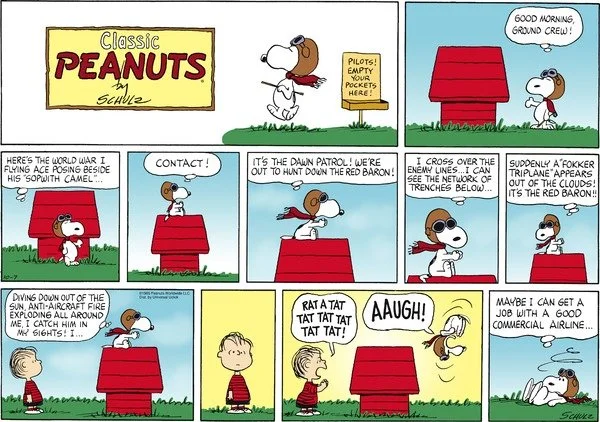
Then on Sunday, 10 October 1965, the comic strip Peanuts, by Charles Schulz, ran this strip:

Color Peanuts Sunday comic featuring Snoopy flying his doghouse against the Red Baron with the text “It’s the Red Baron.”

The first mention of the Red Baron in Peanuts, 10 October 1965

References to Richthofen as the Red Baron began to become more and more common after this date. The novelty song “Snoopy vs. the Red Baron,” written by Phil Gernhard and Dick Holler, was released by the Royal Guardsmen in November 1966, which further contributed to the nickname’s popularity.

Here is an example from Time magazine of 24 March 1967 that shows how the term had become somewhat genericized by that date:

Students in Paris and London have been ransacking secondhand stores for old uniforms dating back to the Crimean and FrancoPrussian [sic] wars. But in the U.S., uniforms are generally out in favor of the Frank Nitti gangster look, including palm tree-studded ties and double-breasted pinstripe jackets. At Dartmouth, the particular “drinking uni” (for uniform) at the moment is the “blow-lunch look” (so called, one student explains, because “when you look at one of those ties you want to blow your lunch”) topped off with a Red Baron Flying Ace helmet, complete with ear flaps and shrapnel holes.

Red Baron is a good example of why one should be careful in ascribing a date to a word or phrase without actual evidence of its use. The occurrence of an event, the coining of a word associated with that event, and when that word enters into the general parlance are not always the same.

Discuss this post


Sources:

“The End of the Red Baron.” Graphic (London), 25 May 1918, 631. British Newspaper Archive.

“Fads: The Follies that Come with Spring.” Time, 24 March 1967, 52/2. Time Vault.

Holman, Brett. “When Was the Red Baron?” Airminded (blog), 20 August 2018.

Image credits:

“The End of the Red Baron,” Joseph Simpson, 1918. The Graphic, 25 May 1918, 631. British Newspaper Archive. Public domain image.

Peanuts, Charles Schulz, 1965. Fair use of a copyrighted image to illustrate the topic under discussion.