bootstrap / boot up

A man in 17th-century dress on horseback pulling himself and his horse out of a swamp by his own hair

Baron von Munchausen pulling himself out of a swamp by his own hair

27 October 2025

A self-made person is one who lifts or pulls oneself up by one’s bootstraps. The phrase is usually used unironically nowadays, despite the fact that the laws of physics make it impossible for one to actually lift oneself by one’s bootstraps. The phrase was originally ironic, recognizing that such a feat is impossible, but as the myth of the self-made man grew (and it is a myth; no one succeeds in life without help), the phrase became unironic in its application.

First though, what are bootstraps? They are quite simply loops, either a pair with one on each side or one at the back of the boot, used to help pull the boot on. This literal meaning goes back the seventeenth century, if not earlier, when it is recorded in George Merton’s 1685 English–Latin dictionary: “Boot strap    Stroppus, m.”

The earliest use of the metaphor underlying the familiar phrase that I know of is from an 1830 physics text by John Lee Comstock, A System of Natural Philosophy:

It was on account of not understanding the principle of action and re-action, that the man undertook to make a fair wind for his pleasure boat, to be used whenever he wished to sail. He fixed an immense bellows in the stern of the boat, not doubting but the wind from it would carry him along. But on making the experiment, he found that his boat wen backwards, instead of forwards. The reason is plain. The reaction of the atmosphere on the stream of wind from bellows, before it reached the sail, moved the boat in a contrary direction. Had the sails received the whole force of the wind from the bellows, the boat would not have moved at all, for then, action and re-action would have been exactly equal, and it would have been like a man’s attempting to raise himself over a fence by the straps of his boots.

Comstock repeats the anecdote in his 1838 Youth’s Book of Natural Philosophy, only this time he uses the phrase as we know it today:

Had this man made, and applied the experiment of attempting to raise himself into the air by pulling at his bootstraps, he would have saved himself the expense of building such a boat.

(The word bootstraps is hyphenated in the printing, but the hyphen is at a line break.)

The phrase appears numerous times in various American newspapers in the latter half of the nineteenth century, all of them acknowledging the fruitlessness of the task.

The earliest apparently unironic use of the metaphor that I know of is from the Eumaeus episode of James Joyce’s 1922 novel Ulysses—although given that it’s Joyce, he may have meant it ironically, too:

However, reverting to the original, there were on the other hand others who had forced their way to the top from the lowest rung by the aid of their bootstraps. Sheer force of natural genius, that.

But a few years later, it is definitively used unironically. This use is also the first known use of the words bootstrapper and bootstrapping. From the 18 September 1927 Times of London:

Now everyone has heard of the American bootlegger. He overs alike an administering angel on the back stairs of every true American home. But the bootstrapper, though less familiar to the foreigner, is an even greater national figure, just as the feat of “lifting oneself by one’s bootstraps” is an almost entirely American accomplishment. Obviously, if you really were born a plumber, and if the unwritten law of the land demands that as a real he-man you must die at least with a white collar round your neck, you have got to do something about it. You do. You lift yourself by your bootstraps.

IT CAN BE DONE

The amazing thing about it is that it can be done—the laws of gravity notwithstanding. An ardent bootstrapper can become not only a successful business man, but a poet, a bestseller, a fashionable portrait painter, and, of course, a politician. I have seen it done.

Bootstrap enters the world of electrical engineering in the 1940s, appearing in a US Army technical manual on radar in April 1944:

Since gain is essential in the operation of this driver, a bootstrap amplifier is used. The bootstrap circuit includes elements which cause the voltage on the grid of the amplifier tube to raise with the cathode voltage, maintaining a constant signal voltage from grid to cathode.

And in the 1950s, the phrase bootstrap technique began to be used in computing to refer to a self-executing program. From a 1953 article by Werner Buchholz on the IBM 701 computer:

Self-Loading Procedure

Another area where the programming facilities of the computer have successfully replaced physical hardware is in the loading of a new program into the computer. There is a load button and a selector switch on the machine, but they do just barely enough to get the process started. The rest is accomplished by a technique sometimes called the “bootstrap technique” The switch determines whether the program is to be loaded from tape, cards, or drum. Pushing the load button then causes one full word to be loaded into a memory address previously set up on the address entry keys on the operator’s panel, after which the program control is directed to that memory address and the computer starts automatically.

By 1980, the verb to boot was in use in computing. From Martha E. Sloan’s 1980 Introduction to Minicomputers & Microcomputers:

Then we must turn on the PDP-11, as we discussed in the last section of Chapter 4. We turn the power knob to ON, and depress the CONTROL and BOOT switches. We call this procedure booting the system.

It is often claimed that lifting oneself up by one’s bootstraps originates with R. E. Raspe’s 1785 novel Baron Munchausen’s Narrative of his Marvellous Travels and Campaigns in Russia, but neither the phrase nor anything like it appears in that work. However, Gottfried August Bürger, in his 1786 translation of the novel into German, Wunderbare Reisen zu Wasser und Lande, Feldzüge und Lustige Abentheuer des Freyherrn von Münchhausen, adds a tale in which the baron pulls himself and his horse out of a muddy swamp by his own hair. Bürger’s metaphor has the same meaning as the American phrase, but there are no bootstraps involved.

Discuss this post


Sources:

Buchholz, Werner. “The System Design of the IBM Type 701 Computer.” Proceedings of the Institute of Radio Engineers, 41.10, October 1953, 1262–75 at 1273/1–2. Archive.org.

Comstock, John Lee. A System of Natural Philosophy, Hartford: D. F. Robinson, 1830, 40. Archive.org.

———. Youth’s Book of Natural Philosophy, Hartford: Reed and Barber, 1838, 45. Archive.org.

Joyce, James. Ulysses (1922). Hans Walter Gabler, ed. New York: Vintage, 1993, 16.1212–15, 528.

Merton, George. Nomenclatura clericalis, or, the Young Clerk’s Vocabulary in English and Latine. London: Richard Lambert, 1685, 55. ProQuest: Early English Books Online (EEBO).

Oxford English Dictionary Online, 1972, s.v. bootstrap, n.; 1989, s.v. bootstrap, v., and boot, v.4.

Radar System Fundamentals (April 1944). War Department Technical Manual, TM 11-467. Washington, DC: U.S. Government Printing Office, April 1946, 164. Archive.org.

Sloan, Martha E. Introduction to Minicomputers and Microcomputers. Reading, Massachusetts: Addison-Wesley, 1980, 158. Archive.org.

Wylie, I. A. R. “The Bootstrapper.” Sunday Times (London), 18 September 1927, 10/4. Gale Primary Sources: Sunday Times Historical Archive.

Image credit: Oskar Herrfurth, before 1934. Wikimedia Commons. Public domain image.

tweetzkrieg

B&W photo of WWII German tanks and armored vehicles

The original Blitzkrieg: tanks and armored vehicles of the German 24th Panzer Division moving through the Ukrainian countryside, 21 June 1942

24 October 2025

I try and avoid posting about brand-new neologisms. They often disappear before they become established, and I don’t want this site to be a graveyard of failed words. (Maybe someone should start such a site, but this one isn’t it.) In 2019, when I originally penned the entry for tweetzkrieg, the word had been circulating for ten years and had recently broken free of Twitter and started to appear in the mainstream press. I thought it was here to stay, but it faded from use shortly after I first wrote about it. And since Twitter has become X and tweet has lost its cachet, it’s unlikely to be revived. So now that it has popped up in my revision cycle, this entry is something of an obituary.

Tweetzkrieg is an alternative name for what is more commonly called a Twitterstorm, a flurry of activity about a trending topic on the social media platform Twitter. But unlike a Twitterstorm, which can be an unorganized response to a tweet or news item, a Tweetzkrieg is often deliberately generated by a single person or group. Tweetzkrieg is, quite obviously, modeled on blitzkrieg, the German WWII-era strategy of a combined arms assault using infantry, armor, artillery, and airpower. The word isn’t terribly common, but it has been around for over ten years.

Tweetzkrieg dates to at least 16 April 2009 when Kemi Adesina Wosu tweeted this (tweet no longer available):

@basseyworld OMG ur little tweetzkrieg (patent pending on that word snitches!) has me LOLing over here!

On 1 March 2011 the website Cycleboredom.com defined the term:

Actually, I think most of the damage was due to lost feeds and the Tweetzkrieg. If you’ve never watched a cycling race with the obligatory Twitter chaser, then you’re a sad individual lost in the purgatorial land of GeoCities. The Tweetzkrieg is the running commentary on Twitter as a race is unfolding.

The term had moved into the realm of international politics a year later on 29 May 2012 in this tweet by David Rothkopf (tweet no longer available) about a Russian government Twitter assault on the U.S. ambassador to that country, Michael McFaul, in response to a speech he had given:

Russian tweetzkrieg on McFaul uses new media to show how unready they are for new media/political reality

And, of course, Tweetzkrieg is often associated with Donald Trump, as in this 10 January 2016 comment on the website Talking Points Memo about an article that stated an Iowa poll had Senator Ted Cruz ahead of Trump in the race for the Republican nomination for president in that year:

Cue the Trump Tweetz-krieg (tm).

Or in this 17 January 2017 post on the blog Blckdgrd in the days leading up to Trump’s first inauguration:

One week from now, holy the fuck — hell, they could Reichstag the Inauguration and declare Martial Law by sunset. The Executive Orders he farts the first 48 hours (with full Tweetzkrieg). I’ll still find these the most fascinating, compelling political times of my life.

And the use that brought the term to my attention was in the pages of The Atlantic on 29 June 2019 in an article by Andrés Martinez:

The June 7 deal may seem to amount to a big victory for Trump, the result of a Tweetzkrieg threatening to impose tariffs on Mexican imports unless Mexico agreed to accomplish within 45 days what the U.S. has failed to do for years: “to sufficiently achieve results in addressing the flow of immigrants from Central America to the southern border.”

As of this writing, the last tweet that used the word tweetzkrieg was posted on 2 June 2021.

Discuss this post


Sources:

C-Huller. “MWBASS: I Got Some Kuurne in My Ompoop.” Cycleboredom.com, 1 March 2011. Archive.org.

dr_coyote. “Discussion: Cruz Takes Lead Over Trump in Latest Poll from Iowa.” Talkingpointsmemo.com, 10 January 2016.

Martinez, Andrés. “Did the U.S. and Mexico Just Link Their Immigration Policies?” The Atlantic, 29 June 2019.

@OhioBaylorFan. Twitter.com (now X.com), 2 June 2021.

“Skin Needs a Cut Before It Heals.” Blckdgrd (blog), 17 January 2017.

Photo credit: Unknown photographer, 1942. Wikimedia Commons. Deutsches Bundesarchiv, Bild 101I-218-0504-36. Licensed under a Creative Commons Attribution-Share Alike 3.0 Germany license.

Saracen

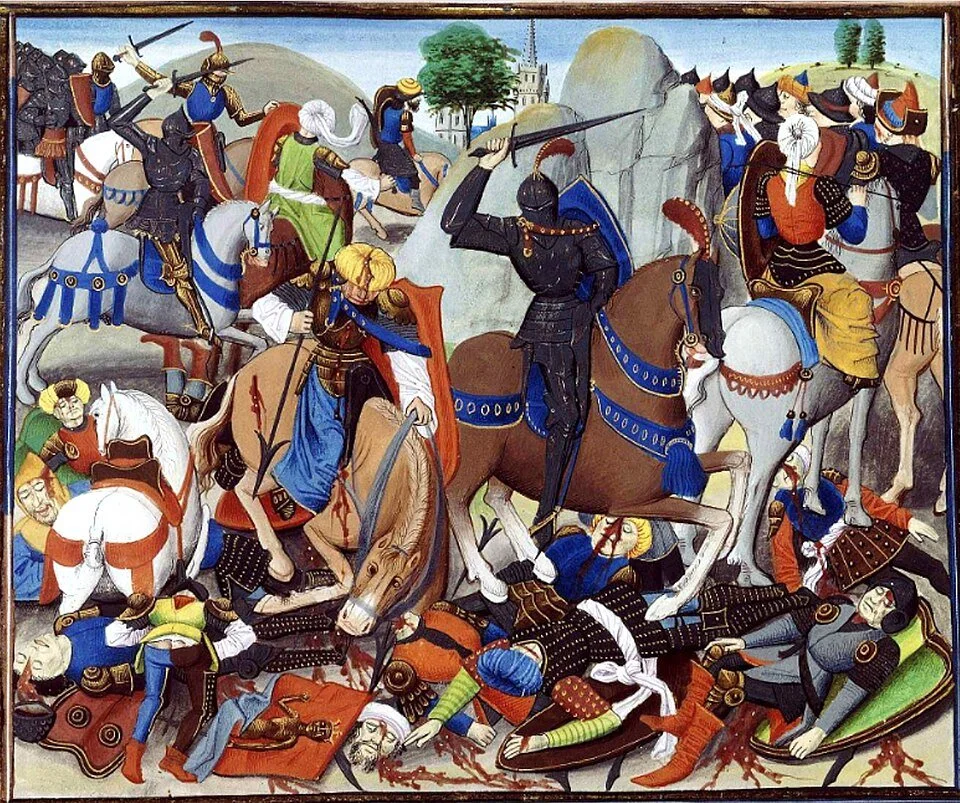
Medieval battle scene between Christians and Muslims featuring a knight in black armor on horseback at the center

Loyset Liédet, c. 1465, medieval illumination of Renaut de Montauban battling Saracens from David Aubert’s version of Quatre Fils Aymon (The Four Sons of Aymon)

22 October 2025

Saracen is term for a Muslim that is primarily used historically to refer to Muslims during the medieval period and especially in reference to the crusades. But it dates to antiquity, long before Islam arose as a religion, and its original sense was much more circumscribed. Its correct etymology isn’t all that interesting, but it does have a fascinating false etymology that circulated widely in Europe during the medieval period.

Saracen was used by medieval Christians in ways that enforced social and power hierarchies and contributed to prejudices and Islamophobia. Care should be taken when using the term today, only using it in ways that limit its application to the medieval meanings and contexts. When referring generally to Muslims in the medieval period, one should use a more neutral term, such as Muslim itself or a more specific regional or sectarian name.

Saracen enters English from the Latin saracenus, which got it from the Greek σαρακηνός (sarakenos). The Greek probably comes from the Arabic root sharq, meaning east, and the word originally referred to a people dwelling in the Sinai peninsula and what is now northwestern Saudi Arabia.

The word is first recorded in Greek as an adjective describing a species of rush growing in the Sinai in Dioscorides’s On Medical Material, a pharmacology written c. 50 C.E. But it is Claudius Ptolemy’s second century Geographia that first mentions Saracens as a distinct group of people. He uses sarakēnē to refer to a region in the northern Sinai peninsula and sarakēnoí as a name for a people in northwestern Arabia. Eusebius takes the word into Latin in his fourth century Historia Ecclesiastica, where he quotes a letter from Dionysius, bishop of Alexandria, that refers to the sarakēnoí of Arabia as existing c. 250 C.E.

The use of Saracen in English dates to the Old English period. For example, there is this from the Old English translation of Orosius’s History Against the Pagans:

Sio Egyptus ðe us near is, be norðan hyre is þæt land Palastine, and be eastan hyre Sarracene ðæt land, & be westan hire Libia þæt land, and be suþan hyre se beorh ðe Climax hatte.

(The part of Egypt that is nearer us has to its north the land of Palestine, and to its east is the land of the Saracens, and to the west is the land of Libya, and to its south is the mountain called Climax [i.e., Mount Catherine].)

In the medieval era, it was common for European writers to claim that the word Saracen derived from a claim by Arab peoples that that they descended from Sarah and her son Isaac, rather than the slave Hagar and her son Ishmael, and in so doing, so the allegation claims, the Arabs were claiming a false genealogical legitimacy. Jerome gives this false etymology in his early fifth century commentary of the biblical book of Ezekiel. And Isidore, in his early seventh century Etymologiae, writes:

Saraceni dicti, vel quia ex Sarra genitos se praedicent, vel sicut gentiles aiunt, quod ex origine Syrorum sint, quasi Syriginae. Hi peramplam habitant solitudinem. Ipsi sunt et Ismaelitae, ut liber Geneseos docet, quod sint ex Ismaele. Ipsi Cedar a filio Ismaelis. Ipsi Agareni ab Agar; qui, ut diximus, perverso nomine Saraceni vocantur, quia ex Sarra se genitos gloriantur.

(The Saracens are so called either because they claim to be descendents of Sarah or, as the pagans say, because they are of Syrian origin, as if the word were Syriginae. They live in a very large deserted region. They are also Ishmaelites, as the Book of Genesis teaches us, because they sprang from Ishmael, and Agarines, from the name Agar (i.e., Hagar). As we have said, they are called Saracens from an alteration of their name, because they are proud to be descendents of Sarah.)

Isidore’s Etymologiae impute theological significance to the etymologies of words and are, by modern standards, laughably wrong, but they were widely copied and read and do provide historical insight into the beliefs of medieval Europeans.

Isidore is using Saracen in the original, narrow sense, of a particular group of people, but the meaning of the word would later be expanded to refer to all Muslims or even more broadly to those non-Christians in lands to the east. Saracen was not used to refer to Christian Arabs. An early example of this broader sense is a list of the final resting places of Christ’s apostles found in the Rituale ecclesiæ Dunelmensis (Rite of the Church of Durham), an early ninth-century collection of Latin liturgical texts and with an interlinear Old English gloss:

Beatus thomas apostolus requiesat Emina, in India Saracenorum.
se ead’ thom’ ap’ gerestað | gireste æt frvmma in ðæm byrig on india saracena.

(The blessed apostle Thomas dwells in Emina, in India of the Saracens.)

So the word Saracen in medieval writing is a nonspecific term, referring generally to non-Christians of the east, and in particular to Muslims, and to medieval Europeans carried negative connotations because it supposedly characterized them as making a false claim of being descended from a more favored line of descent.

Discuss this post


Sources:

American Heritage Dictionary, fifth edition, 2019, s. v. Saracen, n.

Orosius. The Old English History of the World. Malcolm R. Godden, ed. Dumbarton Oaks Medieval Library 44. Cambridge: Harvard UP, 2016, 1.1, 30–31.

Heng, Geraldine, The Invention of Race in the European Middle Ages, Cambridge University Press, 2018, 110–12.

Isidore. Etymologiarvm sive originvm libri XX. Wallace Martin Lindsay, ed. Oxford: Clarendon Press, 1911, 9.2.57, 351. HathiTrust Digital Library.

Isidore. The Etymologies of Isidore of Seville, trans. and ed. by Stephen A. Barney, et al. Cambridge University Press, 2006, 195/1.

Oxford English Dictionary Online, 1909, s.v. Saracen, n. and adj.

Retsö, Jan, The Arabs in Antiquity: Their History from the Assyrians to the Umayyads, RoutledgeCurzon, 2003.

Rituale ecclesiæ Dunelmensis. Publications of the Surtees Society. London: J. B. Nichols and Son, 1840, 196. HathiTrust Digital Library.

Image credit: Loyset Liédet, c. 1465, Paris, Bibliothèque nationale de France, Arsenal, Ms. 5072 Rés., fol. 349v. Wikimedia Commons. Bibliothèque nationale de France. Public domain image.

emoji

A table of 12 emoji showing stylized faces displaying various emotions and moods

20 October 2025

Emoji are pictograms used in electronic communications. An emoji is a digital icon used to express an emotion or idea, a twenty-first century updating of the old ascii emoticons like the winking face, ;-), used to mark a joke or sarcasm. 

The etymology is rather straightforward but may be a bit surprising to some. It’s a borrowing from Japanese, which shouldn’t surprise anyone, but the origin has nothing to do with emotion, as the emo- might suggest. Instead it’s a compounding of e-, meaning picture, and -moji, meaning a letter or character. The word in Japanese dates to at least 1928, and it may be a calque of the English pictograph, which is a blend of similar semantic elements, picto- (picture) + -graph (writing). So the Japanese may have borrowed it from English, translated it into Japanese, and then given the Japanese version back to English.

English use of emoji dates to at least 1997, when it appears in the Nikkei Weekly, an English-language Japanese newspaper:

P-kies CD-ROM Emoji Word Processor software featuring more than 500 pictorial symbols has become a hit since it debuted July 11.

The first citation in the Oxford English Dictionary from a non-Japanese source is from Wired magazine in 2001:

Emoji […] consists of tiny pixelated images that sub for words in mobile gossiping.


Sources:

Oxford English Dictionary Online, December 2013, s.v. emoji, n.

Image credit: Spaynton, 2019. Wikimedia Commons. Licensed under a Creative Commons Attribution-Share Alike 4.0 International license.

witch hunt

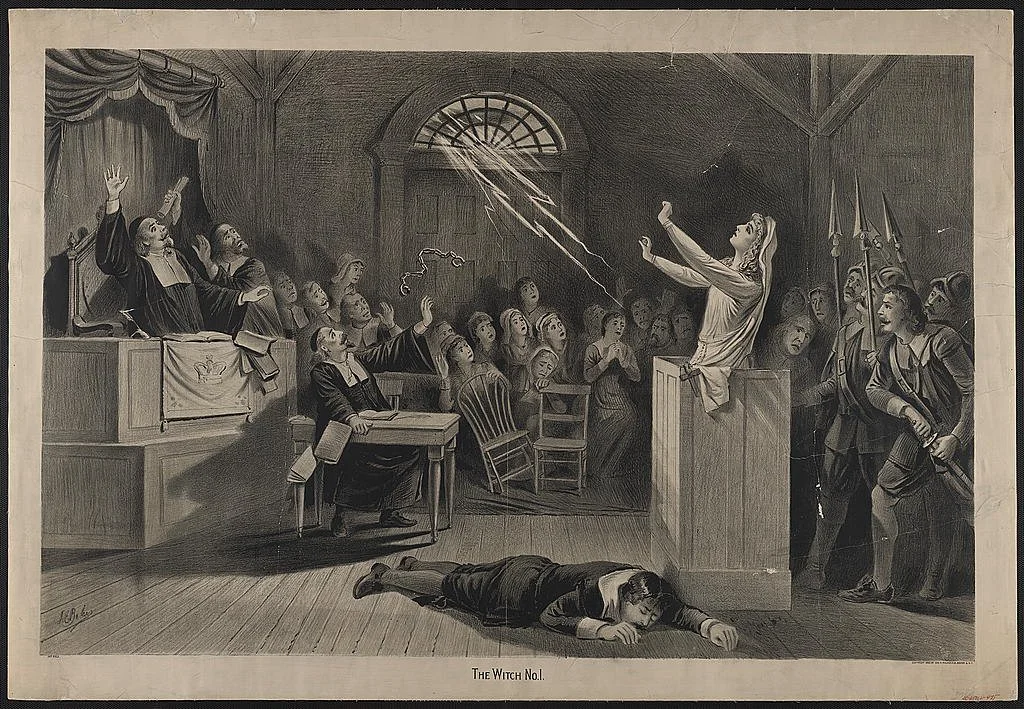
A 17th-century court in an uproar, a woman in the dock, lightning comes through a window, a man lies prone on the floor

c. 1892 lithograph of the Salem witch trials

17 October 2025

The phrase witch hunt is surprisingly recent. One might expect it to date to the seventeenth century, when real hunts for supposed witches were rampant across Europe. But its use in relation to witches only dates to the late nineteenth century and its political use only to the twentieth. And until the mid twentieth century, whether the context was witches or some other undesirable person, witch hunt was almost always applied to the persecution of marginalized groups by those in power. But starting around 1960, the term began to be used by those in power in reference to criticism of themselves and their policies.

The earliest use of witch hunt that I’m aware of is a literal reference to supposed witches in the seventeenth century, but it doesn’t appear until the mid nineteenth. The following account of the infamous Salem witch trials of 1692–93 appears in “Bancroft’s History of the United States,” published in the magazine De Bow’s Review of August 1853. While it is about supposed witches, the description of the zeal and tactics of the persecutors accords with those of the modern political sense:

Some strange cases of convulsions occurred at the village of Danvers, in the family of Parris the minister. Parris had just been engaged in a violent quarrel with some of his flock, and he seized upon this glorious opportunity for revenge. From members of his own family, by instructing and prompting, he obtained the names of those who had bewitched them, and these answers were given as evidence in the court of justice. Against his enemies he employed all the efforts of his malicious and revengeful spirit. But Parris did not do his work of infamy alone. It was too inviting a subject for the ministers of Boston not to participate in, and with Cotton Mather at their head, they eagerly joined in the grand witch hunt. Witch-finding was made a science. Honest bigotry and malicious craft kept up and increased the excitement. Every one who was bold enough to express his disbelief in witchcraft, and his belief in the rascality of the whole business, was a doomed man. Evidence tending to convict their friends was suppressed, and evidence tending to convict their enemies was manufactured. But the holy zeal of the ministers was not satisfied with the judicial murder of those of their flocks who had incurred their displeasure. It was next directed against those of their own order, who had the intelligence and the honest courage to oppose this disgraceful affair.

The earliest figurative and political use of witch hunt I can find of the term is from 1900 in the context of Canadian politics. In a pair of articles, again in the Manchester Guardian, on the Canadian federal election of that year, reporter Harold Spender wrote on 30 October 1900:

For four years there has been absolute peace between the races and religions of this strangely mingled half-continent. For four years; but now I fear that the mischievous race-suspicions of South Africa are already spreading here, and that the pernicious spirit of the witch-hunt is already appearing in the speeches and writings of this campaign.

[…]

But more serious for the moment is the loyalist witch-hunt. You would imagine that Englishmen would be content with the proud consciousness of these people’s [i.e., French Canadians’] allegiance, that they would recognise that such allegiance, so given, demands in return some delicacy and generosity in the recipient. But no; they must peep and pry down the mouth of the gift-horse, and then, when the teeth snap in angry resentment, there is a howl of dismay and shallow indignation.

And on the next day, Spender wrote:

Well, that was the sort of attack Mr. Tarte had to meet—an attack which would, in the zeal of a witch-hunt, turn these innocent sayings into treasonable utterances.

Within two decades the term began to be used in the United States, first in the context of the Red Scare following the Russian Revolution. From the Chicago Daily Tribune of 8 March 1919:

Col. Raymond Robins of Chicago, former head of the American Red Cross mission in Russia, warned the senate propaganda investigating committee today that no headway would be made in trying to check bolshevism by “witch hunt” methods.

The use of witch hunt in American politics spiked again in the 1950s with McCarthyism and the hearings of the House Un-American Activities Committee, and the context was most often that of persecuting those on the political left by those in power.

The OED first records the use of witch hunt to refer to political attacks on government officials in a 29 January 1960 Daily Telegraph article about alleged corruption by British Transportation Minister Ernest Marples, a case of a government official being investigated by the opposition minority:

NO WITCH-HUNT
Labour Leaders’ Attitude

Our Political Correspondent writes: The Opposition Front Bench do not intend to conduct a “witch-hunt” against Mr. Marples over his business connections. But this is no guarantee that back-benchers will not seek to pursue the matter further.

If there is any disposition to criticise Mr. Marples, it will be on the ground that he might have taken steps to get rid of his shares when he became Postmaster-General, rather than wait until he was appointed Minister of Transport.

And, of course, no article on witch hunt could go without referring to Donald Trump, who has elevated this particular sense to new heights. According to the Trump Twitter Archive, a site that is no longer online, Trump had tweeted witch hunt 190 times between his first inauguration and 1 May 2019. For an example that falls outside that date range, on 17 October 2019, Trump tweeted in about the first effort to impeach him:

The Greatest Witch Hunt in American History!

That’s a far cry from the persecution of seventeenth-century women who did not conform to society’s ideas of how they should act.

Discuss this post


Sources:

“Bancroft’s History of the United States.” De Bow’s Review, 15.2, August 1853, 160–86 at 179–80. HathiTrust Digital Library.

“No Witch-Hunt.” Daily Telegraph (London), 29 January 1960, 1/2. Gale Primary Sources: Telegraph Historical Archive.

Oxford English Dictionary Online, September 2021, s. v. witch hunt, n., witch-hunt, v.

Spender, Harold. “The Canadian Elections” (30 October 1900). Manchester Guardian (England), 9 November 1900, 10/3. ProQuest Newspapers.

———. “The Canadian Elections” (31 October 1900). Manchester Guardian (England), 15 November 1900, 10/2. ProQuest Newspapers.

Trump, Donald J. (@realDonaldTrump), Twitter.com (now X.com), 17 October 2019.

“Warns America to Use Care in Fighting Reds” (7 March 1919). Chicago Daily Tribune, 8 March 1919, 2/2. ProQuest Newspapers.

Image credit: Joseph E. Baker, c. 1892, George H. Walker & Co. Library of Congress. Public domain image.