incel

Stylized image of a man and woman happily holding hands while an angry man looks on

12 January 2026

Incel is a portmanteau of involuntary celibate, referring to a person, usually a heterosexual man, who desires a sexual or romantic partner but is unable to find one. The term arose as a self-identifier and spawned a virtual subculture as those who could not find sexual partners reached out for support on the internet. But over the years that subculture and the term itself morphed into one associated with male entitlement to sex and violent misogyny. Ironically, however, the movement was started and the term incel was coined by a bisexual woman, only to be transformed into something quite different than originally envisioned.

In 1997 an anonymous, undergraduate, bisexual woman named Alana at Carleton University in Ottawa, Ontario created the website Alana’s Involuntary Celibacy Project. The website is no longer online. That website launch is apparently the first use of the phrase involuntary celibate. She initially used the abbreviation invcel, shortened to conform to the old DOS eight-character limit for filenames, but by 1999 she had switched to incel when a reader suggested that would be easier to pronounce. Sometime between 17 January and 20 April 1999 she posted an article to her site titled “The Incel Movement: What we can learn from the gay rights movement”:

Society does not understand who we are, or have a name for our problem (in fact, straight incels are often assumed to be gay).

This is apparently the earliest use of the portmanteau incel. (The ambiguity in the date is a result of when the Internet Archive took its snapshots of the site. Alana’s web pages did not contain dates of publication.) Alana and the early incarnations of her site are in no way associated with the violent and misogynist nature of the incel movement today.

The phrase involuntary celibacy is much older, however. For instance, there is this from the 7 July 1874 issue of the New York Times:

Mr. GOLDWIN SMITH has stirred up something very like a hornet’s nest by his article on “Female Suffrage” in Macmillan’s Magazine. A correspondent of the Examiner, URSULA M. BRIGHT, is particularly stinging in her comments. She reminds the Professor that there are 800,000 more women than men in Great Britain, and that it is “particularly cruel that women should be taunted with contempt for matrimony by a man who has himself done nothing to reduce, even by one, the overwhelming numbers of those condemned to involuntary celibacy.”

But for years the portmanteau incel remained restricted to various recesses of the internet. The Urban Dictionary added an entry for incel on 12 March 2007, indicating that despite the paucity of its appearances in mainstream publications, the term was alive and well. The entry also shifted the sex from female to male:

incel
involuntary celibate: someone who is celibate but doesn’t want to be
“He’s an incel. He tries to get dates every week but gets turned down all that time.”

It would take misogynistic men with guns to bring awareness of the term incel to the general public. There is this from the McClatchy-Tribune Business News wire service from 26 January 2013:

Clearly, guns offer more protection in fantasy than in reality.

Further, no one needs weapons of war, i.e., military assault rifles for either self-defense or hunting. Their only use is in the service of violent fantasy or actual murder, or of course in a vain effort to feel sufficiently big, strong and masculine.

Recently, the sexual, as well as the angry, violent and misogynist use of guns has been inadvertently highlighted by men who identify with the “incel” (involuntarily celibate) movement, at least four of whom have been among recent mass murderers.

Since then, the term has entered mainstream discourse.

Discuss this post


Sources:

Alana. “The Word ‘Incel.’” Love, not Anger (blog), 7 October 2019. Archive.org.  

Blum, Lawrence D. “What Guns Really Protect Is a Sense of Manhood.” McClatchy-Tribune Business News, 26 January 2013. ProQuest: Wire Feed.

Bydlowska, Jowita. “The Woman Who Accidentally Started the Incel Movement,” Elle, 1 March 2016.

Donnelly, Denise, et al., “Involuntary Celibacy: A Life Course Analysis,” Journal of Sex Research, 38.2, May 2001, 159–69

New York Times, 7 July 1874, 4/2. ProQuest Historical Newspapers.

Urbandictionary.com, 12 March 2007, s.v. incel.

Zimmer, Ben. “How ‘Incel’ Got Hijacked.” Politico.com, 8 May 2018.

Image credit: Miss Luna Rose 12, 2019. Wikimedia Commons. Licensed under the Creative Commons Attribution-Share Alike 4.0 International license.
ergonomics

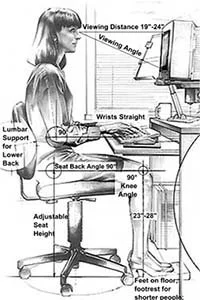
Pencil sketch of a woman sitting at a computer workstation with the proper ergonomic angles marked

9 January 2026

Ergonomics is a combination of the Greek ἔργον (ergo, meaning work) + the English -nomics, taken from economics. It is the study of the interaction of people and their work environments, particularly in reference to efficiency and safety. The word was evidently coined in 1949 by a group of British scientists working in this field. The earliest use in print that I’m aware of is in the British medical journal The Lancet on 1 April 1950:

In July, 1949, a group of people decided to form a new society for which the name the “Ergonomics Research Society” has now been adopted. Ergonomics by definition is to mean “the study of the relation between man and his working environment,” particularly the application of anatomical, physiological, and psychological knowledge of the problems arising therefrom. This covers the field which has variously been described as “fitting the machine to the man,” human engineering, that part of industrial psychology not concerned with vocational guideance, &c.

The adjective ergonomic, applied particularly to the design of objects and working space with efficiency and safety in mind, appears in a paper by Wilfred. E. Le Gros Clarke at a 1951 conference sponsored by the aforementioned Ergonomics Research Society:

One of the difficulties with which the anatomist has to contend in ergonomic problems is the great variability of the dimensions of the human body. This difficulty continually obtrudes itself in connection with the amount of working space which is required by men engaged in different jobs, with the design of seating or standing supports, the positioning of controls, instruments and viewing apparatus, and the fitting of clothing or harness of one sort or another.

Le Gros Clarke is more famous as one of the men who debunked the Piltdown Man hoax.

Discuss this post


Sources:

Browne, R. C., et al. “Ergonomics Research Society.” Lancet, 1 April 1950, 645–646 at 645/2. Elsevier Science Direct.

Le Gros Clarke, Wilfred E. “The Anatomy of Work” (1951). In Symposium on Human Factors in Equipment Design, Proceedings of the Ergonomics Research Society, vol. 2. London: H. K. Lewis, 1954, 5–15 at 6. 1977 Reprint by Arno Press, New York. Archive.org.

Oxford English Dictionary Online, 1972, s.v. ergonomics, n., ergonomic, adj.

Image credit: Yamavu, 2013. Wikimedia Commons. Public domain image.

zero gravity / zero g / microgravity

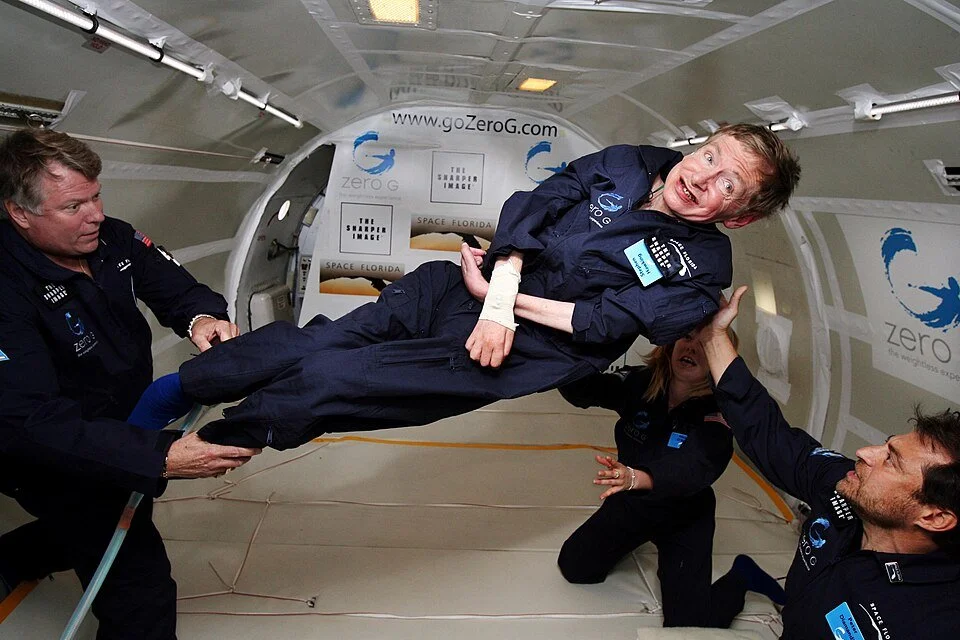
Photo of a man floating in the middle of an airplane bay; three other people are guiding him

Physicist Stephen Hawking experiencing zero gravity on an aircraft flight, 2007

6 January 2026

Zero gravity, also called zero g or microgravity, is the state of weightlessness experienced in outer space (and, as we shall see, at the center of the earth).

The term is much older than you might expect. It first appears back in February 1915 in the journal Science:

First, the instrument commonly taken as the fundamental means of measuring mass—namely, the beam-balance—is essentially a gravitational instrument, depending for its operation on the (established or assumed) equality of the gravitational fields of force at the two ends of the beam; whereas the instrument for measuring forces, at least in a readily idealized form, is a universal instrument, not in any way dependent on locality. For example, if a man should be placed, in imagination, at the “point of zero gravity” between the earth and the moon, it is not at all obvious how he would proceed to measure a given mass with a beam-balance; whereas, if he had a spring balance, in the form, for example, of a grip-testing machine, he could measure the strength of the muscles of his hand, or the attraction between two bodies, just as well under those circumstances as if he were on the surface of the earth.

Zero gravity made its way from science to science fiction by 1938, when the term is used in a story by Jack Binder, “If Science Reached Earth’s Core,” in the October issue of Thrilling Wonder Stories:

Space travel is solved. Starting at the zero-gravity of earth’s core, accumulative acceleration is easily built up in a four-thousand-mile tube. The ships reach the earth’s surface where gravitation is strongest with an appreciable velocity that makes the take-off a simple process of continuation!

Since gravity is the attraction between two masses, if we could go to the center of the earth, we would feel no pull from the earth’s mass. The planet’s mass would surround us, and the pulls in all different directions would cancel each other out—we would be at zero-gravity. Binder's solution for escaping earth's gravity well is quite imaginative, although getting to the earth’s center has proven far, far more difficult than simply launching a rocket into space from the earth’s surface.

For spacecraft in orbit the mechanism is different, but the effect is the same. In earth orbit, the planet’s gravity is still tugging at a spacecraft, but the craft is traveling fast enough that it “falls around” the earth. The craft’s forward motion cancels out the effect of the earth’s gravity and things, including people, float.

We see zero gravity used in reference to actual space flight by December 1952, when it is used in a photo caption in Science News Letter to describe the effects a monkey experienced when launched into space on a rocket:

HISTORIC ZERO-GRAVITY FLIGHT—One of the monkeys which was rocketed nearly 40 miles into space. Results showed that man may be able to stand the gravity-free state for brief periods.

The shorter zero-g is older, dating to an article about Navy dive-bomber pilots that appeared in the 9 June 1940 issue of the Detroit Free Press:

“Recovery,” he said, “occurred in a few seconds following or during a return to zero G (the level) and beyond a brief period of apparent bewilderment, no other effects were noted.”

But here the term is used in a different sense. The article is discussing the effects of high acceleration on pilots, and G here is measuring acceleration, not gravity. Zero-G in this context is the normal acceleration a pilot feels once they have pulled out of a dive and are flying straight and level.

Zero-g is used to mean an absence of gravity in Arthur C. Clarke’s 1952 novel Islands in the Sky:

She was wearing a rather worried smile, and it was quite obvious that she found the absence of gravity very confusing. Remembering my own early struggles, I sympathized with her. She was escorted by an elderly woman who seemed quite at home under zero g and gave Linda a helpful push when she showed signs of being stuck.

The abbreviation or is standard physics notation for the force of gravity and has been in use since at least 1726.

Today, space scientists tend to use the term microgravity to describe most real-world zero-gravity situations. In orbit, the effects of earth’s gravity are not completely cancelled out, and other astronomical bodies, notably the moon and the sun, will exert some, albeit very weak, gravitational influence. These minute gravitational forces are not technically “zero,” so the term microgravity is substituted. Use of microgravity dates to the Skylab missions of the mid 1970s, if not earlier. From the 14 February 1975 issue of Science:

The experiments finally chosen to fly on the various Skylab missions are best characterized as a mixed bag of studies designed to observe the effect of microgravity on a variety of phenomena ranging from solidification of molten semiconductors to joining metals by brazing.


Sources:

Binder, Jack. “If Science Reached Earth’s Core.” Thrilling Wonder Stories, 12.2, October 1938, 98–99 at 99. Archive.org.  

Clarke, Arthur C. Islands in the Sky. Philadelphia: John C. Winston, 1952, 82. Archive.org.

Huntington, Edward V. “Discussion and Correspondence: The Fundamental Equation of Mechanics.” Science, 41.1049, 5 February 1915, 207–209 at 208–209. Biodiversity Heritage Library.

“1952 Science Review.” Science News Letter, 20 December 1952, 389. JSTOR.

Oxford English Dictionary Online, June 2018, s.v. zero gravity, n. & adj., zero-G, adj. & n., G, n.; December 2001, s.v. microgravity, n.

Prevost, Clifford A. “U.S. Developed Dive-Bombing.” Detroit Free Press, 9 June 1940, Magazine page 6/1. ProQuest Historical Newspapers.

Robinson, Arthur L. “Crystal-Growing in Space: Significance Still Up in the Air.” Science, New Series, 187.4176, 14 February 1975, 527–28 at 527/1. JSTOR.

Sheidlower, Jesse. Historical Dictionary of Science Fiction, 27 January 2021, s.v. zero-gravity, n.; 16 December 2020, s.v. zero-g, n.

Photo credit: Jim Campbell, 2007. Wikimedia Commons. Licensed under the Creative Commons Attribution 3.0 Unported license.  

scrapple

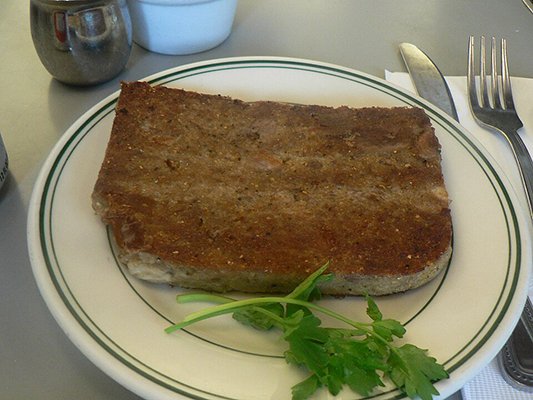
A slice of fried scrapple served on a plate with a sprig of parsley

5 January 2026

Scrapple is a mush of pork scraps—hence the name—cornmeal, and sometimes buckwheat flour. It is typically fried and served as a breakfast meat.It can be found in the Mid-Atlantic United States, from South Jersey to North Carolina. The Pennsylvania German name for it is Panhas.

The earliest reference to scrapple that I have found is in an 1841 list of products for sale in a Philadelphia market:

Blood Pudding.         7a 8
Souse Cheese, lb.        5a 12¼
Scrapple, per lb.          5a 6

And here is an 1853 recipe for preparing it that appeared in a Vermont, of all places, newspaper:

SCRAPPLE. This is generally made of the head, feet, and any pieces which may be left after having made sausage meat. Scrape and wash well all the pieces designed for the scrapple, put them in a pot with just enough water as will cover them. Add a little salt, and let them boil slowly till the flesh is perfectly soft, and the bones loose. Take all the meat out of the pot, pick out the bones, cut it up fine, and return it to the liquor in the pot. Season it with pepper, salt, and rubbed sage, to the taste. Set the pot over the fire, and just before it beings to boil, stir in gradually as much Indian meal as will make it as thick as mush. Let it boil a few minutes, take it off, and pour it in pans. When cold, cut it in slices, flour it, and fry it in hot lard, or sausage fat. Some prefer buckwheat meal; this is added in the same manner as the Indian. Indian meal is preferable, as it is not so solid as buckwheat. Sweet marjoram may be added with the sage, if preferred.

While scrapple is not to everyone’s taste, there are aficionados of the dish. One, a John Leadbeater, even composed a song about it and similar meat products that was published in 1850. It is to be sung to the tune of the Star-Spangled Banner:

THE MYSTERIOUS LOOM.
TUNE—Star Spangled Banner.

Oh say have you heard of the mysterious loom,
In which the famed, “Jarsey Sasuage” [sic] is wove,
Which is work’d in some dark greasy room,
The family heir-loom,—a token of love.
          The “sausage meat” nice,
          Is gone in a trice,
Producing a “link” that will hunger suffice,
Then here’s to that “loom,” whose work when begun,
Uses up the poor porkers, Father, Mother and Son.

Then here is the cheese, that is made of hogsheads,
And scrapple of jelly and fine Indian Meal,
A smile o’er the face of the weaver it sheds,
No pain for his victims he ever does feel.
          Nor thinks of the slain,
          Who his warp doth maintain,
He has but one object, a living to gain.
Then here's to that loom, whose work when begun,
Uses up the poor porkers, Father, Mother, and Son.


Sources:

Dictionary of American Regional English, 2013, s.v. scrapple, n., panhas, n.

Leadbeater, John. “The Mysterious Loom.” Literary Remains of John Leadbeater, Jr. Philadelphia: 1850, 93. HathiTrust Digital Library.

“Miscellany: Domestic Economy.” Vermont Chronicle (Windsor, Vermont), 20 December 1853, 4/2. Readex: America’s Historical Newspapers.

Oxford English Dictionary Online, 1911, s.v. scrapple, n.2.

“Retail Prices in Market—Oct 20, 1841.” Public Ledger (Philadelphia), 21 October 1841, 1/5. Readex: America’s Historical Newspapers.

Photo credit: Stu Spivack, 2006. Wikimedia Commons. Flickr. Licensed under the Creative Commons Attribution-Share Alike 2.0 Generic license.

voluntary / volunteer

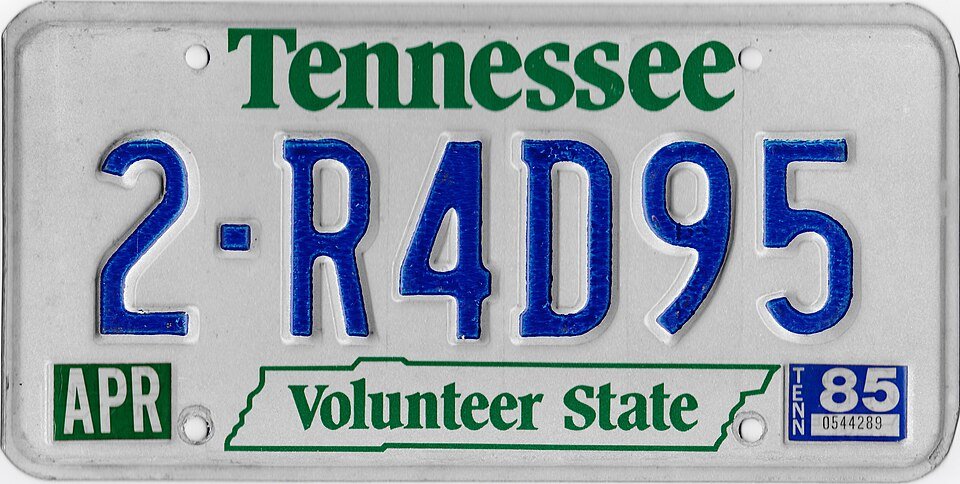
1985 Tennessee license plate with the motto “Volunteer State”

2 January 2026

The adjective voluntary has a rather straightforward etymology. It comes from the Latin voluntarius, meaning willing, of one’s own choice, via the Old French voluntaire. The Latin noun voluntas means will or desire.

The first English incarnation of the word is the noun volunte, meaning will or desire, a direct import of the Old French volonte, which in turn is from the Latin noun. It first appears in a poem called Of Arthour and of Merlin in the Auchinleck manuscript, which was copied c. 1330:

A forseyd deuel liȝt adoun
& of þat wiif made a conioun
To don alle his volunte

(The aforementioned devil sought after and of that woman made a useful idiot who would do his volunte [i.e., will] entirely)

This noun had faded from use by the early sixteenth century. The noun will, from Old English, had won out over the Latin word, but the Latin root stuck around in other uses.

One of these uses is the adjective voluntary, also borrowed from the Old French voluntaire. The English word had appeared by c. 1380 when Chaucer uses it in his Boece, a translation of Boethius’s Consolation of Philosophy:

And yif this thing be oonys igrauntid and resceyved (that is to seyn, that there nis no fre wil), thanne schewith it wel how gret destruccioun and how gret damages ther folwen of thingis of mankynde. For in idel be there thanne purposed and byhyght medes to good folk, and peynes to badde folk, syn that no moevynge of fre corage voluntarie ne hath nat disservid hem (that is to seyn, neither mede ne peyne).

(And if this thing be once granted and received (that is to say, that there is no free will), it shows well how great destruction and how great damages follow from the things of mankind. For in vain would be the intended and promised rewards for good folk and punishments for bad folk, since there is no voluntary moving of free hearts nor have they deserved them (that is to say, neither reward nor punishment).

(Benson, in the Riverside Chaucer, inserts an and between corage and voluntarie, which would make the latter a noun meaning will. That editorial intervention seems unnecessary to me; it reads perfectly well as an adjective.)

The noun volunteer, however, doesn’t appear until the Early Modern era. This noun originally had a military connotation, meaning someone who willingly entered into military service. It’s first recorded in Walter Raleigh’s The Life and Death of Mahomet, of uncertain date but obviously written before Raleigh’s death in 1618:

Mura (as hee was glad for the generall cause of these good successes, yet emulating Tarif) raised in his government an army of 25000 foote; 6000 horse and voluntiers infinite accomodated with all provisions meet for a war.

Within a few decades the word was being used in non-military contexts. In 1648, Thomas Gage wrote of Spanish religious missions being sent to the New World in his The English-American His Travail by Sea and Land:

Yearly are sent thither Missions (as they call them) either of Voluntiers, Fryers Mendicants, Priests or Monkes, or else of forced Jesuites.

The verb to volunteer is in place by 1643, when it appears in a description of the First Battle of Newbury in the English Civil War:

Officers of note hurt there, were Colonell Darcy, George Lisle, and Ned Villiers, and the Lord Viscount Falkland (volunteering it with too much bravery) unfortunately killed.

Finally, Tennessee’s nickname of the Volunteer State comes from the 1847 Mexican-American War. A call for 2,800 volunteers for military service yielded some 30,000 recruits from the state. The nickname is recorded as early as 1853.

Discuss this post


Sources:

Chaucer, Geoffrey. Boece. In Larry D. Benson, ed. The Riverside Chaucer, third edition. Boston: Houghton Mifflin, 1987, 5pr3, lines 152–61, 460b.

Digby, George, Earl of Bristol. A Trve and Impartiall Relation of the Battaile betwixt His Majesties Army and that of the Rebells neare Newbury in Berk-shire, Sept. 20, 1643. Oxford: L. Lichfield, 1643, 7. ProQuest: Early English Books Online (EEBO).

Gage, Thomas. The English-American His Travail by Sea and Land: or, a New Survey of the West-Indies. London: R. Coates, 168, 3. ProQuest: Early English Books Online (EEBO).

Middle English Dictionary, 8 October 2025, s.v. voluntari(e, adj., volunte, n.

“Of Arthour & of Merlin,” lines 679–81, before c. 1330. Edinburgh, National Library of Scotland, Advocates 19.2.1, fol. 205ra.

Oxford English Dictionary Online, 1920, s.v. volunteer, n. & adj., volunteer, v., voluntary, adj., adv., & n.

Raleigh, Walter. The Life and Death of Mahomet, The Conquest of Spaine, together with the Rysing and Ruine of the Sarazen Empire (before 1618). London: Ralph Hodgkinson for Daniel Frere, 1637. 79–80. ProQuest: Early English Books Online (EEBO).

Image credit: Awmcphee, 2016. Wikimedia Commons. Public domain image.