rap/rap sheet

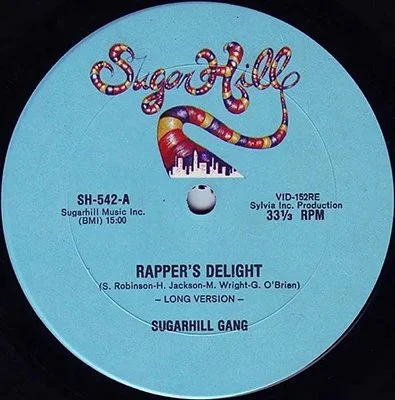
Record label of the single “Rapper’s Delight” by Sugar Hill Gang, 1979

11 February 2026

Rap has four broad senses, all stemming from the first: a blow or strike; a criminal charge; an utterance or conversation; and a musical genre.

The sense of rap meaning a blow or strike is probably echoic in origin. Much like tap and clap, it represents the sound of the blow. The earliest citation in both the Oxford English Dictionary and the Middle English Dictionary is from the poem Roland and Vernagu, found in the Auchinleck manuscript, which was copied c. 1330. The passage depicts a battle between the knight Roland and the giant Vernagu:

Þai gun anoþer fiȝt,
And stones togider þrewe.
Gode rappes for þe nones,
Þai ȝauen wiþ þe stones,
That sete swithe sore.

(They began another fight and together threw stones. In that place for the moment, they very violently gave good raps with the stones.)

The verb appears a few decades later.


The sense of rap, meaning a criminal charge comes from the sense of a blow or strike. It probably developed out of the metaphorical use of rap across the knuckles. We see this longer phrase used literally in a description of a juggler’s trick in Reginald Scot’s 1584 The Discouerie of Witchcraft, which also exposes the tricks of jugglers and stage magicians:

How to rap a Wag on the knuckles.

[…]

Laie one ball upon your shoulder, an other on your arme, and the third on the table: which because it is round, and will not easilie lie upon the point of your knife, you must bid a stander by laie it thereon, saieng that you meane to throwe all those three balles into your mouth at once: and holding a knife as a pen in your hand, when he is laieng it upon the point of your knife, you may easilie with the haft rap him on the fingers, for the other matter wilbe hard to doo.

Roman Catholic historian Hugh Tootell, under the pseudonym Charles Dodd, used rap over the knuckles metaphorically in his 1715 The Secret Policy of the English Society of Jesus to refer to a rebuke:

I shall call upon no other evidence upon this Occasion than his Holiness himself Clement VIII who acquitted the appealing Clergy in a special Brief, and reprimanded the Arch Priest for what he had acted against them; and if it be no Crime to mention the Society upon this Account, you also, Reverend Fatker [sic], have a sensible rap over the Knuckles in the same Brief.

And several decades later we have the lone rap being used metaphorically to mean a rebuke. From a 7 February 1777 letter by William Whipple to Josiah Bartlett, both signatories to the US Declaration of Independence:

I received your favor of 2d December, but not till the 26th January; what occasioned this delay in the post know not, but suppose the fault must lay with the post master general; he has lately had a rap, which I hope will have a good effect.

By the early nineteenth century, rap had acquired a slang sense f an arrest or criminal charge We see it in this poem about the 1838 act of parliament the previous year that abolished imprisonment for suspicion of debt:

But, any way, it does seem rather funny
To lock a man within four walls, and bid him seek for money.
There’s no occasion now for me to hide,
Tho’ once I was a deeply versed court guide;
I fear not now a single rap,
Nor startle at a tap.
From my boot’s sole to my hat crown,
I’ll have it all set down;
As to my tailleur, his suit’s a failure,
And talking of a writ, quite a mis-fit;
So, spite his measures, I’ll take my pleasures;
And, since for debt I need not run away,
Shall I, like vulgar traders, stoop to pay?
Nay!

Rap here, like suit and measures, is being used as a double entendre meaning both a physical blow and a criminal arrest.

The term rap sheet, meaning a police record of a person’s criminal arrests and charges dates to at least 31 May 1931, when it appears in the Tulsa Tribune:

W. F. Worley, another on the liquor defendants list, has a seven-year sentence for arson on his rap sheet, and Jess S. Shive did time at McAlester for grand larceny.

Several of the earliest uses are from Tulsa, hinting that rap sheet may have originated in the local police slang. Here’s another from 8 December 1932 in the Tulsa Daily World:

“The heaviest rap sheet, however, doesn’t mean the most desperate criminal,” Charles Carr, detective sergeant will tell you.

A crafty criminal like [Pretty Boy] Floyd will be picked up only once in a while and the police record on him will be incomplete. It’s those who don’t know their racket and bungle their jobs who get the heavy rap sheet records.

Some incorrectly believe this use is from an acronym for record of arrests and prosecutions, but while you can find this etymology in police manuals and forms, it is a backronym and not the origin of rap.

Another false belief is that this criminal sense of rap comes from counterfeiting and carries a connotation of the criminal charge being false. Rap did once refer to a counterfeit coin. This slang sense probably comes from the Irish rapaire, also meaning a counterfeit coin, but one cannot discount the possibility that it comes from the English as coins are also said to be struck when they are minted. Jonathan Swift refers to such raps in a 1724 open letter about a new brass coin being privately minted in Ireland:  

The Fact is thus, It having been many Years since COPPER HALF PENCE or FARTHINGS were last Coined in this Kingdom, they have been for some time very scarce, and many Counterfeits passed about under the name of RAPS, several Applications were made to England, that we might have Liberty to Coin New ones, as in former times we did; but they did not succeed.

But this sense of a counterfeit coin was dying out in the nineteenth century when the criminal sense of rap developed. The connection of a criminal charge to the counterfeit coin is claimed because of the phrase bum rap, meaning a false criminal charge, but the use of the modifier bum indicates that the unmarked rap is not necessarily, or even usually, false.


The sense of to rap, meaning to speak arose in the sixteenth century, originally meaning to speak sharply, quickly, or vigorously, as if one’s words were blows. It was commonly used in reference to swearing an oath. Thomas Wyatt writes in 1541 in his own defense regarding the charges by Edmund Bonner and Simon Heynes that he had an immoral lifestyle and had spoken against the king:

By this you may perceave that ether theie lye in the tyme and the place, or else thei lye in the reportinge the thynge. But by cawse, I am wonte some tyme to rappe owte an othe in an erneste tawlke; looke how craftylie theie have put in an othe to the matter to mayke the matter seme myne.

By the eighteenth century it was being used in criminal slang, meaning to give evidence, to inform on another. In 1728 criminal James Dalton gave a Genuine Narrative of his crimes in which has this:

This practice of Haul Cly [i.e., pickpocketing], he says, they frequently follow'd  at the Playhouse, when the Audience came out; and there, says he, the Whores are our Safeguard; for when we sling for a Cly, if we are taken on Suspicion, they’ll rap for us, if they are not of the Community of Fro Files [i.e., female pickpockets].

And the glossary at the back of the book defines rap as “swearing against a person.” This criminal slang ties in with and may have influenced the previously discussed sense of a criminal charge.

And by the mid eighteenth century, to rap could also mean to recite poetry. From Henry Fielding’s 1742 novel Joseph Andrews:

Adams then rapt out a hundred Greek verses, and with such a Voice, Emphasis and Action, that he almost frighten’d the Women.

While it is tempting to link Fielding’s use here with present-day rap music, this poetic connection doesn’t seem to have been a distinct sense, for later in the book Fielding writes:

He stopt his Horse, and swore she was the most beautiful Creature he ever beheld. Then instantly alighting, and delivering his Horse to his Servant, he rapt out half a dozen Oaths that he would kiss her; to which she at first submitted, begging he would not be rude.

Rap also developed a sense of ordinary speech or conversation. Joseph Ritson writes in a 1787 letter:

I shall be most glad of my Lords arrival if it were only for the raps you promise me.

The editor of the 1833 volume in which the letter is published glosses this use of raps as “news.”

By the beginning of the twentieth century this sense had crossed the Atlantic. There is this example from the 16 June 1900 issue of the National Police Gazette where boxer John L. Sullivan uses rap meaning a speech, but given the context, the metaphor of a blow or punch is clearly evident:

Justice Martin finally got Sullivan to understand that he was not an expert, and could not testify as he was doing, and the big fellow left the stand disgusted.

“I knew it was agin evidence,” he said when he got into the corridor, “but I got in my rap before they could duck, see? Say, if they’d given me the chance I’d have made the whole lot of them look like 30 cents, especially that lawyer.

And Damon Runyon writes in 1929:

I get to the Marberry around nine o’clock and who opens the door of Madame La Gimp’s apartment for me but Moosh, the door man from Miss Missouri Martin’s Sixteen Hundred Club. Furthermore, he is in his Sixteen Hundred Club uniform, except he has a clean shave. I wish Moosh a hello, and he never raps to me buy only bows, and takes my hat.

And Timothy Leary writes this in 1966:

He started a three-hour rap abou[t] energy, electronics, drugs, politics, the nature of God and the place of man in the divine system.


The musical sense of rap flows out of the speech sense, a reference to the rhythmic delivery of the lyrics. There is this in the 5 May 1979 issue of Billboard:

Rapping DJs reminiscent of early r&b radio jocks such as Jocko and Dr. Jive are making an impressive comeback here—not in radio but in black discos where a jivey rap command as much attention these days as the hottest new disk.

Young DJs like Eddie Cheeba, DJ Hollywood, DJ Starski, and Kurtis Blow are attracting followings with their slick raps All promote themselves with these snappy show business names.

Many black disco promoters now use the rapping DJs to attract young fans to one-shot promotions and a combination of the more popular names have filled this city’s [i.e., New York] ballrooms.

The young man credited with reviving the rapping habit in this area is DJ Hollywood, who started gabbing along with records a few years ago while working his way through school as a disco DJ.  

Hollywood is now so popular that he has played the Apollo with billing as a support act. It is not uncommon to hear Hollywood’s voice coming from one of the countless portable  tape players carried through the city’s streets. Tapes of Hollywood’s raps are considered valuable commodities by young blacks, here.

[…]

Cheeba says the rapping craze grew out of a need for something more than records.

“These people go to discos every week and they need more than music to motivate them,” Cheeba observes. “I not only play records, but I rap to them and they answer me.”

[…]

[Starski] generally works with Cool DJ AJ, who does not rap but is a master of B-beats. B-beats are series of short rhythm breaks strung together to sound like one song.

Starski is proud of his ability to excite a crowd with his rapping. “It’s a beautiful thing to see a dance floor full of people dancing to your music and answering your rap,” Starski says.

In September of that year the Sugarhill Gang released their single Rapper’s Delight, which had the lyrics:

Now, what you hear is not a test, I’m rapping to the beat
And me, the groove, and my friends are gonna try to move your feet

The Sugarhill Gang is often credited with coining this particular sense of rap, but while they were one of the first to use it in published form, and perhaps were the first to use the word in song lyrics, they were using a word that was already familiar among their musical circle.

By the following year rap had become the name for the musical genre.

Discuss this post


Sources:

“Abolition of Arrest on Suspicion of Debt, 1838” (October 1839). The Comic Almanack, first series 1835–43. London: Chatto and Windus, 191. HathiTrust Digital Library.

“Criminals and Pictures Change Since First Police Photograph Back in 1913.” Tulsa Daily World (Oklahoma), 8 December 1932, 9/6. Readex: America’s Historical Newspapers.

Dodd, Charles (Hugh Tootell). The Secret Policy of the English Society of Jesus. London: John Morphew, 1715, 151–52. Gale Primary Sources: Eighteenth Century Collections Online (ECCO).

Fielding, Henry. The History of the Adventures of Joseph Andrews, vol. 2. London: A. Millar, 1743, 18, 163. HathiTrust Digital Library.

Ford, Jr., Robert. “Jive Talking N.Y. DJs Rapping Away in Black Discos.” Billboard, 5 May 1979, 3, 54. ProQuest: Billboard (Archive: 1963–2000).

A Genuine Narrative of All the Street Robberies Committed Since October Last by James Dalton. London: J. Roberts, 1728, 10–11, 60. Archive.org.

Green’s Dictionary of Slang, accessed 21 December 2025, s.v. rap, n.1, rap, n.2, rap, v.1, rap, v.2.

“John L. as an Art Critic.” National Police Gazette (New York), 16 June 1900, 7/4. ProQuest Magazines.

Leary, Timothy. “God’s Secret Agent A.O.S.3” (1966). Politics of Ecstasy. Berkeley: Ronin, n.d., 277. Archive.org.

Middle English Dictionary, 2001, s. v. rappe, n.; rappen, v.(1).

“Once Wealthy Stockman Now Facing U.S. Liquor Charge.” Tulsa Tribune (Oklahoma), 31 May 1931, 7/6. Newspapers.com.

Oxford English Dictionary Online, December 2008, s.v. rap, n.2, rap, v.2, rap, n.4, rap sheet, n.

Ritson, Joseph. Letter to Jack Rowntree, 28 October 1787. In The Letters of Joseph Ritson, Esq., vol. 1 of 2. London: William Pickering, 1833, 129. HathiTrust Digital Library.

Robinson, Sylvia, Henry “Big Hank” Jackson, Michael “Wonder Mike” Wright, and Guy “Master Gee” O’Brien (Sugar Hill Gang). “Rapper’s Delight.” Sugar Hill Records, 1979. AZLyrics.com.

“Roland and Vernagu” (c. 1330). Edinburgh, National Library of Scotland, Advocates MS 19.2.1.

Runyon, Damon. “Madame La Gimp. Cosmopolitan, October 1929. 65/2. Archive.org.

Scot, Reginald. The Discouerie of Witchcraft. London: Henry Denham for William Brome, 1584, book 13, chapter 23, 324. ProQuest: Early English Books Online (EEBO).

Shapiro, Fred. “Re: [ADS-L] ‘rap sheet’ (1932).” ADS-L, 25 December 2025.

Swift, Jonathan (pseud. M. B. Drapier). A Letter to the Shop-Keepers, Tradesmen, Farmers, and Common-People of Ireland, Concerning the Brass Half-Pence Coined by Mr. Woods. Dublin: J. Harding, 1724, 3. Gale Primary Sources: Eighteenth Century Collections Online (ECCO).

Whipple, William. “William Whipple’s Letter. No. III” (7 February 1777). American Pioneer, 2.1, January 1843, 17. HathiTrust Digital Library.

Wyatt, Thomas. “37 Wyatt’s Defence.” In Kenneth Muir, ed. Life and Letters of Sir Thomas Wyatt. Liverpool: Liverpool UP, 1963, 199. Archive.org.

Image credit: Sugar Hill Records, 1979. Fair use of a low-resolution copy to illustrate the topic under discussion.
take me to your leader

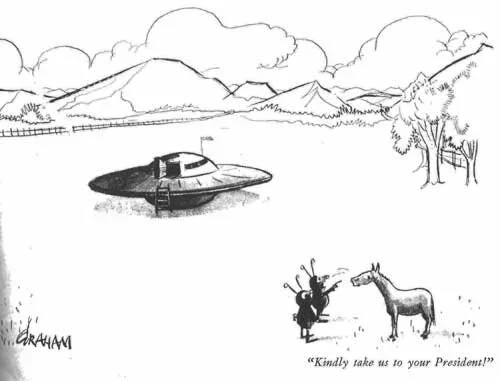
Cartoon by Alex Graham of a flying saucer and two aliens addressing a horse, saying, “Kindly take us to your President!”

6 February 2026 [Updated 9 December with 1950 citation]

The phrase take me to your leader is a science fiction cliché, so much so that in the 2007 “Voyage of the Damned” Christmas episode of Doctor Who the time-traveling, title character said, “Take me to your leader! I’ve always wanted to say that!” (Another phrase in that episode that the good doctor always wanted to say was “Allons-y Alonso!”)

The current popularity of the phrase and its application to extraterrestrials and flying saucers dates to the 1950s, but the phrase itself is considerably older. The first known application of a variant of the phrase to first contact with extraterrestrials dates to 1950 in a science fiction story by Roger Dee:

“You couldn’t rightly say there is a charge, mister,” he admitted. “Your uncle popped into Ben Stuart’s Drop Inn restaurant night before last with a little black box under his arm, naked as a jaybird and talking like a crazy man.

“‘I’m a visitor from Mars,’ he says. ‘Take me to your president, and quick!’ Ben thought he was crazy, or drunk, and ran him out with a meat cleaver, and the old duck went down to the Warner Hotel and pulled the same goofy act.’”

The phrase in this form reached a wider audience on 21 March 1953 with a cartoon by Alex Graham that appeared in the New Yorker (shown here). The cartoon depicts a flying saucer that has landed in a field and two aliens talking to a horse, saying, “Kindly take us to your President!”

We see the phrase in its familiar form in an Associated Press article from 21 August 1956 that reported on the Republican National Convention in San Francisco:

One delegate, intrigued by an outer-space type of portable transmitter in the hands of a network reporter, walked up and demanded, “Take me to your leader.”

But the 10 October 1956 issue of Variety also reports on this incident, calling it “the old space-man gag,” indicating that the catchphrase was already well associated with UFOs.

And before the extraterrestrial invasion of our popular culture, the phrase appears quite often in adventure fiction dating back to the nineteenth century. For instance, there is this from Edward Mitford’s 1867 The Arab’s Pledge: A Tale of Marocco in 1830:

Yusuf had been a patient spectator of the scenes which had been enacted, but it now came to his turn, and one of the robbers approached to strip him.

“Friend,” said he, “offer me no violence. I am under the protection of your Sheik Sidi Hamed Ibn Ishem. My journey is to meet him. In his name, forbear.”

“Infidel dog!” said the robber, “this trick shall not save your gold; you would give a drop of blood for every copper rather than part with it. You know the reward of resistance;” and he seized the defenceless Jew.

“Stop,” said another. “we may repent, if the infidel speak truth. Jew,” said he to Yusuf, “you come alone; have you no token?”

“I have,” said he, “but it is as my life; take me to your leader.”

This 1867 example may have simply been a collocation of the words as opposed to being a catchphrase, but the subsequent instances in nineteenth- and early twentieth-century fiction clearly establish it as a set phrase. A witness to this ossification of the words is an incident reported in the San Francisco Chronicle of 17 June 1956. A trans-Pacific flight carrying, among others, comedian Red Skelton was forced to return to San Francisco because of engine trouble:

On arrival here [Skelton] emerged from the plane giving an Indian salute and exclaiming:

“How! You take me to your leader!”

So the association of extraterrestrial with take me to your leader is the result of a cultural shift from images of European colonial encounters with Indigenous people to those of aliens making first contact with humanity.

Discuss this post


Sources:

Dee, Roger. “Ultimatum.” Planet Stories, 4.6, Spring 1950, 98–101 at 98. Archive.org.

Chandler, Bob. “Doug Edwards Does Some 10th Anni Reflections on TV Commentating.” Variety, 10 October 1956, 46/3. ProQuest Magazines.

“Clipper in Trouble, Skelton Gives Show.” San Francisco Chronicle (California), 17 June 1956, 6/8. Readex: America’s Historical Newspapers.

Graham, Alex. Cartoon. New Yorker, 21 Mar 1953, 43. Archives.newyorker.com.

MMcM. “Take Me to Your Leader!” (comment). Languagehat, 7 February 2026.

Mitford, Edward L., The Arab’s Pledge: A Tale of Marocco in 1830, London: Hatchard and Co., 1867, 62–63. Archive.org.

Pett, Saul, Associated Press. “Convention TV Has Bad Times.” Atlanta Journal, 21 August 1956, 14/2. ProQuest Newspapers.

Shapiro, Fred, ed. The Yale Book of Quotations. Yale University Press. 2006, 320.

Image credit: Alex Graham, 1953. Fair use of a low-resolution copy of a copyrighted image to illustrate the topic under discussion.

tell it to the marines

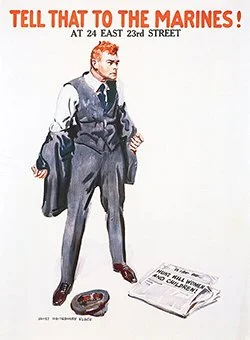
Man doffing his coat as if to fight; a newspaper telling of German atrocities at his feet; caption: “Tell it to the marines”

James Montgomery Flagg, 1917, US WWI recruiting poster

9 February 2026

The origin of the phrase tell that to the marines is exactly what you might think it to be, an expression originally used by sailors that implies their shipmates in the marines are gullible. The earliest example of the phrase that I’m aware of is in John Davis’s 1806 novel The Post-Captain: or, The Wooden Walls Well Manned. Here it is used in an exchange between a sailor and an officer about a young woman who has just been brought aboard ship:

“Is not Flora, sir, a French name?”

“Yes it is; it is Creole French.”

“But the lady, sir, is English. Her husband at least said so.”

“He may tell that to the marines, but the sailors will not believe him.”

At first glance, this use might be just a simple collocation of the words rather than a set phrase. But the phrase appears three other times in the novel, each one followed by some variation saying that sailors are not so gullible.

By December 1820 we see the phrase being used outside a naval context. The article itself, which appears in the New Monthly Magazine and Universal Register, has nothing particular to do with the sea, although the writer connects the phrase to life aboard ship. The introduction of the phrase with nostrum illud solenne (our usual) indicates that it is a catchphrase:

So also the able-bodied seamen, who think a certain part of their crew mere fruges consumere nati on board a ship, regularly consign all exaggerated narratives and incredible propositions to their “willing ears,” according to nostrum illud solenne, “You may tell that to the marines.”

Fruges consumere nati = exist to eat (lit., born to consume crops)

And by 1821 we have an example of the phrase that makes no nautical reference at all. Irish novelist Sydney Morgan (1778–1859) uses it a piece that savages a reviewer or her travelogue of Italy:

“In page 3,” adds this Captain O’Blunder of the Edinburgh,—“in page 3, Conquest is said to be consolidated by Usurpation; but I beg to inform Miladi, that Conquest consolidates Usurpation!"

Oh, my Chronomastix, you may “tell that to the Marines,” but the Cæsars and Napoleons would never have believed you! They were Conquerors first—Emperors afterwards; and they consolidated the conquests, which gave them an influence over the opinions of their fellow citizens, by usurpations, which gave them power over their rights

I think there are many authors who would like to respond to critics in a similar tone and fashion.

Discuss this post


Sources:

Davis, John. The Post-Captain: or, The Wooden Walls Well Manned. London: G. Hazard for Thomas Tegg, 1806, 28–29. Gale Primary Sources: Nineteenth Century Collections Online.

Morgan, Sydney. “Letter to the Reviewers of ‘Italy.’ Edinburgh Magazine, July 1821.” New Monthly Magazine and Literary Journal (London), vol. 2, 1821, 6–26 at 9–10. HathiTrust Digital Archive.  

“The New Adventurer.—No. III.” New Monthly Magazine and Universal Register (London), December 1820, 605–608 at 608/1. ProQuest Historical Periodical.

Oxford English Dictionary Online, September 2015, s.v. tell, v.

Image credit: James Montgomery Flagg, 1917. Wikimedia Commons. Public domain image.

franchise / enfranchise / disenfranchise

Photo of a McDonald’s restaurant in Moncton, New Brunswick, Canada

2 February 2026

The English franchise is a borrowing of an Anglo-Norman word, which could mean freedom in various contexts. It could mean freedom as opposed to serfdom; a special right, privilege, or exemption; a corporate body, such as a town or guild; citizenship or membership in a corporate body; or an area of land in which such privileges or corporate bodies could operate. Franchise could mean nobility of character. These senses were all imported into English.

We see the Middle English fraunchise in a life of St. Edmund in the South English Legendary, written c. 1300:

Wel ofte he bad þe kingue and his : ȝif it were heore wille,
Þat huy ne weorreden nouȝt a·ȝein holi churche : ake laten hire beo stille
In hire fraunchise and in pays : asc heo hadde i-beo ȝare.

(Very often he asked the king and his, if were their will, that they not war against the holy church, but to grant her tranquility in her franchise and in peace, as she had before.)

The French verb form, franchir, was brought into English at about the same time, as well. A bit later however, by the early fifteenth century, the French enfraunchir was also borrowed into English, and that would become the English verb to enfranchise, eventually replacing the form to franchise. It is commonly thought that this verb is a combination of en- + franchise, but that combination occurred in French, and English borrowed the already combined form.

In contrast, the addition of the prefix dis- to the verb, meaning to deprive someone of a right, occurred in English. We see disfranchise by the mid fifteenth century and disenfranchise by the mid seventeenth.

The sense of franchise meaning a right or privilege specialized to refer to particular such rights, for instance the right to vote, was in place by 1769. In early use this was often in the phrase elective franchise. And the sense of the right to operate a business under a certain brand, such as a sports or fast-food franchise, is in place by the late nineteenth century.

Discuss this post


Sources:

Anglo-Norman Dictionary, AND2 Phase 2, 2006–28, s.v., franchise, n., franchir, v.; AND2 Phase 1, 2000–06, s.v. enfranchir, v.

Horstmann, Carl, ed. “St. Eadmund þe Confessor.” The Early South English Legendary. Early English Text Society. London: N. Trübner, 1887, lines 515–17, 446. Oxford, Bodleian Library, MS Laud 108. HathiTrust Digital Library.

Middle English Dictionary, 8 October 2025, s.v. fraunchis(e, n., fraunchisen, v., enfraunchisen, v., disfraunchisen, v.

Oxford English Dictionary Online, September 2009, s.v. franchise, n., franchise, v.; 1891, s.v. enfranchise, v.; 1896, s.v. disenfranchise, v., disfranchise, v.

Photo credit: Stu Pendousmat, 2008. Wikimedia Commons. Licensed under the Creative Commons Attribution-Share Alike 3.0 Unported license.

Tommy / Tommy Atkins

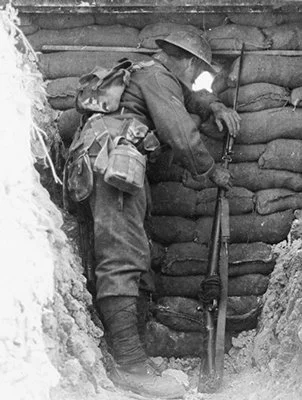
B&W photo of a WWI soldier with a rifle standing in a trench and looking through a gap in a wall of sandbags

A Tommy of the Worcester Regiment in a trench at Ovillers-la-Boisselle, 1916

30 January 2026

The great joy of running this website is that now and again I uncover an origin that simultaneously connects with great historical figures and events and reveals how language, the most human of inventions, works. The British slang term for a soldier, Tommy, is just such a word. It is short for Tommy Atkins, and the word’s history, both purported and real, pulls in both the great, i.e., the Duke of Wellington, and the small, i.e., an example of how to fill out a government form correctly.

As mentioned, Tommy is slang for a British private soldier. It is famously used in an 1890 Rudyard Kipling poem of that title, although that is hardly the first use of the term:

I went into a public-’ouse to get a pint o’ beer,
The publican ’e up and sez, “We serve no red-coats here.”
The girls be’ind the bar they laughed an’ giggled fit to die,
I outs into the street again an’ to myself sez I:

O it’s Tommy this, an’ Tommy that, an’ “Tommy go away”;
But it’s “Thank you, Mister Atkins,” when the band begins to play,
The band begins to play, my boys, the band begins to play,
But it’s “Thank you, Mister Atkins,” when the band begins to play,

Today, the word is chiefly associated with those who fought in the First World War—the British equivalent of the American doughboy—but its origins are at least a hundred years older, dating to the Napoleonic wars, if not before. It’s primarily found in British usage, but North Americans may be familiar with Tommy from movies about the two World Wars and from the Kipling poem. And the oldest among us will remember its use during the first half of the twentieth century, when the word had some currency on this side of the pond.

Who is the Tommy Atkins who lent his name as a sobriquet for the British soldier? Most likely there is no real person behind the term’s use. While there have been a number of British soldiers with that name over the centuries, the name was probably picked because its only remarkable feature is its lack of remarkability, like John Smith. The first securely documented use of the term is in the form Thomas Atkins. And not only is it in that form, it’s quite literally on a form, the 1815 Collection of Orders, Regulations, &c., a book that was issued to every British soldier and that contained a record of his pay and allowances. Like all good bureaucratic documents, that book provides an example of how to properly fill out a form for a soldier’s pay:

Description, Service, &c. of Thomas Atkins, Private, No. 6 Troop, 6th Regt. of Dragoons. Where Born… Parish of Odiham, Hants.
When ditto… 1st January 1784.
Height… 5 Feet 8½ inches.
[...]
Bounty, £7, 7s. Received, Thomas Atkins, his X mark.

The beauty of this specific use is that it would have been seen by thousands of officers and soldiers all across the British Empire, permanently cementing the name’s use as a soldier’s sobriquet. In fact, this book was so closely associated with the name that soldiers took to calling the book itself the Tommy Atkins. We tend to look to Shakespeare and great literary works for linguistic innovation, but more often it’s things like humble bureaucratic documents, texts that we see on a daily basis but don’t take conscious note of, that leave a more profound mark on the language.

There is a popular story that the name in the 1815 document was coined by the Duke of Wellington in honor of a soldier who had died bravely at the Battle of Boxtel in 1794, Wellington’s first major battle. The story, which is unsupported by any evidence other than repeated hearsay claims that it is true, says that the war office consulted the duke on an appropriate name for a soldier to use in its 1815 pay book and that Wellington recalled the battle where Atkins, as he lay dying, told the young duke-to-be that the multiple wounds he had received were “all a day’s work.” Wellington allegedly chose the name to honor the brave lad. In addition to these alleged last words being too good to be true, the biographical details in the pay book don’t match those of the alleged namesake, and most tellingly, it is unlikely that the War Office would have bothered Wellington with such bureaucratic minutiae in 1815, given that the duke was busy with other things at the time, such minor concerns as the Battle of Waterloo and exiling Napoleon to St. Helena.

If this tale has no evidence behind it, what evidence would it take to convince us that it were true? Well, if someone produced a draft manuscript of the 1815 pay book with Wellington’s emendation or a letter from the Duke instructing the change be made, that would clinch it. Failing that, an after-the-fact letter or memoir of Wellington’s telling the story of his directing the change would be almost as good. A documented, second-hand account by someone who knew Wellington would be strong evidence, but not in-and-of-itself convincing. Even evidence from muster rolls that a soldier named Thomas Atkins of the 33rd Regiment of Foot (Wellington’s regiment) died at Boxtel would be something. But we have none of these or anything like them.

Furthermore, the Wellington story doesn’t appear until many decades after the fact—the earliest version I know of that connects Wellington to Tommy Atkins only dates to 1908, and that one that is demonstrably false because it gives the date of Wellington’s coinage as 1843. I have found no versions of the tale, even those told by professional historians, that reference any source material that would support the tale as being true. The tale is simply repeated and everyone, even historians who should know better, take that repetition as evidence. If the Iron Duke ever related the Atkins story to someone, we have no record of him doing so. More likely this is another example of a famous name over time becoming associated with a myth. We have a tendency to ascribe events and phenomenon to famous people.

There is a possible older use of Tommy Atkins to refer to generic British soldiers from 1743, although the evidence for this appearance is only in secondary sources. On 24 December 1937, the Daily Telegraph, which had been publishing an ongoing series of reader commentaries on the origin of the term, published this letter:

Sir—In reference to the interesting discussion in your columns concerning the genesis of the term “Thomas Atkins” as generally applied to the British soldier, it would appear that the appellation had its origin long before the period attributed to Wellington.

This is evidence from a M.S. letter in my possession, dated 1743, and addressed from Jamaica, in which the writer, an Anglo-Irish officer, after giving a vivid and thrilling description of a mutiny among the hired soldiery, says: “… Except for those from N. America (mostly Irish Papists), ye Marines and Tommy Atkins behaved splendidly…”

So much for the modern habit of dogmatic finality on the part of our would-be historians.—Faithfully yours,

EDW. E. BURGESS, F.R.S.A.
Granton-road, Leeds. Dec. 22.

If the manuscript letter is genuine, this would push the date of the term to the first half of the eighteenth century. That is certainly plausible, but all we have is this account of the letter from 1937. But even if the 1743 letter isn't genuine, it is likely that by the time the 1815 document was issued Thomas (or Tommy) Atkins was already a generic slang term for a soldier, and its appearance in the 1815 document is an attestation, rather than a coinage.

Perhaps it is fitting that the archetype of the British soldier be named for someone who exists only in myth.

Discuss this post


Sources:

Burgess, Edward E. “Tommy Atkins in 1743” (letter, 22 December 1937). Daily Telegraph and Morning Post (London), 24 December 1937, 9/2. Gale Primary Sources: The Telegraph.

Carter, Philip. “Atkins, Thomas (d. 1794),” Oxford Dictionary of National Biography, Oxford University Press, 2004, online ed, May 2006.

Clode, Charles M. The Military Forces of the Crown: Their Administration and Government, vol 2 of 2. London: John Murray, 1869. 59. HathiTrust Digital Library.

Green’s Dictionary of Slang, accessed 12 December 2025, s.v. Tommy Atkins, n.

Kipling, Rudyard. “Barrack-Room Ballads. II—‘Tommy.’” Scots Observer, 1 March 1890, 409–10 at 409/2. British Newspaper Archive.

Laffin, John. Tommy Atkins: The Story of the English Soldier. London: Cassell, 1966. xi–xiii. Archive.org.

Oxford English Dictionary Online, June 2014, s.v. Thomas Atkins, n., Tommy Atkins, n.; January 2018, s.v. Tommy, n.1.

Photo credit: John Warwick Brooke, 1916. Imperial War Museum. Wikimedia Commons. Public domain image.