weaponize / weaponized

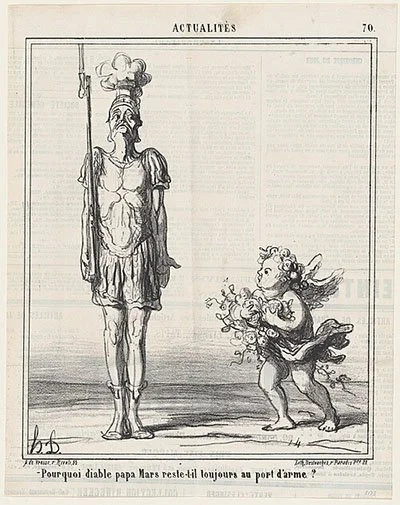
Lithograph on newsprint of the god Mars standing at attention with a rifle and Cupid carrying flowers

“Why in hell is Papa Mars still carrying a weapon?” 27 March 1868

16 March 2026

The verb to weaponize (weapon + -ize) literally means to turn something into an armament. It also has a figurative meaning of using something to undermine, criticize, or oppose others. And accompanying the verb is the adjective weaponized. The words came into widespread use during the Cold War between the United States and Soviet Union. In particular, 1957 is when newspapers, in articles about US ballistic missile programs, started to frequently use the words in their literal sense. But there are uses of weaponize long before this.

The earliest use that I have found is in Vermont’s Rutland Daily Herald of 28 December 1871 in a letter from a traveler to Spain:

I have also observed how general is the custom among the senoritas to trim their unclipped finger-nails sharply to a point, a custom to which to say nothing of its detraction from womanly charms, is very suggestive of an intent to weaponize hands God made for caressing.

While this usage is not in reference to the military, it is a literal use of the verb, turning fingernails into weapons.

There is an odd figurative use of the verb in the Santa Barbara News-Press of 2 April 1944. It uses weaponize as an intransitive verb:

A raised eyebrow might tax your credulity, but a raised lorgnette, madame, will tax you plenty and the piper you pay is your Uncle Sam, who says that plain garden variety spectacles come under the category of necessities, but the long, single-handed optical aid that cartoonists put on grand dames, to weaponize and politely terrorize the little people, will come high.

Of course, the intent might have been to “weaponize the lorgnette,” but if so, it’s poorly phrased.

Figurative use of the adjective weaponized dates to at least 7 August 1960, when it is used in the Binghamton Press in an article about tax policy:

Nothing is sacred in the cool eyes of New York State’s increasingly weaponized tax men. Not even the traditional haphazard financial habits of boxers, wrestlers and chorus girls.


Sources:

Heavey, James. “State Tax Collector Ready for Troupers.” Binghamton Press (New York), 7 August 1960, 12-C/1.

Miss Barbara. “Town Chatter.” Santa Barbara News-Press (California), 2 April 1944, B-3/5–6. Newspapers.com.

O’Toole, Garson. “Re: [ADS-L] weaponize (1871; weaponized (1960).” ADS-L, 23 February 2026.

Oxford English Dictionary Online, December 2008, s.v. weaponize, v., weaponized, adj.

“What a Merchant Saw in Europe” (8 April 1871). Rutland Daily Herald (Vermont), 28 December 1871, 2/4. Readex: America’s Historical Newspapers.

Image credit: Arnauld de Vresse, Pierre Louis Hippolyte Destouches, and Honoré Daumier, Le Charivari, 27 March 1968. Wikimedia Commons. Public domain image.
boycott

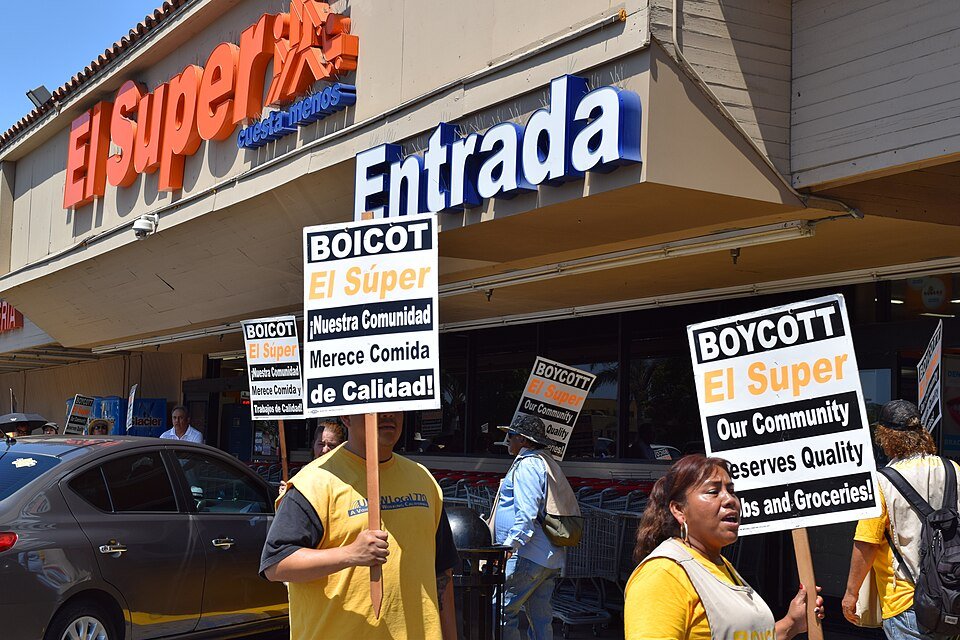
Picketers in front of an Oxnard, California supermarket carrying signs that read Boycott in English and Boicot in Spanish

Picketers in front of an Oxnard, California supermarket carrying signs that read Boycott in English and Boicot in Spanish

13 March 2026

To boycott someone or something is to refuse to buy goods or otherwise engage in commerce with them. Boycotts are usually undertaken as a form of economic, political, or social protest.

Boycott is an eponym, a word that comes from a person’s name. The namesake is Captain Charles Boycott, who managed the Irish estates of the Earl of Erne, an absentee landlord in County Mayo, Ireland. In September 1880, Erne’s tenants and laborers were demanding reduced rents, and Boycott evicted them. In response, the Irish Land League, under the leadership of Charles Parnell, organized the tenants and neighbors to resist the evictions, refuse to rent a farm from which someone had been evicted, refuse to work on the estate Boycott managed, and even to refuse to deliver the mail to Boycott. Boycott managed to get the autumn crop harvested, but at a loss, and by the end of the year he had resigned his post and returned to England.

News of the actions at Boycott’s farm was reported in newspapers throughout Ireland and Britain on 25 September 1880. But at this point the land agent’s name was not yet being used as either a verb or a noun. Here is what London’s Daily News said on that date:

Thursday was the last day for serving the processes, and on Sub-Inspector M‘Cardle making his appearance a crowd proceeded to the house of the agent, Captain Boycott, and drove off every labourer and tenant on the estate. It was resolved that the agent should be deprived of any help whatever from the tenantry.

But on 1 November 1880, the verb to boycott appears in newspapers throughout Ireland and Britain. Here is a passage from Dublin’s Freeman’s Journal of that date:

Mr. John Lavelle proposed—
That we hereby pledge ourselves to take no land from which a tenant has been evicted.
He advised the people to “Boycott” any man who took a farm from which another was evicted.

And by December 1880, the noun boycott and the adjectival use of the past participle boycotted are in place. The Times of London on 9 December uses both:

The magistrates feel a difficulty about treating the Land League meetings as unlawful assemblies, and this makes the law in a great measure inoperative. They also do not feel warranted in regarding the threat of “Boycott” as one that comes within the Act, as it does not refer to violence. This appears to be unreasonable, as Boycotting is a most effectual means of intimidation.

[…]

A butcher who was charged with buying the sheep of a “Boycotted” farmer came forward and stated that for all he possessed he would not break the rules of the League. He had erred through the inadvertence and he promised not to offend again.

The rapidity with which the word boycott caught on is astounding. It even managed to make its way into French by the end of the year. Also surprising is that the term has lasted. Most such eponyms rapidly fade as the events that inspired them recede into memory. For example, how many people still use to bork, meaning to defame someone in order to prevent them from attaining public office, a word inspired by the treatment political opponents gave U.S. Supreme Court nominee Robert Bork in 1987. Boycott has not only survived, but most people who use the word don’t even know who Charles Boycott was.

Discuss this post


Sources:

“Ireland.” Daily News (London), 25 September 1880, 6/5. Gale Primary Sources: British Library Newspapers.

“Ireland” (8 December). Times (London), 9 December 1880, 10/2. Gale Primary Sources: Times Digital Archive.

“The Land Question.” Freeman’s Journal (Dublin), 1 November 1880, 6/8. Gale Primary Sources: British Library Newspapers.

Oxford English Dictionary Online, December 2008, s.v. boycott, v., boycott, n.

Photo credit: United Food and Commercial Workers (UFCW), 8 July 2017. Flickr.com. Wikimedia Commons. Licensed under the Creative Commons Attribution 2.0 Generic license.

tawdry

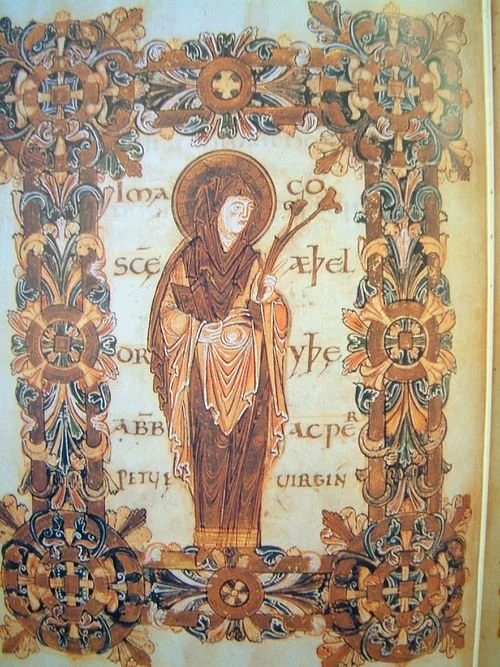
Medieval image of a woman with a halo

Saint Æthelthryth of Ely from the Benedictional of St. Æthelwold, a tenth-century illuminated manuscript in the British Library

11 March 2026

(Edit: minor factual corrections, 20 March 2026)

Something that is tawdry is cheap and gaudy. The word comes from the story of Saint Æþelðryþ (Æthelthryth), also known as Audrey, the daughter of Anna, a seventh-century king of East Anglia. Æthelthryth’s tale is recounted by Bede in his eighth-century Ecclesiastical History and by Ælfric in his late tenth-century Lives of Saints. It is said that Æthelthryth took a vow of perpetual virginity and managed to get through two marriages without sleeping with either husband. Her first husband died before he could get her into the marital bed, and the second marriage was eventually annulled, much to the relief of the very frustrated young man, who had gone so far as attempting to bribe the local bishop to release her from her vow and who, when she fled his advances, had chased after her across England. After the annulment, Æthelthryth took holy orders and went on to found an abbey in the town of Ely in East Anglia. Æthelthryth died of a large tumor on her neck, which she attributed to punishment for having worn many expensive jeweled necklaces in her younger years.

In the sixteenth and seventeenth centuries, lace necklaces, known as St. Audrey’s lace, were sold at the fair held each year on her feast day. And over time, the name of these lace necklaces became clipped to tawdry lace. The merchandise at this fair was the type of stuff that you would find at any tourist trap, cheap and gaudy, hence the fashion eventually became associated with finery of inferior quality.

John Palsgrave includes Seynt Audries lace in a glossary in his 1530 Lesclarcissement de la langue Francoyse, thought to be the first French grammar written in English. (Despite the French title, the text is in English.) Palsgrave translates the phrase with the French cordon, meaning tie. And we get tawdry lace by 1548, when we see it in a list of objectionable (i.e., Roman Catholic) religious practices in William Patten’s The Expedicion into Scotlande:

setting vp candels too saincts in euery corner, & knak kynge of beadstones in euery pewe, tollyng of belles against tempestes, Scala coeli Masses, Pardon Beades, Tanthonie belles, Tauthrie laces, Rosaries, Collets, charmes for euery diseas, and Suffrain suffrages for euery sore

(setting up candles to saints in every corner, & knacking of beads in every pew, tolling of bells against tempests, Scala coeli [ladder of heaven] Masses, Pardon Beads, Tantony [St. Anthony] bells, Tawdry laces, Rosaries, Collets, charms for every disease, and Suffering suffrages for every sore)

And we see tawdry lace, without any opprobrium, in Edmund Spenser’s 1579 Shepheardes Calender:

Ye shepheards daughters, that dwell on the greene,
     hye you there apace:
Let none come there, but that Virgins bene,
     to adorne her grace.
And when you come, whereas shee is in place,
See, that your rudenesse doe not you disgrace:
     Binde your fillets faste,
     And gird in your waste,
For more f[i]nesse, with a tawdrie lace.

But a century later, after the wearing of tawdry lace had fallen out of fashion, we see the adjective tawdry being used to mean cheap and gaudy. This usage appears in Nehemiah Grew’s 1672 Anatomy of Vegetables:

So that a Flower without its Empalement, would hang as uncouth and taudry as a Lady without her Bodies.

That’s how the name of an early medieval English saint came to mean something cheap and in poor taste.

Discuss this post


Sources:

Grew, Nehimiah. The Anatomy of Vegetables. London: for Spencer Hickman, 1672, 131. ProQuest: Early English Books Online (EEBO).

Oxford English Dictionary Online, 1910, s.v. tawdry, n. & adj., tawdry lace, n.

Palsgrave, John. Lesclarcissement de la langue Francoyse. London: Richard Pynson and John Hawkins, 1530, fol. 63r/2. ProQuest: Early English Books Online (EEBO).

Patten, William. The Expedicion into Scotlande, London: Richard Grafton, 1548, sig. c4v. ProQuest: Early English Books Online (EEBO).

Spenser, Edmund. The Shepheardes Calender. London: Hugh Singleton: 1579, fol. 13v. ProQuest: Early English Books Online (EEBO).

Image credit: Unknown tenth-century artist. London, British Library, Add MS 49598. Wikimedia Commons. Public domain image.

notorious

Photo of Ruth Bader Ginsberg, in judicial robe, sitting in a chair

The Notorious R.B.G.

9 March 2026

Usage manuals like to point out that notorious refers to someone or something of unfavorable reputation and that the word should not be used to mean merely famous or notable. While this is true to an extent, like many questions of usage the answer is more complicated, and in fact few writers actually use the word mistakenly.

Notorius comes into English a Medieval Latin word meaning famous, well-known, but it could also carry a negative connotation, infamous. When it was originally adopted into English it carried both of these connotations, the value-neutral one and the negative one. The adjective notorious isn’t recorded in English until the 1530s, but the adverb notoriously appears several decades earlier, around 1495, in a bill of attainder for Gerald fitz Thomas, earl of Kildare for treason and other crimes. Since adjectives generally predate their adverbial forms it is believed that the adjective is at least this old:

All we [which] wt [with] dyverse and many greate and horrible tresons, Rebellyons conceylmentes and conspiraces by him don & commytted contrary to his faith and allegeance be notoryously and openly knowne by due examynacon, and perfectly understanden to all the Lordes of this land and comynes of the same.

And we have this from a 1512 law granting a subsidy to King Henry VIII:

FOR ASMOCHE as it ys openly and notoryously knowen unto all p[er]sones of Cristes Religion, That Lewes the Frensche Kyng adversary unto owre moste drede Sovereigne and naturall liege Lorde Kyng Herry the viij and to hys realme of Englande hathe moved and styred and dayly moveth & styreth by all the subtyle meanes to hys powre to sett and bryng scisme variaunce and asmoche as in hym lyeth studyeth the meane of contynuall errour to be had in the Churche of Cryste.

In both of these examples the overall context may be a negative one, but the adverb notoriously is being used in with a value-neutral connotation, meaning simply openly, well known.

Another law book, this time from 1534, has two uses of the adjective notorious, and again both are in a negative context but the word itself has a value-neutral connotation. From the Constitutions Prouincialles, and of Otho and Octhobone:

LEt ther be in euery deanerye .ii. or .iii. men, hauynge god before theyr eyes, whych beynge appoynted at the commau[n]dement of the byshoppe or his officyalles maye denunce vnto them the open and notorious excesses of the prelates, & other clerkes.

And:

The preste may not inquyre the names of the persons with whom the co[n]fytent hath synned, but after confession he may inquyre, whether he were clerk or lay monke or preste or deane, & alwayes the greater crymes & specially suche as be notorious must be reserued to the hyer prelates

Very quickly, however, the word started being associated with fame of an unsavory or infamous nature. The 1549 Book of Common Prayer, for example, uses notorious twice. The first of these is again in a negative context but with the word itself carrying a value-neutral connotation:

And if any of those be an open and notorious euill liuer, so that the congregacion by hym is offended, or haue doen any wrong to his neighbours, by worde, or dede: The Curate shall cal hym, & aduertise hym, in any wise not to presume to the lordes table, vntill he haue openly declared hymselfe, to haue truly repented, and amended his former naughtie life.

And with the notorious itself carrying a negative connotation:

BRethre[n], in the primatiue churche there was a godlye discipline, that at the begynning of lente suche persones as were notorious sinners, were put to open penaunce, and punished in this worlde, that theyr soules myght be saued in the daye of the Lorde.

It was from oft-read uses like this that notorious acquired its unsavory reputation. But the sense of notorious with neutral, or even favorable, connotations did not go away and remains in use today. There is, however, a subtlety in its use.

When used to describe a person or persons, notorious carries the negative or infamous connotation, even if it is used humorously or in a mildly deprecating fashion, as when, for instance, Harry Truman writes in his diary of 20 September 1945:

We arrived in the Capital City at 7:45 P.M., E.S.T., and Alben and I had our pictures taken, as is usual when notorious persons leave or arrive in cities.

Almost two decades later, Truman uses the word again in his diary to describe himself, only this time it is even clearer that he is being playful with the word’s connotations. From 12 September 1962:

My home town, Independence, the County Seat of Jackson County, Missouri, is in my opinion the best place for a retired Missouri farmer to live. That state has had three “notorious” characters—Mark Twain, Jesse James and myself. The other two are shoveling coal for Pluto and I’m all that’s left to appear for them.

But when used to describe things or situations, notorious can have the neutral meaning of simply noted or famous. It can be pejorative, but such connotation has to be derived from the context and not simply from the word itself. Thus you get descriptions of “notorious dance marathons” of the 1920s or of E=mc2 as a “notorious equation.”

Most writers and native speakers of English understand this subtle distinction, even if it is only a tacit understanding, and will seldom use notorious incorrectly.

Discuss this post


Sources:

“Attainder of Gerald, Earl of Kildare.” In Agnes Conway, ed. Henry VII’s Relations with Scotland and Ireland, 1495–1498. Cambridge: Cambridge UP, 1932, 217. Lambeth, Carew MSS 603, fol. 177. Archive.org.

The Booke of the Commone Prayer and Administracion of the Sacramentes. London: Edward Whitchurch and Nicholas Hill, 1549, sig. fol. cc., fol. clii.v. ProQuest: Early English Books Online (EEBO).

Constitutions Prouincialles, and of Otho and Octhobone. London: Robert Redman, 1534, 76r, 94v. ProQuest: Early English Books Online (EEBO).

“De subsidio regi concess” (1512). 4 Hen. VIII. C. 19. In The Statutes of the Realm, vol. 3. London: 1817, 74. Archive.org.

Latham, Ronald E., David R. Howlett, and Richard K. Ashdowne, eds. Dictionary of Medieval Latin from British Sources. Oxford: British Academy, 2013, s.v. notorius. Brepolis: Database of Latin Dictionaries.

Merriam-Webster’s Dictionary of English Usage. Springfield, Massachusetts: 1994, s.v. notorious, 668–69. Archive.org.

Oxford English Dictionary Online, December 2003, s.v. notorious, adj.1 & adv., notoriously, adv.

Truman, Harry S. Off the Record: The Private Papers of Harry S. Truman. Robert H. Ferrell, ed. Harmondsworth, Middlesex, England: Penguin, 1980, 67, 406. Archive.org.

Photo credit: Steve Petteway/Supreme Court of the United States, 2016. Wikimedia Commons. Public domain image.

hurricane

Image of large tropical cyclone taken from earth orbit

Hurricane Florence, 12 September 2018, from the International Space Station

6 March 2026

Hurricane comes to us from the Taino language of the Caribbean via Spanish. The Taino word is hurákan. It makes its first English language appearance in Richard Eden’s 1555 translation of Gonzalo Fernández de Oviedo y Valdés’s 1535 summary of La historia general de las Indias. Eden included portions of Oviedo’s work, and the works of other authors, in his translation of Peter Martyr d’Anghiera’s Decadas del nuevo mundo:

Lykewyse when the deuyll greatly intendeth to feare theym, he threteneth to sende them great tempestes which they caule Furacanas or Haurachanas, and are so vehement that they ouerthrowe many howses and great trees.

Today, the official definition of a hurricane is a western-hemisphere tropical cyclone (i.e., forms over tropical or sub-tropical waters) with sustained winds of 64 knots (74 mph, 119 kph). Those with lower sustained winds are dubbed tropical storms. The Saffir-Simpson Hurricane Wind Scale classifies hurricanes into five categories of increasing severity based on windspeed, category five being the worst, with sustained winds in excess of 137 knots (157 mph, 252 kph).

Before 1953, the names of individual hurricanes and tropical storms were arbitrary and unofficial. For instance an 1842 storm ripped the mast off the boat Antje and became known as Antje’s Hurricane. Saint’s names for storms that hit on the particular saint’s feast day were also common but could be confusing if storms hit on the same day in multiple years. Beginning in 1953, names for North Atlantic storms were assigned by the U. S. National Weather Service, now NOAA’s National Hurricane Center. These names were originally all female ones, but in 1979 male names started to be alternated with female ones. Names for cyclones in other regions are assigned by various nations’ meteorological bureaus, and all of these names are coordinated by the World Meteorological Organization. When a storm is particularly devastating, the name is retired from the list and replaced. Recent retirees include Katrina (USA, 2005), Haiyan (Philippines, 2013), and Sandy (USA, 2012).

Discuss this post


Sources:

American Heritage Dictionary, fifth edition, 2017, s.v. hurricane, n.

Anghiera, Pietro Martire d'. The Decades of the Newe Worlde or West India. Richard Eden, trans. London: William Powell, 1555, 183. ProQuest: Early English Books Online (EEBO).

Oxford English Dictionary Online, 1899, s.v. hurricane, n.

“Tropical Cyclone Naming,” World Meteorological Organization, 24 November 2023.

Image credit: NASA/Goddard Space Flight Center, 2018. Wikimedia Commons. Public domain image.