speed

Screenshot of the Ookla internet speed test showing a download speed of 420 Mbps

25 March 2026

Speed is a word with a rather straightforward etymology but one with several archaic meanings that may be surprising to some. It is from the Old English word sped, which, among other senses, carried the meaning of quickness, swiftness that we are familiar with today.

In Old English the sense of quickness was a secondary and rarer sense of the word. In the extant literature it only appears in the dative plural form spedum and is used adverbially to mean speedily. (In Old English the dative plural of a noun can function as an adverb.) For example, there are these lines from the Old English poem Genesis:

                              Him þa broðor þry
æt spræce þære    spedum miclum
hældon hyge-sorge    heardum wordum.

(The three brothers very speedily healed his heart-sorrow with hard words in that deliberation.)

In Middle English speed was still mainly used adverbially, but as part of an adverbial phrase, often with a preposition. An example from the mid-thirteenth century poem The Story of Genesis and Exodus about Jacob:

Fro bersabe he ferde wið sped.

(He went from Beersheba with speed.)

It isn’t until the Early Modern period that speed starts to be widely used as a general noun meaning quickness, as in these lines from Milton’s 1667 Paradise Lost:

Back to thy punishment,
False fugitive, and to thy speed add wings.

Going back to Old English, sped was more commonly used to mean abundance, wealth and power, might. These senses died out in the early part of the Middle English period, not being found after about 1250, so they are among the words and meanings that didn’t survive the transition from Old to Middle English.

In Old English sped could also mean success, good fortune. This sense was somewhat more successful and is commonly found into the early modern era. It is still found in Scottish dialect.

The verb to speed follows a similar pattern. The Old English verb spedan meant to succeed or prosper. It wasn’t until the Middle English period that it started to be used to mean to hasten. And in addition to the straightforward use of the word to mean hasten, it also developed into the fixed phrase, now a bit old fashioned but still in use, of God speed.

In its Indo-European roots, speed is part of a larger group of words relating to swaths of time and distance and movement toward a goal. Some examples from other languages include the German spät (late), the Latin spatium (space), and the Old Slavic speti (to thrive).

Speed also has some specialized meanings that have developed with technology. The sense meaning the gear ratio of a bicycle, as in a ten-speed bike, dates to 1866 and the early forerunner of the bicycle, the velocipede. The application of the word to photographic film dates to 1892. One wonders how long this photographic sense will survive into the digital age—probably for quite a while as digital cameras also have a speed setting and film will probably remain in use for specialized applications for decades to come. And the use of speed as a slang term for methamphetamine is first attested to in 1967, one of the children of the Summer of Love.

Discuss this post


Sources:

“Genesis.” In Daniel Anlezark, ed. Old Testament Narratives. Dumbarton Oaks Medieval Library 7. Cambridge: Harvard UP, 2011, lines 2033–35, 142.

Liberman, Anatoly, Word Origins...And How We Know Them, Oxford University Press, 2005, 192.

Middle English Dictionary, 31 January 2026, s.v. sped(e, n., speden, v.

Milton, John. Paradise Lost. London: Peter Parker, et al., 1667, 2:699–700. ProQuest: Early English Books Online.

Morris, Richard, ed. The Story of Genesis and Exodus. Early English Text Society, O.S. 7. London: Trübner, 1865, line 1598, 46. Archive.org.

Oxford English Dictionary Online, 1914, s.v. speed, n., speed, v.

Image credit: Ookla, LLC, 2026.
sophisticated

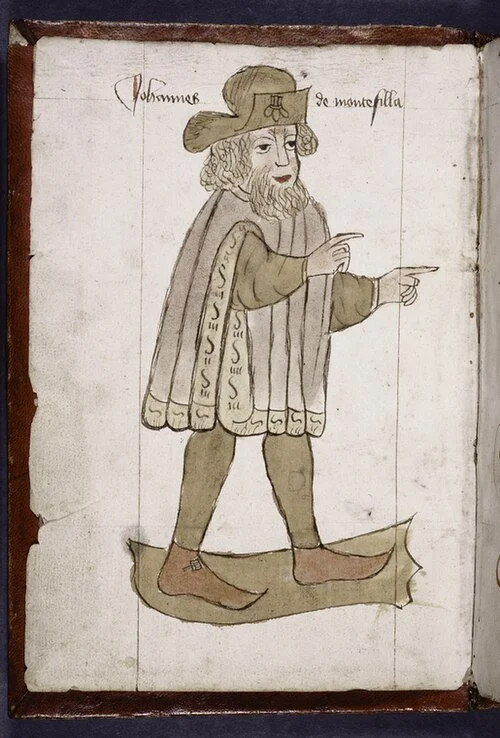
Drawing of a man in medieval dress labeled “Johannes de Montevilla.”

Sir John Mandeville, c. 1459, presumably drawn on unsophisticated paper

23 March 2026

Sophisticated is an adjective, but the root of the word entered English as a verb meaning to adulterate a substance, that is to mix it with inferior substances. It is taken from the Medieval Latin sophisticare, which in turn comes from the Greek σοφιστής (sophistes), meaning one who accepts payment for instruction. These sophists, were different from the philosophers, who engaged in intellectual pursuits and education for higher purposes and not for money, hence the sophists were considered by some to be tainted or adulterated by base and material motivations. As a result, their teachings became associated, often unfairly, with specious and poor reasoning, or sophistry. The word was borrowed into English first as verb, to sophisticate, meaning to mix or adulterate with foreign substances.

The key to understanding the modern shift in meaning of sophisticated is the sense of altered from a natural state. Something that is cultured or refined is also altered from its natural state. Also, something that is mixed or made up of many substances is complex. The development of the current meanings is not surprising, but what is a bit of a shock is the rapidity with which they have taken over. The senses of adulterated and altered have all but completely vanished, and you have to turn academic literary criticism to find sophisticated used to mean altered during printing.

Our current senses of sophisticated, meaning either refined, cultured, or highly developed or complicated, are surprisingly recent. The Oxford English Dictionary dates the use of the adjective to mean meaning experienced or refined people to 1895, when it appears in Thomas Hardy’s novel Jude the Obscure:

Though so sophisticated in many things she was such a child in others that this satisfied her.

The sense applied to things that are complex or advanced is even more recent. From C. S. Lewis’s 1945 science fiction novel That Hideous Strength:

The man was so very allusive and used gesture so extensively that Mark’s less sophisticated modes of communication were almost useless.

The noun sophisticate, meaning a worldly, cultured person, is from 1923.

Other senses of the adjective are older, however. The sense of sophisticated meaning adulterated or mixed with a foreign substance dates to at least 1607, when it appears in Thomas Dekker’s play The Whore of Babylon:

The drinke euen in that golden cup, they sweare
Is wine sophisticated, that does runne
Low on the lees of error.

And when applied to literary works, sophisticated can mean having been altered during copying or printing.

It makes sense, then, that the adjective comes from the verb to sophisticate, meaning to mix with a foreign substance, which dates to before 1390 in Aaron Daniels’s Herbal in a passage about adulterating laudanum:

Whan thei wil sofisticaten it, thei medle þerwith getes croteles & oþere blake thinges.

(When they wish to sophisticate it, they meddle it with goat’s excrement and other black things.)

And we have this from before 1425 in the Egerton version of The Book of John Mandeville:

Neuerþeles it fallez oft tyme þat marchands sophisticatez peper, when it es alde, as Ysidoris tellez. For þai take alde peper and stepez it and strewez apon it spume of siluer or of leed and driez it agayne, and so by cause of þe weight it semes fresch and new.

(Nevertheless, it often happens that merchants sophisticate paper, when it is old, as Isidore tells us. For they take old paper and steep it and strew upon it litharge of silver or of lead and dry it again, and so because of the weight it seems fresh and new.)

So if you mix with the right circle of people, you too can become sophisticated.

Discuss this post


Sources:

Dekker, Thomas. The Whore of Babylon. London: Eliot’s Court Press [?] for Nathaniel Butter, 1607, sig. H3v

Hardy, Thomas. Jude the Obscure. New York: A. L. Burt, 1913, 286. Archive.org.

Lewis, Charlton T. and Charles Short. A Latin Dictionary, 1879, s.v. sophisma, n. Brepolis: Database of Latin Dictionaries.

Lewis, C. S. That Hideous Strength. London: John Lane, 1945, 384. Archive.org.

Mandeville, John. Mandeville’s Travels: The Egerton Version. George F. Warner, ed. Westminster: Nichols & Sons, 1889, 84. Corpus of Middle English Prose and Verse.

Middle English Dictionary, 31 January 2026, s.v. sophisticaten, v.

Oxford English Dictionary Online, 1986, s.v. sophisticate, n.; 1913. sophisticate, v., sophisticate, adj., sophisticated, adj., sophistry, n.

Image credit: Unknown artist, c. 1459. New York, NY Public Library, Spencer Collection MS 037. Wikimedia Commons. Public Domain Image.

Oregon

Photo of a large river flowing through a forested, mountain region

Columbia River Gorge, from Crown Point, Oregon

20 March 2026

About the origin of the name Oregon, little can be said with certainty. It is of Native American origin and was first applied in English as the name of a river, but that’s about it.

The name first appears in a 1765 petition to English Privy Council by Robert Rogers, a colonial military officer. Rogers refers to the Ouragon River, saying it is an Indian name for a yet-to-be-seen-by-Europeans river (probably what would come to be known as the Columbia River):

The route Major Rogers proposes to take is from the Great Lakes towards the head of the Mississippi and from thence to the river called by the Indians Ouragon, which flows into a bay that projects north-eastwardly into the country from the Pacific Ocean, and there to explore the said bay and its outlets and also the western margin of the continent to such a northern latitude as shall be thought necessary.

Rogers’s use of the name indicates that the name could be from a pidgin of one of the Algonquin languages and English, wauregan, meaning beautiful. But alternatively, it could be from a Shoshonean word formed from ogwa (water) + pe-on’ (west).

The spelling Oregon appears in print in Jonathan Carver’s 1778 Travels through the Interior Part of North America:

The four great rivers that take their rise within a few leagues of each other, nearly about the center of this great continent; viz. The River Bourbon, which empties itself into Hudson’s Bay; the Waters of the Saint Lawrence; the Mississippi, and the River Oregon, or the River of the West, that falls into the Pacific Ocean at the straits of Annian.

And William Cullen Bryant uses the name in his 1817 poem Thanatopsis:

                                      Take the wings
Of morning—and the Borean desert pierce—
Or lose thyself in the continuous woods
That veil Oregan, where he hears no sound,
Save his own dashings.

Bryant’s poem made the name famous and indirectly led to the naming of the territory and eventually the state.

An alternative, but now largely discounted, hypothesis for the origin appears in a 1944 article in American Speech where it is postulated that the name comes from Ouariconsint. The name appears on a French map from sometime before 1709 and the name is split into two lines, with -sint appearing below, giving the impression to a casual reader that the river’s name is Ouaricon. The river in question is the Wisconsin River. According to this hypothesis English explorers like Rogers confused the name with a river further to the west.

Discuss this post


Sources:

Bryant, William Cullen. “Thanatopsis.” North-American Review and Miscellaneous Journal, 5.1, September 1817, 338–340 at 339. JSTOR.

Carver, Jonathan. Travels through the Interior Parts of North-America in the Years 1766, 1767, and 1768. London: 1778, ix. HathiTrust Digital Library.

Everett-Heath, John. Concise Oxford Dictionary of World Place Names, sixth ed. Oxford: Oxford UP, 2020, s.v. Oregon. Oxfordreference.com.

“North West Passage” (13 September 1765). Acts of the Privy Council of England, Colonial Series, Vol. 6. London: Stationary Office, 1912, 418. HathiTrust Digital Library.

Oxford English Dictionary Online, September 2004, s.v. Oregon, n.

Stewart, George R. “The Source of the Name ‘Oregon.’” American Speech, 19.2, April 1944, 115–17. JSTOR.

Photo credit: Hux, 2009. Wikimedia Commons. Public domain image.

lam, on the

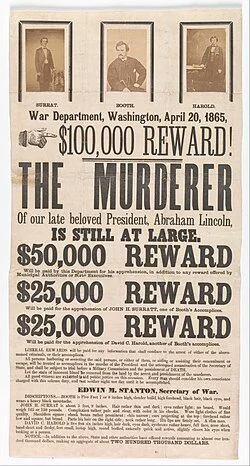
1865 “wanted” broadside for John Wilkes Booth and two other wanted for the assassination of Abraham Lincoln

18 March 2026

To be on the lam means to be fleeing, especially from the law. Lam probably comes from an English dialectical verb meaning to thrash or to strike, and that verb may ultimately come from the Old Norse lemja, also meaning to beat or strike, but the connection is not certain. The shift in meaning to that of flight happens in American criminal slang of the late nineteenth century. This shift is undoubtedly influenced by the phrases to beat one’s way and to beat it. These phrases meaning to travel, especially without paying the fare, date to at least 1872, and somewhat later they come to mean to leave or go away, especially in haste

We see the English verb, in the form belamb, meaning to beat or strike, in Anthony Copley’s 1595 Wits Fittes and Fancies:

A Constable coming to arrest a shomaker within his house; the shoomakers wife so well bestirred her, that she brauely belamb’d the constable, whiles in the mean time her husband got away: The Constable then came vnto the Duke of Infantasgo & complained vnto him of the battery, and of the shoomakers vviues misusage; alledging that if so scandalous a fact were not very seuerely, & that eftsoones corrected, it would greatly redound to his L. disgrace: wherunto the Duke answered: Seeing as thou saist, the disgrace will be mine, I forgiue the shoomakers wife.

And the earliest reference to lam in American criminal slang that I’m aware of is in Allan Pinkerton's 1884 Thirty Years a Detective. He uses it in a passage about pickpockets:

The pickpockets have adopted certain words or signals, which are thoroughly understood by the craft, and these signals are given by the “tool” or “hook.” If he is rather slow about getting to the wallet or money, and he notices that the front men are getting somewhat uneasy, he calls out “stick!” This mean that in a few seconds he will be successful, and that they are to stay in their respective positions. After he has secured the wallet he will chirp like a bird, or will utter the word “lam!” This means to let the man go, and to get out of the way as soon as possible. This word is also used in case the money cannot be taken, and further attempts are useless.

And A. F. B. Crofton, in an article on criminal slang in the April 1897 issue of Appleton’s Popular Science Monthly defines do a lam as “to run.”

Finally in 1904 we see the phrasing on a lam in Number 1500’s Life in Sing Sing:

He plugged the main guy for keeps and I took it on a lam for mine.


Sources:

Copley, Anthony. “Of Noblemen and Ambassadors.” Wits Fittes and Fancies. London: Richard Jones, 1595, 18–19. ProQuest: Early English Books Online (EEBO).

Crofton, A. F. B. “The Language of Crime.” Appleton’s Popular Science Monthly. 50.4, April 1897, 831–35 at 832. Archive.org.

Green’s Dictionary of Slang, accessed 23 February 2026, s.v. lam, v.2, lam, n.

Lighter, J. E., ed. Historical Dictionary of American Slang, vol. 2, H–O. New York: Random House, 1997, s.v. lam, n., lam, v.

Number 1500. “Slang Among Convicts.” Life in Sing Sing. Indianapolis: Bobbs-Merrill, 1904, 263. HathiTrust Digital Library.

Oxford English Dictionary Online, 1976, s.v. lam, n.3; 1901, s.v. lam, v.; 1887, s.v. belam, v.; June 2025, s.v. beat, v.1.

Pinkerton, Allan. Thirty Years a Detective. New York: G. W. Carleton, 1884, 40–41. Archive.org.

Image credit: Alexander Gardner, 1865. Wikimedia Commons. Metropolitan Museum of Art, New York. Public Domain Image.

weaponize / weaponized

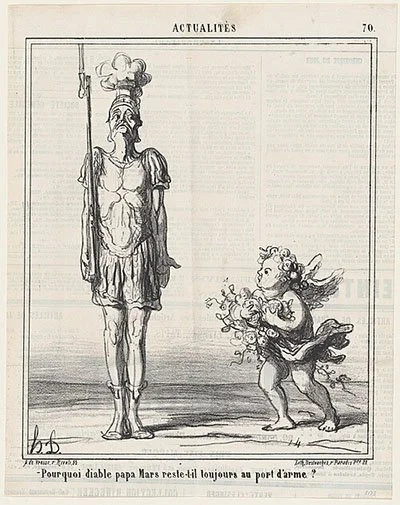
Lithograph on newsprint of the god Mars standing at attention with a rifle and Cupid carrying flowers

“Why in hell is Papa Mars still carrying a weapon?” 27 March 1868

16 March 2026

The verb to weaponize (weapon + -ize) literally means to turn something into an armament. It also has a figurative meaning of using something to undermine, criticize, or oppose others. And accompanying the verb is the adjective weaponized. The words came into widespread use during the Cold War between the United States and Soviet Union. In particular, 1957 is when newspapers, in articles about US ballistic missile programs, started to frequently use the words in their literal sense. But there are uses of weaponize long before this.

The earliest use that I have found is in Vermont’s Rutland Daily Herald of 28 December 1871 in a letter from a traveler to Spain:

I have also observed how general is the custom among the senoritas to trim their unclipped finger-nails sharply to a point, a custom to which to say nothing of its detraction from womanly charms, is very suggestive of an intent to weaponize hands God made for caressing.

While this usage is not in reference to the military, it is a literal use of the verb, turning fingernails into weapons.

There is an odd figurative use of the verb in the Santa Barbara News-Press of 2 April 1944. It uses weaponize as an intransitive verb:

A raised eyebrow might tax your credulity, but a raised lorgnette, madame, will tax you plenty and the piper you pay is your Uncle Sam, who says that plain garden variety spectacles come under the category of necessities, but the long, single-handed optical aid that cartoonists put on grand dames, to weaponize and politely terrorize the little people, will come high.

Of course, the intent might have been to “weaponize the lorgnette,” but if so, it’s poorly phrased.

Figurative use of the adjective weaponized dates to at least 7 August 1960, when it is used in the Binghamton Press in an article about tax policy:

Nothing is sacred in the cool eyes of New York State’s increasingly weaponized tax men. Not even the traditional haphazard financial habits of boxers, wrestlers and chorus girls.


Sources:

Heavey, James. “State Tax Collector Ready for Troupers.” Binghamton Press (New York), 7 August 1960, 12-C/1.

Miss Barbara. “Town Chatter.” Santa Barbara News-Press (California), 2 April 1944, B-3/5–6. Newspapers.com.

O’Toole, Garson. “Re: [ADS-L] weaponize (1871; weaponized (1960).” ADS-L, 23 February 2026.

Oxford English Dictionary Online, December 2008, s.v. weaponize, v., weaponized, adj.

“What a Merchant Saw in Europe” (8 April 1871). Rutland Daily Herald (Vermont), 28 December 1871, 2/4. Readex: America’s Historical Newspapers.

Image credit: Arnauld de Vresse, Pierre Louis Hippolyte Destouches, and Honoré Daumier, Le Charivari, 27 March 1968. Wikimedia Commons. Public domain image.