lavender

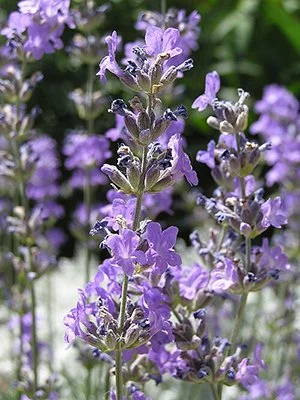
Photo of lavender flowers

Lavandula angustifolia

22 May 2026

(For lavender meaning laundry, see this entry.)

Lavender is a flower, a shade of purple, and a slang term associated with gay men. The slang sense is commonly seen in lavender marriage, a companionate, and often celebrity, marriage of convenience where one or both partners are gay. There is also the Lavender Scare, the label applied the U.S. government’s persecution of gays in government service in the mid twentieth century.

The flower, Lavandula angustfolia, gives rise to the name of the color, and English use for the name of the flower dates to the thirteenth century, with the oldest extant appearance being in the form lauendre in a gloss of the Latin lauendula.

Use of the word as a name for the color appears much later, in the nineteenth century. There is this 1840 article by John F. W. Herschel in the Philosophical Transactions of the Royal Society that uses the word as a name for the color, but which indicates the term, or at least the compounds lavender-gray and lavender-colored were in common use:

The fact to which I allude is that of the existence of luminous rays beyond the violet, but not affecting the eye with a sensation of violet, nor of any other of the recognised prismatic hues, but rather with that colour which is commonly termed lavender-grey.

And

The following experiment will show, that these rays when so concentrated as to possess an unequivocal illuminating power, still show no colour, but that sort of imperfect white which is best distinguished by the terms grey, ash-colour, lavender-colour, or such expressions. As orange, indigo, and violet, vegetable tints, are used for those of the prismatic hues, I may be allowed to express by the epithet lavender the rays which produce the tint in question, rather for the purpose of abbreviating the uncouth appellation of ultra-violet, and avoiding the ambiguity attaching to the term chemical rays (which exist in all regions of the spectrum) than for that of laying any undue stress on the observed fact.

When lavender became associated with homosexuality isn’t known for certain. It was clearly in place by 1919, but likely dates back further. The ballad Ninety-Ninth Hussars, published in the 1870 book Songs for the Army has these suggestive lyrics:

Sir Lavender Silk was a pretty young man,
[...]
His men, though respectful, had thoughts of their own
Which might have spoke out if they chose,
That Sir Lavender Silk had the aspect alone
Of a Lady dressed up in men’s clothes!

Lawrence Murphy’s 1988 book Perverts by Official Order: The Campaign Against Homosexuals by the United States Navy has the following use of dash of lavender from a 1919 investigation into homosexual activities among sailors at the Newport, Rhode Island naval base that gives a rather specific idea of what that phrase means:

Then came the ultimate question: “Are you the only straight one in this crowd?” “I am not,” replied [Fred Hoage], “saying that I am straight.” What he meant became clearer when he denied having participated in a sixty-nine party. “A straight person,” he went on, “must be straight and not reciprocate in any way.” Just what was he then? “As they say in sets I have known,” he confessed, “it is a dash of lavender.” Then you have reciprocated in these sexual acts?” queried the court. “Depending on what they were,” he answered, “I might have what they call, yanked someone off…”

Murphy’s book, while well researched, tells the tale in a narrative that does not reproduce an exact transcript of what was said or give a clear timeline of events. Without a visit to the National Archives to view the paper record of the proceedings, I cannot determine the exact date of these quotations, but the words dash of lavender were probably uttered sometime in March or April of 1919.

In the 1920s, pulp editor and sometime poet Harold Hersey penned a song titled The Lavender Cowboy. There are various versions of the lyrics, but the version that appears in his 1926 collection Singing Rawhide reads as follows:

He was only a lavender cowboy,
The hairs on his chest were two….
He wished to follow the heroes
Who fight as the he-men do.

Yet he was inwardly troubled
By a dream that gave no rest;
When he read of heroes in action,
He wanted more hair on his chest.

Herpicide, many hair-tonics
Were rubbed in morning and night….
Still, when he looked in the mirror
No new hair grew in sight.

He battled for “Red Nell’s” honor
Then cleaned out a hold-up next,
And died with his six-guns smoking….
But only two hairs on his chest.

Again, the Lavender Cowboy, at least in this version, is merely suggestive of homosexuality, but in 1927 we see lavender clearly being used with that connotation. The following poem appeared in the McGill Daily, the student newspaper of McGill University in Montreal on 16 February 1927:

QUESTION

Lesbians and lavender men
Do not attract each other;
Why is it?
I have asked the Students’ Council,
But they will not tell me—
Or they do not know

Why lavender men do not attract
Lesbians………….

—EUPHORIAN (TEXAS)

And there is Mae West’s 1928 play Pleasure Man that uses the word in the queer sense. The play had a single performance on Broadway before it was closed by police for obscene (read queer) content. Paradise Dupont is an effeminate character in the play whose appearance in the script reads as follows:

LEADER: “Yeah, we’ve always got to wait. You’d think they were Dukes or Earls or maybe Queens….

(Enter PARADISE DUPONT tripping lightly)

PARADISE: Whoops! I’ve been discovered, Royalty has arrived dearie.

And lavender appears later in the act in this exchange:

STEVE (To Paradise): Go ahead with your rehearsal, the boys won’t annoy you.

STANLEY: And don’t you annoy the boys, Violet.

PARADISE: Lavender, maybe but violet never.


Sources:

Herschel, John F. W. “On the Chemical Action of the Rays of the Solar Spectrum on Preparations of Silver and other Substances, both metallic and non-metallic, and on some Photo- graphic Processes.” Philosophical Transactions of the Royal Society, part 1, vol. 130. London: Richard and John Taylor, 1840,1–59 at 19, 20. HathiTrust Digital Library.

Hersey, Harold. “The Lavender Cowboy.” Singing Rawhide: A Book of Western Ballads. New York: George H. Doran, 1926, 13. HathiTrust Digital Archive.  

Green’s Dictionary of Slang, accessed 21 April 2026, s.v. lavender, n., lavender, adj.

Middle English Dictionary, 31 January 2026, s.v. lavender(e, n.(2).

Mullins, Bill. “Antedating of ‘Lavender’ (Homosexual).” ADS-L, 24 October 2022.

Murphy, Lawrence R. Perverts by Official Order: The Campaign Against Homosexuals by the United States Navy. New York: Harrington Park Press, 1988, 54.

Oxford English Dictionary Online, 1997, s.v. lavender, n.2 & adj.

“Question.” McGill Daily (Montreal), 16 February 1927, 2/3. Archive.org.

West, Mae. Pleasure Man. Typescript, 1928. Archive.org.

Photo credit: Andrey Butko, 2010. Wikimedia Commons. Licensed under the Creative Commons Attribution-Share Alike 3.0 Unported license.
on/off the hook

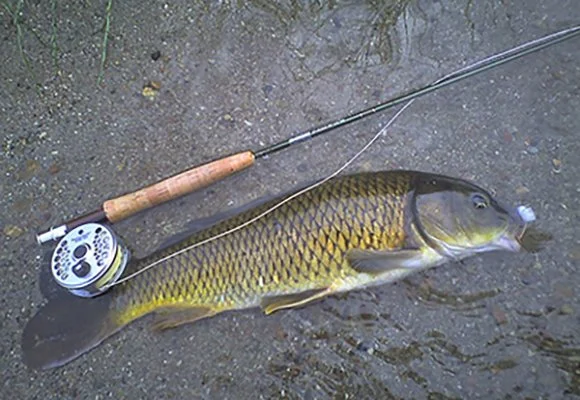
Photo of a dead carp, lying on the ground with a hook in its mouth, next to a rod and reel

20 May 2026

The phrases on the hook and off the hook have had various meanings over the centuries. Of course, there are many literal uses of the phrases, but the figurative ones extend from on the hook metaphorically meaning to be ensnared or entrapped, like a fish on an angler’s line, to off the hook meaning to be wild and out of control. The use of hook as a metaphor for entrapment or being under control underlies all the figurative senses.

The metaphorical use of on the hook dates to the seventeenth century when Robert Naughton uses it in his 1642 Fragmenta regalia. The following passage is about Queen Elizabeth I’s spymaster, Francis Walsingham, who, starting in 1580, had used information about William Parry, a Roman Catholic, to compel him to spy on others of his faith, but Parry was a double agent and plotted to assassinate Elizabeth. Parry was caught and executed in 1585.

They note him to have had certain curiosities, and secret wayes of intelligence above the rest, but I must confesse I am to seek wherefore he suffered Parry to play so long on the hook, before he hoysed him up; and I have been a little curious in the search thereof, though I have not to do with the Arcana Imperii [i.e., secrets of the empire].

And in that same era we see off the hooks to mean being flustered or in a bad temper. From Robert Davenport’s 1639 play A New Trick to Cheat the Divell:

Rog[er]. I doe not like this shufling.

Gef[frey]. What Roger, al amort, me thinkes th’art off o’th’hookes?

Rog. Yes faith, and Henges too, I’me almost desperate,
And care not how I am.

And by the nineteenth century, off the hooks in the ill-tempered sense had developed into being crazy or eccentric. We see the sense in Walter Scott’s 1824 novel St Ronan’s Well:

So saying, he exhibited a very handsome, highly-finished, and richly mounted pair of pistols.

“Catch me without my tools,” said he, significantly buttoning his coat over the arms, which were concealed in a side-pocket, ingeniously contrived for that purpose. “I see you do not know what to make of me,” he continued, in a familiar and confidential tone; “but, to tell you the truth, everybody that has meddled in this St Ronan’s business is a little off the hooks—something of a tête exaltée, in plain words, a little crazy, or so; and I do not affect to be much wiser than other people.

By the middle of the twentieth century, we see off the hook in American slang, meaning to be freed from an obligation, debt, or unfortunate situation. From Jim Thompson’s 1953 novel The Criminal:

Maybe that Federal judgeship will come through soon enough to take me off the hook.

And by the end of that century, off the hook was being used in teen and Black slang to refer positively to situations that were crazy or out of control. The college slang project at California State Polytechnic University (Cal Poly), Pomona defined off the hook as “happening; incredibly cool and hip.”

Discuss this post


Sources:

Davenport, Robert. A New Trick to Cheat the Divell. London: John Okes for Humphrey Blunden, 1639, Act 1.1, B2r. ProQuest: Early English Books Online (EEBO).

Green’s Dictionary of Slang, accessed 26 April 2026, s.v. hook, n.1.

Naunton, Robert. Fragmenta regalia, or Observations on the Late Queen Elizabeth, Her Times and Favourites. London: 1642, 19. HathiTrust Digital Library.

Oxford English Dictionary Online, 2024, s.v. hook, n.1.

Scott, Walter. St Ronan’s Well, vol. 3 of 3. Edinburgh: Archibald Constable, 1824, 95–96. HathiTrust Digital Library.

Photo credit: Fishfeeder, 2009. Wikimedia Commons. https://commons.wikimedia.org/wiki/File:Carp_fly_fishing.jpg Licensed under a Creative Commons Attribution-Share Alike 3.0 Unported license.

haggard

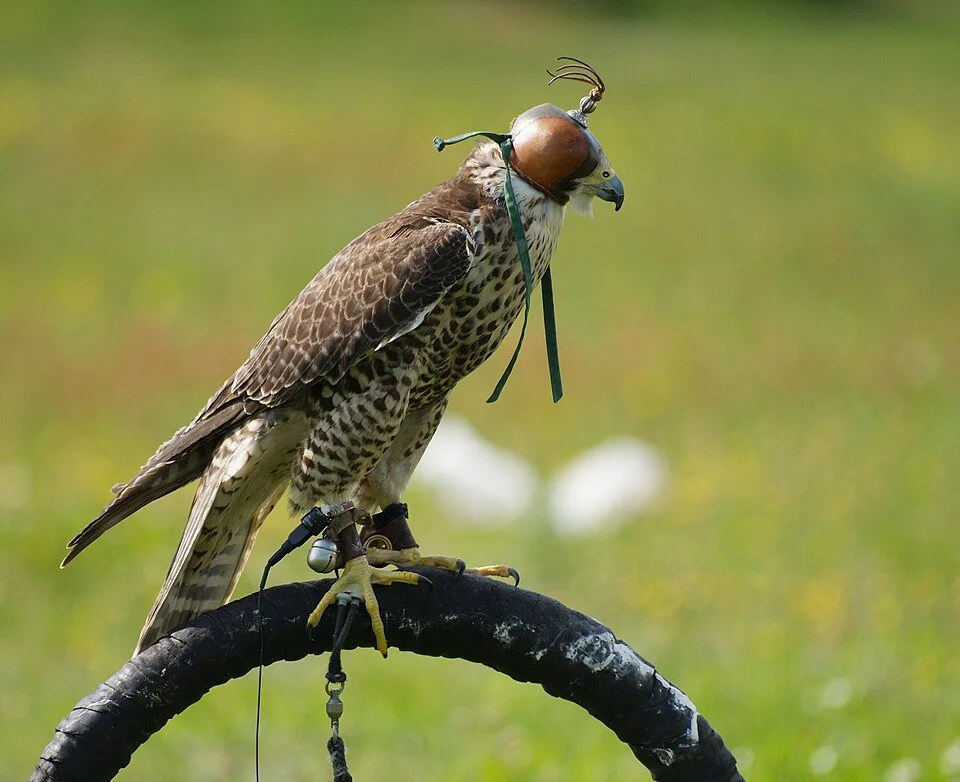
Photo of a hawk used in falconry, perched wearing a hood and belled leash

18 May 2026

The adjective haggard today is generally used to describe someone who presents an emaciated, worn, weary, or disheveled appearance. But the original sense of the word is quite different, coming from the sport of falconry. The word was borrowed into English in the mid sixteenth century from the Middle French hagart, where it was both a noun and adjective. It could mean a wild hawk that had been caught and trained, as opposed to one that had been raised in captivity, or an adjective referring to such a bird.

The modern sense of haggard appears in the seventeenth century. And this shift in meaning was probably influenced by the word hag, although that word has a very different origin.

We first see English use of haggard in a poem by Richard Edwards that was penned sometime before 1566 (his death). Here the word is being used to describe a hawk, although the context is that of a spurned lover, one in which many of the early uses of the adjective will appear:

The striken Deare hath helpe, to heale his wounde,
The haggerd hauke, with toile is made full tame:
The strongest tower, the Canon laies on grounde,
The wisest witt, that euer had the fame.
Was thrall to Loue, by Cupids sleights,
Then waie my case with equall waights.

It is applied to people by 1566 as well, when William Painter uses it in Delectable Demaundes, and Pleasant Questions, a translation of a work by Ortensio Landi, to describe recalcitrant students:

But bicause the name of vertue is of suche maiestie, as at the firste vewe it would dashe and dismaie her firste and feble beholders, certaine Philosophers castinge asyde their frostie beardes, and other such ceremonies of Philosophicall showe: with louing care to cherishe and mainteine those soft and gentle minds, that could not yet wel broke the pain full bruntes of scollerlike customes: haue deuised certein pleasant confections (as it were wherwith to sauce and sweten the studie of Philosophie,) handling eche parte therof so familiarlie, that the most wild and haggard heades were oftetimes reclaimed to harken & follow their holsome Lessons.

The following year, George Turberville uses the metaphor of a haggarde Hauke to describe a woman who has rejected a lover:

Haue you not heard it long ago
of cunning Fawkners tolde,
That Haukes which loue their keepers call
are woorth their weight in Golde?
And such as knowe the luring voice
of him that feedes them still:
And neuer rangle farre abroade
against the keepers will,
Doe farre exceede the haggarde Hauke
that stoopeth to no stale:
Nor forceth on the Lure awhit,
but mounts with euery gale?
Yes, yes, I know you know it well,
and I by proufe haue tride,
That wylde and haggard Hawkes are worse
than such as will abide.

And in the same poem, Turberville uses the noun as part of the extended metaphor:

You flee with wings of often chaunge
at random where you please:
But that in time will breede in you
some fowle and fell disease.
Liue like a haggard still therefore,
and for no luring care.

Ten years later, in 1576, Thomas Achelley uses haggard again in the context of a woman rejecting a lover in his translation of a work by Matteo Bandello, but the extended metaphor of falconry is absent:

Vnfold those restles agonies,
Expresse the endles smarte:
Which since th’encounter of her vewe,
Haue slaine thy poore true harte.
Perchaunce, she is not of haggards kind,
Nor hart so hard is bend:
But thy distylling teares in fine,
May moue her to relend.

The noun haggard also came into use for a while as a noun meaning a wild or recalcitrant person, especially a woman. Shakespeare uses it in The Taming of the Shrew, written c. 1591 but not published until 1623. In that play, the character Hortensio uses the noun in reference to Bianca, whom he had formerly pursued:

I wil be married to a wealthy Widdow,
Ere three dayes passe, which hath as long lou’d me,
As I haue lou’d this proud disdainful Haggard.

By the late seventeenth century, the modern sense of the word appears. Here it is in John Dryden’s 1687 poem The Hind and Panther:

More haughty than the rest the wolfish race,
Appear with belly Gaunt, and famish’d face:
Never was so deform’d a beast of Grace.
His ragged tail betwixt his leggs he wears
Close clap’d for shame, but his rough crest he rears,
And pricks up his predestinating ears.
His wild disorder’d walk, his hagger’d eyes,
Did all the bestial citizens surprize.


Sources:

Bandello, Matteo. A Most Lamentable and Tragicall Historie Conteyning the Outragious and Horrible Tyrannie Which a Spanishe Gentlewoman Named Violenta Executed vpon Her Louer Didaco. Thomas Achelley, trans. London: John Charlewood for Thomas Butter, 1576, sig. C4v. ProQuest: Early English Books Online (EEBO).

Dryden, John. The Hind and Panther. London: Jacob Tonson, 1687, 10. ProQuest: Early English Books Online (EEBO).

Edwards, Richard. “A Louer Reiected, Complaineth” (before 1566). A Paradyse of Daynty Deuises. London: Henry Disle, 1576, 76. ProQuest: Early English Books Online (EEBO).

Landi, Ortensio. Delectable Demaundes, and Pleasant Questions. William Painter, trans. London: John Cawood for Nicholas Englande, 1566, sig. ⁋2v. ProQuest: Early English Books Online (EEBO).

Oxford English Dictionary Online, September 2021, s.v. haggard, adj., haggard, n.2., haggard, n.3.

Shakespeare, William. The Taming of the Shrew, Act 3. In Mr. William Shakespeare’s Comedies, Histories, & Tragedies (First Folio). London: Isaac Jaggard and Edward Blount, 1623, 222. Folger Shakespeare Library. (The scene is numerated as Act 4, Scene 2 in modern editions.)

Turberville, George. “The Louer to a Gentlewoman, That After Great Friendship Without Desart or Cause of Mislyking Refused Him.” Epitaphes, Epigrams, Songs and Sonnets. London: Henry Denham, 1567, 14v–15v. ProQuest: Early English Books Online (EEBO).

Photo credit: Krzysztof Wiśniewski, 2008, Wikimedia Commons. Licensed under the Creative Commons Attribution-Share Alike 4.0 International License.

stay in your lane

Photo of cars driving on the New Jersey Turnpike near Exit 8A

15 May 2026

The underlying metaphor under the clichéd piece of advice to stay in your lane is rather obvious, but the use of the phrase appears to have moved from the literal to the metaphorical in US military in the closing decade of the twentieth century.

That metaphor is one of driving. Automobiles should, of course, stay in their respective lanes to avoid accidents. And literal use of stay in your lane in the context of driving has been around for as long as roads have been marked with lane divisions. You can also find literal use of the phrase in sports like track and swimming that have demarcated lanes.

In the 1970s we start to see quasi-literal uses in sports that don’t have clear lane markers, but the phrase is still used in reference to position on the field of play. For instance, there is this about American football in Cleveland’s Plain Dealer of 22 November 1972:

ROMAN GOT TO Terry Bradshaw twice. He also hurried the passer on several other occasions and help reasonably well against the Steelers’ powerful ground attack.

“Against Bradshaw you just have to stay in your lane and he’ll eventually come to you,” said Roman. “Walter Johnson and Jerry Sherk do such a great job it makes it easier for the ends here.

And there is this in the context of hockey in Rhode Island’s Providence Journal of 21 December 1976:

Last night Vermont coach Jim Cross told his players, “Stay in your lane, play your position and don't get any stupid penalties.” The Catamounts followed orders and their right forechecking completely disrupted  RPI’s freewheeling attack which had averaged almost seven goals a game going into the tournament.

It’s not unusual for slang phrases to make early print appearances as the names of racehorses, and in 1989 there was horse named Stay In Your Lane. Whether the name was inspired by the idea of a horse running in a “lane” (horseracing doesn’t have demarcated lanes) or if it represented a more general figurative use is unknown.

Purely figurative use of stay in your lane can be found in the US Army by the mid-1990s. An article of that title appears in the Spring 1995 issue of NCO Journal, and the text of that article reads in part:

“You have to know what you’re supposed to do and then do it. Don’t waste your time worrying about how an officer does his job. That’s officer’s business. If your soldiers fail, it won’t be an officer’s fault.” What he told that sergeant was “…stay in your lane.”

The January–April 1998 issue of Infantry magazine has an article titled “Lane Training in Haiti.” What lane training means is not explicitly defined, and the phrase appears in quotation marks, indicating that it is not a usual term of art. From the context, however, lane training appears to refer to training on adhering to the rules of engagement prior to deployment to Haiti. The article also uses stay in your lane:

The soldier should first ask the reporter for press credentials and picture ID. Soldiers will not answer any question dealing with operational security or national policy. Soldiers may answer questions about personal matters, such as those in b, e, j, and q. (Only talk about your area of expertise: Stay in your lane. If you own it, drive it, carry it, you can talk about it.)

Another article in Infantry, this time from January–April 2000, clearly links the military phrase to driving a car:

A key rule of the road is to stay in your lane. Your fellow staff officers and the company commanders will appreciate your active support, but not your active involvement in their business.

The figurative stay in your lane starts appearing in non-military contexts in the early 2000s. In an 8 December 2002 article in the Washington Post, dancer and actor Chita Rivera reminisces about going to an audition early in her career (c. 1948) and places the phrase in the mouth of her ballet teacher, Doris Jones:

When Jones, her ballet teacher in Washington, escorted her to the tryout, she calmed her student with a piece of advice Rivera has never forgotten: “Conchita, stay in your lane.” She meant: Don’t worry about the long bodies and blond ponytails lining up next to you for the auditions, be who you are.

It is common for the brain to insert anachronistic phrases into memories as it recalls and reconstructs them. Given that there are no other known figurative uses of the phrase from that era, it is all but certain that Jones did not actually utter the phrase in the late 1940s. But the article does tell us that stay in your lane had moved out of the military and into the world of entertainment by 2002.

The Newark, New Jersey Star-Ledger of 8 March 2006 quotes singer Mary J. Blige as using the prhase:

Mary J. Blige says conglomerate-owned music companies force musicians to choose a certain niche and stay in it: “You have to stay in your lane.”

And the New York Post has music producer Russell Simmons using the phrase in its 13 July 2007 issue in an article about the “laws” of success in the industry:

Law No. 2: Always do you. Never change for the mainstream—stay in your lane, and if you’re talented and resilient enough, the mainstream will come to you.


Sources:

Brooks, Lieutenant Colonel Leo A. and Captain Michael O. Lacey. “Lane Training in Haiti.” Infantry, January–April 1998, 88.1, 25/2. HathiTrust Digital Library.

Heaton, Chuck. “To Browns He’s Noblest Roman.” Plain Dealer (Cleveland, Ohio), 22 November 1972, 2-C/4. Readex: America’s Historical Newspapers

Hooker, Lieutenant Colonel Richard D. “‘On the Staff’: Success through Teamwork.” Infantry, 90.1, January–April 2000, 35/2. HathiTrust Digital Archive.

“Matter of Fact: Horse Racing.” Cincinnati Post (Ohio), 12 January 1989, 4C/5. Readex: America’s Historical Newspapers.

Pendry, J. D. “Stay in Your Lane.” NCO Journal, 5.2, Spring 1995 [?], 4/3. HathiTrust Digital Library. (The date in the printed journal reads “Winter 94–95,” but issue 5.1 bears that same date. Issue 5.3 is dated “Summer 95.”)

Philips, Dave. “Vermont Victory in Bruin Tourney.” Providence Journal (Rhode Island), 21 December 1976, B-10/6. Readex: America’s Historical Newspapers.

Simmons, Russell. “Uncommon ‘Laws’: Excerpts from Rap’s Keys to Success.” New York Post, 13 July 2007, 45/3. Readex: America’s Historical Newspapers.

Trescott, Jacqueline. “For Chita Rivera, a Career with Legs.” Washington Post, 8 December 2002, G10/2. ProQuest Historical Newspapers.

Zoller Seitz, Matt. “Passing Fancy.” Star-Ledger (Newark, New Jersey), 8 March 2006, 27/2. Readex: America’s Historical Newspapers.

Photo credit: Mlaurenti, 2006. Wikimedia Commons. Licensed under the Creative Commons Attribution-Share Alike 3.0 Unported license.

sophism / sophomore / sophomoric

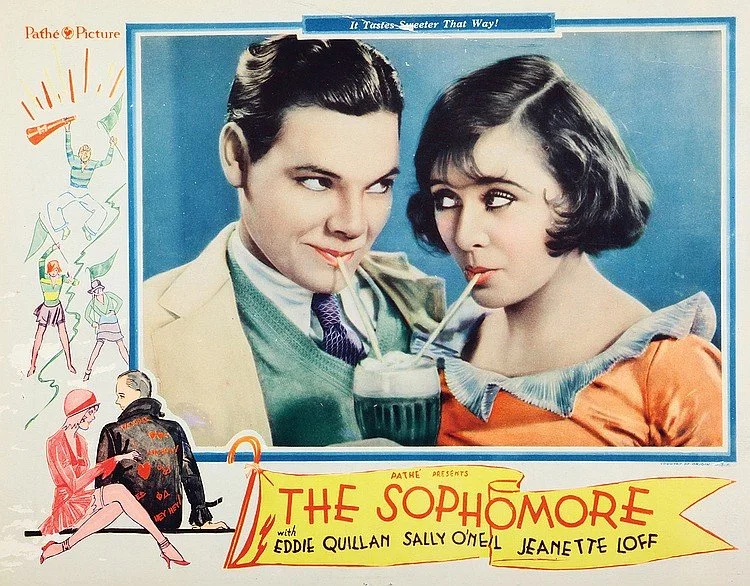
Advertisement for the 1929 film The Sophomore featuring a picture of a young man and woman sharing a soda through two straws

Lobby card for the 1929 film The Sophomore

8 May 2026

(Edit: 13 May 2026, clarified the Middle English roots)

An argument or statement that is sophomoric is pretentious and crudely reasoned (cf. sophisticated). It is no surprise that it comes from sophomore, a word for second-year university student. And that word’s root is sophism (in the seventeenth-century form sophom), which brings us full circle as that word refers to a fallacious argument or an ambiguous or paradoxical sentence, and often one that is used as an exercise in logic.

Sophism is a borrowing, partly from the Anglo-Norman sofisme and partly directly from the Latin sophisma. The Latin, in turn, comes from the Greek σόϕισμα (sophisma), meaning a clever trick or argument. We have evidence of English use of the word from the late fourteenth century but was probably in use somewhat earlier than the surviving manuscripts that have it.

One of these early English uses is in John Trevisa’s translation of Ranulf Higden’s Polychronicon, written sometime before 1387, which has this passage:

And for no pompe and boste schulde faille, þe kyng maked þe ȝonge sones of þe eorle of Mollent appose þe cardinales þat were þo presente, and upbroyde hem and snarlede him wiþ sotil sophyms.

(And in case pomp and boast should fail, the king made the young sons of the earl of Mollent examine the cardinals that where then present, and upbraided them and ensnared them with subtle sophisms.)

Higden’s Latin is sophismatibus.

The use of sophism in the sense of an exercise in logic dates to at least 1566, when we find it in the record of a disciplinary proceeding against a professor at Corpus Christi College, Oxford, as recorded in Thomas Fowler’s history of that school:

Item, he harde no sophisme, as he ys bounde twise or thrice a weke, these iii yeres.

(Item, he heard no sophisms these three years, as he is obligated to do twice or thrice a week.)

The Middle English sophim(e went through various forms and spellings, and by the early seventeenth century one of this was sophom, which bequeathed to us sophomore (sophom + -or) by 1688, when it appears in Randle Holme’s The Academy of Armory:

Commoners, are such as are at the University Commons, which till they come to some Degree or Preferment there, are distinguished according to their time of being there; as 1. Fresh Men. 2. Sophy Moores. 3. Junior Soph, or Sophester. And lastly Senior Soph.

And the sense of sophomoric, meaning a pretentious or badly reasoned argument, like that a sophomore, that is someone who has not yet mastered the arts of logic and argumentation but knows just enough to be dangerous, was originally an Americanism. It appears by 1810, when the Boston Patriot, a Democratic-Republican paper, in its 23 June 1810 issue, praises the newly elected Democratic-Republican governor, Elbridge Gerry, and slights his Federalist predecessor:

We think it justifies the popular opinion of the learning, the genius, and the abilities of this statesman [i.e. Elbridge Gerry] of forty years—While the boyish pedantry, the foppish learning, the sophomoric rant, the college style, and the garish metaphors of his predecessor [i.e., Christopher Gore] are forgotten.

Gerry, of course, is best known in etymological circles as the namesake for gerrymander.

Discuss this post


Sources:

Anglo-Norman Dictionary, 2018–21, s.v. sofisme, n.

Fowler, Thomas. The History of Corpus Christi College. Oxford Historical Society. Oxford: Clarendon Press, 1893, 112. HathiTrust Digital Library.

“Governor Gerry’s Speech.” Boston Patriot (Massachusetts), 23 June 1810, 2/3. Readex: America’s Historical Newspapers.

Higden, Ranulf. Polychronicon, vol. 7. John Trevisa, trans. Joseph Rawson Lumby, ed. London: Longman, 1879, 431. HathiTrust Digital Library.

Holme, Randle. The Academy of Armory. Chester: 1688, 198–99. ProQuest: Early English Books Online (EEBO).

Middle English Dictionary, 31 January 2026, s.v. sophim(e, n.

Oxford English Dictionary Online, 1913, s.v. sophism, n., sophomore, n., sophomoric, adj. & n.