
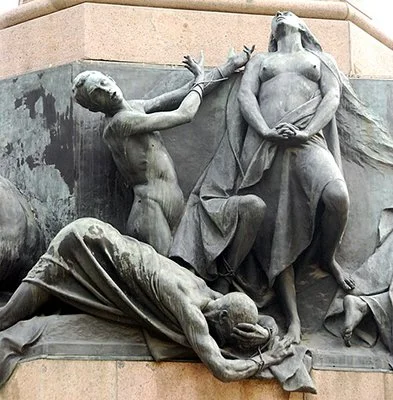
Detail of the 19th-century Monument to Dante in Trento, Italy by Florentine artist Cesare Zocchi
22 June 2026
As the word is generally used today, to atone is to offer propitiation to an injured party, to make amends for a wrong one has committed, and atonement is the product of that verb. But the word did not always mean this, and it has an etymology that may seem surprising at first, but which once you have learned is glaringly obvious every time you read the word.
The original sense of atone was to reconcile, to unite. And the word is a compound of at + one. The verb appears in the written record c. 1300 in the romance Sir Beues of Hamtoun:
“Fet me,” a seide “me ȝerde of golde.
Gii, is fader, was me marchal
Also Beues, is sone, schal.”
His ȝerd he gan him þer take;
So þai atonede wiþoute sake.
(Fetch me,” he said, “my staff of gold.
Gii, his father, was my marshal
Bevis, his son shall be also.”
His staff he went to take to him;
So they atoned without strife.)
The noun, in the form of the phrase in to onement, appears in an early fifteenth-century Wycliffite Bible, in a translation of Ezekiel 37:16–17:
And thou, sone of man, take thou an other tree, and write on it, Joseph, the tree of Effraym, and of al the hous of Israel, and of hise felowis. And ioyne thou tho trees oon to the tother in to o tree to thee; and tho schulen be in to onement in thin hond.
(And you, son of man, take another stick and write on it, “For Joseph, the stick of Ephraim, and all the house of Israel and its fellows.” And join these sticks one to the other so they are one stick to you; and they shall become a onement in your hand.)
The shift to the present meaning occurs by the early seventeenth century. It’s a straightforward shift from a state of unity to one of being reconciled with God. The 1611 King James Version of Leviticus 1:4 uses the noun:
And he shall put his hand upon the head of the burnt offering; and it shall be accepted for him to make atonement for him.
The Hebrew is לְכַפֵּר (lechaper); the Vulgate reads expiationem.
And we see the verb in the present-day sense in Joseph Glanvill’s 1665 Scepsis Scientifica:
I might reasonably expect a pardon from the ingenious, for faults committed in an immaturity of Age and Judgment that would exclude them; and perhaps I may have still need to plead it to attone for the imperfections of this Adress.
Sources:
American Heritage Dictionary, fifth edition, 2022, s.v., atone, v.
Ezekiel 37:16–17. The Holy Bible Containing the Old and New Testaments with the Apocryphal Books, in the Earliest English Versions Made from the Latin Vulgate by John Wycliffe and His Followers, vol. 3 of 4. Josiah Forshall and Frederic Madden, eds. Oxford: Oxford UP, 1851, 588–89. HathiTrust Digital Library.
Glanvill, Joseph. Scepsis Scientifica: or, Confest Ignorance, the Way to Science. London: E. Cotes for Henry Eversden, 1665, sig. C4r–v. HathiTrust Digital Archive.
Leviticus 1:4. The Bible, Authorized King James Version with Apocrypha (1611). Oxford: Oxford UP, 2008, 119.
Merriam-Webster.com, accessed 30 May 2026, s.v. atone, v.
Middle English Dictionary, 31 January 2026, s.v. at-onen, v., onement(e, n.
Oxford English Dictionary Online, June 2004, onement, n.: 1885, s.v. atonement, n., atone, v., at one, adv.
“Sir Beues of Hamtoun.” The Auchinleck Manuscript, Edinburgh, National Library of Scotland, Advocates’ MS 19.2.1, lines 1330–34. National Library of Scotland.
Photo credit: Niccolò Caranti, 2009. Wikimedia Commons. Licensed under the Creative Commons Attribution-Share Alike 3.0 Unported license.