
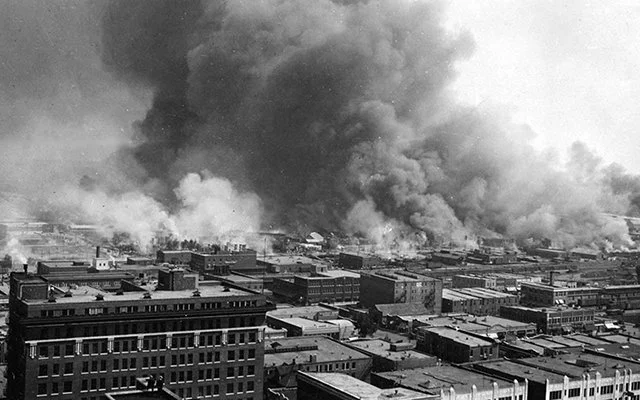
Smoke from arson billowing from the Greenwood district of Tulsa during the 1921 race massacre
6 November 2026
The Greenwood District of Tulsa, Oklahoma is frequently cited as being once known as the Black Wall Street, due to it having been a neighborhood known for thriving businesses owned by and catering to the city’s Black population. On 31 May–1 June 1921, mobs of white residents perpetrated a massacre that burned more than 35 square blocks of the district, killing anywhere between 39 and 300 people, almost all Black. It was one of the worst incidents of racial violence in US history. The district was left largely undeveloped for over fifty years following the attack.
But the Tulsa district was not the only Black Wall Street. The moniker has been applied to a number of neighborhoods with thriving Black businesses. And, in fact, I have been unable to find the Tulsa district being given that label prior to 1979, although there are undoubtedly earlier examples out there.
The first example, and most of these early examples given here, of a similar phrase being applied to a Black business district was uncovered by Bonnie Taylor-Blake. It is a use of Negro Wall Street in Ohio’s Cleveland Gazette of 28 May 1892 and refers to a neighborhood in Washington, DC:
The Negroes have a Negro Patti, a Negro Sullivan, a Negro Gladstone, and, in Washington, to be up with the imitation, we have a Negro Wall street. Eighth street, N. W., opposite the post office department is our Negro Wall street, and just around the corner, in the same building, is our Negro bank, all domiciled in the Le Droit building, owned by a man who was first attracted to Washington by a position tendered to him in part by Negroes. He has now grown rich, and has served notice on these Negro brokers, bankers and real estate agents to "vamose the ranch," quit! get out!! go away! go to — — anywhere. You are a nuisance. Well, the Negroes attribute it all to everything but the right thing. They think the white man is jealous of the business capacity of the colored man, and that he is standing in their way financially.
And we see colored Wall Street in Washington, DC’s Colored American of 5 December 1903, this time referring to Richmond, Virginia:
Of the four big colored organizations of Richmond doing a National business, perhaps the Independent Order St. Luke, is the most prominent. Its phenomenal progress within the last two or three years has astounded the Southern whites and created a sensation fever of push and go even within the strenuous confines of what is called the colored Wall Street, in Richmond.
The earliest use of Black Wall Street that I’m aware of is in reference to Atlanta, Georgia, and is found in Baltimore’s Afro-American of 21 March 1925:
It is only here and there that you will find a flourishing business among our people. Auburn avenue, in Atlanta, Ga., which was once known as the "Black Wall Street of the South," is in mourning as a result of the migration of the majority of its black capitalists.
In contrast, I’ve only been able to date the phrase used in reference to Tulsa to 1979, when it starts appearing in the Tulsa World in articles about redevelopment projects in the Greenwood District. One from 13 January 1979 reads:
Business-Oil looks at an attempt to revitalize Tulsa’s Greenwood area, called “Little Black Wall Street” in days gone by.
And there is this from 10 March 1979:
One already begun with EDA funding is feasibility study of redeveloping the commercial area along Greenwood Avenue north from downtown. The area was once known as the thriving "Black Wall Street of the Southwest," but is largely vacant now.
The association of the Tulsa neighborhood with the phrase was brought to the attention of a national audience on 13 March 1983 with an article in Parade Magazine, a Sunday insert in many newspapers, on the 1921 massacre by Irving Wallace, David Wallechinsky, and Amy Wallace. A photo caption accompanying the article read:
Tulsa’s “Negro Wall Street” after police broke up riot—and neighborhood.
And the article itself had this:
Before the riot, Tulsa blacks were so successful that their business district was called “The Negro’s Wall Street.”
While I have not been able to find instances of the phrase used to refer to Tulsa before 1979, that is likely due to mainstream publications simply not addressing the uglier aspects of American history and not addressing Black history more generally. It is probable that the Black community in Tulsa was using the phrase long before this, even perhaps as far back as before the 1921 massacre.
Sources:
Arnold, Henry F. “Laborers Moving Northward Professional Men Follow.” Afro-American (Baltimore, Maryland), 21 March 1925, 16/5. Newspapers.com.
“A Blow Between the Eyes.” Cleveland Gazette (Ohio), 28 May 1892, 1/4. Readex: America’s Historical Newspapers.
“City Hopes to Spur Development in Decaying Areas.” Tulsa World (Oklahoma), 10 March 1979, A-1/4. Newspapers.com.
“The Old Dominion. Colored Banks and Insurance Companies Thrive.” Colored American (Washington, DC), 5 December 1903, 7/1. Readex: America’s Historical Newspapers.
Shapiro, Fred. “‘Black Wall Street’ (Not in OED).” ADS-L, 25 September 2026.
“Shrug Off the Cold.” Tulsa World (Oklahoma), 13 January 1979, C-1/1. Newspapers.com.
Taylor-Blake, Bonnie. “Black Wall Street (Negro Wall Street; Colored Wall Street).” ADS-L, 12 July 2026.
Wallace, Irving, David Wallechinsky, and Amy Wallace. “Significa.” Parade Magazine, 13 March 1983, 30. In Houston Post (Texas), 13 March 1983. Readex: America’s Historical Newspapers.
Photo credit: Alvin C. Krupnick Co., 1921. Library of Congress. Public domain image.