
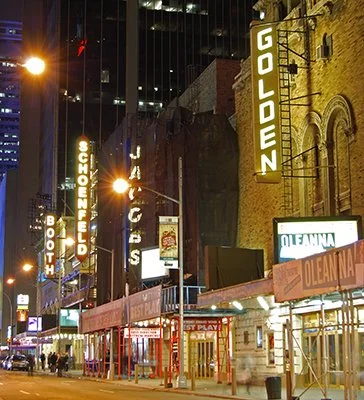
Broadway theaters on West 45th Street, New York City
30 September 2026
Broadway is the metonym for the major theatrical productions in New York City, so called because many of the big theaters are on that street. But smaller theaters and productions are labeled off-Broadway, and even smaller productions are referred to as off-off-Broadway, regardless of their actual location. Off-off-Broadway productions are often avant-garde or experimental theater.
Use of Broadway as a metonym for New York theater dates to the middle of the nineteenth century. We see it in the Wisconsin State Journal of 29 May 1853, a use that shows that the word Broadway had resonance in middle America by that date:
Messrs. Langrishe & Atwater, with their Theatrical campany [sic], are about to visit Kenosha, and a Correspondent of the Tribune, in that place, goes into ecstacies over it. In the communication we find the following sentence, which must be very gratifying to Mr. Atwater’s feelings:
“In the real Tragedy, one who has not a censorious spirit and false taste, can enjoy more in one night of Atwater’s Othello or William Tell, than in a month of this Broadway star playing.”
The phrase off-Broadway makes its appearance at the turn of the twentieth century. Hamilton Ontario’s Spectator reprinted the following from the New York Telegraph on 12 December 1903
Mantell is an accomplished actor, but he is making his present appeal for favor in an off-Broadway theater, where robust activity tells and quiet subtlety doesn’t count at all and where he responds with no sign of unwillingness to the demand for noisy force.
And the phrase appears in the New York Times on 2 October 1904
“Checkers” at the Academy of Music has won a success seldom given to off-Broadway plays. It has been here three weeks this year and isn’t ready to leave yet.
Off-off-Broadway premieres half a century later. The earliest use of the phrase that I’m aware of is in the Brooklyn Eagle of 27 February 1954. Geographically, Brooklyn is quite literally “off-off-Broadway”:
“Off-Broadway” plays have been numerous and stimulating this theatrical season—and now the first “off-off-Broadway” production has cropped up in Brooklyn.
And here is a piece from the Chicago Tribune of 27 March 1955 that nicely encapsulates the ethos of off-Broadway and off-off-Broadway productions:
The neighborhood of “off Broadway” is a strange one, for it is no place in particular. It might be right in the Broadway, or commercial theater district itself, as is the case of “Shoestring Revue,” playing in the little President theater in W. 48th st.
It might be in a church. One church group is having off-off-Broadway tryouts of its shows, sending them to out of town churches before bringing them in. It might be in a full size playhouse which progress has passed by, like the Phoenix and downtown National, both on lower 2d av. It might be in a loft building, a hotel, or a converted movie house.
“Off-Broadway,” is a state of mind and a condition of the pocketbook, rather than a place. As a state of mind, it is the domain of the true torch bearers—people who just can’t be kept from acting.
As a condition of the pocketbook, it is impoverished—the last resort of the shoestringer.
And like the big Broadway productions with their Tony awards, off-Broadway productions have their Obie awards, the name being an initialism for, of course, off-Broadway. The Obies have been awarded since 1956, first sponsored by the Village Voice newspaper, and since 2014 by the American Theater Wing, the organization that sponsors the Tonys. The name Obie appears in an announcement of the upcoming first award ceremony in the Village Voice of 13 June 1956:
Shelley Winters, star of Broadway’s “A Hatful of Rain,” will be the master of ceremonies at the first annual Village Voice Off-Broadway (“Obies”) Awards, which are to be given out at a ceremony attended by many prominent stage personalities, Monday afternoon at 3 at the Limelight Coffee House, 91 Seventh Avenue South.
Sources:
Chapman, John. “A True Actor Can’t Be Kept from Theater.” Chicago Sunday Tribune, 27 March 1955, Part 7, Section 2, Page 4/1. ProQuest Historical Newspapers.
“‘In Brooklyn’ May Be New Stage Trend.” Brooklyn Eagle (New York), 27 February 1954, 2/4. Newspapers.com.
“Mantell as an Actor.” Hamilton Spectator (Ontario), 12 December 1903, 16/1. Newspapers.com.
Oxford English Dictionary Online, December 2022, s.v. Broadway, adj.2 & n.2; March 2004, s.v. Obie, n.; off-Broadway, adj., adv. & n.; off-off-Broadway, adj., adv. & n.
“Plays that Hold.” New York Times, 2 October 1904, Part 4, 3/3. ProQuest Historical Newspapers.
“Voice ‘Obie’ Awards Monday; Shelly Winters to Be MC.” Village Voice, 13 June 1956, 1/4. Google News.
Wisconsin State Journal (Madison), 29 August 1853, 2/4. Newspapers.com.
Photo credit: Matt Wade, 2009. Wikimedia Commons. Licensed under the Creative Commons Attribution-Share Alike 3.0 Unported license.
