
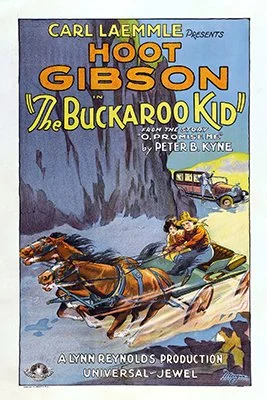
1926 movie poster for Hoot Gibson’s “The Buckeroo Kid”
26 August 2026
A buckaroo is a cowboy, or in later usage someone with the demeanor and vibe of a cowboy. The word has a rather straightforward etymology: it is an alteration of the Spanish vaquero (cowherd, cowboy), and its use comes out of the nineteenth-century American West. Like many such terms, its written form took many different spellings before it became standardized on buckaroo.
The earliest use of the term, in the form bakhara, that I’m aware of is in a letter written by William B. Dewees on 6 January 1827. Dewees was describing the region in and around Saltillo, Mexico:
To me, there is nothing more agreeable than to wake in the morning, when among the mountains, and listen to the bleating of the calves and lambs, the lowing of the cows, the braying of the mules and donkies, and to behold the bakharas herding the cattle, the horses and mules, while on every cliff and rock, sheep and goats may be seen sporting from rock to rock, and leaping over every dangerous cliff.
[…]
This country is settled differently, from any place I was ever in. The people all reside in large towns, which are situated from twenty to forty miles apart. The country between these towns, is not settled by farmers, as in America. A few wealthy rancheros dwell in the country, who own vast herds of stock, of all kinds. These, usually, are surrounded by ten or fifteen families of poor people, who reside near them, together with peons and bakharas, or herdsmen.
The spelling buckiero appears in the journal of Alfred Doten for 15 April 1851:
April 15—Clear and pleasant—Forenoon I went down to McDonald’s ranch looking for my horse—I did not find him but on the way back over the hills I came across a horse and two mules which were stolen at the same time—I gave information of it at Chinn’s store and “Boss” started off after them and in the afternoon he came in with them and, to my surprise, brought my horse, which he found tied to a tree about 6 miles back in the hills—he did not see anything of the remainder of the missing animals—Chinn and his buckiero have been gone in pursuit of the missing animals since yesterday morning.
The 1889 Century Dictionary includes the term, with the spelling buckayro, as well as the clipped form bucker:
buckayro (bu-kā´ rō), n. Same as bucker3. (Western U. S.)
[…]
bucker3 (buk´ėr), n. (Abbr. of buckayro, and accom., simulating bucker1, of Sp. vaquero, a cowherd: see vaquero.) A cowboy. T. Roosevelt. (Western U. S.)
We get closer to the standard spelling in Stewart Edward White’s 1907 Arizona Nights. The passage that uses the word describes an Englishman who wants to become a cowboy and works hard at copying the demeanor and learning the skills necessary for the occupation:
He was always easing the trigger-pull, or filing the sights. In time he got to be a fairly accurate and very quick shot.
The same way with roping and hog-tying and all the rest.
“What’s the use?” I used to ask him. “If you were going to be a buckeroo, you couldn’t go into harder training.”
Finally, we get the spelling buckaroo in a glossary published in the journal Dialect Notes for 1913:
buckaroo´, n. A broncho buster, cowpuncher, cowboy. Used throughout the cattle-raising states and in Mexico and Canada. It is probably a corruption of Span. vaquero. “That night the buckaroos shot up the town.” “He is some buckaroo all right.”
And the extended use of buckaroo to refer to a person who exudes the vibe and demeanor of a cowboy in an advertisement that appears in Appleton, Wisconsin’s Daily Post of 6 January 1920:
Buckaroo (buck-a-roo) [...] Meaning, when applied to the masculine gender of the human species, a lively young buck. 2. A gay dog.
It has been suggested by some older sources that buckaroo has an origin in one or another African languages, but the evidence for such an origin is scant, whereas the origin in vaquero is well documented and the sound and spelling changes that have transformed the Spanish word into buckaroo are both normal and well documented in the historical record.
Sources:
Century Dictionary of the English Language, vol. 3, Bice–Carboy. William Dwight Whitney, ed. New York: Century Co., 1889, s.v. buckayro n. & bucker3, n. Archive.org.
Dewees, William B. Letter, 6 January 1827. Letters from an Early Settler of Texas, second edition. Cara Cardelle, ed. Louisville, Kentucky: New Albany Tribune, 1858, 65–66. Archive.org.
Doten, Alfred. Journal entry, 15 April 1851. The Journals of Alfred Doten, 1849–1903, vol. 1. Walter van Tilburg Clark, ed. Reno: U of Nevada Press, 1973, 84–85. Archive.org.
Green’s Dictionary of Slang, accessed 7 August 2026, s.v. buckaroo, n.
Harvey, Bartle T. “A Word-List from the Northwest.” Dialect Notes, 4.1, 1913, 26–28 at 26. Archive.org.
Oxford English Dictionary Online, 1933, s.v. buckaroo, n.; 1916, vaquero, n.
White, Stewart Edward. Arizona Nights. Toronto: Musson, 1907, 51. Archive.org.
Image credit: Universal Pictures, 1926. Wikimedia Commons. Public domain image.
