
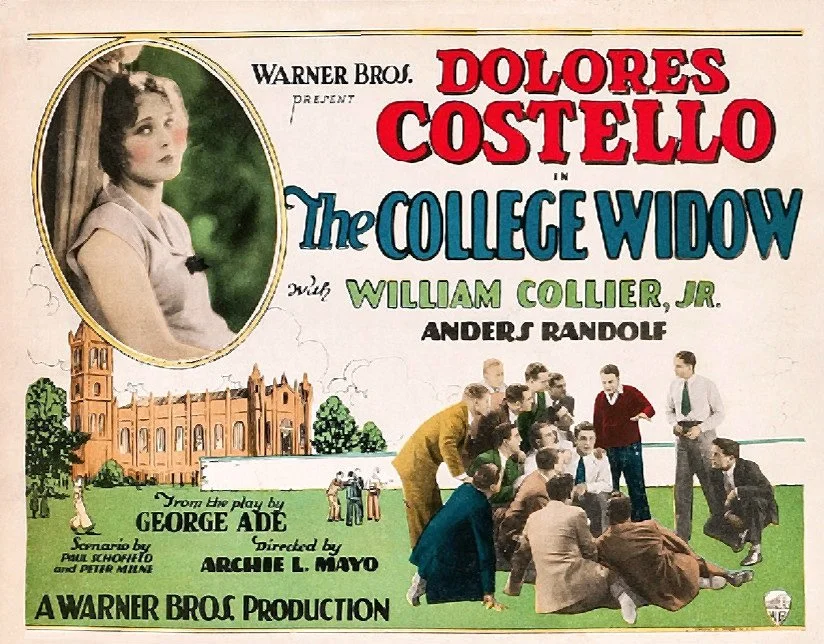
Lobby card for the 1927 film The College Widow, starring Dolores Costello
27 April 2026
College widow is a term you don’t hear anymore, except in historical usage. It harkens back to a time when only men attended university and short-lived love affairs between the male students and female residents of college towns were common.
A college widow was often, but not always, an older woman. Whether she was a naïve romantic wronged by a series of men or a predatory cougar using and discarding the students varies with the perspective of the user of the term.
The term is an Americanism dating to the middle of the nineteenth century. (The Oxford English Dictionary has an 1829 citation for college widows, but that seems to be a nonce collocation of the words in a different sense, that of a charitable institution.) The earliest I have been able to date it to is a piece entitled “An Old Maid’s Soliloquy” that appeared in the Temperance Crusader of Penfield, Georgia on 15 March 1856 that very succinctly defines the term college widow:
Twenty years have I been on the carpet. I have had numerous suitors, and visitors without number. I have been besonnetted by poetical geniuses in almost every class graduated since my debut. Yet despite of all this, I am a “college-widow” with as little prospect as ever of being comforted in my widowhood.
I particularly like the use of "besonnetted."
And on the same day, this appeared in Pennsylvania’s Sunbury American:
Was there any mental stimulant, such as love, hate, remorse, that I had not tried? No. I hated every body. I had been in love with all the “college widows,” and several beside.
A few years later, on 2 April 1859, this piece appeared in Illinois’s Springfield Daily Republican advising a young man who was disenchanted with the affections of college widows to switch schools to a seminary where he would learn the Christian benefits of the institution of marriage:
Meanwhile, this case of yours is easily sealed. I understand it all. You conceived a disgust for the college widows of your Alma Mater. I plead guilty to the same soft impeachment. You have come home and generously[?] distributed your dislike for a few over the best half of creation; I went to the seminary a year ago, and have been purged of mine most effectually. You should go to the seminary, sir. Capital place, that, to dissipate your monkish notions, and to impress upon your mind the sacredness and blessedness of that good old Gospel institution, wedlock; with all the beneficial appurtenances which do either accompany or flow therefrom.
The Bomb, a humor magazine of Middlebury College in Connecticut published this poem on “flamming” in its 24 April 1860 issue:
In college halls this word is found;
The college walls this word resound;
By college boys is flamming done;
From this do “college widows” come.
“But flamming! pray what may it mean?”
Is asked quite oft by Freshmen green;
[…]
The student claims with all his heart
To love the maid—that ne’er must part;
But when his college course is done,
He’ll seek for her and him a home;
And there they’ll live in constant bliss;
The vow is sealed by mutual kiss.
It happens oft by such pretensions,
He shields at first some vile intentions.
At best, for her no more he cares,
Than she herself for what she wears;
For swiftly as the fashions glide,
Old robes are shed and new ones tried;
So students oft their flams arrange;
That every year they make a change.
The 21 March 1861 issue of the Democrat and Reflector of Schenectady, New York has this that bemoans the fate of such wronged women:
“College Widows.”—To go into mourning in the spring time is peculiarly incongruous. Sad must be the heart that bleeds amid the birds caroling. […] Their mammas told them students could not always be trusted, but who could believe mamas against a mouse—tach? “A look so young—so ingenious—so kind?” “I told you he was only flirting.” Well, term has ended—he is not even coming to commencement! Oh! O is he gone! Lucinda calls on Julia—Julia calls on Cecilia, all are weeping.—Let us go to society meeting to-night Boys part—well primed—last drink “To the College Vidders.”
This piece in Massachusetts’s Pittsfield Sun of 28 May 1863 casts the archetypical local gossip and scold, Mrs. Grundy, as a college widow; one speculates that perhaps she acquired her prudish attitude as a result of being wronged by a series of young men:
However, we would not have you believe that nothing at all has happened, that Williams, buried in her winter’s snows, has been in a state of grand lethargy like the hibernation of bears, that for the past three months the numerous ladies of the place have lived wholly without anything to talk about, for that would be impossible. Mrs. Grundy, though quite a college widow, still has managed to exist through the winter.
Finally, there is this letter of 1 October 1869, published in the Detroit Free Press a few days later, that turns the table and casts the young student as the wronged party. It is my favorite of all these early examples. Not only does it use the term anchorite, which excites the medievalist in me, but the description of his rival for the woman’s affections as a “long-haired resident ‘lit.’” is simply delightful:
Ann Arbor is renowned not only for her natural charms and educational advantages, but also for the beauty and amiability of her fair daughters, and for their devotedness to their loves. It isn’t considered the correct thing for any young lady to accept over a dozen proposals during one winter, and it’s a breach of etiquette for her to maintain over three matrimonial engagements at one and the same time. Some of these “naughty, naughty girls” are the most “engaged” as well as the most engaging young persons that it ever was my misfortune to meet; and he must be an Anchorite indeed who can hope to resist their charms. Some one has had the malignity and ungallantry to style these young ladies “college widows,” which perhaps is no misnomer after all. Last night I went to see my college widow, the faithful young angel who during the past few months has consumed quire after quire of monogram paper in imparting to me the “inexpressible loneliness” which she experienced in my absence, and the “anxious longing” with which she looked forward to my return to the classic shades of Ann Arbor, but who I now find has been consoling herself in my absence in the delectable society of “Buggs,” a long-haired resident “lit.,” whom she knows I never could tolerate. However, not that I am enabled to look after my case in person I shall enter a “demurrer,” or demand a “nolle prosequi.” [unwillingness to continue]
Sources:
“College Widows.” Democrat and Reflector (Schenectady, New York), 21 March 1861, 2/4. Readex: America’s Historical Newspapers.
“Flamming.” The Bomb (Middlebury College, Connecticut), 24 April 1860, 6/1. Newspapers.com. (Metadata mistakenly credits this to the Bennington Banner, Vermont.)
Green’s Dictionary of Slang, accessed 11 April 2026, s.v. college, n.
“Letter from Williamstown.” Pittsfield Sun (Massachusetts), 28 May 1863, 1/4. Readex: America’s Historical Newspapers.
“An Old Maid’s Soliloquy.” Temperance Crusader (Penfield, Georgia), 15 March 1856, 2/3. NewspaperArchive.com.
Oxford English Dictionary, March 2026, s.v. college widow, n.
“A Story about Love and a Fortune.” Springfield Daily Republican (Illinois), 2 April 1859, 6/1–2. Readex: America’s Historical Newspapers.
“The Terrible Tree.” Sunbury American (Sunbury, Pennsylvania), 15 March 1856, 1/2. Newspapers.com.
“The University. A Gossipy Letter from ‘Athens’” (1 October 1869). Detroit Free Press (Michigan), 4 October 1869, 4/3. ProQuest Historical Newspapers.