
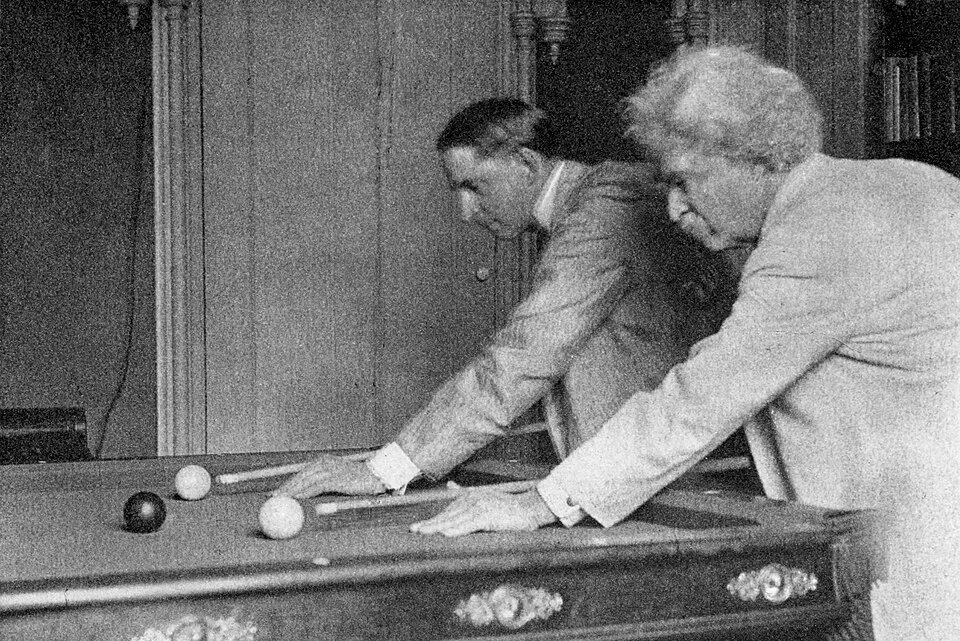
Mark Twain and his biographer Albert Bigelow Paine playing billiards, 1907
4 May 2026
In billiards, and in other sports, to put English on a ball is to cause it to spin so that it’s course changes. In billiards, this is done by striking the ball on one side, and the course change often occurs after it caroms off the cushion. The term arose in the United States in the mid nineteenth century.
Why this is referred to as English is not known. The most likely explanation is that billiard players from England introduced the technique to those in the United States, but there is no firm evidence of this. The Oxford English Dictionary has a quotation from a 1959 letter written to London’s Sunday Times in claiming that it was a man named English who introduced the technique to the Americas, but this is almost certainly an after-the-fact invention to explain the term.
The earliest use of English in this sense that I’m aware of is in the Cleveland Daily Plain Dealer of 14 October 1861:
The following are tricks most frequently practiced at billiards by a cunning adversary, of which I desire to warn you:
[…]
3. Immediately after shooting using his cue as a magic wand and flourishing it in the air above the table to give an increased “English” to his ball.
And Mark Twain used the term in his 1869 Innocents Abroad in a description of Parisian pool halls:
The cushions were hard and inelastic, and the cues were so crooked that in making a shot you had to allow for the curve or you would infallibly put the “English” on the wrong side of the ball.
And English as a verb appears in the Atlanta Constitution of 31 January 1875 in an article about King Kalakaua of Hawaii playing billiards in Omaha, Nebraska:
His royal highness again scored several, and to make up for his miscue he “jawed” the balls, and would and would [sic] have made a big run had not the balls “shewed” round so that it was impossible to make the shot without going to cushion first, and “Englishing.” The king failed on his “English,” not putting enough of it on.
The Constitution credits this article to the Omaha Bee, but that paper’s digitization is spotty, with only two issues of the Omaha paper from January 1875 available. In those, I see coverage of the king’s visit to the city, but not of this particular event.
Sources:
“Kalakaua as a Billiard Player. Atlanta Constitution (Georgia), 31 January 1875, 2/5. ProQuest Historical Newspapers.
Oxford English Dictionary Online, December 2008, s.v. English, adj. (& adv.) & n., English, v.
Smith, Norman. “Giving It English.” Sunday Times (London), 5 April 1959, 4/3. Gale Primary Sources: The Sunday Times.
“Tricks at Billiards.” Cleveland Daily Plain Dealer (Ohio), 14 October 1861, 4/3. Readex: America’s Historical Newspapers.
Twain, Mark. The Innocents Abroad. San Francisco: H. H. Bancroft, 1869, 116. HathiTrust Digital Library.
Photo credit: Unknown photographer, 1907. Wikimedia Commons. From Paine, Albert Bigelow. Mark Twain: A Biography, vol. 4 of 4. New York: Gabriel Wells, 1923, facing page 1326. Archive.org. Public domain image.