
19 August 2026
In current parlance, a great white hope, sometimes simply white hope, refers to someone in a particular field in whom others place expectations and desires for success. Originally it referred to a white person who might have success in a field dominated by people of color, and specifically to any white boxer who might dethrone Black boxer Jack Johnson, who reigned as world heavyweight champion from 1908–15. While the phrase today may be used without any racist intent, its history makes its use highly problematic, to say the least.
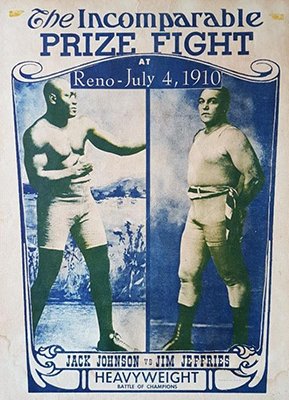
It is claimed by some that Jack London coined the phrase, but there is no record of the writer using the term. He did, however, express the sentiment of the phrase in his reporting in the Baltimore Sun on Johnson’s 4 July 1910 fight with James J. Jeffries, a former heavyweight champion who had come out of retirement to battle Johnson. London wrote:
Once again, has Johnson sent down to defeat the chosen representative of the white race, and this time the greatest of them.
Riots broke out following the fight as white mobs attacked Blacks celebrating Johnson’s victory. More than twenty people died.
The phrase white hope predates London’s Baltimore Sun article, appearing in the months leading up to the Johnson-Jeffries fight. Here is the earliest example that I’m aware of, from a headline the Kansas City Star of 27 June 1910:
JEFFRIES PUT ON SPEED
Eleven Fast Rounds Indulged in by the White Hope
And here’s a post-fight example, from the Indianapolis Black newspaper The Freeman of 22 October 1910, although this use is an adjective phrase, not a noun phrase:
After being turned down by seven American life insurance companies in his quest for a $75,000 policy, Jack Johnson, the “white hope blaster,” was notified by a London company that it would insure his life in any sum up to $100,000. The premium demanded by the London company is said to be one of the highest on record.
A few months later, on 30 December 1910, the Los Angeles Daily Times used the noun phrase in reference to boxer Carl Morris:
WHITE “HOPE” TALKS LOUDLY.
Morris Sure He Can Thrash Big Jack Johnson
And we the great is added the following year, when it appears in the Oakland Tribune of 30 April 1911. The original paper used for the digital scan is damaged, hence the lacunae, but the phrase can still be made out clearly:
Wednesday night will decide once and for all whether or not “Gunboat” Smith is to become a real white hope among the heavyweights at present meandering about the globe in the hope of establishing a right to claim a match with Mr. John Artha Johnson.
[…]
With all the care with which a loving [m]other could nurse a baby Harry Foley [ ]ling and preparing the Gunboat [ b]attle of Wednesday. Foley as [ ] of the great white hope of the [ ]d amass a fortune.
Five years later, an out-of-shape Johnson would eventually lose the title in the twenty-sixth round of a bout with Jess Willard.
Sources:
“Jack Johnson’s Insurance Policy.” The Freeman (Indianapolis), 22 October 1910, 7/2. Readex: America’s Historical Newspapers.
“Jeffries Put on Speed.” Kansas City Star (Missouri), 27 June 1910, 1/3. Newspapers.com.
“Live Doings in the Field of Sports.” Los Angeles Daily Times, 30 December 1910, 6/1. ProQuest Newspapers.
London, Jack. “Jeffries Falls a Victim” (4 July 1910). The Sun (Baltimore, Maryland), 5 July 1910, 1/8.
Oxford English Dictionary Online, March 2015, s.v. white hope, n.
Shapiro, Fred. “Re: (great) white hope (1910).” ADS-L, 25 July 2026.
Smith, Eddie. “Victory Means Much to Either Smith or Barry.” Oakland Tribune (California), 30 April 1911, 39/1. NewspaperArchive.com.
Image credit: unknown creator, 1910. Wikimedia Commons. Public domain image.
