
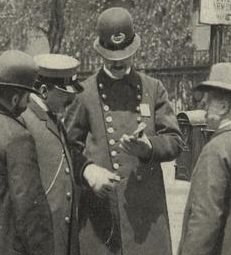
An 1899 New York City policeman giving directions to three men
1 December 2025 [Edit, same day: added 1958 NYT example]
What is a hairbag? And is it a bad thing?
The term has been New York City police slang for a veteran officer since at least 1958, when it was recorded in two glossaries of police slang. The first appears in a New York Times Magazine piece on 14 March 1958:
Hair bag—A veteran policeman, especially knowledgeable about the inner workings of the Police Department.
The second glossary is in the October issue of Spring 3100, a New York Police Department magazine. That glossary defines a hair bag as “a veteran policeman.” And a New York Times article from 15 February 1970 defines it as “a veteran patrolman, also a patrolman with backbone.”
While these early definitions are positive, the term has subsequently generally been a negative one. For instance, Edward Droge’s 1973 The Patrolman: A Cop’s Story says:
My partner that night, a lethargic old ‘hairbag’ (old-timer) who could not be aroused by Raquel Welch.
And William Heffernan’s 2003 novel A Time Gone By has this:
Donahue was a sergeant closing in on his thirty years—an old hairbag in department lexicon, a term used to describe an aging and often useless cop who was just biding his time until he could get out.
A 9 November 2019 New York Times article has this to say about the term:
For as long as anyone can remember, younger officers in the New York Police Department have referred to their elders as “hairbags”—usually behind their backs.
It’s an archaic bit of slang with obscure origins. In police parlance, “the bag” means “the uniform.” So some officers believe “hairbag” is a riff on a longtime officer’s uniform—so old it has become hairy—and describes veterans who know what the police call “The Job” inside out.
Others think the phrase is an insult that comes from the practice, perhaps apocryphal, of officers using a haircut as an excuse for leaving their posts. This theory holds that sergeants used to demand a bag of hair trimmings as proof, and eventually burned-out officers who shirked work came to be known as “hairbags.”
It’s questionable whether either of these explanations are true. The one about haircuts is especially suspect.
And of course, hairbag can also mean a bag for holding and storing a wig or a bag made out of hair, but the etymology of those senses is obvious.
Sources:
Burnham, David. “Police (Cops?) Have Slanguage of Own.” New York Times, 15 Feb 1970, 65/4. ProQuest Newspapers.
Goldstein, Joseph and Ali Watkins. “Before There was ‘O.K. Boomer,’ the City’s Police Had ‘Hairbag.’” New York Times, 9 Nov 2019, A21/1. ProQuest Newspapers.
Green’s Dictionary of Slang, accessed 2 November 2025, s. v. hair, n.
Heffernan, William. A Time Gone By. New York: Simon & Schuster, 2003, 27. Archive.org.
Lighter, J. E., ed. Historical Dictionary of American Slang (HDAS), vol. 2 of 2. New York: Random House, 1997, s.v. hairbag, n.
“Police Cant…Oh Yes They Can!” Spring 3100, October 1958, 5–10 at 9/1. John Jay College of Criminal Justice, Lloyd Sealy Library Digital Collections.
Wells, George V. “Station House Slang.” New York Times Magazine, 14 March 1958, 14. ProQuest Historical Newspapers.
Image credit: unknown photographer, 1899. Wikimedia Commons. Public domain photo.