
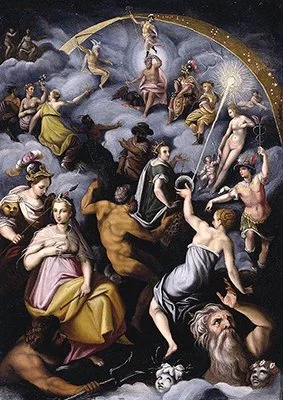
“The Assembly of the Gods,” Jacopo Zucchi, c. 1575, oil on copper
13 November 2026
Polytheism and monotheism would seem to many to be rather straightforward concepts, but the term monotheism, at least, did not always mean exactly what we use it today to mean.
The etymologies are straightforward enough. Poly- is from the Greek πολυ-, meaning many, and the mono- is from the Greek μονο-, meaning one or lone. Theo- is also from Greek, θεο-, meaning god. The suffix -ism is from the Latin -ismus, which in turn is from the Greek ‑ισμός (-ismos), used to form a noun from a verb, denoting a completed action or its result; in English, the suffix is also used to denote the action or beliefs of a class of people. So we have polytheism, the belief in many gods and monotheism, the belief in only one God. But etymology is not destiny, and the meaning of a word comes from use, not its etymons.
Polytheism is recorded first, in Samuel Purchas’s 1613 gazetteer of the world, Purchas His Pilgrimage. Purchas uses the word twice. The first is in an accusation that the Roman Catholic church, with its veneration of saints, is a polytheistic religion:
Although vpon that golden foundation they build afterward their owne Hay and Stubble, with their racke of Confession, and rabble of Ceremonies, and (the most dangerous to new Conuerts) an exchanged Polytheisme in worshipping of Saints, Images, and the Host.
And the second is in reference to the Muslim ruler Tamerlane (d. 1405):
His Religion was not pure Mahumetisme, for he thought GOD was delighted with varietie of worships; yet he hated Polytheisme and Idols, onely one GOD he acknowledged, and that with much deuotion, after his manner. Thus he beat downe all the Idols in China, but honoured the Christians, with great admiration at the strict life of some Votaries.
The term monotheism is coined some decades later. The first person known to have used it is the theologian Henry More. In his 1660 An Explanation of the Grand Mystery of Godliness, More claims the ancient Egyptians were a kind of monotheist, only they worshipped a false god:
Lastly, The Aegyptians, a people more infamous for Polytheism and variety of Religions then any nation under the cope of Heaven, yet their Priests are observed more compendiously to do their Ceremonies to certain Spheres or round Globes, whereof there was one in every Temple, but kept very close from the sight of the vulgar; the Priests reserving the knowledge of the Unity of the Object of their worship as an Arcanum only belonging to themselves.
But that This One Object of Worship was not the true God, but the Material World […] But thus to make the World God, is to make no God at all; and therefore this Kinde of Monotheisme of the Heathen is as rank Atheisme as their Polytheisme was proved to be before.
Later in that same book, More applies the term to Islam, but in so doing implies that Christians, with their concept of the Trinity, are not strictly monotheists:
To point at the Saracens hypocritical ostentation of Monotheisme or worshipping one God, which they doe mainly in envy and opposition to the Christians profession of the Trinity, while themselves in the mean time are under the Destroyer, and are still as truly Pagans as the Assyrians and Greeks that worshipped Adad and Apollo.
Twenty years later, in his exegesis of the book of Revelation, Apocalypsis Apocalypseos, More corrects this implication:
It denotes, that with their conquests they would bring in a Religion contrary to that of Christ, and destroy the worship of the Son of God under an ignorant pretense of Monotheisme, as if the Christian Religion were inconsistent with the worship of one God, whereas the more distinct knowledge of that one God does not make us less Monotheists than they.
In his 1701 essay Against Atheism, William Anstruther picks up on More’s labeling of ancient Egyptians as monotheists:
Although the ignorant amongst the Heathens, did in this manner establish a Polytheism, yet I find all who were thoughtfull amongst them, did believe in a Monotheism, which that venerable Riddle or Enigmatical Inscription in the Pagan Temples doth evince; I am all that was, and is, and is to come, and my Vail [sic] no Mortal ever did yet uncover. And they did beleive [sic] One Eternal Deity infinitly good Omniscient, Omnipotent &c.
And Nathan Bailey, in his 1736 Dictionarium Britannicum picks up on More’s implication that the Christian doctrine of the Trinity is not monotheistic:
Monoth´eism [of μόνο alone, and Θεὸς, God] the Doctrine or Principles of the Unitarians.
These early uses of monotheism are not so much about the number of gods, but rather they are more about the nature of the one God. One may worship one god, but if it’s not the right kind of god, that is the same kind as the speaker, then one is not a monotheist.
For the next ninety years, every English dictionary that included the word would copy Bailey’s definition, although the more general use in literature was the one we use today. Samuel Johnson’s 1755 dictionary did not have an entry for monotheism, but it would fall to Noah Webster and his 1828 dictionary to be the first to print the more common definition:
MONOTH´EISM, n. [Gr. μόνο, only, and Θεὸς, God]
The doctrine or belief of the existence of one God only.
But Webster here is relying on the etymological fallacy, the idea that a word’s roots determine its meaning, rather than actual usage in the early nineteenth century. The sense of monotheism that is most common today was succinctly expressed by atheist Charles Bradlaugh in 1882:
I take Monotheism to be the doctrine “that the universe owes its existence and continuance in existence to the wisdom and will of a supreme, self-existent, eternal, infinite, omnipotent, omniscient, righteous, and benevolent personal being, who is distinct from and independent of what he has created.”
Bradlaugh’s definition, like the earlier ones, is not just about the number of gods but also about the nature of the one God.
Sources:
Anstruther, William. “Against Atheism.” Essays, Moral and Divine. Edinburgh: George Mosman, 1701, 19. Gale Primary Sources: Eighteenth Century Collections Online.
Bailey, Nathan. Dictionarium Britannicum. London: T. Cox, 1736, Preface (end). HathiTrust Digital Library.
Bradlaugh, Charles. “A Plea for Atheism.” In Theological Essays. London: Freethought Publishing, 1882, 23. HathiTrust Digital Library.
McClellan, Dan. “Monotheism.” Oxford Research Encyclopedia of Religion, 16 April 2025. DOI: 10.1093/acrefore/9780199340378.013.1195.
More, Henry. Apocalypsis Apocalypseos. London: J. M. for J. Martyn and W. Kettilby, 1680, 83–84. ProQuest: Early English Books Online (EEBO).
———. An Explanation of the Grand Mystery of Godliness. London: J. Flesher for W. Morden, 1660, 61–62, 188. ProQuest: Early English Books Online (EEBO).
Oxford English Dictionary Online, December 2002, s.v. monotheism, i.
Purchas, Samuel. Purchas His Pilgrimage. London: William Stansby for Henry Fetherstone, 1613, 43, 357. ProQuest: Early English Books Online (EEBO).
Webster, Noah. An American Dictionary of the English Language (1828), vol. 2 of 2. New York: Johnson Reprint, 1970, s.v. monotheism, n. Archive.org.
Image credit: Jacopo Zucchi, c. 1575. Wikimedia Commons. Public domain image as a mechanical reproduction of a public domain work.
