
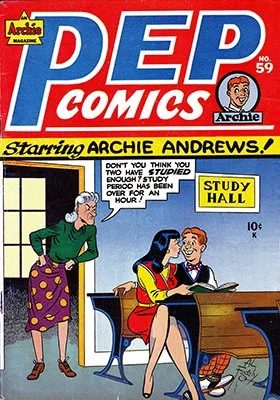
Pep Comics, #59, October 1945
24 July 2026
Mrs. Grundy is a proverbial character, a scold and purveyor of society’s moral sentiments. She has her origin in Thomas Morton’s play Speed the Plough, penned in 1798 and first performed in 1800. While largely forgotten today, the play was enormously popular in its day. Multiple characters refer to her throughout the comedy, although she herself does not appear on stage—fittingly, the threat of moral judgment looms unseen, off stage—and the line “What will Mrs. Grundy say?” is repeated several times during the play.
Here’s an instance from Act 1, Scene 1, in which Farmer Ashfield and his wife are talking:
Dame. And I assure you Dame Grundy’s butter was quite the crack of the market.
Ash.. Be quiet, woolye? aleways ding, dinging Dame Grundy into my ears—what will Mrs. Grundy zay? What will Mrs. Grundy think?—Casn’t thee be quiet, let ur alone, and behave thyzel pratty?
And another from Act 4, Scene 1:
Ash.. How many silk gowns have thee got, Dame?
Dame. Three, Tummas—and sell them all—and I’ll go to church in a stuff one—and let Mrs. Grundy turn up her nose as much as she pleases.
References to “What would Mrs. Grundy say?” start popping up shortly after the play’s debut. Here’s one from Francis Lathom’s 1803 novel, Very Strange, But Very True!:
“Oh Lord,” exclaimed Lady Catherine with a sigh, “I cannot bear marrying out of a church; it is a thing I can’t bear to see.”
“Oh don’t get up,” replied his lordship, “we can get on very well without you.”
“Not get up sir!” rejoined her ladyship, “strange indeed if my own daughter was to be married under my own roof, and I not present at the ceremony.”
“Aye, what would Mrs. Grundy say to that?” cried Sir Luke with an arch smile at Jane.
“Spare your jests, son, if you please,” replied her ladyship, “none of your jokes out of plays upon me, they are out of place and out of person.”
Or this one, from Amelia Opie’s 1809 short story, The Uncle and Nephew:
Fear of what the world may think will never, I trust, deter us from acting prudently: indeed, my dear Charles, I hope that neither you nor I shall be in the habit of exclaiming, like the woman in the comedy, “But what will Mrs. Grundy say?”—No, no, we will have no Mrs. Grundies; or rather, you shall be my Mrs. Grundy, and I yours.
There were even songs about it. Here’s a 22 July 1810 advertisement for a theatrical revue that appeared in London’s Observer:
NEW COMIC PANTOMIME.
AQUATIC THEATRE, SADLER’s-WELLS.
To-morrow (Monday, July 23), and following Evenings, a New Dance, composed by Mr. Grimaldi, Called THE BOLD SERGEANT.—A New Comic Pantomime (including four Scenes from three of the Author’s most popular Pantomimes), with new Music, Scenery, &c. […] Songs in the Pantomime: “Bang up,” sung by Mr. A. Slader […] and “Tea-table Talk; or, What’ll Mrs. Grundy say?” sung by Mr. Grimaldi.
And not to be left out, here’s a North American use of the phrase from Philadelphia’s National Recorder of 18 November 1820:
“What will Mrs. Grundy say?” is the constant exclamation of some of our ultrapatriots. If any abuse in or governments or any striking instance of depravity is pointed out, there is an immediate reference to the opinions that foreigners will have of it, and it is often said that it is better to hush up any disgraceful matter as quietly as we can.
It is a testament to the power of peer pressure and society’s moral judgments that Mrs. Grundy lives on, long after Morton’s play is forgotten by all except those who study eighteenth-century drama.
Sources:
“The American Character.” National Recorder (Philadelphia), 18 November 1820, 1.1. ProQuest Magazines.
Lathom, Francis. Very Strange, But Very True! or, the History of an Old Man’s Young Wife, vol 3 of 4. London: A. Strahan for T. N. Longman and O. Rees, 1803, 70–71. Gale Primary Sources: Eighteenth Century Collections Online.
Opie, Amelia Anderson. “The Uncle and Nephew.” Simple Tales, vol. 4, third edition. London: Longman, Hurst, Rees and Orme, 1809, 12. Gale Primary Sources: Nineteenth Century Collections Online.
Morton, Thomas. Speed the Plough (1798), fourth edition. Dublin: William Porter, 1800, 1.1, 5–6 and 4.1, 52. Gale Primary Sources: Eighteenth Century Collections Online.
“New Comic Pantomime” (advertisement). Observer (London), 22 July 1810, 3/3. ProQuest Newspapers.
Oxford English Dictionary Online, 1900, s.v. Grundy, n.3.
Image credit: Pep Comics, #59, October 1945. Archiecomics.com. Fair use of low-resolution copy of a copyrighted image to illustrate the topic under discussion.