
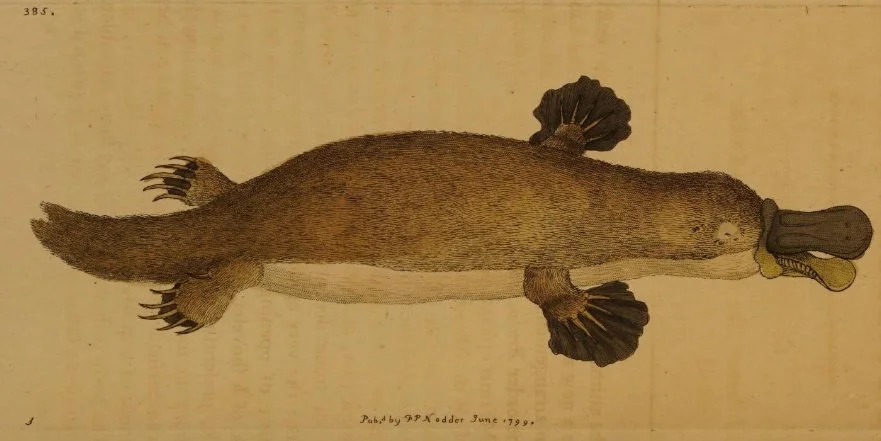
Drawing of a platypus that accompanied George Shaw’s 1799 description of the creature
26 October 2026
The platypus, or duck-billed platypus, (Ornithorhynchus anatinus) is perhaps the oddest mammal. It is a semiaquatic monotreme (i.e., it lays eggs). It has a leathery bill that resembles that of a duck and uses electrolocation to find its prey (larvae, worms, shrimp, crayfish, and the like) in the water—it and the Guiana dolphin are the only mammals with this sense. Males have venomous spurs on their hind feet. It is native to Eastern Australia and Tasmania.
The name was coined by naturalist George Shaw in 1799. It is a Latin coinage from Greek roots: πλατυ (platy, flat) + πούς (pous, foot). The plural is usually platypuses, or more rarely, like the plural of octopus, platypi (Latin) or platypodes (Greek).
Shaw named and described the platypus in the 1799 volume ten of his Naturalist’s Miscellany:
THE DUCK-BILLED PLATYPUS
****************************
GENERIC CHARACTER.
Mouth shaped like the bill of a Duck.
Feet webbed.
And at the end of the description of the animal, Shaw adds:
The Platypus is a native of Australasia or New Holland, and is at present in the possession of Mr. Dobson, so much distinguished by his exquisite manner of preparing specimens of vegetable anatomy.
Sources:
Oxford English Dictionary Online, June 2006, s.v. platypus, n.
Shaw, George. Naturalist’s Miscellany, vol. 10. London: J. Cooper for F. P. Nodder, 1799, n.p. HathiTrust Digital Library.
Image credit: Shaw, George. Naturalist’s Miscellany, vol. 10. London: J. Cooper for F. P. Nodder, 1799, plate 385. HathiTrust Digital Library. Public domain image.