
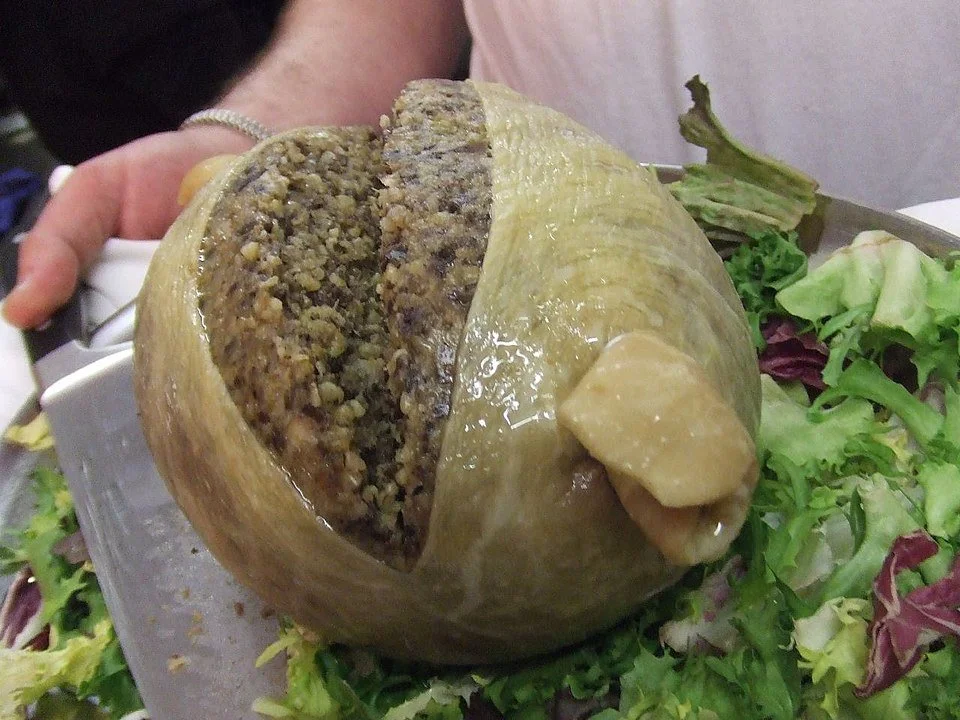
A haggis, the “Great Chieftain o’ the Puddin-race”
17 June 2026
Pudding is a word that means different things on either side of the Atlantic, and it is also a word that has acquired additional senses over of the centuries. Pudding dates to the late thirteenth century, and its original meaning is that of a sausage, a mix of meat, suet, oats or other grains, seasonings, etc. stuffed into the intestine or stomach of a sheep, pig, or other animal. Over time, it has also come to mean a boiled, steamed, or baked dish, both savory and sweet, as well as a custard-like dessert, or just a dessert course in general.
Pudding most likely comes from the Anglo-Norman bodin, referring to animal intestines generally and sausage more specifically. In the twentieth century, Canadian French borrowed pudding and changed it into a very different dish, poutine, before handing that variant of the word back to English, along with a hardening of the arteries.
But the earliest reference to pudding in the original sense of sausage that I’m aware of is in the records of the court leet for Norwich, England in 1287. A court leet was a local court that tried minor offenses. The roll for that year inserts the English word into an otherwise Latin record:
Presentant etiam quod omnes illi de Sproxton vendunt hillas et pudinges, emunt scienter porcos superseminatos et vendunt in foro Norwyci predictas hillas et pundinges, non necessarias corporibus hominum.
(They present also that all those Sprowston men sell sausages and puddings, they knowingly buy diseased/inferior pigs, and they sell the said sausages and puddings, unfit for human bodies, in Norwich market.)
The exact meaning of the Latin superseminatos (oversown) here is uncertain, but in context, it clearly refers to pigs that will produce diseased or otherwise inferior meat. The 1892 edition from which I take the quotation translates it as measly, which does not match the present-day colloquial sense of small/puny nor the technical sense of infected with cysticercosis, which is probably too specific for this passage.
A fully English use can be found in the poem The Land of Cockaygne, composed in the thirteenth century with a manuscript witness from c. 1335:
Þer is a wel fair abbei
Of white monkes and of grei.
Þer beþ bowris and halles,
Al of pasteiis beþ þe walles,
Of fleis, of fisse and rich met,
Þe likfullist þat man mai et.
Fluren cakes beþ þe schingles alle
Of cherche, cloister, boure and halle,
Þe pinnes beþ fat podinges,
Rich met to princeȝ and kinges.
(There is a very fine abbey
Of white monks and of gray,
There are bowers and halls,
All of pasties are the walls,
Of flesh, of fish, and rich meat,
The most delicious that one may eat.
Flour cakes are the shingles all
of church, cloister, house and hall,
The nails are fat puddings,
Rich food for princes and kings.)
By the early modern era, pudding had also come to mean a boiled or steamed dish, either savory or sweet. Such dishes were boiled or steamed in a bag, analogous to the intestine used to make sausage, hence the semantic change. Here we see an example from 1544, although here the recipe is for a poultice or medical dressing that resembles a pudding, not for the food itself. From Thomas Phaer’s translation of Jean Goerot’s Regiment of Lyfe:
Take oyle of roses, cromes of breade, yolkes of egges, and cowes mylke, with a lytle saffron, seeth them togyther a lytle as ye woulde make a puddynge, afterwarde sprede them vpon cloutes & laye vpon the sore.
The original French reads bouillie (porridge, gruel).
Over time, this use of pudding grew to encompass similar baked dishes. And in current British use is almost exclusively restricted to sweet dishes, except in certain named savory dishes, such as Yorkshire pudding, hasty pudding, black pudding, etc. This sense is now rare in North America except for those specifically named dishes.
But in North America pudding became associated with custard-like desserts in the late nineteenth century. Here is a recipe for two such puddings in Fannie Farmer’s bestselling Boston Cooking-School Cook Book:
Rebecca Pudding
4 cups scalded milk.
½ cup corn-starch.
¼ cup sugar.
¼ teaspoon salt.
½ cup cold milk.
1 teaspoon vanilla.
Whites 3 eggs.
Mix corn-starch, sugar, and salt, dilute with cold milk, add to scalded milk, stirring constantly until mixture thickens, afterwards occasionally; cook fifteen minutes. Add flavoring and whites of eggs beaten stiff, mix thoroughly, mould, chill, and serve with Yellow Sauce I. or II.
[…]
Pineapple Pudding
2 ¾ cups scalded milk.
¼ cup cold milk.
⅓ cup corn-starch.
¼ cup sugar.
¼ teaspoon salt.
½ can grated pineapple.
Whites 3 eggs.
Follow directions for Rebecca Pudding, and add pineapple just before moulding. Fill individual moulds, previously dipped in cold water. Serve with cream.
Note, the Fanny Farmer candy company is unrelated to Fannie Farmer of culinary fame. The company was founded after her death and so named to cash in on her reputation, using a spelling variant of her name to avoid trademark violations.
A different semantic change happened in Britain, where in the early twentieth century pudding generalized from the sweet boiled/steamed/baked dishes to refer to the dessert course. Here is an example from the London’s Times of 27 November 1934:
We give good nourishing dinners to expectant and nursing mothers in a quiet room in the centre, at a time convenient to the mothers. These dinners satisfy the requirements of our medical officers. They cost 6½d. to 7d. each, and consist of fish or meat, two vegetables, and a pudding.
Sources:
Anglo-Norman Dictionary, AND2 Phase 1, 2000–06, bodins, n.
Farmer, Fannie Merritt. The Boston Cooking-School Cook Book. Boston: Little, Brown, 1896, 344–45. HathiTrust Digital Library.
Goeurot, Jean. The Regiment of Lyfe. Thomas Phaer, trans. London: Edward Whitchurch, 1544, fol. 80v. ProQuest: Early English Books Online (EEBO).
Heuser, W., ed. “The Land of Cockaygne.” Die Kildare-Gedichte. Bonner Beiträge zur Anglistik 14. Bonn: P. Hanstein, 1904, lines 51–60, 146. London, British Library, MS Harley 913. Corpus of Middle English Prose and Verse.
“Leet Roll of 16 Edward I (1287/8).” Hudson, William, ed. Leet Jurisdiction in the City of Norwich During the XIIIth and XIVth Centuries. Publications of the Selden Society, vol. 5. London: Bernard Quaritch, 1892, 8. HathiTrust Digital Library.
Middle English Dictionary, 31 January 2026, s.v. poding, n.
Oxford English Dictionary Online, September 2007, s.v. pudding, n.
“Points from Letters: Maternal Mortality.” Times (London), 27 November 1934, 10/5. Gale Primary Sources: The Times Digital Archive.
Photo credit: Tess Watson, 2007. Wikimedia Commons. Flickr. Licensed under the Creative Commons Attribution 2.0 Generic license.