
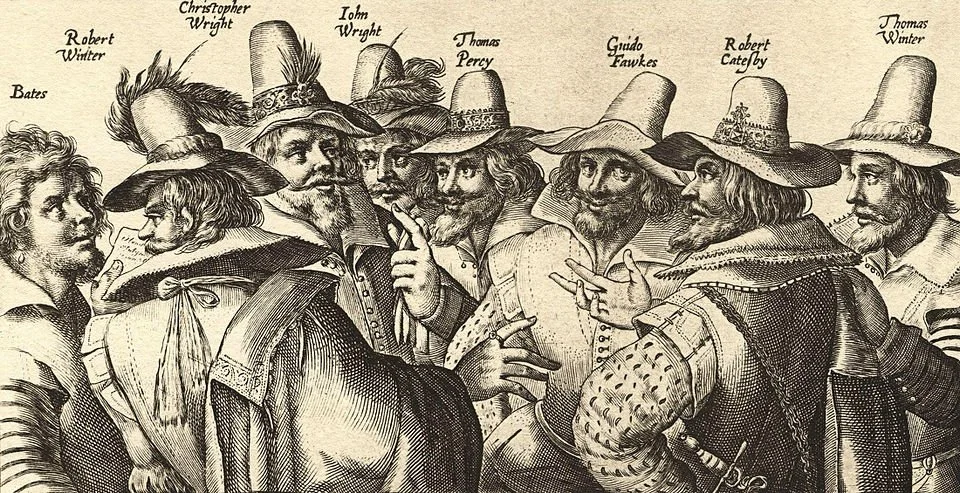
Crispijn de Passe the Elder, c. 1605, engraving of the Gunpowder Plot conspirators; Guy Fawkes is third from right
16 February 2026
Ring comes down to us from the Old English hring with much the same meaning as today, a circlet, often made of metal, to be worn as an ornament, or more generally, any similar circular structure, or a group of people arranged in a circle, as in a dance. (Cf. ring around the rosie)
By the thirteenth century ring was being used metaphorically to refer more generally to a group of people joined by some association, not simply those arranged in a circle. We see this usage in Hali Meidenhad, a homily that encouraged young women to enter religious orders rather than be married:
For ȝif ha beoð acwiket & imaket hale, ha beoð i widewene ring, & ſchulen, i widewene ring, bifore þe iweddede ſingen in heuene.
(For if they are quickened and made whole, they are in the ring of the widowed, and must, in the widowed ring, sing before the wedded in heaven.)
And by the beginning of the sixteenth century, ring was being used to describe a criminal or mutinous conspiracy. This is evident by the appearance of the word ringleader, which can be found in a c. 1503 letter from English soldier and politician John Flamank to King Henry VII:
“Thees men,” he said, “never lovyd the kyngis grace, nor never woldo, with many mo of the same mynd within this toune. Now that I have shewed all the wyrst. This be a sherwde company sett in yll mynde. Dout ye not but this will falle in dede but good provysion be made for the remedy in tyme.
[…]
“And we do wysly, I doutnot but by good counsell we shalbe able by good polici to distrii alle the captayns and ryngledres that be of yll and contrarij mynde.”
The earliest citation of the sense of ring to mean a criminal conspiracy in the Oxford English Dictionary is from John Bee’s 1823 slang dictionary:
Ring—the word was applied by the city-officers to that connexion, circle, or secret understanding which is supposed to exist among the caddees of stage-coaches who are upon the lay—or kedge; and in this sense of a ring representing a circle, round, or connexion, better heads than their’s concur.
But the existence of ringleader from centuries before indicates that this sense of ring must have been circulating for at least as long, and probably earlier than c.1503.
Sources:
Bee, John. (pseud. John Badcock). Slang. A Dictionary of the Turf, the Ring, the Chase, the Pit, of Bon-Ton, and the Varieties of Life. London: T. Hughes, 1823, 212. Archive.org.
Flamank, John. Letter to Henry VII (c. 1503). In Gairdner, John, ed. Letters and Papers Illustrative of the Reigns of Richard III and Henry VII, vol. 1. London: Longman, Green, Longman, and Roberts, 1961, 237–238. Archive.org.
Furnivall, F. J., ed. Hali Meidenhad: An Alliterative Homily of the Thirteenth Century (c. 1225). Early English Text Society O.S. 18. Oxford: Oxford UP, 1922, 29. London, British Library, Cotton MS Titus D.18. Archive.org.
Middle English Dictionary, 3 January 2026, s.v. ring, n.
Oxford English Dictionary Online, June 2010, s.v. ring, n.1, ringleader, n.
Image credit: Crispijn de Passe, the Elder, c. 1605. Wikipedia Commons. UK National Portrait Gallery, NPG 334a. Public domain image.