
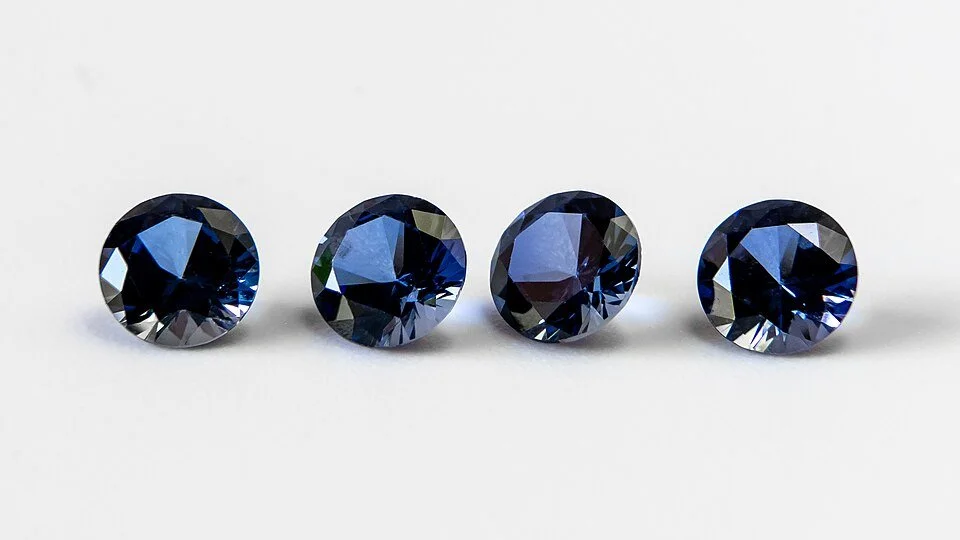
Four man-made sapphires
23 February 2026
Sapphire is a gem, usually blue in color, a variety of corundum. The word came into English from the Anglo-Norman saphir, which is from the Latin sapphirus, which, in turn, is from the Greek σάπφειρος (sappheiros). After the Greek, the trail gets muddy. It may come from a Semitic root, akin to the Hebrew sappir or the Aramaic sampirina, or it may come from a Proto-Indo-European root, akin to the Sanskrit canipriya, literally meaning dear to the planet Saturn, and used to refer to some dark gemstone. The difficulty in tracing the origin stems from the possibility of earlier borrowings between Semitic and Indo-European languages.
The earliest use of the word in English may be in Thomas of Hales’s thirteenth-century Love Ron:
Hwat spekestu of eny bolde
þat wrouhte þe wise salomon
of iaspe, of saphir, of merede golde,
& of mony on-oþer ston?
Hit is feyrure if feole volde
more þan ich eu telle con;
Þis bold, mayde, þe is bihote
if þat þu bist his leouemon.
(What do you say of any temple that the wise Solomon built of jasper, of sapphire, of refined gold, and of many other stones? It [i.e., the dwelling that God will give you] is fairer by many times, for than I can tell you. This temple, maid, is promised if you are his lover.)
Sources:
Anglo-Norman Dictionary, AND2 Phase 5, 2018–21, s.v. saphir, n.
Middle English Dictionary, 3 January 2026, s.v. saphir(e, n.
Oxford English Dictionary Online, 1909, s.v. sapphire, n.
Thomas of Hales. “Friar Thomas de Hales’s Love Ron.” Carleton, Brown, ed. English Lyrics of the XIIIth Century. Oxford: Clarendon Press, 1932, lines 113–20, 71. Oxford, Jesus College, MS 29. Archive.org.
———. “Love Rune.” Susanna Fein, ed. Middle English Text Series (METS).
Photo credit: W. Carter, 2020. Wikimedia Commons. Licensed under the Creative Commons Attribution 4.0 International license.