
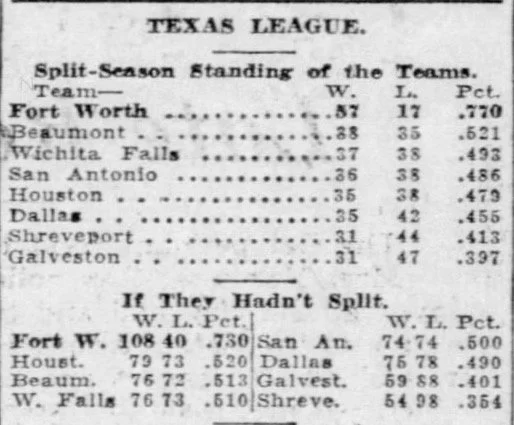
Standings of baseball’s Texas League, one of the minor leagues, as of 14 September 1934
17 July 2026
[Edit 20 July: added paragraph on the sound change in Middle English]
The nouns scrub and shrub are essentially variants on the same word. They both come from the Old English scrybb, meaning bushes or brush. In addition to literal meaning of low or stunted plant growth, scrub has been applied to small breeds of cattle, in a figurative use referring to a low or disreputable person, and in North American colloquial speech to a second-tier athlete.
The /ʃ/ or /sh/ pronunciation developed in Middle English. As a general rule, an initial /sk-/ sound in a Present-Day English word indicates the word is not originally from Old English, most often a borrowing from Old Norse in the late Old English or early Middle English period. An exception to this rule is the initial /skr-/, a combination rarely found in Old Norse, which indicates an Old English root. The shift from /skr-/ to /ʃr/ is a regular sound change and resulted in the creation of two different forms in several other word pairs: shred/screed from the Old English screade and shrew/screw from the Old English screawa, for example. (Screw here is an English dialect term for the animal.)
The verb to scrub, meaning to clean, comes into English from a different source and is etymologically unrelated. It’s a fifteenth-century borrowing from either the Middle Dutch or Middle Low German schrubben, originally meaning to curry a horse.
The Old English scrybb, meaning brush, only appears once in the extant corpus. It’s in the will of Ælflæd, daughter of King Edmund I and Æthelflæd of Damerham, dated c. 972. Scrybb appears in a section of the will demarcating land boundaries. While such legal documents are primarily in Latin, sections describing geographic boundaries are typically in English:
Ðis synd þa landmearca to Byligesdyne. […] of the stanstræte &lang scrybbe þ[æt] hit cymð to Acantune.
(These are the land-boundaries at Bilson. […] From the stone-road along the scrub until it comes to Acton.)
We can see the split between scrub and shrub in John Trevisa’s translation of Bartholomæus Anglicus’s De proprietatibus rerum. Trevisa uses both forms in book 17 of the work, which describes herbs and plants. One passage reads:
Balsamum is a tree oþer a scrub þat neuere growiþ passyng þe height and quantite.of tweye Cubites, as Isider seiþ.
(Balsum is a tree or a scrub that never grows beyond the height and measure of two cubits, according to Isidore.
And another reads:
A busshe hatte rubus and is þikkenesse of þornes and of breres, and of oþer sshrubbes and prikkes whanne (he) groweth in a place yfere, as Ysider seith.
(A bush that is called rubus is a thicket of thorns and briars, and of other shrubs and pricks when it grows in a place with them, according to Isidore.)
Scrub is applied to small breeds of cattle in the sixteenth century. And it comes to mean a low or disreputable person in the seventeenth. From a 1687 translation of Cervantes’s Don Quixote:
And now they were got into the open Plain, at what time they discover'd the three Countrey Girls within a Stone's throw. Upon which, Don Quixote casting his Eyes towards Toboso, and seeing no other then these three Tatterdemallions upon the Road, strangely dejected in Spirit, quo he to Sancho, Was the Princess come forth of the City, when you left her? How d' ye mean forth of the City, quo Sancho?— Where be your Eyes? i' the Nape of your Neck? I see nothing, Sancho, quo Don Quixote, but three tatter'd Scrubs upon three ragged Colts.
And this sense of a disreputable person came to refer to a low-quality or ad hoc baseball team in North America of the mid nineteenth century. We see it in phrases like scrub game, scrub match, scrub nine, and scrub team. Here’s an example of scrub nine from the New York Herald of 11 August 1868:
A club boasting of such a large number of members as the Mutual, having so many good players at command, should never contract a match game unless the club can be properly represented and without players being put to the humiliating necessity of borrowing parts of a ball suit from one place and other parts from another place and presenting on the field the appearance of a “scrub nine.”
And here’s another example in a very sexist article that appeared in the Dallas Morning News of 12 January 1886:
The young ladies’ base ball club and young ladies’ military company visited this city and “took in” a few of the populace, this week. They are the biggest humbug that every visited Texas, except “Goheen,” the boy mesmerist. They cannot play base ball at all. A scrub nine was gotten up among the boys of the city (they should all be ashamed of being caught in such company) and at the first inning the boys made ten tallies and the girls made nothing, and one of them got a black eye. Their character is rather doubtful. However, no lady will put herself out of her sphere, and base ball is certainly no game for young ladies, and no girl of good morals will ever be caught playing it.
And we see scrub referring to an individual player in an article in Outing magazine of November 1891, this time in the context of American football:
Upon most of the college fields up to the last few weeks of practice the scrub side can and do show a better understanding of the kicking game than do the ’varsity. This arises from the fact that, owing to the preponderance of weight and strength in the ’varsity rush line, the scrubs are forced to kick more often, and hence their ends and tackles learn far more as to the movements they should make than they would upon the other side.
It’s tempting to try and link this sense of scrub to the phrase bush league, but while scrub may have reinforced and influenced the popularity of this other phrase, it more likely comes from the sense of bush meaning rural or wilderness. A bush league plays far away from the bright lights of the big city.
Sources:
Bartholomæus Anglicus. On the Properties of Things (De proprietatibus rerum), vol. 2 of 3. John Trevisa, trans. M. C. Seymour, ed. 17.18, 916 and 17.140. 1036. London, British Library, Additional 27944.
Bosworth Toller’s Anglo-Saxon Dictionary Online, 2019, s.v. scrybb, n.
Camp, Walter. “Football of 1891.” Outing (New York), November 1891, 153–57 at 156/1. ProQuest Magazines.
Cervantes, Saavedra, Miguel de. The History of the Most Renowned Don Quixote and His Trusty Squire Sancho Panza, book 1, part 2. John Phillips, trans. London: Thomas Hodgkin, 1687, 334. ProQuest: Early English Books Online (EEBO).
Dickson, Paul. The Dickson Baseball Dictionary, third edition. New York: W. W. Norton, 2009, s.v. scrub game, scrub match, scrub nine, scrub team, 751.
Green’s Dictionary of Slang, accessed 27 June 2026, s.v. scrub, n.1.
Middle English Dictionary, 17 June 2026, s.v. shrub(be, n., shrubben, v.
“The National Game.” New York Herald, 11 August 1868, 9/4. Library of Congress: Chronicling America.
Oxford English Dictionary Online, 1911, s.v. scrub, n.1, scrub, v.1; 1914, s.v. shrub, n.1; 1909, s.v. S, n.1 (etymology updated since 1909).
“The State Press.” Dallas Morning News (Texas), 12 January 1886, 4/6. Readex: America’s Historical Newspapers.
Thorpe, Benjamin. “Ælflæd’s Will, Reciting Queen Æthelflæd’s, circa 972.” Diplomatarium Anglicum ævi Saxonici. London: Macmillan, 1865, 519–26 at 525. Archive.org.
Image credit: Fort Worth Star-Telegram, 14 September 1924. Wikimedia Commons. Newspapers.com. Public domain image.
.jpg)