
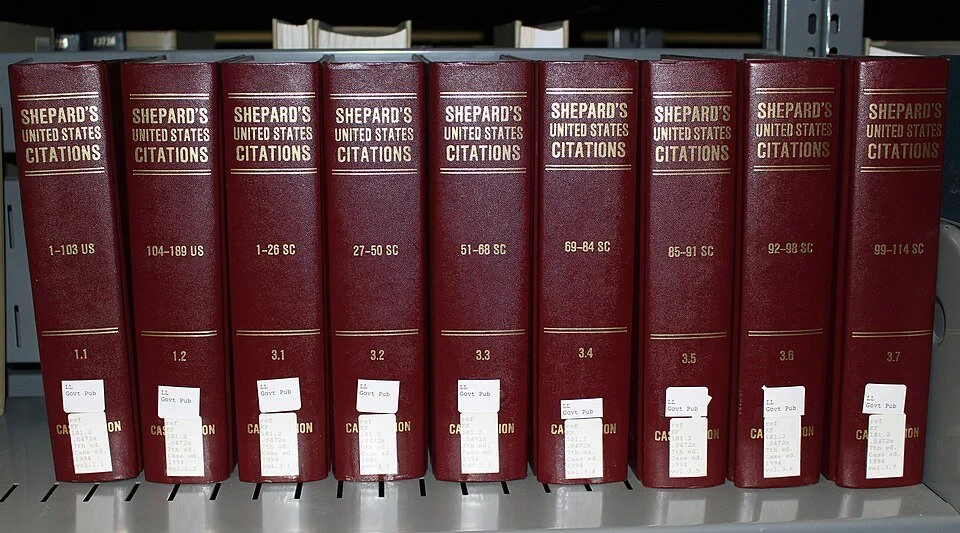
Shepard’s United States Citations
13 July 2026
Unless you’re a lawyer, it’s unlikely you’ve ever run across the verb to shepardize, or its corresponding nouns shepardization and shepardizing. To shepardize a judicial opinion is to trace the subsequent cases that have cited the opinion to uncover its precedential value so it can be used in legal arguments. Learning how to shepardize a case is part of the standard law school curriculum. The verb is from Shepard (surname) + -ize.
The entry for the verb in Black’s Law Dictionary reads:
shepardize, vb. 1. (often cap.) To determine the subsequent history of (a case) by using a printed or computerized version of Shepard’s Citations. 2. Loosely, to check the precedential value of (a case) by the same or similar means. — shepardization; shepardizing, n.
Frank Shepard (1848–1900) was a salesman of law books who realized there was a market for a publication for lawyers and law clerks that traced the citations of judicial opinions. In 1875, Shepard started his own company, at first selling collections of adhesive stickers that could be applied to law books to indicate whether an opinion had been affirmed, overturned, or modified by later rulings. And eventually he started selling books, Shepard’s Citations, that outlined the precedential history of legal cases in various jurisdictions.
The verb was in use by 1920. (Earlier citations can probably be found.) Here is an example from an advertisement by the Frank Shepard Company that appeared in January 1920 law journals:
There is only one short cut to absolute efficiency and accuracy in running down the law. It is expressed in one word…
Shepardize!
And here is an example of a civil rights lawyer using the verb in a 10 July 1946 letter to a colleague. The letter is by Robert L. Carter, at the time a lawyer for the NAACP and Thurgood Marshall’s assistant:
The weight of authorization in the United States is to the effect that the death of a defendant in a suit such as ours abates the action. However, I have run across a case in Louisiana which is to the effect that where a public office is involved, the duty pertains to the office and not to the person, and that the officer’s death does not abate the action. See: Basset v. Barbin, 11 La. Ann. 672 also State ex rel Mississippi and M. G. Ship Canal Co. v. New Orleans, 35 La. Ann. 68. I have not had an opportunity to shepardize these cases but will work on it in the near future.
Nowadays, of course, the descendants of Shepard’s books are online databases.
Since 1960, the process of shepardizing has been widely used in other academic disciplines, tracking how and how many times an article has been cited—the basis for the ranking of academic journals—although to my knowledge the verb itself is not used outside of legal circles.
Sources:
Carter, Robert L. Letter to A. P. Tureaud, 10 July 1946. In “Hall v. Nagel, Louisiana Voter Registration Case.” NAACP Papers, Part 05: Voting Rights and the Voting Rights Campaign, 1916–1965. ProQuest Archival Material.
Frank Shepard Company. “Mortality Tables of Case and Statutory Law” (advertisement). Case & Comment, Pocket Edition. Rochester, NY: Lawyers Co-operative, Jan–Feb 1920, 190. HathiTrust Digital Library.
Garner, Bryan A., ed. Black’s Law Dictionary, eighth edition. St. Paul, Minnesota: Thomson West, 2004, s.v. shepardize, v., 1409.
Merriam-Webster.com, accessed 22 June 2026, s.v. Shepardize, v.
Oks, David. “How Citations Ruined Science.” Substack, 31 March 2026.
Photo credit: Coolcaesar, 2022. Wikimedia Commons. Licensed under the Creative Commons Attribution-Share Alike 4.0 International license.
