
5 October 2026
The word tea ultimately comes from Chinese, which in Mandarin is 茶 (ch’a) and in the Fujian dialect of Xiamen (Amoy) is tiä or te. These words were borrowed several times into European languages, often through intermediary languages. Hence, in addition to the English tea, we have the French thé, the Spanish te, the Italian tè, the Dutch and German thee, and the Danish and Swedish te. The /t/ forms may have come to Europe via the Malay te or teh. And we see /ʧ/ form in the Portugeuse cha, the Russian чай (chai), the Hindi चाय (chai) the Persian and Urdu چای (chā), the Arabic شاي (shay), and the Turkish çay.
The earliest English uses are in the /ʧ/ form. We see it in the diary of Richard Cocks, an English merchant in Japan, for 6 December 1616:
I sent the China Capt. Brother a kerymon and 2 salmons […] and a silver chaw pot and a fan to Capt. China wife; and pear tabis with string and fan to his doughter.
The /t/ form makes its way into English by 1655 when it appears in a translation of Alvaro Semedo’s history of China:
Chá is a leafe of a tree, about the bignesse of Mirtle; in other provinces, of the herbe Basil; and in others, of the smal Pomgranat. They drie it over the fire in iron-sives, where it hardens and sticketh together. There is of many sorts of it, as well because the plant is various, as also the upper leaves do exceed the other in finenesse; a property almost of all plants. There is of it, from a Crown a pound to four farthings according to the quality of it, there being so many differences therof. It being thus dryed and cast into warme water, it giveth it a colour, smell, and tast, at the first unpleasing, but custome makes it more acceptable; Tis much used in China and Giappone, for it serveth not only for ordinary drink in stead of water, but also for entertainment to strangers when they visit them, as wine doth in Northern parts.
To this paragraph is attached the following marginal note:
See a larger discourse of the ordering of this leafe, and of the many vertues of the drink in the voyage and missions of Alexander d Rhodes (printed at Paris 1653. I part. 13 cap. its called also Tay.
The /t/ form would become the dominant one in English, but the /ʧ/ form would make a comeback in the latter half of the twentieth century with chai, various preparations of tea, often with sweetened and mixed with milk and other spices. Here is an example from the Chicago Tribune of 18 April 1957:
Mayflower guild of the Assyrian Congregational church, 447 Hazel st., recently sponsored a benefit, “An Afternoon in Iran,” which the group made as typically Iranian as possible with authentic costumes, music, and food.
Waitresses dressed in authentic costumes served typical near eastern food. The menu included pilau, heavily buttered rice; koorush, meats, vegetables, and spices in a tomato gravy; dolma kalama, herbs, spices, rice, and meat wrapped in cabbage leaves; lawasha, a leavened bread made in sheets, and chai, tea specially prepared in a samovar.
Chai is perhaps most often used to refer to masala chai, an Indian preparation consisting of tea, sweetened milk, cardamon, cinnamon, and anise.
Tea can also refer to a meal or social gathering where the drink is served. This sense appears in the eighteenth century referring to light meal in the late afternoon at which tea is served. We see this sense in Jonathan Swift’s 1738 Collection of Genteel and Ingenious Conversation:
So, there is no Point wherein I have so much laboured, as that of improving, and polishing all Parts of Conversation between Persons of Quality, whether they meet by Accident or Invitation, at Meals, Tea, or Visits, Mornings, Noons, or Evenings.
In England, especially in the north, and in Australia and New Zealand, this sense of tea as a meal is often applied to the evening meal. We see this sense in Beatrice Harraden’s 1897 short story The Remittance Man. Oddly, the story is set in California, but the character speaks in Briticisms:
Jesse Holles immediately appeared at the door, holding a frying-pan in one hand and a dish in the other.
“Hi there old man!” he said in his own cheery way. “You're just in time for a rattling good tea—hot rolls, fried potatoes, and quail; and if you're not satisfied, the devil take you!”
And there is a slang use of tea to mean gossip, but that's another story.
Sources:
Cocks, Richard. Diary entry for 6 December 1616. Diary of Richard Cocks, vol. 1. Edward Maunde Thompson, ed. Hakluyt Society 66. London: 1883, 215. HathiTrust Digital Library.
Harraden, Beatrice. “The Remittance Man.” In Hilda Strafford and The Remittance Man, eighth edition. Edinburgh: William Blackwood and Sons, 1897, 226. HathiTrust Digital Library.
“Iranian Fete Aids Assyrian Church Fund.” Chicago Daily Tribune, 18 April 1957, part 4, 4/3. ProQuest Historical Newspapers.
Oxford English Dictionary Online, 1910, s.v. tea, n.; 1889, cha, n.; 2008, s.v. chai, n.2, masala chai, n.
Semedo, Alvaro. The History of that Great and Renowned Monarchy of China. London: E. Tyler for John Crook, 1655, 19. HathiTrust Digital Library.
Swift, Jonathan (pseud. Simon Wagstaff). A Compleat Collection of Genteel and Ingenious Conversation. London: For B. Motte and C. Bathurst, 1738, i–ii. Google Books.
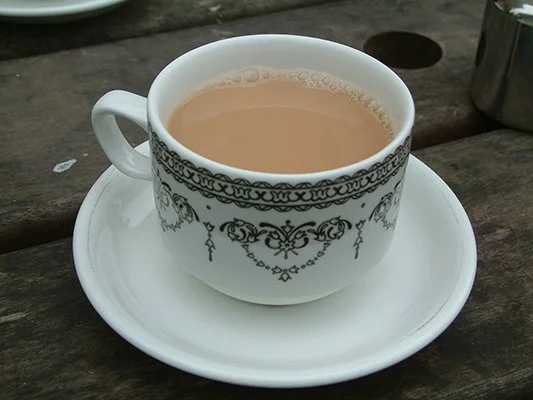
Image credit: Aesop, 2005. Wikimedia Commons. Flickr. Licensed under the Creative Commons Attribution-Share Alike 2.0 Generic license.
