
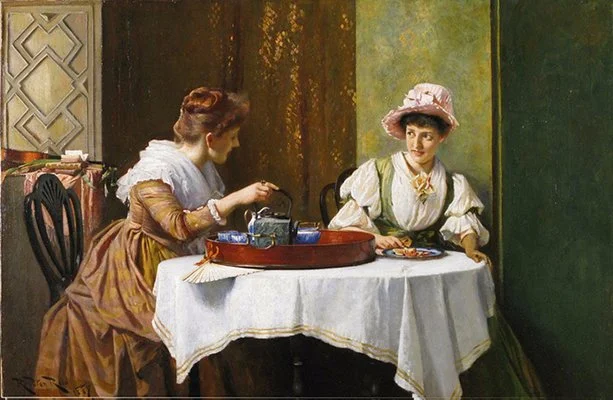
“Little Tea and Gossip,” Robert Payton Reid, 1887
14 September 2026
The slang usage of tea to mean gossip is first documented in the early 1970s, although long before that the drink has been associated with gossip and the exchange of information as people would gather to socialize over the drink. In writing, the slang term is sometimes expressed as T.
As with many slang terms, the exact origins of tea as gossip are murky. Since slang is primarily oral, its use is often not documented for years, if not decades, after its coinage. Early written uses are found in both American gay and Black discourses, or perhaps it was gay-Black discourse.
The earliest documentation of the slang term that I’m aware of is in Bruce Rodgers 1972 Gay Talk (alternative title The Queen’s Vernacular). Rodgers’ lexicon has several entries relating to tea:
serve (some) tea to group together outside a restroom or bar to gossip; to gab everyone else’s tricks out the door.
scandal soup (camp) tea as a gossip’s refreshment.
have some tea engage in small talk.
A few years later, in February 1977, Joseph Chism, a dancer on the television show Soul Train, began writing a column for the Black magazine Right On! titled “And that’s the ‘T’!” Note that Chism was both Black and gay:
As I look back on the year 1976 and the Soul Train show, I have witnessed and been a part of many things. I have had some great times on the show and in this article I would like to share with you some of the “T” I have been a part of and some of the personalities I have been involved with.
So by this date (if not earlier), the term was circulating in Black discourse.
And later that year we see it in a 17 December 1977 gossip column in the Black newspaper the Racine Courier:
This week, once again, the hawk was in definite control of the streets, and the main weekend activity for most folks was running to get in out of the ice, snow, and cold, cold temperatures. But just like the mailman and the pony express, your Roving Eye was out there fighting the elements to bring you the latest hot tea…oops, I should say iced tea (gossip)!
(Hawk here is the regional term for winter winds off Lake Michigan.)
Tea often appears in the phrase spill the tea, meaning to tell or spread the gossip. This phrase was undoubtedly influenced by the older spill the beans. The first use of spill the tea in this sense that I’m aware of is from 1985, again written by a gay, Black man (see below for the quote).
We start seeing tea meaning gossip making its way into general American discourse in the 2010s. For instance there is this 5 December 2016 Business Wire article on the television show Real Housewives of Atlanta:
On today's premiere, Bravo's Real Housewives of Atlanta star, Sheree Whitfield, will join the show to “spill the tea” on her castmates, dig into the lasting impact of her iconic catchphrase “Who gon’ check me, boo,” and field questions from live video callers from the audience around the world via the VCC video calling platform.
Note that Whitfield is Black, so the use of tea here is still connected to Black culture and discourse.
But by the next year tea is shown to be firmly established in general slang, as can be seen in this article on Gen Z slang in the Philippines newspaper Business Mirror of 18 June 2017:
Tea-refers to juicy gossip, can be spilled (shared) or sipped (quietly consumed).
Time to spill the tea.
I'm just sitting here, sipping tea.
“What's the 411?” is long gone, and “tea” is now being used to refer to gossip in general. Variations like “spilling tea” or “sipping tea” show who’s sharing and who’s listening. It has found its way to mainstream online lifestyle and entertainment media, where the phrase is used in headlines and articles.
Finally, the oldest use of spill the tea that I’m aware of is in Billi Gordon’s 1985 Billi Gordon’s You’ve Had Worse Things in Your Mouth Cookbook. The etymology that Gordon relates is a tall tale and not to be taken seriously (for example, there is no reason to think the phrase has its origins in the antebellum South), but it’s worth repeating for several reasons. First, it is an early use of spill the tea. Second, it is a fun tale. Third, like many such tales there is a grain of truth in it, namely the Black and gay connections. Finally Gordon himself is a fascinating figure. He was a gay, Black actor and model, who frequently appeared in female roles. He was obese and a public advocate for social acceptance of overweight people and for public health issues. And following his entertainment career, he earned a PhD in neuroscience. Truly a renaissance man. Here is what Gordon wrote about tea:
The Final “T”
Before I go any further, let me explain the meaning of the word “T.” T has a rich heritage. It comes from the slave women. You see, when the slave women were serving the old belles of the antebellum south, they used to eavesdrop on the gossip at the tea parties. The belles would, of course, be gossiping about what Rebecca was doing with Beauregard, and what Ellie Ann had been rumored to have done with those frisky Merrill boys.
Well, sometimes the slave women would become so engrossed in the gossip that they would stop paying attention to what they were doing and spill the tea. And when they got back to the kitchen, the cooks and helpers would ask the servers, “Well, did you spill the tea, girl?” Meaning, of course, was the gossip good? Hence the expression, “spill the T.”
Then came the war, and a ravaged and ragged south turned its weak and battered eyes towards a dark and dismal sky, and a silence fell upon Atlanta, a silence more frightening than the thunder of the Yankee cannons…oops wrong story…What happened was the freeing of the slaves, and a lot of the slave women went into “domestic work” where they continued to use the expression “spill the tea” to mean “give me the juice” or the jist of it. Well most of the rich white women’s sons grew up to be gay. And the rich queens brought the expression to the gay bars. At the bars it was shortened to “T,” meaning, “pertinent facts,” “jist of,” “skinny on,” “story,” etc. Now there’s even low T and high T. High T being good news or good information, and Low T bad news or terrible facts.
Sources:
Annell. “The Roving Eye.” Racine Courier (Wisconsin), 17 December 1977, 5/1. Readex: America’s Historical Newspapers.
Chism, Joseph. “And that’s the ‘T’!” Right On!, 6.4, February 1977, 22. Archive.org.
Gordon, Billi. Billi Gordon’s You’ve Had Worse Things in Your Mouth Cookbook. San Francisco: West Graphics, 1985, 82. Archive.org.
Green’s Dictionary of Slang, accessed 19 August 2026, s.v. tea, n.
Merriam-Webster.com, s.v. tea, n.
Mullins, Bill. “Tea, and more.” ADS-L, 1 July 2024 and 2 July 2024.
Oxford English Dictionary Online, 1910, s.v. tea, n.
Preston-Kendal, Daphne. “Tea, and more.” ADS-L, 3 July 2024.
Rodgers, Bruce. Gay Talk (alt. title The Queen’s Vernacular). New York: Paragon, 1972, 177, 178, and 194.
Sirof, Evan. “Bravo's RHOA Star Sheree Whitfield Spills the Tea with Fans and Revisits ‘Who gon’ check me, boo?’ in Daily Video Call-In Gossip Show Premiere.” Business Wire (New York), 5 December 2016. ProQuest Wire Feed.
“Who Are the Gen Z and What’s the Language They Speak?” Business Mirror (Makati City, Philippines), 18 June 2017. ProQuest Newspapers.
Zimmer, Ben. “Tea, and more.” ADS-L, 1 July 2024.
Image credit: Robert Payton Reid, 1887. Wikimedia Commons. Public domain photo as a faithful reproduction of a public domain work.
