
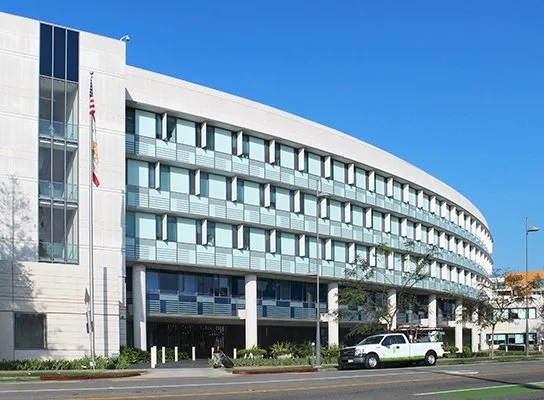
RAND Corporation headquarters, Santa Monica, California
20 November 2026
A think tank is a research institution, especially one that gathers experts in a particular subject area to resolve scientific, technical, social, or political problems. The metaphor is that of a tank or receptacle for smart people. The use of the phrase in this sense dates to the mid twentieth century, but it has an older sense meaning the brain or head. And there are even older terms, thought box and think box, for the brain, that is a receptacle of ideas.
The use of thought box, meaning brain, dates to 1801 when poet Samuel Taylor Coleridge uses it in a letter discussing an essay by John Locke:
Sometimes again the Ideas are considered as objects of the mind in thinking, sometimes they stand for the mind itself, and sometimes we are the thinkers, & the mind is only the Thought-Box.—In short, the Mind in Mr. Locke’s Essay has three senses—the Ware-house, the Wares, and the Ware-house man.
And we get an American version of the metaphor in think box, which appears in an article in the El Paso Daily Times of 1 April 1892:
This happy thought flew from a nook in the seething think box of Cy Warmon, poet of the Rockies and managing editor and literary director of the Creede Amethyst, one of the three daily papers of the camp.
The first time we see think tank, it is in a twist on the brain metaphor. Instead of a biological brain, it is in reference to mechanical device for storing thoughts, specifically Thoms Edison’s version of the dictaphone. It what appears to be a one-off usage, the phrase is used to describe the dictaphone in a 4 December 1887 Los Angeles Times article:
In fact, Mr. Edison has now perfected, or announces that he is on the road to the perfection of, a machine which I may be pardoned for calling a storage think-tank. This will enable a brainy man to sit at home, and, with an electric motor and a perfected phonograph, he can think into a tin dipper, or funnel, which will, by the aid of electricity and a new style of foil, record and preserve his ideas on a sheet of soft metal.
And a couple of years later the Los Angeles Times of 10 November 1889 uses it in a headline to refer to a human brain:
Think Tank Thoughts on “The State of the Union.”
And the institutional sense of think tank is in place by 21 September 1958, when the New York Times records its use as a reference to Stanford University’s Center for Advanced Study in the Behavioral Sciences:
The Ford Foundation put the center under way in 1954 in a group of modern redwood and glass buildings, dubbed the “Think Tank” and “The Monastery,” with a grant of $3,500,000. Since then $5,000,000 more has been made available.
Sources:
“49 Scholars Hold Man Up to Mirror. New York Times, 21 September 1958, 66/3. ProQuest Newspapers.
“Camp Creede’s First Baby.” El Paso Daily Times (Texas), 1 April 1892, 5/2. ProQuest Newspapers.
“The City of B. and C.: “Think Tank Thoughts on ‘The State of the Union.’” Los Angeles Times, 10 November 1889, 9/4. ProQuest Historical Newspapers.
Coleridge, Samuel Taylor. Letter to Josiah Wedgewood, February 1801. Collected Letters of Samuel Taylor Coleridge, vol. 2. Earl Leslie Griggs, ed. Oxford: Clarendon Press, 696. Archive.org.
Nye, Bill. (No, not the “science guy.”) “Nye as a Scientist.” Los Angeles Times, 4 December 1887, 12/2. ProQuest Historical Newspapers.
Oxford English Dictionary Online, September 2009, s.v. think-tank, n., think box, n., thought box, n.
Photo credit: Coolcaesar, 2015. Wikimedia Commons. Licensed under the Creative Commons Attribution-Share Alike 4.0 International license.
