
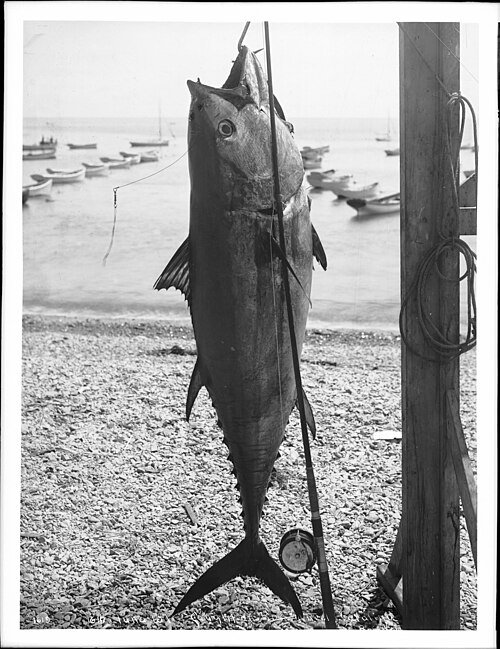
Tuna caught off Santa Catalina Island, California, c. 1910
1 July 2026
Tuna are a variety of fishes of the family Scombridae which are widely fished both for food and for sport. They range widely in size, with the Atlantic bluefin tuna reaching weights as high as 1,500 pounds (680 kb).
The name tuna is a relatively recent addition to English. It dates to the late nineteenth century, with the older and now rare name tunny dating to the sixteenth century. The fish is also sometimes referred to by the redundant tuna fish, although that open compound is most commonly used to refer to the meat of the fish, particularly when it is canned. One would generally not refer to a tuna steak as tuna fish.
The older name tunny is a borrowing from the French, thon + y (English diminutive suffix). The French comes from the Latin thunnus, which in turn comes from the Greek θύννος (thunnos). The form tuna is originally an American alteration of the Spanish atún. The Spanish word does not come directly via the usual Romance path, but rather from the Andalusian Arabic at-tūn, which only then circles back to the Latin.
Tunny appears as an entry in John Palsgrave’s 1530 textbook on the French language, a somewhat odd entry for that text as it contains no French:
Tunny fysshe
Tuna is recorded in an 1881 academic article on fishes found along the Pacific coast of the United States, although this article says the term is restricted to specific species, the skipjack and another the authors were unable to catch. According to this article, the albacore is not a tuna:
88. Orcynus alalonga (Gmelin) Risso.—Albicore.
(Orcynus pacificus Cooper; Thynnus pacificus C. & V.)
From San Francisco southward; abundant in summer south of Point Concepcion and taken by trolling. It is found in deeper water than the bonito, being rarely taken within 6 miles of the shore. It feeds on anchovy and squid, and occasionally rare deep-water fishes are found in its stomach. It is shorter and deeper than the bonito, weighing 12 to 15 pounds. It is little valued as a food-fish, selling at about 25 cents. It is caught chiefly for sport, as it is a very gamy fish.
Another Orcynus, known as the “tuna”, exists about Santa Cruz Island, but we failed to obtain it.
89. Sarda chilensis (Cuvier & Valenciennes) J. & G.—Bonito; Spanish Mackerel; Skipjack; Tuna.
From Monterey southward; very abundant everywhere in summer, when it is taken in great numbers, by trolling, at a distance of 2 or 3 miles from shore. It is extensively salted and dried, but the flesh is rather coarse, and it brings a lower price than the yellow-tail and barracuda. It reaches a weight of about 12 pounds and sells at about 25 cents. After the spawning season the young are very abundant in the kelp.
We see tuna fish being used to refer to the fish a few years later. A headline in the Cincinnati Enquirer of 24 September 1898 reads, “Catching: A Monster Tuna Fish. Exciting Sport Along the Pacific Coast.”
And we find canned tuna fish two years later in a grocer’s advertisement in Kansas’s Hutchinson News of 5 October 1900:
Maggi Bouillon Liquid Extract of Beef, per bottle……….55c
Tuna Fish, per can………………………………….......... 25c
Monarch Codfish Steaks (fresh and very fine) 1 lb can.....15c
Sources:
American Heritage Dictionary, fifth edition, 2022, s.v. tuna1, n.
“Among the Delicacies” (advertisement). Hutchinson News (Kansas), 5 October 1900, 5/5. Newspapers.com.
“Catching: A Monster Tuna Fish. Exciting Sport Along the Pacific Coast.” Cincinnati Enquirer (Ohio), 24 September 1898, 12/8. ProQuest Newspapers.
Jordan, David S. and Charles H. Gilbert. “Notes on the Fishes of the Pacific Coast of the United States.” Proceedings of the United States National Museum, vol. 4, 1881. Washington, DC: Government Printing Office, 1882, 45. HathiTrust Digital Library.
Merriam-Webster, accessed 11 June 2026, s.v. tuna, n.
Oxford English Dictionary Online, 1915, s.v. tuna, n.2, tunny, n.; 1986, tuna fish, n.
Palsgrave, John. Lesclarcissement de la langue Francoyse. London: Richard Pynson, 1530, fol. 70v. ProQuest: Early English Books Online (EEBO).
Photo credit: Brickey, c. 1910. Wikimedia Commons. Public domain photo.
.jpg)