tariff

Headshot of a man (Ben Stein) standing before a blackboard with economic terms written on it

Still from the 1986 film Ferris Bueller’s Day Off of Ben Stein lecturing extremely bored students about the 1930 Hawley-Smoot Tariff

8 March 2025

A tariff is a tax on imported or exported goods, or more precisely, it is a schedule of such tax rates for various types of goods. The word is also used more generally to mean a fee or charge. It was borrowed into English from the Italian tariffa in the late sixteenth century. The Italian word, in turn, comes from the Arabic تَعْرِفَة (ta’rif), meaning notification. As such, it clearly comes out of the lingua franca of cross-Mediterranean trade of the period.

But tariff first appears in an English context in the sense of a table or schedule more generally. That is in Garrard and Hitchcock’s 1591 Arte of Warre, where the authors use it to mean a table of the soldiers in a unit (in present-day U.S. Army jargon a Table of Organization and Equipment or TO&E). In this book it is clear that the word had not yet been fully anglicized as it is in italics and a synonym, table, also provided. Many English military terms were borrowed from Continental languages in the Early Modern period, so the Italian source isn’t surprising:

So that helping your memorie with certain Tablei or Tariffas made of purpose to know the numbers of the souldiers that are to enter into ranke, and what number of rankes will performe the iust square, you can neuer erre, but vpon any sodaine, set in battell any number of souldiers whatsoeuer.

The following year we see the word used in the context of taxation, but here it seems to refer to general taxes, not those on imports or exports. It is in a 3 October 1592 letter from English diplomat Henry Wooton to Edward la Zouche, 11th Baron Zouche. (Digression: Zouche was one of the commissioners at the trial of Mary, Queen of Scots and was the lone vote against her death sentence.) Again, tariff is not fully anglicized; it is highlighted and is in the context of taxes on Italian cities:

The book that I put to be copied for your Honour is not yet ended, nor the tariffa of all the towns in the Grand Duke’s territories, in my hands; for which I have tarried eight days in Florence longer than my determination.

And the word appears in John Florio’s 1598 Italian-English dictionary, A Worlde of Wordes:

Tariffa, arithmetike or casting of accounts.

All these early examples are of an Italian word being used in an English-language text. But by the end of the seventeenth century the word had been fully anglicized and the specific sense of a schedule of taxes on imports and exports was in place. We seen this with the word’s appearance in the 1699 slang dictionary, A New Dictionary of the Canting Crew:

Tariff, a Book of Rates or Customs; also another of the Current Coin.


Sources:

B.E. A New Dictionary of the Terms Ancient and Modern of the Canting Crew, London: For W. Hawes, P. Gilbourne, and W. Davis, 1699, sig. L8r. ProQuest: Early English Books Online (EEBO).

Florio, John. A Worlde of Wordes. London: Arnold Hatfield for Edward Blount, 1598, 413/1. ProQuest: Early English Books Online (EEBO).

Garrard, William and R. Hitchcock. The Arte of Warre. London: John Charlewood and William Howe for Roger Warde, 1591, 224. ProQuest: Early English Books Online (EEBO).

Oxford English Dictionary, second edition, 1989, s.v. tariff, n.

Wotton, Henry. Letter to Edward la Zouche, 11th Baron Zouche, 3 October 1592.  In Logan Pearsall Smith, ed. The Life and Letters of Sir Henry Wotton, vol. 1 of 2. Oxford: Clarendon Press, 1907, 288–89. Archive.org.

Image credit: Paramount Pictures, 1986. Fair use of a single, low-resolution still from a motion picture to illustrate the topic under discussion.

Mandela Effect

Headshot of South African President Nelson Mandela, a gray-haired, Black man in a suit and tie

Nelson Mandela, 1994

7 March 2025

The Mandela Effect is the phenomenon of many people sharing the same false memory. The classic examples, which are cited in nearly every description of the phenomenon, are memories of watching news reports of the death of Nelson Mandela in the 1980s, long before the South African leader’s actual death in 2013, and that the children’s book and television characters were originally spelled Berenstein Bears rather than the actual name, Berenstain Bears.

The fact that many people share such false memories has led some to believe that the phenomenon is evidence for the existence of a parallel universe (or universes) that we only get glimpses of. False memories are extremely common, and while shared false memories may raise eyebrows, prosaic explanations for them are available with no need to resort to the paranormal. For instance, many of those who remember Mandela dying in the 1980s may be conflating Mandela with anti-apartheid activist Steve Biko, who died in 1977 while in the custody of South African police. And because the spelling -stein is more common that -stain, people naturally read -stein when they see -stain. (The 2010 US Census lists 128 instances of Berenstein and 17,916 for Bernstein, while Berenstain and Bernstain appear less than 100 times. The Census does not call out names that appear less than 100 times.)

The earliest example of the phrase Mandela Effect that I have been able find is in the blog The Wood Between Worlds on 23 June 2012, written by Reece:

Plenty of people have brought up the Mandela Effect. Depending on your take on things, this is when huge groups of people all have similar false memories. Alternately, this is when some people shift to a different timeline and notice that their transplanted memories no longer accord with official history. The name comes from an apparently widespread belief that Nelson Mandela died in the 80’s, which resulted in massive riots throughout Africa.

The Berenstein/Berenstain confusion is included on their list of common memories. Also included are things like a portrait of Henry VIII eating a turkey leg, or New Zealand once being located north of Australia.

Reece also claims to have originated the parallel universe explanation (they were taking a class on quantum field theory when they discovered that the name was actually Berenstain), although their parallel universe explanation was just idle musing not an actual belief.

Various online blogs and websites picked up on Reece’s use, and Mandela Effect appears with some frequency on the internet in subsequent years.

The earliest example of the name that I have found in legacy media is a 17 August 2015 article in Toronto’s Globe and Mail newspaper:

Most of the articles claimed that there are several such widely held historical false memories. They refer to something supposedly called the Mandela Effect: This theory has it that many people believe that Nelson Mandela died in prison in the 1980s. There are conspiracy-theory websites claiming that if so many people have such a false memory, then this un-fact could also have existed in a parallel universe that we somehow got a glimpse of.

Some news articles credit a Fiona Broome, a “paranormal researcher,” with coining the phrase and inventing the parallel universe theory, but there is no evidence that she originated either one.

Discuss this post

Sources:

Reece. “On the Berenstein Bears Switcheroo.” The Wood Between Worlds (blog), 23 June 2014.

Smith, Russell. “A Case of Schrodinger’s Nostalgia.” Globe and Mail (Toronto), 17 August 2015, L3/1–2. ProQuest Historical Newspapers.

US Census Bureau. “Frequently Occurring Surnames from the 2010 Census—File B: Surnames Occurring 100 or More Times.” Census.gov. Page last revised on 8 October 2021.

Photo credit: John Mathew Smith, 1994. Wikimedia Commons. Licensed under a Creative Commons Attribution-Share Alike 2.0 Generic license.

robot / android

Photo of a human-shaped robot with a Toyota logo playing the trumpet

5 March 2025

Robots are a staple of science fiction and increasingly an important part of life in our present-day world. The word comes from the Czech robota, a word literally meaning forced labor (the root rob means slave) but which is also used figuratively to mean drudgery, hard work. Robota has cognates in several Slavic languages, and the use of robot in English to refer to the system of serfdom in Eastern Europe dates to the early nineteenth century. Here is an example from John Paget’s 1839 Hungary and Transylvania that criticizes the system of robota, not because forced labor is inherently immoral, but because the system encourages sloth among the working class and doesn’t benefit the capitalists:

I believe that many of these laws have an injurious effect on the character of the peasantry. The system of rent by robot or forced labour,—that is, so many days ’ labour without any specification of the quantity of work to be performed,—is a direct premium on idleness.

The Austrian Empire abolished the system of robota following the 1848 revolutions that swept over Europe.

But the sense meaning an artificial being that can, in some fashion, take the place of a human is more recent. Czech writer Karel Čapek (1890–1938) created this new sense by modifying the word robota and coining robot in his 1920 play R. U. R. Rossum’s Universal Robots—the play was originally written and performed in Czech, but the name of the company was in English, which tells us something about the state of capitalism in Eastern Europe in the period. One of the play’s stage directions reads:

Ústřední kancelář továrny Rossum's Universal Robots. V pravo vchod. Okny v průčelní stěně pohled na nekonečné řady továrních budov. Vlevodalšířiditelské místnosti.

(The central office of Rossum's Universal Robots. On the right is the entrance. Windows in the front wall look out onto the endless rows of factory buildings. On the left are the other management offices.)

Čapek credited his brother Josef for helping him come up with the word.

The dystopian play, set in a robot factory, is about a world where humans rely on automated labor. The outline of the play’s plot, a robot rebellion against their human masters, is now a staple of science fiction (TerminatorBattlestar GalacticaI, Robot2001: A Space Odyssey; etc.), and this March 1922 summary of the play by Edward Moore has one of the first uses of this sense of robot in English:  

Rossum’s Universal Robots (which one may translate as Knowall’s Universal Hands) is a firm for the production of mechanical men who have the advantage, from the commercial point of view, of working more efficiently than real men, and at a fraction of the cost. Being without desires, incapable of feeling pain or pleasure, or of laughing or crying, they are tremendously efficient, and after the lapse of ten years they not only do the world's work, but fight the nation's wars. At the same time, children cease to be born; nature, it appears, has no longer any need of man, and declines to give herself the trouble of producing him. The Robots, logical in everything, exterminate the human race until only one man is left, Alquist, an architect at the factory, who for his own salvation has always worked with his hands, and whom they spare on the equivocal ground that he is a Robot. The new masters of the world are left with the problem of reproducing themselves; a difficult question, for they do not know the trade secret and they are all due to die in twenty years, even the more recently-made among them who are superior in brain and in sensibility to the earlier Robots. Alquist is unable to do anything for them, but he happens to overhear two of them laughing together, and making love: and he realizes that life will go on again, and a new world will begin with a new Adam and Eve.

R. U. R. was a popular play and quickly translated into English, opening on Broadway in 1922. In a time where industrialization and factory labor was combining with rising totalitarianism (e.g., the 1917 Bolshevik revolution in Russia and the 1922 fascist rise to power in Italy), robot struck a chord that resonated with the times. The play was a hit on Broadway, and by December 1922 robot was being used in contexts divorced from Čapek’s play. Here is a syndicated film review that appeared in newspapers on 15 December 1922:

The only time acting was ever required of Edna Purviance, Chaplin’s leading woman, was in “The Kid.” She showed in that that she was wasting her talent by remaining in comics. Mildred Davis was an essential character in “Doctor Jack” and “Grandma’s Boy,” but in his other comedies Harold Lloyd could well have had a robot in her place.

A good sign that a word has entered the language to stay is when it is modified to form new words or used as a different part of speech, and indeed by 1924 the adverb robotically, meaning to act mechanically, without emotion, had been coined. In 1927 the adjective robotic was in use; Isaac Asimov was using robotics by 1941, and the combining form robo- was in place by 1945.

Čapek’s robots were human-like androids, but the word, especially in its actual application to real-world automatons, is often used for machines that do not resemble humans at all. This shift is not recent and goes back at least to 1927, almost as long as the word has been in use in English. In 1930, for example, automated traffic signals in London were dubbed robots. This particular use of the word has fallen out of use in British English, but survives in South Africa.

While Čapek coined this sense of robot, he did not invent the concept. The idea of human-like automatons, or androids, has been around for centuries. And the Czech origin of robot recalls the Jewish tradition of the golem, a robot-like servant made from mud. Golem is Hebrew for shapeless mass. And reinforcing the Czech origins of the concept of robots, the most famous tale of a golem takes place in sixteenth-century Prague, where rabbi Judah Loew ben Bezalel creates one to defend Prague’s Jewish ghetto from a pogrom.

The English word android is borrowed from the French androïde, which is formed from andro- (Greek ἀνδρο-, man) + -oid (Greek -οειδής, form or likeness). Albertus Magnus (c. 1200–80) allegedly created a magical android, and accounts of this fictional accomplishment using the French word appear in English by 1657. From John Davies’s translation of Gabriel Naudé’s The History of Magick from that year:

And that is Original is true and well deduc’d, where is a manifest indicium, in that Henry d’Assia and Bartholomæus Siillus affirm, that the Androides of Albertus, and the Head made by Virgil, were compos’d of flesh and bone, yet not by Nature but by Art.

This definition of androides appears in Pantologia, an 1819 encyclopedia:

ANDROIDES. (ανηρ, ἀνδρο, man, and ειδος, form) A human figure, which, by certain springs or other movements, is capable of performing some of the natural motions of a living animal. The motions of the human body are more complicated, and consequently more difficult to be imitated, than those of any other creature; whence the construction of androides, in such a manner as to imitate any of these actions with tolerble exactness, is justly supposed to indicate greater skill in mechanics than any other piece of workmanship whatever.

This definition is followed by a description of a flute-playing android, on display in Paris in 1738.

But the use of android in science fiction postdates Čapek’s play. The following appears in Jack Williamson’s 1936 Cometeers:

“The illegal experiments of Eldo Arrynu,” Jay Kalam continued, still unhurried, “had been in the synthesis of life—repeated horrors long ago forced the council to outlaw such efforts.

“And upon the asteroid, he carried out his forbidden work to a triumphant completion. The traffic that brought him such enormous wealth was the production and sale of androids.”

For a moment the nearere shining thing seemed frozen. Red star and violet star ceased their regular beat. And the misty spindle between them was congealed into a pillar of green-white crystal. Then it broke into quivering motion, and a startled word cam out of it: “Androids!”

“Eldo Arrynu,” amplified Jay Kalam, “had come upon the secret of synthetic life. He generated artificial cells, and propagated them in nutrient media, controlling development by radiological and biochemical means.

He was an artist, as well as a scientist. The genius of creation was a supernal flame in him. He worked in living, synthetic flesh. He achieved miracles—diabolical miracles——"

The history of robots, both literary and industrial, reflects our ambivalence to the concept and the fear of humans assuming god-like powers of creation without god-like wisdom, whether it be fears of rebellion and genocide or simply those of unemployment.

Discuss this post


Sources:

Čapek, Karel. R. U. R. Rossum’s Universal Robots. Prague: Aventinum, 1922, 7. HathiTrust Digital Archive.

Dean, James. W. “Fraternity Foolishness is Basis for Very Funny Film.” Port Huron Times-Herald (Michigan), 15 December 1922, 8/3. ProQuest Historical Newspapers.

Good, John Mason, Olinthus Gregory, and Newton Bosworth. Pantologia, vol. 1 of 12. London: J. Walter, et al., 1819, s.v. androides. HathiTrust Digital Archive.

Historical Dictionary of Science Fiction, s.v. robot, n. (18 March 2021); robotic, adj. (26 January 2025); robo-, prefix (18 March 2021); robotically, adv.1 (17 November 2024); robotically, adv.2 (20 December 2020); robotics, n. (16 December 2020); android, n. (5 December 2024).

Languagehat. “The Android of Albertus Magnus.” Languagehat.com (blog), 19 January 2013.

Moore, Edward. “Prague Letter” (March 1922). The Dial, April 1922, 407. ProQuest Magazine.

Naudé, Gabriel. The History of Magick. John Davies, trans. London: Joh Streater, 1657, 250. HathiTrust Digital Archive.

Oxford English Dictionary, third edition, June 2010, s.v. robot, n.2, robot, n.1, robotic, adj. & n.; September 2022, s.v. android, n. & adj.

Paget, John. Hungary and Transylvania, vol. 1 of 2. London: John Murray, 1839, 305–06. HathiTrust Digital Archive.

Williamson, Jack. “The Cometeers” (conclusion). Astounding Stories, 17.6, August 1936, 121–52 at 146. Archive.org.

Photo credit: Chris 73, 2005. Wikimedia Commons. Licensed under a Creative Commons Attribution-Share Alike 3.0 Unported license.

quick

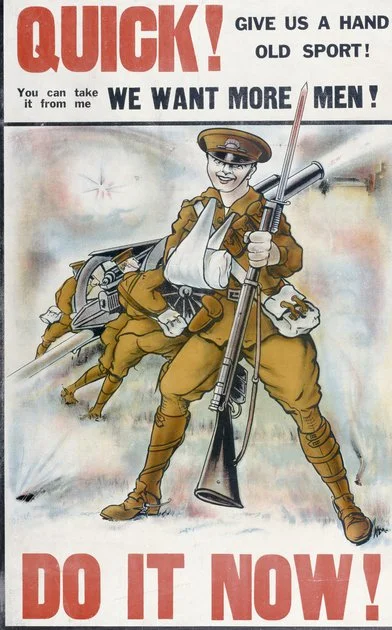
WWI recruiting poster that reads, “Quick! Give us a hand old sport!” with an image of a wounded soldier holding out a rifle

Australian recruiting poster, c. 1915

3 March 2025

The meanings of words change over time. But when a particular sense of a word falls out of general use, sometimes the old meaning sticks around in idiomatic and stock phrases. Such is the case with quick, which did not always mean fast, rapid.

The word comes from the Old English cwic, meaning alive. This original sense of the word is still occasionally used, but outside of the stock phrases the quick and the dead (the living and the dead) and cut to the quick (seriously wound, a reference to living flesh and the cutting a nail down to the living tissue) it is pretty rare nowadays. And the rarity of the original meaning is demonstrated by how often these stock phrases are reanalyzed to use the “fast” meaning. The quick and the dead is often taken to mean be fast or you will die, as in the title of Sam Raimi’s 1995 gunslinger film. And cut to the quick is often erroneously used to mean stop delaying get to the heart of the matter, stop beating around the bush.

The original sense appears in a few other contexts, like the phrase quick with child, meaning pregnant. This is an inversion of the original with quick child. The word quickening, once common but now pretty rare, refers to the first movements of a fetus in the womb, and it was also featured in the title of the 1991 sci-fi film Highlander II: The Quickening. What is it about quick and schlock film titles?

We see the original sense in this passage from Beowulf, lines 791–794a, in which the eponymous hero intends to fight the monster Grendel to its death:

Nolde eorla hleo    ænige þinga
þone cwealm-cuman    cwicne forlætan,
ne his lif-dagas    leod ængum
nytte tealde.

(The protector of men did not want the murderous visitor to depart quick [i.e., alive] by any means, nor did he reckon the days of his life of use to anyone)

The original sense also survives in quicksilver, another name for mercury, a word that goes back to the Old English cwicseolfor and is a reference to the fact that drops of liquid mercury move as if they were alive (cf. mercury).

Around the year 1300, quick acquired the sense of moving, shifting and also fast, swift—only things that are alive move. The first gives us quicksand, or moving sand, and the latter is the dominant sense of the word today. The sense of quick meaning mentally agile or smart appears around 1450, although there is a single use of cwices modes or “quick mind” in surviving Old English texts, specifically in the Old English translation of Bede’s Ecclesiastical History, where the phrase corresponds to the Latin adulescens animi uiuacis (a youth of lively mind).

In a way, you can say that language is quick. It is metaphorically alive and constantly moving and changing. And quick itself is an example of this.

Discuss this post


Sources:

Dictionary of Old English: A to Le, 2024, s.v. cwic, cucu.

Fulk, R. D., Robert E. Bjork, and John D. Niles, eds. Klaeber’s Beowulf, fourth edition. Toronto: U of Toronto Press, 2008, lines 791–794a, 29.

Oxford English Dictionary, third edition, December 2007, s.v. quick, adj., n.1, & adv.

Image credit: Queensland Recruiting Committee, c. 1915. Australian War Memorial, ARTV00139. Wikimedia Commons. Public domain work.

curd / crud / cruddy

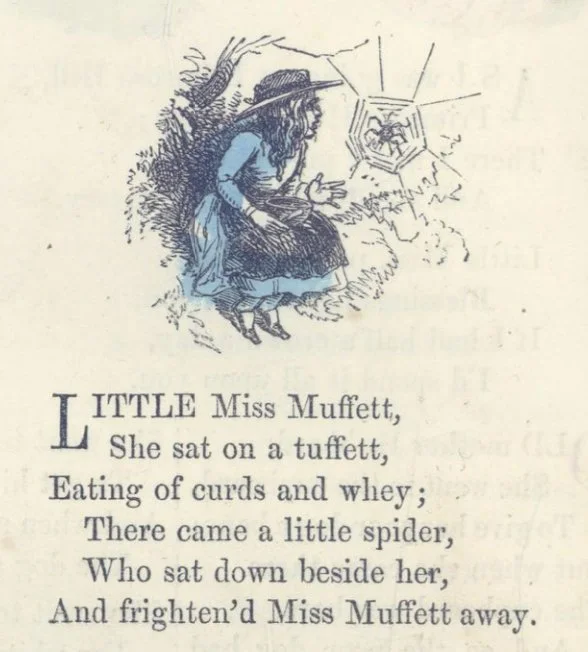
Clip from a mid 19th-century book with the text of “Little Miss Muffet” and a drawing of a sitting girl looking at a spider

28 February 2025

Most Americans today only see curd in descriptions of cottage cheese, in the nursery rhyme Little Miss Muffet, or in the verb form to curdle. The word in its original sense referred to the soft, white solid formed when milk or cream coagulates, but it has acquired additional senses over the centuries. First recorded in the form crud, by the late fifteenth century we start seeing the form curd, formed by metathesis, the transposition of phonemes in a word.

Its origin is obscure, first appearing in the late fourteenth century, probably from a Germanic root. It may be from an unattested Old English noun or it could be borrowing from Old Norse; Norwegian has the regional terms krodda, boiled cheese, and krodde, dregs or curds, which are undoubtedly related to the English word, but exactly how is uncertain.

One of the earliest attested uses of curd, or in this case crud, is in William Langland’s late fourteenth-century poem Piers Plowman:

“Y behote the,” quod Hunger, “that hennes ne wol Y wende
Ar Y haue ydyned be this day and ydronke bothe.”
“Y haue no peny,’ quod Peres, “polettes for to begge,
Ne nother goos ne gries but two grene cheses
And a fewe croddes and craym and a cake of otes
And bred for my barnes of benes and of peses.”

(“I assure you,” said Hunger, “that hence I will not go
Before I have both dined and drunk this very day.”
“I have no penny,” said Piers, “with which to buy pullets,
Neither geese nor suckling pigs, but two green cheeses
And a few curds and cream and a cake of oats
And bread of beans and peas for my children.”)

By the early fifteenth century curd was being used to refer to any coagulated substance, not just milk. From a cookbook written c. 1425:

Jussel enforsed.

Take brothe of capons withoute herbes, and breke eyren, and cast into the pot, and make a crudde thereof, and colour hit with saffron, and then presse oute the brothe and kerve it on leches.

The adjective cruddy appears toward the end of the fourteenth century in the sense of curd-like. We see it John Trevisa’s translation of Bartholomæus Anglicus’s De proprietatibus rerum (On the Properties of Things) in a description of testicles and how semen was thought to be formed within the body:

Constantinus seiþ þat þe substaunce of þe stones is imade of vddry and cruddy fleisch, white, neische, and nouȝt ful sad and hard, and þat is for kepinge and sauynge of hete and for chaunginge of blood into whitenes. And þat is by strong hete in here substauns þat seþith þe blood and turneþ it and makeþ it white.

(Constantinus says that the substance of the stones [i.e., testicles] is made of spongy [lit. like an udder] and cruddy flesh, white, pliant, and not at all fixed and hard, and that is for the keeping and saving of heat and for the changing of blood into whiteness. And it is by strong heat in their substance that seethes the blood and turns it and makes it white.)

Cruddy would continue to be associated with bodily fluids. In Book 1 of his 1590 Faerie Queene, Edmund Spenser uses the adjective to describe coagulated blood:

So well they sped, that they be come at length
Vnto the place, whereas the Paynim lay,
Deuoid of outward sence, and natiue strength,
Couerd with charmed cloud from vew of day
And sight of men, since his late luckelesse fray.
His cruell wounds with cruddy bloud congeald
They binden vp so wisely, as they may,
And handle softly, till they can be healed:
So lay him in her charet close in night concealed.

Our current sense of cruddy meaning something filthy or unpleasant appears in American slang in the late nineteenth century. We see it in Allan Pinkerton’s 1877 The Molly Maguires and the Detectives in an attempt to replicate the speech of an Irish-American. Here Pinkerton uses it to mean filthy:

“Tell me, thrue and honest now,” said McKenna, “how this thing happened. It is plain enough that it wor your own hand that did it.”

“Why the d—1 do you say that?”

“Sure an’ you needn’t take me for a gomersal, cruddy from the bogs! I kin see, wid half an eye, that nobody could iver shoot ye like this, exceptin’ Mike Lawler himself!”

And in this passage, he uses it to describe a person:

Mike, meanwhile, took occasion once more to caution the operative against saying anything about their talk of the forenoon. He was reassured when McParlan suggested that he was no cruddy idiot, and reiterated his promise to observe great care over his lips. “Trust me to know better than to blather over what is tould me in confidence!” were his concluding words.

Crud, referring to an unspecified illness, is first seen in college slang in 1930s. The journal American Speech records it being in use on the Stanford University campus in California in 1932:

Crud means illness. “I’ve got the crud, means “I’m ill.”

This illness sense of crud would become widespread in the American military during the Second World War.

Discuss this post


Sources:

Bartholomæus Anglicus. On the Properties of Things (De proprietatibus rerum), vol 1 of 3. John Trevisa, trans. M. C. Seymour, ed. Oxford: Clarendon Press, 1975, 5.48, 261.

Green’s Dictionary of Slang, n.d., s.v. crud, n. cruddy, adj.

J. D. “Jottings.” American Speech, 7.3 (February 1932), 232. JSTOR.

Langland, William. Piers Plowman (C-text). Derek Pearsall, ed. Liverpool: Liverpool UP, 2008, lines 8.300–205, 167–68.

Middle English Dictionary, 13 January 2025, s.v crud, n.

Oxford English Dictionary, third edition, June 2019, s.v. curd, n.

Pinkerton, Allan. The Molly Maguires and the Detectives. Allan Pinkerton’s Detective Stories 6. New York: G. W. Carleton, 1877, 157 & 385. HathiTrust Digital Archive.

“Receipts in Ancient Cookery” (c. 1425). In A Collection of Ordinances and Regulations for the Government of the Royal Household, Made in Divers Reigns. London: John Nichols for the Society of Antiquaries, 1790, 463. Gale Primary Sources: Nineteenth Century Collections Online. London, British Library, MS Arundel 334.

“Little Miss Muffet.” Songs for the Nursery. London: Tabart, 1806, 23. (The 1806 text is identical to that of the 1856(?) edition shown in the above image. There is an 1805 edition which I don’t have access to, which is, I believe, the earliest printed version of the rhyme.)

Spenser, Edmund. The Faerie Qveene, London: William Ponsonbie, 1590, 1.5.29, 68. Project Gutenberg.

Image credit: “Little Miss Muffet.” Songs for the Nursery. London: Darton & Co., 1856(?), 8/2. Gale Primary Sources: Nineteenth Century Collections Online. Public domain image.