suborn

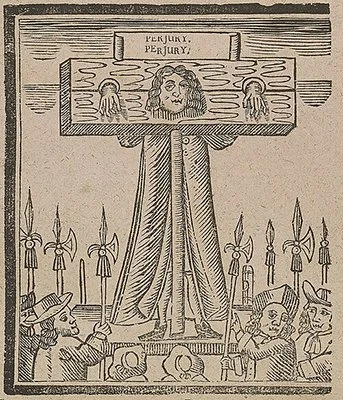
Engraving of a man in 17th-century dress in a pillory with the words, “Perjury, Perjury” displayed over his head

Illustration accompanying the c. 1686 broadside ballad “Perjury Punish’d with Equal Justice; or, Miles Prance”

26 September 2025

Suborn is a verb that is usually heard in the context of lying under oath, and indeed roughly half of the instances of the verb in the Corpus of Contemporary American English are in the phrase suborn perjury. The verb clearly means to induce someone to commit a crime, but where does it come from?

Like many English legal terms, this one comes from French, a result of the Normans taking over the English legal system after 1066. In particular the English suborn comes from the Anglo-Norman suburner or subhorner, the meaning of which is remarkably consistent with the present-day English verb.

From a 1358 city of London statute:

Et plus curial chose serroit et accordaunt a ley et reson que homme se acquittat par son serment et siz bones gentz de jurer ovesqe lui ou par enquest de doze hommes qe par deux, issint subornés et faucement procures et enformés

(And because it would be more seemly and more according to law and reason that man should acquit himself his oath and that of six good people swearing with him, or by an inquest of twelve men, than by the witness of two thus suborned and tortiously procured and primed)

We see the English use of the word in the Parliamentary Rolls for 1430–31, in the case of Eleanor de Holland, wife of James Tuchet, 5th Baron Audley. She was trying to prove that her birth was legitimate and, therefore, that she was the heiress to her father, Edmund, Earl of Kent. A petition in the Rolls by Edmund’s sisters, who would otherwise inherit, alleges that she suborned false testimony:

Alianore, wyf to James, upon grete subtilite, ymagined processe, prive labour, and colored menes and weyes, to yentent yat she shuld be certified mulire be sum ordinarie, in case yat bastardie were alleged in her persone, hath broght in examination afore certein Jugges in Court Cristiene and Spirituell, nat enfourmed, nor havyng knawleche of ye saide subtilite, ymagined processe, prive labour, coloured menes and weyes, certeyns subornatz proves and persones of hir assent and covyne.

(Eleanor, wife to James, with great trickery, imagined process, secret labor, and deceitful means and ways, intending that she should be certified legitimate by some authority, in case that bastardy were alleged in her person, has brought in examination before certain judges in ecclesiastical court, not informed, nor having knowledge of the said trickery imagined process, secret labor, and deceitful means and ways, certain suborned proofs and persons with her assent and fraud.)

We don’t have a record of what the ecclesiastical court decided, but from the petition’s wording (the court being unaware of the alleged perjury) it appears that they decided in Eleanor’s favor. Regardless of the truth of the matter, Parliament granted the petition, and the sisters inherited.

Of course, with the word coming from French, we can trace suborn’s roots back to Latin, where the basic meaning of the verb subornare is to equip, to adorn, but where it was also used to refer to inducing or inciting a crime, especially perjury. For instance we have this from Cicero’s Pro Aulo Caecina 71, a speech he gave in 69 B.C.E.:

Itaque in ceteris controversiis atque iudiciis, quum quaeritur, aliquid factum necne sit, verum an falsum proferatur, et fictus testis subornari solet, et interponi falsae tabulae, nonnumquam honesto ac probabili nomine bono viro iudici error obiici, improbo facultas dari, ut, quum sciens perperam iudicarit, testem tamen aut tabulas secutus esse videatur.

(And so it often happens in the ordinary disputes that come before a court, when it is a question of whether something is or is not a fact or whether an allegation is true or false, that a false witness is suborned, forged documents are put in and sometimes, under the guise of fair and honest dealing, an honest juror is deceived or a dishonest juror afforded the chance of giving the impression that his wrong verdict, which was really intentional, was the result of his having been guided by the witness or the documents.)

The etymology of suborn is, therefore, quite ordinary and straightforward, but it is unusual in that the meaning and patterns of usage have been preserved pretty much unchanged for over two millennia.

Discuss this post


Sources:

Anglo-Norman Dictionary, AND Phase 5 (R–S) 2018–21, suburné.

Bateson, Mary. Borough Customs, vol. 1 of 2. Seldon Society 18. London: Bernard Quaritch, 1904, 169–70. HathiTrust Digital Library.

Cicero. Pro lege Manila. Pro Caecina. Pro Cluentio. Pro Rabiro perduellionis reo. Jeffrey Henderson, ed. H. Grose Hodge, trans. Loeb Classical Library, Cicero 9, LCL 198. Cambridge: Harvard UP, 1927, 166–69. Loeb Classical Library Online.

Middle English Dictionary, 4 March 2025, s.v. subornate, ppl.

Oxford English Dictionary Online, June 2012, s.v. suborn, v.

“Parliament. IX Hen. VI” (1430–31). Rotuli parliamentorum; ut et petiones, et placita in parliamento. Tempore Henrici R. V., vol. 4. London: 1767–77,  375b. Gale Primary Sources: Eighteenth Century Collections Online.

Image credit: unknown illustrator, c. 1686. Wikimedia Commons. English Broadside Ballad Archive. Public domain image.

hogmanay

Fireworks exploding over a cityscape featuring a clock tower

24 September 2025

This word is one that will be unfamiliar to many, if not most, Americans. Hogmanay is a Scots word for New Year’s Eve or for a gift given to someone, especially a child, at the new year. It is a borrowing from the French auguilanleu, which in turn is probably a variation on l’an neuf, (the new year).

It is first recorded in an otherwise Latin record of gifts given at the order of Sir Robert Waterton in Methley, West Yorkshire for New Year’s 1443–44:

Et solutum xxxj die decembris magn. hagnonayse xijd. Et parv. Hagnonayse viijd. xxd.
Et solutum primo die mensis Januarij Pasy munstrallo ex precepto domini xijd. Et solutum iiij die mensis Januarij instrionibus Thome Haryngton ex precepto domini xxd.

(And paid on 31 December (for) a large hogmanay 12 pence, and (for) a small hogmanay 8 pence 20 pence.
And paid on 1 January to Pasy, a minstrel, by the lord’s command 12 pence. And paid on 4 January to the players of Thomas Haryngton, by the lord’s command, 20 pence.)

Hogmanay doesn’t appear again for some 150 years, making this relatively southern appearance of the word even more of an outlier. It seems likely, therefore, that the word was oral and colloquial use in the fifteenth and sixteenth centuries in both the north of England and in Scotland.

We next see the word in the court records of Elgin Scotland for 1604, when a certain William Patton was summoned for “singing hogmanay.” The Oxford English Dictionary places this use under the sense of a New Year’s gift, meaning that Patton was accused of asking for such a gift. Alternatively, he could have been celebrating hogmanay:

January 3rd.—Jonet Wulsoun and Meg Gadderar accusit for dancing on Sonday last befoir the Shereffis yet. William Pattoun delatit to haue been singand hagmonayis on Satirday and thairfoir to be summonit to Fryday nixt.

(3 January—Janet Wulsoun and Meg Gadderar are accused of dancing last Sunday before the sheriff’s gate. William Pattoun accused of having been singing hogmanay on Saturday, and therefore to be summoned next Friday.)

It clearly appears as a name for New Year’s Eve in a “Blasphemous & Treasonable Paper” published in 1681:

We renounce the names of Moneths, as January, February, March, April, May, June, July, August, September, October, Nov. December. Sunday, Monday, Tuesday, Wednesday, Thursday, Friday, Saturday, Martymass, Hol•••yes, for there is none holy but the Sabbath day. Lambas day, Whitsunday, Candlemass, Beltan, Crossstones, and Images Fairs, named by Saints, and all the remnants of Popery, Yool or Christmas, old wives Fables and By words, as Palmsunday, Carlinsunday, the 29. of May, being dedicat by this Generation to Prophanity, Peacesunday, Halloweven, Hogmynae night, Valenteins even; no Marrying in the Moneth they call May.

The entire pamphlet is one long list of “blasphemies” that the authors are rejecting. The authors claim to be in prison in London for their crimes, and this is supposed to be a confession. It’s clearly satire and not to be taken seriously, but the mention of hogmanay is legitimate evidence for our purposes here.

Discuss this post


Sources:

Cramond, William. The Records of Elgin 1234–1800, vol. 2. Stephen Ree, ed. Aberdeen: University of Aberdeen, 1908, 119. HathiTrust Digital Library.

Ker, Walter, et al. A Blasphemous & Treasonable Paper, Emitted by the Phanatical Under-subscribers, on May 1, 1681, 3. University of Michigan Library. Google Books.

Oxford English Dictionary Online, November 2010, s.v. hogmanay, n.

Scottish National Dictionary, 2005, s.v. hogmanay, n. Dictionaries of the Scots Language | Dictionars of the Scots Leid.

Yarwood, R. E. “Hogmanay 1443 in West Yorkshire.” Folklore, 95.2, 1984, 252–254 at 253. JSTOR.

Photo credit: Robbie Shade, 2009. Wikimedia Commons. Licensed under a Creative Commons Attribution 2.0 Unported license.

just do it

B&W image of the trademark Nike “swoosh” logo

22 September 2025

Nike’s famous Just Do It advertising campaign was launched in 1988 and went on to become one of the most famous slogans of all time. But the inspiration for the slogan is somewhat morbid, rooted in the execution of an infamous spree killer.

The campaign was the brainchild of the Wieden+Kennedy ad agency, and co-founder Dan Wieden says he got the idea from the last words of Gary Gilmore. Convicted in Utah of multiple murders in 1976, Gilmore was executed by firing squad in January 1977. The case was notable because Gilmore had refused to appeal the case and had protested stays of execution made on his behalf, and because in 1972 the U. S. Supreme Court had ruled capital punishment unconstitutional but reversed itself in 1976. As a result, Gilmore was the first person executed in the United States after that reinstatement. That, plus Gilmore’s express wish to die, made the case something of a media sensation. For example, prior to the execution, the cast of the comedy-variety show Saturday Night Live had performed a medley of Christmas songs titled “Let’s Kill Gary Gilmore for Christmas.”

Shortly after the execution, Playboy published an interview it had conducted with Gilmore. And Norman Mailer wrote a Pulitzer-prize winning book, The Executioner’s Song, about Gilmore, which was later made into a TV movie starring Tommy Lee Jones as Gilmore. And as late as 1991, an episode of the sitcom Seinfeld was quoting Gilmore’s “immortal” last words.

Those last words were, “Let’s do it.”

In 1988, when tasked with the Nike account, Wieden recalled the phrase and tinkered with it, producing Just Do It. Evidently at the time, Nike was unaware that Gilmore had been Wieden’s inspiration.

Discuss this post


Sources:

Greene, David. “In the Immortal Words of Gary Gilmore and NIKE, “[Just] Do It.” Entertainment Agent Blog, 20 June 2010. Archive.org.

Jones, Michael Owen. “Dining on Death Row: Last Meals and the Crutch of Ritual.” Journal of American Folklore, vol. 127, no. 503, Winter 2014, 3–26 at 14. Project Muse.

Peters, Jeremy W. “The Birth of ‘Just Do It’ and Other Magic Words.” New York Times, 19 August 2009, B3. ProQuest Historical Newspapers.

Shapiro, Fred R. The Yale Book of Quotations. Yale UP, 2006, 310.

Image credit: Carolyn Davidson/Nike, 1971. Wikimedia Commons. Public domain image, but subject to trademark restrictions.

whole nine yards

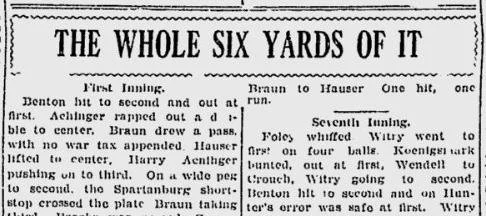
Newspaper headline reading “The Whole Six Yards of It”

7 May 1921 headline from the Spartanburg Herald

19 September 2025

Few phrases have as many tales attached to their origin as does the whole nine yards, which has spawned a raft of popular etymologies, all of them wrong. The phrase doesn’t have one particular origin, nor does it represent one particular metaphor. Instead, it seems to have evolved from a sense of yard meaning a vague quantity of something. Later, the words full or whole were attached to it, and even later it was quantified by the numbers six and nine (cf. cloud nine), with the whole nine yards eventually winning out and becoming the canonical form. Use of the full phrase was for a long time restricted to the American Midwest, in particular to the region around the Kentucky-Indiana border, before breaking out into general American parlance in the middle of the twentieth century.

The word yard has long been used to denote an inexact linear measurement. Chaucer’s fourteenth-century The Knight’s Tale has these lines:

Yclothed was she fressh, for to devyse:
Hir yelow heer was broyded in a tresse
Bihynde hir bak a yerde long, I gesse.

(She was cheerfully clothed, so to say:
Her yellow hair was braided in a tress
Behind her back, a yard long, I guess.)

Chaucer is not saying that her hair was literally thirty-six inches in length, but rather that it was very long. More recently, Robert Southey’s Southey’s Common-Place Book, published in 1850 has this disparaging the works of Spanish poet Luis de Góngora:

Latinisms,—yard-and-half-long words. The pedantry of Pagan mythology—violent metaphors, and more violent hyperboles.

Here the word yard is being used completely figuratively. Southey is not intimating, nor would any reader assume, that Góngora’s words are literally four-and-a-half feet long. But while figurative, it’s still a linear measure.

But at about the same time, use of yard to mean a great quantity, and not necessarily a linear or spatial dimension, appears. And we still use the phrase by the yard to describe producing a great quantity of something. The Razor Strop Man an 1845 song by Joseph W. Turner published in 1852 has these lines:

He was spinning poetical rhyme by the yard;
Had Shakespear been living ‘twould astonish’d the bard.

Also in the nineteenth century, the phrase whole yards started appearing in the sense of a great quantity of something, especially of talk, writing, or information. An early example is this line from a sermon by British Baptist preacher Charles H. Spurgeon. The sermon is undated, but was published in 1883:

We have heard of men talk of their experience, which can give us whole yards of godliness, if that consists in the tongue; but when they come to practice, ah! their religion is not made to bear every-day pressure.

Also in the mid nineteenth century we start to see numbers, most commonly six and nine, attached to this figurative use of yard. The following letter appeared in the Louisiana, Missouri Democratic Banner on 4 December 1850. It is part of a verbal feud between two local notables, W. K. Kennedy and Edwin Draper. Kennedy writes, referring to Draper’s last statement:

SIR, — Your last “nine yards” would be unworthy of notice, as it commences with a falsehood and ends with a lie, was it not that you therein wish to create the impression on those that are unacquainted with the circumstances, that I had endeavored (had it not been for your shrewdness) to swindle the treasury out of a portion of the revenue. [...] I will not attempt to follow you through your “nine yards” in all its serpentine windings, but confine myself to one or two points more, and compare.

And there is this later example from the 7 May 1902 Atlanta Constitution:

The International Magazine of Billville has out a prospectus nine yards long. The editor says the first number of the magazine “will be a gem.” He is a trifle short of copy just now, as the favorable crop season has constrained him to make hay while the sun shines. He is therefor plowing his leading poets and novelists; but they will soon order pens, ink and paper and get down to business.

But nine is not the only number associated with yards. There is this earlier example, from a poem titled “A Flowery Tragedy,” published in the Atlanta Constitution on 12 November 1895 that uses six yards:

The poet found a violet
   Upon the frozen way.
Blue-eyed and bright it charmed his sight—
   A memory of May.

He took the outcast to his breast—
   A little pearl of price;
And marveled much at finding such
   A tender flower in ice.

He wrote a poem six yards long:
   His wife—she laid it flat
By saying: “Dear, that violet
   Was cloth—from Sallie’s hat.

The poet would seem to be engaging in wordplay, using yard in the figurative sense of quantity while also referring to cloth measurement, and with a double entendre in laid it flat.

But in all of these examples, we don’t have an actual instance of the present-day phrase the whole nine yards. Bonnie Taylor-Blake, who the etymological world owes a great debt for her indefatigable work on this phrase, has unearthed the earliest known use that combines all the elements of the present-day phrase in its current sense. It’s from a Mitchell Commercial (Indiana) newspaper article of 2 May 1907 about a local baseball game:

This afternoon at 2:30 will be called one of the baseball games that will be worth going a long way to see. 

The regular nine is going to play the business men as many innings as they can, but we can not promise the full nine yards.

But note this instance uses full, not whole. And it’s tempting to associate nine yards with nine innings of baseball, and undoubtedly the journalist who penned this was playing off this idea, but a year later, on 4 June 1908, the same newspaper published the earliest known use of the phrase as we commonly use it today, and it has nothing to do with baseball:

Roscoe Edwards and wife returned Wednesday evening of last week from Saltillo where they had been visiting Mr. and Mrs. W.C. Cook.  While there Roscoe went fishing and has a big story to tell, but we refuse to stand while he unloads. He will catch some unsuspecting individual some of these days and give him the whole nine yards.

The lack of significance of the number nine is buttressed by this use in reference to the battle for the Republican presidential nomination between Theodore Roosevelt and William Taft in the 17 May 1912 edition of the Mount Vernon Signal (Kentucky):

But there is one thing sure, we dems [sic] would never have known that there was such crookedness in the Rebublican [sic] party if Ted and Taft had not got crossed at each other. Just wait boys until the fix gets to a fever heat and they will tell the whole six yards.

And nine years later the phrase The Whole Six Yards of It turns up as the title of an article in South Carolina’s Spartanburg Herald of 7 May 1921, which gives a detailed summary of a local baseball game.

It’s common for numbers in slang expressions to vary like this in the early uses, until a convention is established and usage settles on one particular number. Another example is cloud nine, which in early uses appears as cloud sevencloud eight, and cloud thirty-nine.

By mid century, the phrase had broken out of its Midwestern place of origin and began to be used across the United States. The fall 1962 issue of Michigan Voices: A Literary Quarterly contained a short story by Robert E. Wegner, “Man on the Thresh-Hold” that used the phrase:

Then the dog would catch on and go ki-yi-yi-ing from one to the other of the shouting pyjama clad participants mad, mad, mad, the consequence of house, home, kids, respectability, status as a college professor and the whole nine yards, as a brush salesman who came by the house was fond of saying, the whole damn nine yards.

And in December of that year, the magazine Car Life used “all nine yards of goodies” to describe the Chevrolet Impala. So by this date, the phrase was well ensconced in general American parlance.

One thing to note about research into this phrase is that there are hundreds, if not thousands, of examples of nine yards or six yards to be found. Most of these are literal measurements of length, and it is often difficult to determine a century or so later if a particular use is figurative or a literal, linear measure. These can very easily trip up a researcher. The examples I have given above are clearly figurative uses and likely precursors to the present-day phrase. There are many others I could have included but are ambiguous. One such ambiguous instance which is commonly cited by many sources, including the OED, is from an Indiana newspaper in 1855. But this would seem to be simply a collocation of the words denoting a literal measure of length, and not an example of the catchphrase as we know it today. The phrase appears as the punch line of a humorous story, “The Judge’s Big Shirt,” published in New Albany (Indiana) Daily Ledger on 30 January 1855. The story has a tailor telling a seamstress to purchase enough material for three shirts and then complaining:

What a silly, stupid woman! I told her to get just enough to make three shirts; instead of making three, she has put the whole nine yards into one shirt!

The story is republished in many different newspapers of the era—it was a common practice in the nineteenth century for newspapers to reprint, often plagiarizing, material from other papers. The story was thus repeated many times and was certainly well known. The fact that these are Indiana papers would seem to be significant, but the long gap, over fifty years, between this citation and the next militates against this story being related to the present-day phrase. 

So regardless of what someone else has told you, the whole nine yards does not refer to the length of a belt of WWII machine-gun ammunition, the amount of material needed to make a Scottish kilt, the number of spars on a sailing ship, the amount of concrete a cement mixer holds, or anything else.

Discuss this post


Sources:

“Baseball.” Mitchell Commercial (Indiana), 2 May 1907, 2/3. NewspaperArchive.com.

Chaucer, Geoffrey. “The Knight’s Tale.” The Canterbury Tales, 1:1048–50. Harvard’s Geoffrey Chaucer Website.

Goranson, Stephen. “Re: The whole nine yards (1937–1916).” ADS-L, 8 September 2013.

Green’s Dictionary of Slang, accessed 16 August 2025, s.v. whole nine yards, n.

“The Judge’s Big Shirt.” New Albany Daily Ledger (Indiana), 30 January 1855, 1/4. NewspaperArchive.com.

“Just from Georgia.” Atlanta Constitution, 12 November 1895, 4/6. ProQuest Historical Newspapers.

———. Atlanta Constitution, 7 May 1902, 6/4. ProQuest Historical Newspapers.

Kennedy, W. K. “Third Epistle to Edwin.” Democratic Banner, Louisiana, Missouri. 4 Dec 1850, 1/1–2. NewspaperArchive.com. (The database’s metadata gives the location as Bowling Green, Missouri.)

“Livingston.” Mount Vernon Signal (Kentucky), 17 May 1912, 1/5. NewspaperArchive.com.

Mitchell Commercial (Indiana), 4 June 1908, 3/5. NewspaperArchive.com.

O’Toole, Garson.  “Re: Major Discovery Relating to ‘Whole Nine Yards.’” ADS-L, 27 April 2015. (There are multiple, relevant posts on that date by O’Toole with this title).

Oxford English Dictionary Online, September 2003, s.v. nine, adj. & n.

Shapiro, Fred. “Major Discovery Relating to ‘Whole Nine Yards.’” ADS-L, 27 April 2015.

———. “You Can Quote Them.” Yale Alumni Magazine. May/Jun 2009.

———. “You Can Quote Them: The Inflation of ‘Cloud Seven’ and ‘The Whole Six Yards.’” Yale Alumni Magazine. Jan/Feb 2013.

Southey, Robert. Southey’s Common-Place Book, second series. John Wood Warter, ed. New York: Harper & Brothers, 1850, 148. HathiTrust Digital Library.

Spurgeon, C. H. “A Visit to Calvary.” Sermons of Rev. C. H. Spurgeon of London, second series. New York: Robert Carter & Brothers, 1883, 328–44 at 341. HathiTrust Digital Library.

Turner, Joseph W. “The Razor Strop Man.” Boston: Prentiss, 1845, 4. Johns Hopkins University, Lester S. Levy Sheet Music Collection.

“The Whole Six Yards of It.” Spartanburg Herald (South Carolina), 7 May 1921, 5/5–6. Google News.

Image credit: Spartanburg Herald (South Carolina), 7 May 1921, 5/5–6. Google News. Public domain image.

unicorn

Fresco of a woman sitting in a verdant setting with a white unicorn climbing onto her lap

Domenichino, “Virgin and Unicorn,” fresco, c. 1602. The woman depicted is, ironically, Giulia Farnese (1474–1524), mistress to Pope Alexander IV (and sister of Pope Paul III).

17 September 2025

We all know a unicorn is a mythical creature resembling a horse with a single horn projecting from its forehead, but the term has some quite interesting slang uses. The word comes to English via Anglo-Norman, the variety of French spoken in England after the Norman conquest, and ultimately from the Latin unicornisuni- (one) + cornu (horn).

The earliest appearance of unicorn in English is in the text Ancren Riwle, a monastic manual for female anchorites, written c. 1230:

Wreaððe is a forschuppilt, as me teleð I spelles, for ha reueð mon his wit ant changeð al his chere, ant forshuppeð him from mon into beastes cunde. Wummon wrað is wuluene; Mon wulf oðer liun oðer unicorne.

(Wrath is a shape-shifter, as it is depicted in tales, for it takes from a man his reason and changes his countenance, and transforms him from a man into the nature of a beast. A woman’s wrath is wolf-like; man’s is wolf, or lion, or unicorn.)

Common medieval typology had the unicorn representing anger or wrath, especially the wrath of God, which was tamed by Christ, represented as a virgin. Hence the myths about maidens taming unicorns. Medieval texts almost invariably represented unicorns as male; evidently there were no female unicorns. The unicorn’s horn and the spears that penetrate the beast’s flesh during a unicorn hunt are phallic and a commentary on virginity and temptation.

Middle English translations of the Bible and various bestiaries used the word unicorn as the name for the rhinoceros, not a mythical or symbolic beast at all. These were translations of either the Latin unicornis, the Greek μονόκερως (monoceros). From a 1382 Wycliffite translation of Numbers 23:22:

The Lord God hath ladde hym out of Egipte, whos strengthe is lijk to an vnycorn.

The translator here was working from Jerome's Vulgate text which uses the word rinocerotis. Modern translations tend to render the term in this passage, the Hebrew רְאֵם (rĕ’ēm), as “wild ox.”

But in present-day slang, unicorn is used to refer to something that is highly sought after but extremely rare and perhaps non-existent—not unlike the medieval unicorn. For instance, this sense appeared in the Los Angeles Times in April 1987 about the search for extra-terrestrial life:

[Robert] Rood, professor of astronomy at the University of Virginia, was giving the people what they presumably wanted. Speaking Friday at the annual conference of the Committee for the Scientific Investigation of Claims of the Paranormal, a national organization of skeptics, he sought to “cast some sees of doubt” regarding the international network of Search for Extraterrestrial Intelligence, which is listening for intergalactic radio transmissions.

[…]

Two scientists who have participated in the activities, sometimes wincing at Rood’s jabs, defended their beliefs in extraterrestrial life. It is a matter of overwhelming probabilities, they said, that other planets in the universe have life forms as advanced as ours.

“We’re not looking for unicorns but something we know very well exists—evidence of another technology,” said Jill Tartar, research astronomer at University of California, Berkeley.

This general slang sense has spawned several specific applications of the word. One such comes to us out of Silicon Valley, where a unicorn is a software startup that is valued at over $1 billion dollars, what every venture capitalist wants to find. Unlike most slang usages, we can pinpoint an exact origin for this particular definition. Venture capitalist Aileen Lee used this sense in a blog post in November 2013:

We found 39 companies belong to what we call the “Unicorn Club” (by our definition, U.S.-based software companies started since 2003 and valued at over $1 billion by public or private market investors).

An older and very different slang sense is sexual in nature. The word has been used to refer to bisexual men, a mythical creature in the eyes of those who think men must be either straight or gay. This sense appears in The Advocate as early as 2007:

“I’m a unicorn.” That’s what I may as well have said to the handsome man sitting across the table from me. We were on our first date, having “met” on MySpace. Thanks to his online profile, I already knew he was competing for the title Mr. Gay Universe, that he often frequented pool parties wearing nothing but purple paint and a few strategically placed sequins, that the wrote poems a first-grader would call puerile. Even so, it was he who regarded me as a potential embarrassment.

“I’m bisexual” is what I actually said.

His response, i.e., repulsion barely masked as fascination, was one I've become accustomed to. I'm not alone. Other members of society—alcoholics, ex-convicts, cast members of Diff'rent Strokes—all face similar skepticism when revealing personal information to new acquaintances. People simply don't trust us.

Or they claim that, like a unicorn, we don't exist. Were I to include an online poll with this article, I'm willing to bet most of you believe we're more likely to suddenly find weapons of mass destruction in Iraq than a true bisexual.

The term is also used to refer to a bisexual person, and unlike the medieval unicorn usually female, who is willing to have sex with a couple with no strings attached. Urban Dictionary records this sense from 16 February 2004:

Young girls that have three ways with couples (woman and a man)

Hubbie and I are still looking for our Unicorn.

The word has come a long way from referring to a creature that only a virgin can tame.

Discuss this post


Sources:

Brother, Job. “Fairy Tales.” The Advocate, 1 October 2007.

Forshall, Josiah and Frederic Madden, eds. The Holy Bible, Containing the Old and New Testaments, with the Apocryphal Books, in the Earliest English Versions Made from the Latin Vulgate by John Wycliffe and his Followers, vol. 1. Oxford: Oxford UP, 1850, Numbers 23:22, 430. Archive.org.

Green’s Dictionary of Slang, accessed 15 August 2025, s.v. unicorn, n.

Lee, Aileen. “Welcome to the Unicorn Club: Learning from Billion-Dollar Startups.” TechCrunch, 2 November 2013.

Middle English Dictionary, 4 March 2025, s.v. unicorn(e, n.

Millett, Bella, ed. Ancrene Wisse. A Corrected Edition of the Text in Cambridge, Corpus Christi College, MS 401, with Variants from Other Manuscripts. Early English Text Society 325. Oxford: Oxford UP, 2005, 48. Cambridge, Corpus Christi College, MS 402, fol. 32v. Archive.org.

Newton, Edmund. “Skeptics Spar with Scientists Seeking ETs.” Los Angeles Times, 5 April 1987, Part II-AR 11/1–2. ProQuest Historical Newspapers.

Oxford English Dictionary Online, 1924, s.v. unicorn, n.

Urbandictionary.com, 16 February 2004, s. v. unicorn.