Calvinball

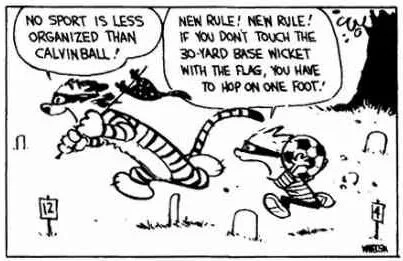
Comic of a masked boy holding a soccer ball chasing a masked, flag-holding tiger around croquet wickets and numbered posts

Panel from 5 May 1990 Calvin and Hobbes comic strip featuring the word Calvinball

6 October 2025

Calvinball is the name of a fictional sport coined by cartoonist Bill Watterston in his syndicated comic strip Calvin and Hobbes. In the strip, Calvinball is a sport where the participants make up the rules as they go along. But the word has not remained within the confines of the comic and is now being used in other contexts where the “rules” are constantly changing.

Calvin and Hobbes ran from 1985–95. The strip centers around the imagination of a small boy, Calvin, and his stuffed tiger, Hobbes, who comes to life in Calvin’s imagination. Enormously popular and critically acclaimed, the comic strip is recognized as one of the greatest of the genre. Calvinball first appeared in the 5 May 1990 strip.

True to its nature, Calvinball could not be restricted by artificial boundaries and broke free of the strip with blinding speed. Use of the word appears in an October 1990 article by Lars T. Lih on Russian politics during the collapse of the Soviet Union:

Several years ago Sovietologist Robert Tucker wrote that “history is on the move again in the Soviet Union”; today, history has been galloping at a frantic pace. Outside observers could not figure out the new rules of the game—but then, neither could the players themselves. Soviet politics seems to be a form of Bill Watterson’s Calvinball, where the only rule is that the same rules are never used twice.

And by 1994 it was appearing without explanatory reference to the comic. From a book by Travis A. Haskins published that year that uses Calvinball in a sports context:

“There'll be a team championship and an individual championship,” he pronounced, resorting to Calvinball procedures to preserve his chances for victory. “The individual champ will be the one with the lowest point total for the two games. The scorekeeper will have to keep team totals and individual totals.”

And by early in the new century, Calvinball was being used both outside of the context of sports and without reference to the comic strip, indicating the concept was firmly embedded in the popular imagination. There is this by Phillipe Duhart in the September 2003 alternative zine Destroy All Monthly about the recall of Gray Davis that would eventually put Arnold Schwarzenegger in the California governor’s mansion:

How is it that the employment of paid-by-the-signature petition-gatherers by a millionaire with gubernatorial aspirations defined as a grassroots, populist movement? Gray Davis has dubbed this recall a “right-wing conspiracy.” In examining the recent shenanigans of Republicans in manipulating and undoing elections—i.e. the Clinton impeachment, the 2000 Florida election debacle, and this year's quasi-legal gerrymandering in Texas—it does seem that the Right is playing “Calvinball” with the Democratic system. But the voters will triumph in the end. And Schwarzenegger will be our governor. That's the degree of faith I have in the electorate.


Sources:

Duhart, Phillipe. “Who Are You to Accuse Me?” Destroy All Monthly, September 2003, 86/1. Archive.org.

Haskins, Travis A. Darin: A Soulprint. Orange, California: Soulprint, 1994, 122. Archive.org.

Lih, Lars T. “Soviet Politics: Breakdown or Renewal?” Current History, 89:549, October 1990. 309–12 at 309/1. JSTOR.

Oxford English Dictionary Online, March 2025, s.v. Calvinball, n.

Watterston, Bill. Calvin and Hobbes. Andrews McMeel Publishing. 5 May 1990.

Image credit: Bill Watterston/Andrew McMeel Publishing, 1990. Fair use of a low-resolution copy to illustrate the topic under discussion.
fond

Photo of a gray-and-white cat nuzzling a black dog

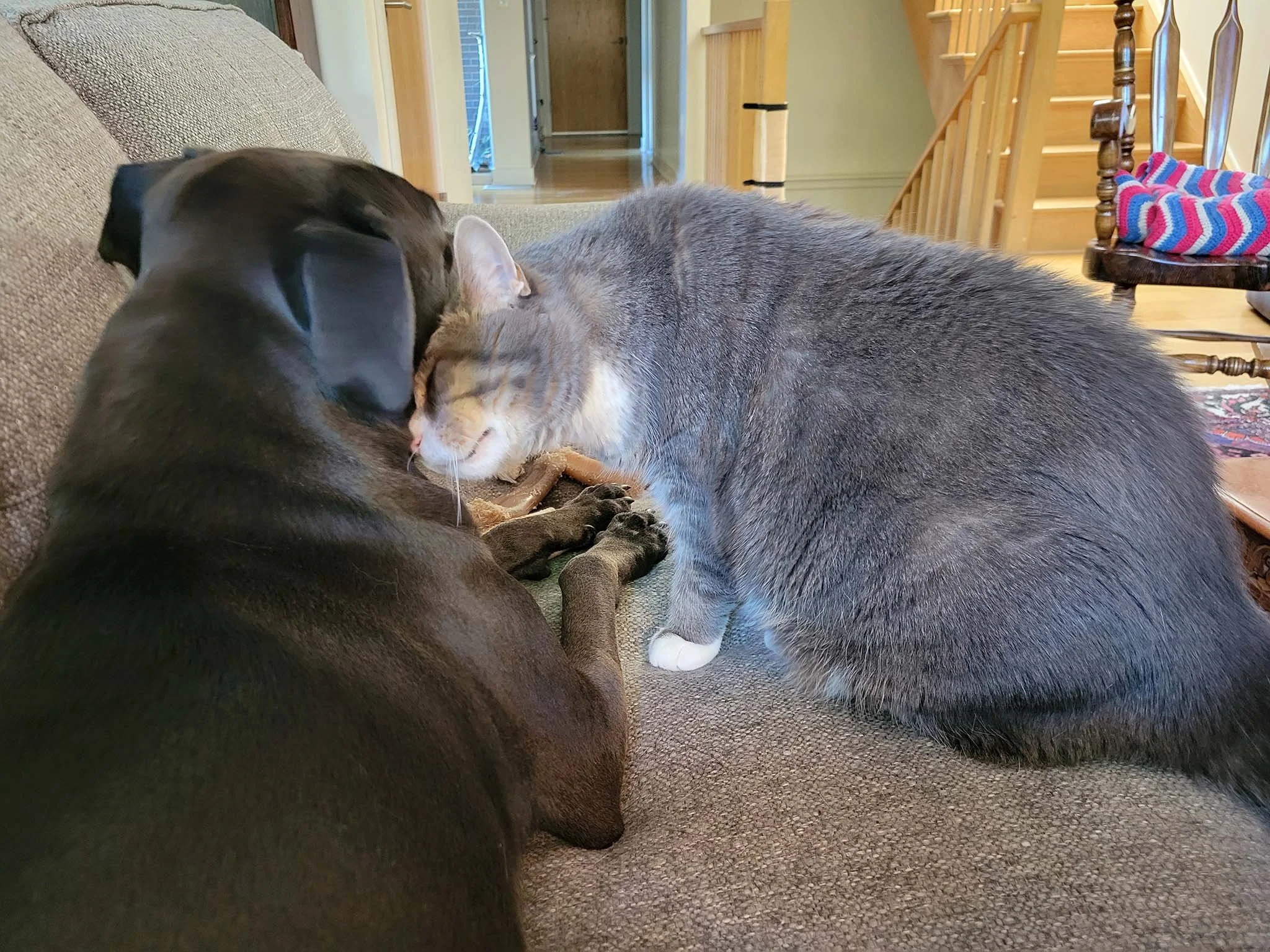
Stella (the dog) and Erik (the cat) are fond of one another

3 October 2025

The modern adjective fond refers to the quality of having affection, liking, or eagerness for someone or something. But this was not always so. In Middle English fonned could mean foolish or stupid. The verb fonnen meant to be foolish or misguided or to fool or make a fool of someone, and the modern fond comes from the past participle of that verb, fonned. The word fun comes from the same root, and in early use could mean a fraud or deception or, as a verb, to cheat. And the modern verb to fondle is derived from the verb fonnen, appearing in the sixteenth century.

We don’t know where fond comes from; it just appears in Middle English. There are what look to be cognates in Swedish and Icelandic, which might point to the word having been brought to England by the Vikings, but there are phonological problems with that hypothesis that make it unlikely.

In Middle English, fond could also be a noun, meaning “fool,” as in Chaucer’s The Reeve’s Tale, written c. 1390:

Why ne had thow pit the capul in the lathe?
Ilhayl! By God, Alayn, thou is a fonne!

(Why did you not put the horse in the barn?
Ill fortune! By God, Alan, you are a fond!)

But over time, the word softened, coming to mean gently foolish, as in a person overcome with the madness of love. In 1578, John Lyly writes in his Euphues:

If Phillis were now to take counsayle, shee would not be so foolish to hang hir selfe, neyther Dido so fonde to dye for Aeneas, neyther Pasiphae so monstrous to loue a Bull, nor Phedra so vnnaturall to be enamoured of hir sonne.

And by 1590, Shakespeare was using fond in its modern sense, where the foolish connotation has been dropped, leaving only the gently loving. In A Midsummer Night’s Dream (2.1), Oberon tells Puck:

A sweet Athenian Lady is in loue
With a disdainefull youth: annoint his eyes,
But doe it when the next thing he espies,
May be the Lady. Thou shalt know the man,
By the Athenian garments he hath on,
Effect it with some care, that he may proue
More fond on her then she vpon her loue.

But the older sense of foolish did not completely disappear for some while. Thirteen years later the Bard has this exchange in Measure for Measure (2.2)

Isab[ella]. Hark, how Ile bribe you: good my Lord turn back.

Ang[elo]. How? bribe me?

Is. I, with such gifts the heauen shall share with you.

Luc[io]. You had mar’d all else.

Isab. Not with fond Sickles [foolish shekels] of the tested gold,
Or Stones, whose rate are either rich, or poore
As fancie values them: but with true prayers.

So when you say you are fond of words and language, there may be double entendre buried in there.

Discuss this post


Sources:

Chaucer, Geoffrey. “The Reeve’s Tale.” The Canterbury Tales, lines 1:4088–89. Harvard Geoffrey Chaucer Website.

Liberman, Anatoly, Word Origins ... And How We Know Them, Oxford: Oxford University Press, 2005, 91, 195.

Lyly, John. Euphues. The Anatomy of Wyt. London: Gabriell Cawood, 1578, 39. ProQuest: Early English Books Online.

Middle English Dictionary, 4 March 2025, s.v. fonnen, v., fonne, n., fonned, ppl. & adj.

Oxford English Dictionary Online, December 2020, s.v. fond, adj. (& adv.) & n.1, fon, v., fon, n.1 & adj.1, fondle, v.; September 2017, fun, n. & adj., fun, v.

Shakespeare, William. Measure for Measure. In Mr. William Shakespeares Comedies, Histories, & Tragedies. London: Isaac Jaggard and Edward Blount, 1623, 2.2, 68. STC 22273 Fo.1 no.68. Folger Shakespeare Library.

———. A Midsommer Nights Dreame. In Mr. William Shakespeares Comedies, Histories, & Tragedies. London: Isaac Jaggard and Edward Blount, 1623, 2.1, 150. STC 22273 Fo.1 no.68. Folger Shakespeare Library.

Photo credit: Dave Wilton, 2025. Licensable under a Creative Commons Attribution-NonCommercial-ShareAlike 4.0 International License.

meritocracy

Painting of a group of 17th/18th-century Chinese scholars taking an exam with one submitting his exam paper to an official

Imperial examination, Ming Dynasty, 17th/18th century

1 October 2025

A meritocracy is lauded in some circles as the ideal society, where one is rewarded for one’s skill, intelligence, and abilities rather than, for instance, the circumstances of one’s birth. Yet it is worth knowing that the word meritocracy, was originally intended as a description of a dystopian society, and early use was often in a tongue-in-cheek, satirical vein. Like the phrase pull oneself up by one’s bootstraps, it was not intended to be taken as a serious proposition.

The term meritocracy arose in socialist circles in the 1950s as a derisive term for a new system of class oppression. The first known use of the term is by Alan Fox in the journal Socialist Commentary of May 1956. Fox writes:

[Social stratification] will remain as long as we assume it to be a law of nature that those of higher occupational status must not only enjoy markedly superior education as well but also, by right and necessity, have a higher income in the bargain. As long as that assumption remains—as long as violation of it are regarded as grotesque paradoxes—then so long will our society be divisible into the blessed and the unblessed—those who get the best of everything, and those who get the poorest and the least. This way lies the “meritocracy”; the society in which the gifted, the smart, the energetic, the ambitious and the ruthless are carefully sifted out and helped towards their destined positions of dominance, where they proceed not only to enjoy the fulfillment of exercising their natural endowment but also to receive a fat bonus thrown in for good measure.

This is not enough. Merely to devise bigger and better “sieves” (“equality of opportunity”) to help the clever boys get to the top and then pile rewards on them when they get there is the vision of a certain brand of New Conservatism; it has never been the vision of socialism.

The term made its way into mainstream discourse via the publication of Michael Young’s 1958 The Rise of the Meritocracy, 1870–2033: The New Elite of Our Social Revolution. Young’s book is a satirical look at 1950s British society from the perspective of someone writing from the distant perspective of the year 2034. Young writes of an imagined scenario where a fixed retirement age created a system that, while preferable to the old aristocratic hereditary order, ended up sidelining the most experienced and able:

Before the meritocracy was fully established, age-stratification as a substitute for the hereditary order may have been necessary for the sake of social stability. But the cost was very high. Every year hundreds of thousands of elderly me, some of whom would have been much more assets than liabilities to their employers, were forced to retreat into idleness, and deprived of their own self-esteem, by the rigidity of the promotion system.

Young is basically echoing Fox’s sentiment that the meritocracy is simply a replacement of one class of bosses with another. In Young’s fictional future-history, the hereditary rulers of Britain had been replaced by a seniority system (“age-stratification”), which, in the 1950s, was being replaced by one based on perceived merit. Young’s book made something of a splash, and was much commented upon in the mainstream press upon its publication.

Young later claimed to have coined the term, and he may have used it without conscious awareness that it was already in use. And many writers have followed suit, crediting Young with coining the term. But he did not—as any quick look at the OED, which contains the Fox citation from two years earlier, would confirm. Young was simply using a term that was already in use by those discussing the problems of social and economic stratification.

Meritocracy was originally derisive, not satirical, although Young’s book is definitely satire. But it is certainly ironic that twenty-first century capitalism has adopted this socialist slur as justification for its existence.

Discuss this post


Sources:

Fox, Alan. “Class and Equality.” Socialist Commentary. May 1956, 11–13 at 13.

Oxford English Dictionary Online, September 2001. s.v. meritocracy, n.

Young, Michael. The Rise of the Meritocracy, 1870–2033: The New Elite of Our Social Revolution (1958). Hammondsworth, England: Penguin, 1961, 91.

Zimmer, Ben. “A ‘Meritocracy’ Is Not What People Think It Is.” The Atlantic. 14 March 2019.

Image credit: Unknown artist, 17th or 18th century. Wikimedia Commons. Public domain image.

Ultima Thule / Thule

Colored 16th-century map depicting various islands, real and fictional, in the North Atlantic

Detail of Olaus Magnus’s 1539 Carta marina map, showing Thule (Tile) between the Hebrides, the Orkney, and the Faeroe islands, in a place where no actual island exists; Iceland is depicted on the map outside of this detailed section

29 September 2025

The name Thule has a long history of referring to some distant place. It may be most familiar to English-speakers today as the name of place in Greenland. In 1910, Danish explorer Knud Rasmussen established a trading post with that name at the site the Inuit called Uummannaq (heart-shaped). Subsequently the Inuit settlement came to be called Pituffik (where dogs are tied). In 1951, the US Air Force relocated the Inuit residents and constructed an airbase there, dubbing it Thule after Rasmussen’s nomenclature. In 2020 the base was rechristened Pituffik Space Base.

Of more recent vintage, in 2014 astronomer Marc Buie discovered what is now called 486958 Arrokoth (cloud in the Powhatan language), a Kuiper Belt object. The object was provisionally nicknamed Ultima Thule, and in 2019 the New Horizons spacecraft flew by the object, making it the most distant object visited by a spacecraft. Almost every news report of the New Horizons encounter said that the name meant “beyond the edges of the known world.” But that is not exactly the case. Ultima Thule is not a vague, undefined location. It is a specific place in the North Atlantic, although exactly which place it refers to is uncertain to us today, and various classical and medieval writers may have used the name to refer to different places. It has been used in the metaphorical sense that the news articles describe, but that’s not the name’s meaning. The metaphorical sense is akin to referring to Timbuktu, a very real place in North Africa, as metaphor for somewhere distant and inaccessible. 

Ultima simply means “farthest” in Latin, and Thule is a place name of unknown origin. So the name simply means that Thule is very far away.

The earliest known reference to Ultima Thule is in Polybius’s account of the voyage of Pytheas, written in the second century BCE. Pytheas supposedly traveled to Thule, an island six days sail north of Britain. Today we’re not sure exactly which place in the North Atlantic Polybius was referring to. It may have been the Shetland Islands, Iceland, or somewhere in what is now Denmark or Norway, but it was definitely a specific, defined location. Pliny, Tacitus, and Virgil also made reference to Ultima Thule. Classical and medieval references to Ultima Thule are to this specific place, although today we aren’t quite sure where that is.

The earliest references to Thule in English dates to the late ninth century. It appears in the Old English translation of Boethius’s Consolation of Philosophy. In this passage the character of Wisdom is speaking of a hypothetical emperor who rules the entire world:

Þeah he nu ricsige ofer eallne middangeard from eastweardum oð westeweardne, from Indeum, þæt is se suðeastende þisses middaneardes, oð ðæt iland þe we hatað Tyle, þæt is on þam norðwestende þisses middaneardes, þær ne bið nawþer ne on sumera niht ne on wintra dæg, þeah he nu þæs ealles wealde, næfð he no þe maran anweald gif he his ingeþances anweald næfð and gif he hine ne warenað with þa unþeawas þe we ær ymb spræcon.

(Though he now ruled over all middle earth, from east to west, from India, which is the southeast corner of this middle earth, to that island we call Thule, which is in the northwest corner of this middle earth, where there is neither night in summer nor day in winter, though he now ruled all that, he does not rule over his inner thoughts if he does not protect himself against the vices that we spoke about before)

From the description of Thule here, it is clear that it is a reference to a place above, or at least near, the Arctic Circle.

The name also appears in the Old English adaptation of Orosius’s History Against the Pagans, written at about the same time:

And on westhealfe on oþre healfe þæs sæs earmes is Ibernia þæt igland, and on the norðhealfe Orcadus þæt igland. Igbernia, þæt we “Scotland” hatað, hit is on ælce healfe ymbfangen mid garsecge. And forðon þe sio sunne þær gæð near on setl þonne on oðrum lande, þær syndon lyðran wedera þonne on Brettannia. Þonne be westannorðan Ibernia is þæt ytemeste land þæt man hæt Thila, and hit is feawum mannum cuð for þære oferfyrre.

(And to the west, on the other side of the arm of this sea is the island of Hibernia, and to the north the island of Orkney. Hibernia, which we call “Scotland,” is on each side surrounded by the ocean. And because the sun comes neaer to it when it sets than to other lands, there the weather is milder than in Britain. Northwest of Hibernia is the farthest land, which people call Thule, and it is known to few people because of the distance.)

Hibernia is the Latin name for Ireland (despite the name Scotland, a reference to the Scoti people which originally referred to the Celtic people of Ireland), and in this passage Thule refers to someplace more distant than the Orkneys, perhaps Iceland.

Discuss this post


Sources:

Boethius. The Old English Boethius, vol. 1 of 2. Malcolm Godden and Susan Irvine, eds. Oxford: Oxford UP, 2009, 29.77–88, 303.

Orosius. The Old English History of the World. Malcom R. Godden, ed. Dumbarton Oaks Medieval Library 44. Cambridge: Harvard UP, 2016, 1.32, 50–52.

Oxford English Dictionary Online, 1912, s.v. Thule, n.

Image credit: Olaus Magnus, 1539. Wikimedia Commons. Public domain image.