emoji

A table of 12 emoji showing stylized faces displaying various emotions and moods

20 October 2025

Emoji are pictograms used in electronic communications. An emoji is a digital icon used to express an emotion or idea, a twenty-first century updating of the old ascii emoticons like the winking face, ;-), used to mark a joke or sarcasm. 

The etymology is rather straightforward but may be a bit surprising to some. It’s a borrowing from Japanese, which shouldn’t surprise anyone, but the origin has nothing to do with emotion, as the emo- might suggest. Instead it’s a compounding of e-, meaning picture, and -moji, meaning a letter or character. The word in Japanese dates to at least 1928, and it may be a calque of the English pictograph, which is a blend of similar semantic elements, picto- (picture) + -graph (writing). So the Japanese may have borrowed it from English, translated it into Japanese, and then given the Japanese version back to English.

English use of emoji dates to at least 1997, when it appears in the Nikkei Weekly, an English-language Japanese newspaper:

P-kies CD-ROM Emoji Word Processor software featuring more than 500 pictorial symbols has become a hit since it debuted July 11.

The first citation in the Oxford English Dictionary from a non-Japanese source is from Wired magazine in 2001:

Emoji […] consists of tiny pixelated images that sub for words in mobile gossiping.


Sources:

Oxford English Dictionary Online, December 2013, s.v. emoji, n.

Image credit: Spaynton, 2019. Wikimedia Commons. Licensed under a Creative Commons Attribution-Share Alike 4.0 International license.
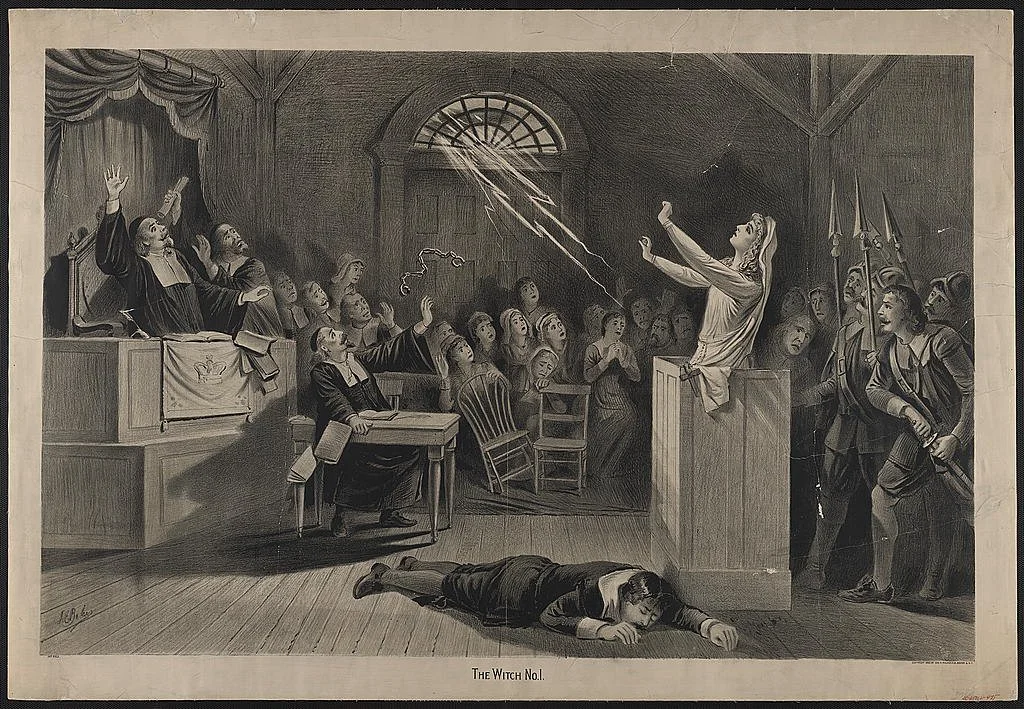
witch hunt

A 17th-century court in an uproar, a woman in the dock, lightning comes through a window, a man lies prone on the floor

c. 1892 lithograph of the Salem witch trials

17 October 2025

The phrase witch hunt is surprisingly recent. One might expect it to date to the seventeenth century, when real hunts for supposed witches were rampant across Europe. But its use in relation to witches only dates to the late nineteenth century and its political use only to the twentieth. And until the mid twentieth century, whether the context was witches or some other undesirable person, witch hunt was almost always applied to the persecution of marginalized groups by those in power. But starting around 1960, the term began to be used by those in power in reference to criticism of themselves and their policies.

The earliest use of witch hunt that I’m aware of is a literal reference to supposed witches in the seventeenth century, but it doesn’t appear until the mid nineteenth. The following account of the infamous Salem witch trials of 1692–93 appears in “Bancroft’s History of the United States,” published in the magazine De Bow’s Review of August 1853. While it is about supposed witches, the description of the zeal and tactics of the persecutors accords with those of the modern political sense:

Some strange cases of convulsions occurred at the village of Danvers, in the family of Parris the minister. Parris had just been engaged in a violent quarrel with some of his flock, and he seized upon this glorious opportunity for revenge. From members of his own family, by instructing and prompting, he obtained the names of those who had bewitched them, and these answers were given as evidence in the court of justice. Against his enemies he employed all the efforts of his malicious and revengeful spirit. But Parris did not do his work of infamy alone. It was too inviting a subject for the ministers of Boston not to participate in, and with Cotton Mather at their head, they eagerly joined in the grand witch hunt. Witch-finding was made a science. Honest bigotry and malicious craft kept up and increased the excitement. Every one who was bold enough to express his disbelief in witchcraft, and his belief in the rascality of the whole business, was a doomed man. Evidence tending to convict their friends was suppressed, and evidence tending to convict their enemies was manufactured. But the holy zeal of the ministers was not satisfied with the judicial murder of those of their flocks who had incurred their displeasure. It was next directed against those of their own order, who had the intelligence and the honest courage to oppose this disgraceful affair.

The earliest figurative and political use of witch hunt I can find of the term is from 1900 in the context of Canadian politics. In a pair of articles, again in the Manchester Guardian, on the Canadian federal election of that year, reporter Harold Spender wrote on 30 October 1900:

For four years there has been absolute peace between the races and religions of this strangely mingled half-continent. For four years; but now I fear that the mischievous race-suspicions of South Africa are already spreading here, and that the pernicious spirit of the witch-hunt is already appearing in the speeches and writings of this campaign.

[…]

But more serious for the moment is the loyalist witch-hunt. You would imagine that Englishmen would be content with the proud consciousness of these people’s [i.e., French Canadians’] allegiance, that they would recognise that such allegiance, so given, demands in return some delicacy and generosity in the recipient. But no; they must peep and pry down the mouth of the gift-horse, and then, when the teeth snap in angry resentment, there is a howl of dismay and shallow indignation.

And on the next day, Spender wrote:

Well, that was the sort of attack Mr. Tarte had to meet—an attack which would, in the zeal of a witch-hunt, turn these innocent sayings into treasonable utterances.

Within two decades the term began to be used in the United States, first in the context of the Red Scare following the Russian Revolution. From the Chicago Daily Tribune of 8 March 1919:

Col. Raymond Robins of Chicago, former head of the American Red Cross mission in Russia, warned the senate propaganda investigating committee today that no headway would be made in trying to check bolshevism by “witch hunt” methods.

The use of witch hunt in American politics spiked again in the 1950s with McCarthyism and the hearings of the House Un-American Activities Committee, and the context was most often that of persecuting those on the political left by those in power.

The OED first records the use of witch hunt to refer to political attacks on government officials in a 29 January 1960 Daily Telegraph article about alleged corruption by British Transportation Minister Ernest Marples, a case of a government official being investigated by the opposition minority:

NO WITCH-HUNT
Labour Leaders’ Attitude

Our Political Correspondent writes: The Opposition Front Bench do not intend to conduct a “witch-hunt” against Mr. Marples over his business connections. But this is no guarantee that back-benchers will not seek to pursue the matter further.

If there is any disposition to criticise Mr. Marples, it will be on the ground that he might have taken steps to get rid of his shares when he became Postmaster-General, rather than wait until he was appointed Minister of Transport.

And, of course, no article on witch hunt could go without referring to Donald Trump, who has elevated this particular sense to new heights. According to the Trump Twitter Archive, a site that is no longer online, Trump had tweeted witch hunt 190 times between his first inauguration and 1 May 2019. For an example that falls outside that date range, on 17 October 2019, Trump tweeted in about the first effort to impeach him:

The Greatest Witch Hunt in American History!

That’s a far cry from the persecution of seventeenth-century women who did not conform to society’s ideas of how they should act.

Discuss this post


Sources:

“Bancroft’s History of the United States.” De Bow’s Review, 15.2, August 1853, 160–86 at 179–80. HathiTrust Digital Library.

“No Witch-Hunt.” Daily Telegraph (London), 29 January 1960, 1/2. Gale Primary Sources: Telegraph Historical Archive.

Oxford English Dictionary Online, September 2021, s. v. witch hunt, n., witch-hunt, v.

Spender, Harold. “The Canadian Elections” (30 October 1900). Manchester Guardian (England), 9 November 1900, 10/3. ProQuest Newspapers.

———. “The Canadian Elections” (31 October 1900). Manchester Guardian (England), 15 November 1900, 10/2. ProQuest Newspapers.

Trump, Donald J. (@realDonaldTrump), Twitter.com (now X.com), 17 October 2019.

“Warns America to Use Care in Fighting Reds” (7 March 1919). Chicago Daily Tribune, 8 March 1919, 2/2. ProQuest Newspapers.

Image credit: Joseph E. Baker, c. 1892, George H. Walker & Co. Library of Congress. Public domain image.

hag

Drawing of an emaciated woman with a cat on her shoulder and a staff, dressed in rags, leading an emaciated dog and horse

The Hag of the Mill, Arthur Rackham, 1920

15 October 2025

The word hag, like the woman it represents, is old, tracing back to Old English, but hag does not appear to be a very common word until the sixteenth century, when it underwent an explosion of usage and popularity. And while today hag simply means an ugly old woman, the history of the word indicates that it once meant something darker and more sinister.

The Old English progenitor of the word is hægtesse, which meant a Fury of classical mythology, a witch or sorceress, or, in one instance, anger personified. The Old English word is relatively rare, appearing mostly in glosses of Latin texts that reference the Furies. It does appear in the Metrical Charm 4 / Lacnunga 127, which was to be used to cure a stab wound or a stabbing pain:

Ut, spere,    næs in, spere!
Gif her inne sy    isernes dæl,
hægtessan geweorc,    hit sceal gemyltan.

(Out, spear! Not in, spear! If here within is any piece of iron, the work of hags, it shall melt.)

A clipped form *hægge may have existed in Old English, but if it did, it doesn’t appear in the extant corpus. But we do see the clipped hagge in Middle English. The clipped hagge appears in the B text of William Langland’s poem Piers Plowman, c. 1378:

And þanne cam coueytise    can I hym nouȝte descryue,
So hungriliche and holwe   sire [Heruy] hym loked.
He was bitelbrowed,    and baberlipped also,
With two blered eyghen    as a blynde hagge.

(And then came Avarice. I cannot describe him. Hungry-looking and hollow, he looked like Sir Hervy. He was sullen [lit. sharp-browed], and thick-lipped also, with two bleary eyes, as a blind hag.)

(“Sir Hervy” is probably a cultural reference with whom the fourteenth-century audience would have been familiar but whose significance is lost to us today.)

The modern hag has cognates in other Germanic languages that underwent parallel transformations. The Old High German hagazissa became the modern German hexe, and the Middle Dutch haghetisse became the modern Dutch hecse. The English hex, meaning a magical spell, while ultimately from the same root, is a nineteenth century import from modern German.

In modern use, hag has a number of different, albeit related, meanings. Because the term is not common before 1550 and by that date all the senses were in use, it is hard to determine the order in which the senses arose. These include references to the Furies and Harpies of classical myth, assorted evil creatures (such as bogeymen and nightmares), witches, and simply old women. We do know that from its earliest days, hag has had the meaning of an evil spirit, especially a female demon. The term night-hag dates to the seventeenth century, originally referring to female ghosts and spirits believed to visit men at night—the succubi of nightmares—but now used to refer to the psychological phenomenon of imagined paralysis and hallucination that occurs in some people as they fall asleep, often mistaken today as alien abduction.

Discuss this post


Sources:

Dictionary of Old English: A to Le, 2024, s.v. hægtesse, n.

Langland, William. The Vision of William Concerning Piers the Plowman, part 2 of 4. Walter W. Skeat, ed. London: N. Trübner, 1869, 5.188–91, 67. Archive.org.

Middle English Dictionary, 4 March 2025, s.v. hagge, n.

Niles, John D, ed. “Lacnunga 127.” In John D. Niles and Maria D’Aronco, eds. Medical Writings from Early Medieval England, vol. 1. Dumbarton Oaks Medieval Library 81. Cambridge: Harvard UP, 2023, lines 15–17, 494–97. London, British Library, MS Harley 585.

Oxford English Dictionary Online, September 2021, s.v. hag, n.1.; September 2023, s.v. night-hag, n.

Image credit: Arthur Rackham, 1920. In James Stephens, Irish Fairy Tales. New York: Macmillan, 1920, opposite 310. Archive.org. Wikimedia Commons. Public domain image.

Mecca

Nighttime photo of a large black cube surrounded by pilgrims within an open-air mosque; beyond are minarets & city buildings

The Kaaba in Mecca, Saudi Arabia

13 October 2025

Mecca is a place name, a toponym, that has acquired a figurative meaning over the years. Literally, it is a city in Saudi Arabia, the birthplace of the prophet Muhammad, to which devout Muslims are required to undertake a pilgrimage to at some point in their lives. Figuratively, it is used to refer to any place that attracts a certain group of people or that is the center of their activity, as in, Las Vegas is a Mecca for gamblers or Rodeo Drive is a mecca for shoppers. The pilgrimage metaphor underlying the figurative sense is obvious, but when did the sense develop?

Mecca is a variation on the Arabic name for the city, Makka or Makkah. An earlier name for the city is Bakkah, but in present-day usage that word is generally reserved for the sacred space around the Kaaba within the modern city. The ultimate etymologies of both names are uncertain, but it is thought by many to come from the Arabic mahram (sanctuary) or mihrab (holy of holies), probably originally a reference to the Kaaba.

The figurative use developed in the early nineteenth century. Edward Baines, in his 1817 History of the Wars of the French Revolution, wrote of the conflict between the British East India Company and the Maratha Empire in India:

Colonel Harcourt accordingly proceeded to Jagarnaut, the Mecca of the Hindoos, and on the 18th encamped in the neighbourhood of this metropolis of idolatry, the Pagoda having been previously evacuated by the Mahratta forces.

Here the use is still in a religious context but is not a reference to Islam.

The metaphor became separated from religion within a few years. An anonymous writer, going by the name of Scotus, writes an over-the-top description of the glories of an Edinburgh medical education in the pages of the Lancet in 1826:

As my education, however, proceeded, the prejudices of my youth were further strengthened by a daily communion with the names of authors and books, most of which I traced to a Caledonian origin, every elementary work put into my hands being either composed, revised, or compiled by some luminary of the North, while the magical letters of EDINBURGH, emblazoned at the bottom of each title page, inspired me with a veneration even for its types.

Contracting my progress, what many wiseacres would be pleased to call an idle habit of looking into reviews, journals, and medical biography, the intellectual feats of Scottish Chrichtons recorded in these pages struck my imagination with the force of a scientific romance. Here I ever found the appellation of “nurse of science,” “the modern Athens,” the “cradle of philosophers,” ready at the point of some patriotic pen, to do homage to this land of learning. It was consequently the “Mecca,” the “Delphic Oracle,” the “Vale of Egeria,” to which all studious pilgrims should resort to drink of the pure springs of knowledge; in short, the idol brightened as I gazed, until, purged of all earthly traces of imperfection by the intensity of my admiration, it shone forth at length the true divinity of my worship.

And there is this more recent example, from an account of an exhibition of photographs of the Beatles taken by Paul McCartney in the London Standard of 28 August 2025:

These ones are also for sale, which means the site will probably become a mecca for fans over the next month or so. Many of the frames have been designed by McCartney, which adds to the momentous nature of it all.

Many Muslims consider the figurative use of Mecca to be offensive, and it’s easy to see why, especially when a spiritual practice is associated with such materialistic pursuits like gambling or shopping. To ameliorate this, many style guides recommend using lower case and an indefinite article when using Mecca figuratively, as in the London Standard quotation above, but that doesn’t seem like much of a fix.

Discuss this post


Sources:

Baines, Edward. History of the Wars of the French Revolution, vol. 1 of 2. London: Longman, Hurst, Rees, Orme, and Brown, 1817, 451. HathiTrust Digital Library.

Everett-Heath, John. Concise Oxford Dictionary of World Place Names, sixth edition. Oxford: Oxford UP, 2020, s.v. Mecca. Oxford Premium Reference Collection.

Jessop, Vicky. “This Glimpse of The Fab Four Is Really Something.” London Standard, 28 August 2025, 31/1. ProQuest Newspapers.

Oxford English Dictionary Online, June 2011, s.v. Mecca, n.

Scotus. “Sketches of the Medical Schools of Scotland” (10 November 1826). The Lancet, vol. 7, no. 169, 25 November 1826, 254–256: 254/2. HathiTrust Digital Library. https://babel.hathitrust.org/cgi/pt?id=njp.32101078204938&seq=260

Photo credit: Al Jazeera English, 2008. Wikimedia Commons. Licensed under a Creative Commons Attribution-Share Alike 2.0 Generic license.

Judeo-Christian

Graphic that combines images of a menorah, a Magan David, and the Christian fish symbol

A symbol of Messianic Judaism

10 October 2025

Judeo-Christian has two main meanings. The first refers to Jews who have converted to Christianity. The second, and today more common, meaning refers to the common ethical and cultural values of Judaism and Christianity. This second meaning originally grew out of desire for inclusivity, but the term Judeo-Christian is now increasingly used to exclude other religions.

The etymology is simple. It’s a straightforward compounding of the standard combining form Judeo-, referring to Judaism, and the adjective Christian.

We see the first sense, that of Jews who have converted to Christianity, in a letter written from Warsaw and published in December 1821 issue of The Jewish Expositor, the journal of the London Society for Promoting Christianity among the Jews:

From all I can see there is but one way to bring about the object of the Society, that is by erecting a Judæo Christian community, a city of refuge, where all who wish to be baptized could be supplied with the means of earning their bread.

Another early use in this sense is from the United States, in the Guardian, or Youth’s Religious Instructor of 1 June 1822:

The operations among the Jews in Poland and Germany are going forward, with encouraging success. In Frankfort [sic], and the adjacent places, fifteen Jews have lately embraced Christianity. Tracts and Testaments are received with avidity and read with attention. A Jew in Germany has ordered 1000 Testaments to be printed at his own expense, and another is endeavouring to establish a Bible Society among the Jews. The urgent necessity of establishing a Judӕo Christian Community, to afford an asylum for those Jews who embrace Christianity, becomes daily more apparent.

Slightly later, we see Judeo-Christian used in a historical context, referring to the early Christian church made up of converted Jews, primarily in Jerusalem, in contrast to the Pauline churches made up of Gentiles that were scattered across the eastern Mediterranean. Samuel Taylor Coleridge uses this sense in an 1827 commentary on Edward Irving’s translation of Manuel de Lacunza y Diaz’s “The Coming of the Messiah in Glory and Majesty.” Lacunza (1731–1801) was a Jesuit priest who wrote under the pseudonym Juan Josafat Ben-Ezra:

But there is yet another and worse wresting of the text. Who that reads Lacunza, p. 108, last line but twelve, would not understand that the Apocalypt [sic] had asserted this enthronement of the souls of the Gentile and Judaeo-Christian Martyrs which he beheld in the train or suite of the descending Messiah.

This historical sense has similar terms in other languages at appear somewhat earlier, the German Judenchrist and the Latin Judaeo-Christianus. The English term may be modeled after one or both of these.

The second sense of Judeo-Christian relates to those values and customs shared by Judaism and Christianity and is rooted in the idea that Christianity supersedes Judaism. While it may seem to reflect a spirit of inclusivity, the supersession and the exclusion of other religion belies that reflection. The Oxford English Dictionary has a quotation in this sense from January 1881 from Dickinson’s Theological Quarterly:

They have learned in their studies that pure and complete theism never existed, in a general manner, save in the Judeo-Christian tradition.

I have been unable to locate a copy of this text, so I cannot provide any further context.

Of course, not all uses of the Judeo-Christian have such negative connotations. One such use is in the context of a June 1934 resolution by the Central Conference of American Rabbis in response to a call by others for Jews to engage the Nazis with good will:

We protest with all our might against the oppression of any individual on these grounds as contrary to the great Judaeo-Christian heritage of our civilization.

We are deeply grateful for the many evidences of understanding and sympathy which Christian leaders have manifested and for the outspoken opposition to the Hitler terrorism on the part of all the truly liberal forces of the world.

But today the term is more likely to be used to differentiate and exclude other religious faiths from participation in the American polity. For example, there is this from a November 2015 op-ed in the New York Times:

Working our way down the roster, what of the former governor of Arkansas Mike Huckabee or Gov. John Kasich of Ohio? Mr. Huckabee has called Islam “a religion that promotes the most murderous mayhem on the planet,” and Mr. Kasich has proposed a federal agency to spread “Judeo-Christian Western values.”

The denotation, the dictionary definition, of this second sense hasn’t changed, but its connotation has.

The term Abrahamic has been proposed as one that would include Islam in the same cultural tradition, but like Judeo-Christian, it fails to include Buddhism, Hinduism, or other religions.

Discuss this post


Sources:

Coleridge, Samuel Taylor. “Notes on Irving’s Ben-Ezra” (1827). Literary Remains, vol. 4. Henry Nelson Coleridge, ed. London: William Pickering, 1839, 406. HathiTrust Digital Library.

“Foreign.” The Guardian, or Youth’s Religious Instructor (New Haven, Connecticut), 1 June 1822, 215. Gale Primary Sources: American Historical Periodicals from the American Antiquarian Society.

“Good-Will Barred to Nazis by Rabbis.” New York Times, 16 June 1934, 16/6–7.

Hasan, Mehdi. “Why I Miss George W. Bush.” New York Times, 30 November 2015, A23/3.

Hawley, C. S. “Extract of a Letter from Mr. McCaul.” The Jewish Expositor and Friend of Israel, December 1821, 478/1. HathiTrust Digital Library.

Oxford English Dictionary Online, December 2013, s.v. Judaeo-Christian | Judeo-Christian, adj. and n., Judaeo-Christianity | Judeo-Christianity, n.