measles / measly

Grainy photograph of a red oval against a blue background

Colorized transmission electron micrograph of a measles virus (red)

29 October 2025

(Edit, 30 Oct 2025: added measly)

Measles is a potentially fatal, but vaccine-preventable, disease caused by a Morbillivirus, and it is one of the most highly contagious diseases that infect humans. The disease, once rendered rare in the industrialized world, has made a comeback in recent years, largely due to low rates of vaccination. The disease is considered by many to be a “childhood illness” and more of a nuisance than a threat, but measles commonly leads to serious and permanent, even fatal, complications. But the name measles is an odd one with an innocuous connotation that belies how dangerous the disease really is. Where does the name measles come from?

The name measles is also sometimes applied to the parasitical disease cysticercocsis, which primarily infects pigs but which can infect humans, as well. That disease, which can cause cysts on the skin that resemble those caused by Morbillivirus, hence both names, is caused by a tapeworm and is biologically unrelated. It is this sense of measles that gives us the adjective measly. The use of measly to refer to infected pork dates to the late sixteenth century, and in the mid nineteenth century it generalized, coming to refer to anything considered inferior or of little value or anything that was blotchy or spotted.

Measles comes from a Germanic root, but its exact route into English is uncertain. It appears by the early fourteenth century and is either a borrowing of the Middle Dutch masels, the Middle Low German maselen, or both. Both of these Germanic etymons are plural, just like the English word. The Old Saxon masala is a blood blister, and the disease’s name comes from the red pustules that appear on the skin during the course of the disease.

The first known use of the word in English is from before 1325 in Walter of Bibbesworth’s Tretiz. Bibbesworth, an Essex knight, wrote the treatise to instruct English speakers in Anglo-Norman French vocabulary. He glosses the Anglo-Norman word rugeroles with maseles (or maselinges depending on which manuscript you consult). Rugerole literally means “red poppy” and was used to refer to the red rash caused by a sexually transmitted infection (which one or ones is uncertain). And in early use the word was used to refer to any disease that caused red spots.

The use of measles to refer to a sexually transmitted infection also gave us the now obsolete mesel, originally referring to leprosy or other skin diseases and later extended to those who were generally considered repellent. This word also first appears in English around the year 1300, but it is of a very different origin, coming from the Anglo-Norman mesel, meaning “leprous, leper, repellent person” and ultimately from the Latin misellus, meaning “poor, wretched.” At the time, leprosy was thought to result from sinful sexual behavior. These Latin and Anglo-Norman words undoubtedly had an influence on the spelling and pronunciation of measles, but they’re not the direct origin of the modern English word.

The form maselinges in one copy of Bibbesworth’s treatise can still be found in the form measlings in certain regions of Britain. This form comes to English via Scandinavia (compare the Swedish mässlingen, the Danish mæslinger, and the Icelandic mislingar—all plural forms), but this Scandinavian form comes from the Dutch/Low German word, just like the more common measles.

Discuss this post


Sources:

Anglo-Norman Dictionary, AND2 Phase5 (R–S), 2018–21, s.v. [rugeole], n., rugerole, n., rugerolé, n.; AND2 Phase 3 (I/Y–M), 2008–12, mesel1, n.

Middle English Dictionary, 4 March 2025, s.v. masel, n.

Oxford English Dictionary Online, March 2001, s.v. measles, n., measlings, n., measle, adj., mesel, adj. & n., measle, v., measly, adj.

Sayers, William, “A Popular View of Sexually Transmitted Disease in Late Thirteenth-Century Britain.” Mediaevistik, vol. 23, 2010, 187–96 at 192–94. JSTOR.

Image credit: U.S. Centers for Disease Control (CDC) and National Institute of Allergy and Infectious Diseases (NIAID), 2024. Wikimedia Commons. Public domain photo.
dyke

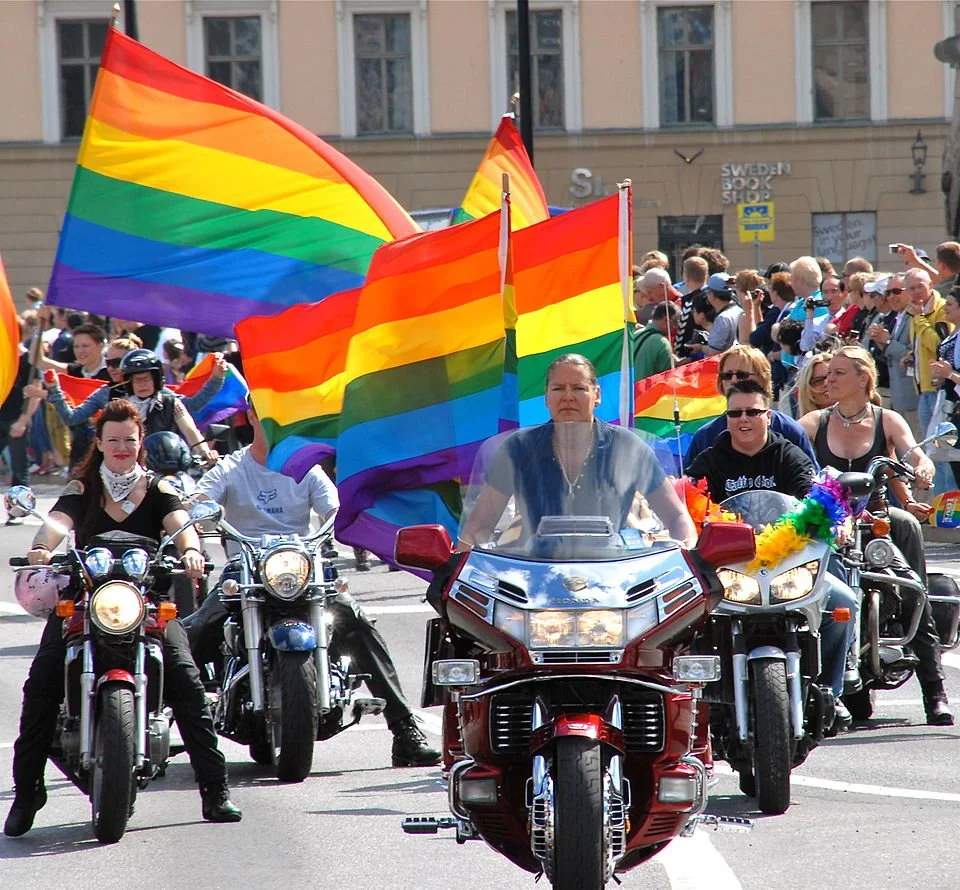
Photo of a group of women on motorcycles with rainbow, pride flags

“Dykes on Bikes,” Stockholm (Sweden) Pride, 2010

27 October 2025

A dyke is a lesbian or a woman whose appearance is regarded as masculine, with the implication that she is a lesbian. The word was originally a slur and is still offensive in many contexts—particularly when used by cis-gendered, heterosexual men—although it has been reclaimed as a positive or neutral term by the LBGTQ+ community. Much of the word’s origin is not known, but dyke appears in print c.1930 and is most likely a clipping of the older bull dyke and bulldyker. But the origin of these older terms remains a mystery with several plausible explanations. First, the facts:

The earliest known appearance of bulldyke is actually as a nickname for a man. From Chicago’s Daily Inter Ocean of 28 July 1892:

With the idea of killing off a portion of the women in the levee district Hattie Washinging [sic], a colored woman, started out at 6:30 o’clock yesterday afternoon with a big revolver in her hand.

She went to Blanche Alexander’s place on Custom House place in search of Belle Watkins, who, she said, had won the affections of Harvey Neal, alias “Bulldyke.” Belle got wind of her coming, and made her escape, but as soon as the woman got inside of the house she began firing right and left.

The same paper on 12 November 1892 ran a short note about Hattie Washington, out on bail, stabbing Harvey Neal with a small knife. Unfortunately, we don’t know how this story ended. But the paper on 24 September 1893 reports Washington being arrested again for pickpocketing. How, if at all, this nickname relates to the later sense of the word is uncertain, but the fact that in this case Bulldyke refers to a man and the fact that both Washington and Neal were Black may provide a clue as to the term’s origin.

The earliest recorded use of dyke to refer to a lesbian is in the form bulldyker. From Joseph Parke’s 1906 book Human Sexuality:

In American homosexual argot, female inverts, or lesbian lovers, are known euphemistically as “bulldykers,” whatever that may mean: at least that is the sobriquet in the “Red Light” district of Philadelphia.

The above quotation is from a note to the following in the main text:

In all large cities there are coteries of these inverts. In Vienna, according to Krafft-Ebing, they call themselves “sisters,” in other places “aunts,” the same writer stating that two very masculine prostitutes, in the city named, who lived in perverse sexual relations with each other, had informed a correspondent that the name “uncle” was applied to women of a similar character.

Parke is not simply using the term as a synonym for lesbian but seems to be implying that it also connotes “masculine” characteristics, which would align with the earlier use of Bulldyke as a man’s nickname.

Bull diking appears in a 1921 article by Perry Lichtenstein in the journal Medical Review of Reviews as a slang term for tribadism or scissoring:

How do these people gain sexual satisfaction? By friction of the clitoris. The following case will illustrate: I had occasion to make a mental and physical examination of a young woman in whose case the Court of General Sessions had appointed a lunacy commission. She was found sane. She stated that she had indulged in the practice of “bull diking,” as she termed it. She was a prisoner in one of the reformatories, and there a certain young woman fell in love with her. This second young woman was a waitress. One morning while the young woman to whom I was talking was in bed the other young woman entered and sat down on the bed. She put her arms around the defendant and squeezed and kissed her. She then jumped into the bed and lifting the other’s clothes had intercourse with her by friction of the clitoris. After that morning the practice was continued with regularity. “Lady lovers” are by no means rare. I might add that a good many cases of such practice are to be found among nurses as well as among actresses. Such women seldom marry. Because of their dislike for men they are, as a rule, looked upon by the community as virtuous.

Bulldiker and the adjective bulldycking appear in two 1920s Harlem Renaissance novels. The first is Carl van Vechten’s 1926 N[——] Heaven. In the passage a man and a woman are discussing where to go to dance:

Winter Palace? She inquired.
A nasty shadow flitted across Anatole’s face.
Naw, he retorted. Too many ofays an’ jigchasers.
Bowie Wilcox’s is dicty.
Too many monks.
Atlantic City Joe’s?
Too many pink-chasers an’ bulldikers.
Where den?
Duh Black Venus.

And the second is Claude McKay’s 1928 Home to Harlem, in which it appears in the lyrics to a song that is “an old tune, so far as popular tunes go”:

And it is ashes to ashes and dust to dust,
Can you show me a woman that a man can trust?

Oh, baby, how are you?
Oh, baby, what are you?
Oh, can I have you now?
Or have I got to wait?
Oh, let me have a date,
Why do you hesitate?

And there is two things in Harlem I don't understan'
It is a bulldycking woman and a faggotty man.

Oh, baby how are you?
Oh, baby, what are you? …

The shorter dyke is in place by 1931, when it appears in the tabloid New Broadway Brevities, which featured articles and news items of a sexually titillating nature. From the 31 August 1931 issue, which is cited by the Oxford English Dictionary:

Benches in the more obscure parts are used continually by couples, pansies and dykes.

Finally, the form bull-dagger appears by Apri 1932, when it appears in an opinion issued by the Mississippi Supreme Court in Burns v. State:

The appellant urges here as error the refusal of the court to permit him to prove, by several witnesses, that the appellant had information from these witnesses that Betty May Griffin was a degenerate, not a proper person to associate with his wife, and that this degenerate woman would likely debauch his wife. We here quote from the record the statement of the appellant’s counsel in the court below as to this excluded evidence: “And so the defendant told that the deceased, Betty May Bay-ford, was a degenerate, commonly called a ‘bull-dagger,’ and that it would be well for him to keep his wife out of her company. I further offer to prove by Jessie Bunns that on the same day Saturday immediately preceding the day of the killing, he had a conversation with the deceased in which he accused the deceased of being a bull-dagger, degenerate, told her that she should not go with the wife of the deceased, and that she then told him that, the witness, that he would go with her, and that he would not be interfered with by the defendant, and if he did interfere that she would do him great bodily harm, that by other witnesses that the general reputation of the deceased was that of the degenerate woman, practiced immoral habits with women, and further then by the defendant that these threats were communicated to him prior to the time of the homicide.”

The above quotations cover the spectrum of early uses and variations. They provide clues to the origin but nothing definitive. We can say with confidence that dyke is a clipping of the older bulldyke. It also seems likely that bulldyke arose in American Black slang. While neither Parke nor Lichtenstein refer to the race of their subjects, the 1892 Black man’s nickname and the two Harlem Renaissance novels indicate that it was present in Black speech. But little beyond these two conclusions can be asserted with confidence, and what follows is informed speculation.

Let’s take the two elements, bull- and -dyke, separately.

It is a reasonable assumption that the bull- is a reference to masculinity. But Susan Krantz has suggested that the bull- may be a reference to falsity, as in bullshit or a lot of bull.

As to the second element, the best guess is that -dyke is variation on dick, either as a generic term for a man or meaning a penis. Thus, Harvey “Bulldyke” Neal may have been a large, exceptionally masculine man, and the term connoting masculinity later transferred from men to lesbians. If the penis sense was intended, then bulldyke might refer to size and connote the mistaken folk belief that lesbians have large clitorises or that the clitoris is some sort of false penis. The form bulldagger, while appearing later, is almost certainly a folk etymology that tries to make sense of the -dyke element by changing it to something familiar, in this case, something phallic and penetrative.

Older references sometimes speculate that that dyke is a variation on either hermaphrodite or morphodite, but this explanation is no longer considered viable and there is no good evidence supporting it. The shift from -dite to -dike is phonologically unlikely, and there is only one early instance of it. Wider use of the spelling morphodike only appears decades later and is likely influenced by dyke, not the other way around. Also, while both hermaphrodite and morphodite are old terms for those with same-sex attraction, both were general terms referring to both men and women, and neither specialized to refer only to lesbians.

To sum up, we don’t know the origin of dyke with any certainty, but there are a number of intriguing possibilities. Perhaps if we find more early uses, the origin will become clearer.

Discuss this post


Sources:

Burns v. State, 141 So. 278, 163 Miss. 258, 1932 Miss. LEXIS 36. Courtlistener.com.

“Celestial and Negro Quarrel.” Daily Inter Ocean (Chicago), 26 May 1896, 8/6. Readex: America’s Historical Newspapers.

Green’s Dictionary of Slang, accessed 27 October 2025, s.v. dyke, n., bull-dyke, n., bull-dagger, n. in bull, n.1.

Krantz, Susan E. “Reconsidering the Etymology of Bulldike.” American Speech, Summer 1995, 70:2, 217–21.

Lichtenstein, Perry M. “The ‘Fairy’ and the Lady Lover.” Medical Review of Reviews, vol. 27, no. 8, August 1921, 373/1. HathiTrust Digital Library.

McKay, Claude. Home to Harlem. New York: Harper & Brothers, 1928, 36–37. HathiTrust Digital Library.

“Miscellaneous.” Daily Inter Ocean (Chicago), 12 November 1892, 7/2. Readex: America’s Historical Newspapers.

“A Negress Runs Amuck.” Daily Inter Ocean (Chicago), 28 July 1892, 8/2. Readex: America’s Historical Newspapers.

Oxford English Dictionary online, June 2018, s.v. dyke n., bull dyke, n., bulldagger, n., bull-dyking, adj.

Parke, Joseph Richardson. Human Sexuality. Philadelphia: Professional Pub. Co., 1906, 309. HathiTrust Digital Library.

Spears, Richard A. “On the Etymology of Dike.” American Speech, Winter 1985, 60:4, 318–27.

“Stole Valuable Papers.” Daily Inter Ocean (Chicago), 24 September 1893, 5/3. Readex: America’s Historical Newspapers.

van Vechten, Carl. N[——]r Heaven. New York: Knopf, 1926, 12. HathiTrust Digital Library.

Photo credit: Frankie Fouganthin, 2010. Wikimedia Commons. Licensed under a Creative Commons Attribution-Share Alike 3.0 Unported license.

bootstrap / boot up

A man in 17th-century dress on horseback pulling himself and his horse out of a swamp by his own hair

Baron von Munchausen pulling himself out of a swamp by his own hair

27 October 2025

A self-made person is one who lifts or pulls oneself up by one’s bootstraps. The phrase is usually used unironically nowadays, despite the fact that the laws of physics make it impossible for one to actually lift oneself by one’s bootstraps. The phrase was originally ironic, recognizing that such a feat is impossible, but as the myth of the self-made man grew (and it is a myth; no one succeeds in life without help), the phrase became unironic in its application.

First though, what are bootstraps? They are quite simply loops, either a pair with one on each side or one at the back of the boot, used to help pull the boot on. This literal meaning goes back the seventeenth century, if not earlier, when it is recorded in George Merton’s 1685 English–Latin dictionary: “Boot strap    Stroppus, m.”

The earliest use of the metaphor underlying the familiar phrase that I know of is from an 1830 physics text by John Lee Comstock, A System of Natural Philosophy:

It was on account of not understanding the principle of action and re-action, that the man undertook to make a fair wind for his pleasure boat, to be used whenever he wished to sail. He fixed an immense bellows in the stern of the boat, not doubting but the wind from it would carry him along. But on making the experiment, he found that his boat wen backwards, instead of forwards. The reason is plain. The reaction of the atmosphere on the stream of wind from bellows, before it reached the sail, moved the boat in a contrary direction. Had the sails received the whole force of the wind from the bellows, the boat would not have moved at all, for then, action and re-action would have been exactly equal, and it would have been like a man’s attempting to raise himself over a fence by the straps of his boots.

Comstock repeats the anecdote in his 1838 Youth’s Book of Natural Philosophy, only this time he uses the phrase as we know it today:

Had this man made, and applied the experiment of attempting to raise himself into the air by pulling at his bootstraps, he would have saved himself the expense of building such a boat.

(The word bootstraps is hyphenated in the printing, but the hyphen is at a line break.)

The phrase appears numerous times in various American newspapers in the latter half of the nineteenth century, all of them acknowledging the fruitlessness of the task.

The earliest apparently unironic use of the metaphor that I know of is from the Eumaeus episode of James Joyce’s 1922 novel Ulysses—although given that it’s Joyce, he may have meant it ironically, too:

However, reverting to the original, there were on the other hand others who had forced their way to the top from the lowest rung by the aid of their bootstraps. Sheer force of natural genius, that.

But a few years later, it is definitively used unironically. This use is also the first known use of the words bootstrapper and bootstrapping. From the 18 September 1927 Times of London:

Now everyone has heard of the American bootlegger. He overs alike an administering angel on the back stairs of every true American home. But the bootstrapper, though less familiar to the foreigner, is an even greater national figure, just as the feat of “lifting oneself by one’s bootstraps” is an almost entirely American accomplishment. Obviously, if you really were born a plumber, and if the unwritten law of the land demands that as a real he-man you must die at least with a white collar round your neck, you have got to do something about it. You do. You lift yourself by your bootstraps.

IT CAN BE DONE

The amazing thing about it is that it can be done—the laws of gravity notwithstanding. An ardent bootstrapper can become not only a successful business man, but a poet, a bestseller, a fashionable portrait painter, and, of course, a politician. I have seen it done.

Bootstrap enters the world of electrical engineering in the 1940s, appearing in a US Army technical manual on radar in April 1944:

Since gain is essential in the operation of this driver, a bootstrap amplifier is used. The bootstrap circuit includes elements which cause the voltage on the grid of the amplifier tube to raise with the cathode voltage, maintaining a constant signal voltage from grid to cathode.

And in the 1950s, the phrase bootstrap technique began to be used in computing to refer to a self-executing program. From a 1953 article by Werner Buchholz on the IBM 701 computer:

Self-Loading Procedure

Another area where the programming facilities of the computer have successfully replaced physical hardware is in the loading of a new program into the computer. There is a load button and a selector switch on the machine, but they do just barely enough to get the process started. The rest is accomplished by a technique sometimes called the “bootstrap technique” The switch determines whether the program is to be loaded from tape, cards, or drum. Pushing the load button then causes one full word to be loaded into a memory address previously set up on the address entry keys on the operator’s panel, after which the program control is directed to that memory address and the computer starts automatically.

By 1980, the verb to boot was in use in computing. From Martha E. Sloan’s 1980 Introduction to Minicomputers & Microcomputers:

Then we must turn on the PDP-11, as we discussed in the last section of Chapter 4. We turn the power knob to ON, and depress the CONTROL and BOOT switches. We call this procedure booting the system.

It is often claimed that lifting oneself up by one’s bootstraps originates with R. E. Raspe’s 1785 novel Baron Munchausen’s Narrative of his Marvellous Travels and Campaigns in Russia, but neither the phrase nor anything like it appears in that work. However, Gottfried August Bürger, in his 1786 translation of the novel into German, Wunderbare Reisen zu Wasser und Lande, Feldzüge und Lustige Abentheuer des Freyherrn von Münchhausen, adds a tale in which the baron pulls himself and his horse out of a muddy swamp by his own hair. Bürger’s metaphor has the same meaning as the American phrase, but there are no bootstraps involved.

Discuss this post


Sources:

Buchholz, Werner. “The System Design of the IBM Type 701 Computer.” Proceedings of the Institute of Radio Engineers, 41.10, October 1953, 1262–75 at 1273/1–2. Archive.org.

Comstock, John Lee. A System of Natural Philosophy, Hartford: D. F. Robinson, 1830, 40. Archive.org.

———. Youth’s Book of Natural Philosophy, Hartford: Reed and Barber, 1838, 45. Archive.org.

Joyce, James. Ulysses (1922). Hans Walter Gabler, ed. New York: Vintage, 1993, 16.1212–15, 528.

Merton, George. Nomenclatura clericalis, or, the Young Clerk’s Vocabulary in English and Latine. London: Richard Lambert, 1685, 55. ProQuest: Early English Books Online (EEBO).

Oxford English Dictionary Online, 1972, s.v. bootstrap, n.; 1989, s.v. bootstrap, v., and boot, v.4.

Radar System Fundamentals (April 1944). War Department Technical Manual, TM 11-467. Washington, DC: U.S. Government Printing Office, April 1946, 164. Archive.org.

Sloan, Martha E. Introduction to Minicomputers and Microcomputers. Reading, Massachusetts: Addison-Wesley, 1980, 158. Archive.org.

Wylie, I. A. R. “The Bootstrapper.” Sunday Times (London), 18 September 1927, 10/4. Gale Primary Sources: Sunday Times Historical Archive.

Image credit: Oskar Herrfurth, before 1934. Wikimedia Commons. Public domain image.

tweetzkrieg

B&W photo of WWII German tanks and armored vehicles

The original Blitzkrieg: tanks and armored vehicles of the German 24th Panzer Division moving through the Ukrainian countryside, 21 June 1942

24 October 2025

I try and avoid posting about brand-new neologisms. They often disappear before they become established, and I don’t want this site to be a graveyard of failed words. (Maybe someone should start such a site, but this one isn’t it.) In 2019, when I originally penned the entry for tweetzkrieg, the word had been circulating for ten years and had recently broken free of Twitter and started to appear in the mainstream press. I thought it was here to stay, but it faded from use shortly after I first wrote about it. And since Twitter has become X and tweet has lost its cachet, it’s unlikely to be revived. So now that it has popped up in my revision cycle, this entry is something of an obituary.

Tweetzkrieg is an alternative name for what is more commonly called a Twitterstorm, a flurry of activity about a trending topic on the social media platform Twitter. But unlike a Twitterstorm, which can be an unorganized response to a tweet or news item, a Tweetzkrieg is often deliberately generated by a single person or group. Tweetzkrieg is, quite obviously, modeled on blitzkrieg, the German WWII-era strategy of a combined arms assault using infantry, armor, artillery, and airpower. The word isn’t terribly common, but it has been around for over ten years.

Tweetzkrieg dates to at least 16 April 2009 when Kemi Adesina Wosu tweeted this (tweet no longer available):

@basseyworld OMG ur little tweetzkrieg (patent pending on that word snitches!) has me LOLing over here!

On 1 March 2011 the website Cycleboredom.com defined the term:

Actually, I think most of the damage was due to lost feeds and the Tweetzkrieg. If you’ve never watched a cycling race with the obligatory Twitter chaser, then you’re a sad individual lost in the purgatorial land of GeoCities. The Tweetzkrieg is the running commentary on Twitter as a race is unfolding.

The term had moved into the realm of international politics a year later on 29 May 2012 in this tweet by David Rothkopf (tweet no longer available) about a Russian government Twitter assault on the U.S. ambassador to that country, Michael McFaul, in response to a speech he had given:

Russian tweetzkrieg on McFaul uses new media to show how unready they are for new media/political reality

And, of course, Tweetzkrieg is often associated with Donald Trump, as in this 10 January 2016 comment on the website Talking Points Memo about an article that stated an Iowa poll had Senator Ted Cruz ahead of Trump in the race for the Republican nomination for president in that year:

Cue the Trump Tweetz-krieg (tm).

Or in this 17 January 2017 post on the blog Blckdgrd in the days leading up to Trump’s first inauguration:

One week from now, holy the fuck — hell, they could Reichstag the Inauguration and declare Martial Law by sunset. The Executive Orders he farts the first 48 hours (with full Tweetzkrieg). I’ll still find these the most fascinating, compelling political times of my life.

And the use that brought the term to my attention was in the pages of The Atlantic on 29 June 2019 in an article by Andrés Martinez:

The June 7 deal may seem to amount to a big victory for Trump, the result of a Tweetzkrieg threatening to impose tariffs on Mexican imports unless Mexico agreed to accomplish within 45 days what the U.S. has failed to do for years: “to sufficiently achieve results in addressing the flow of immigrants from Central America to the southern border.”

As of this writing, the last tweet that used the word tweetzkrieg was posted on 2 June 2021.

Discuss this post


Sources:

C-Huller. “MWBASS: I Got Some Kuurne in My Ompoop.” Cycleboredom.com, 1 March 2011. Archive.org.

dr_coyote. “Discussion: Cruz Takes Lead Over Trump in Latest Poll from Iowa.” Talkingpointsmemo.com, 10 January 2016.

Martinez, Andrés. “Did the U.S. and Mexico Just Link Their Immigration Policies?” The Atlantic, 29 June 2019.

@OhioBaylorFan. Twitter.com (now X.com), 2 June 2021.

“Skin Needs a Cut Before It Heals.” Blckdgrd (blog), 17 January 2017.

Photo credit: Unknown photographer, 1942. Wikimedia Commons. Deutsches Bundesarchiv, Bild 101I-218-0504-36. Licensed under a Creative Commons Attribution-Share Alike 3.0 Germany license.

Saracen

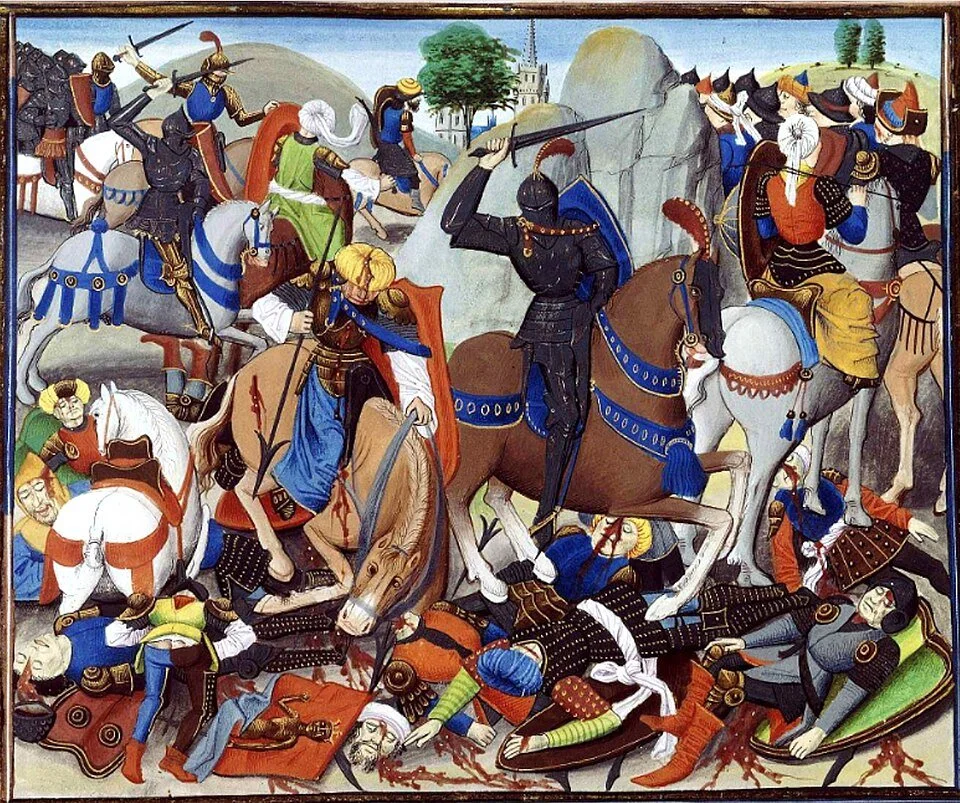
Medieval battle scene between Christians and Muslims featuring a knight in black armor on horseback at the center

Loyset Liédet, c. 1465, medieval illumination of Renaut de Montauban battling Saracens from David Aubert’s version of Quatre Fils Aymon (The Four Sons of Aymon)

22 October 2025

Saracen is term for a Muslim that is primarily used historically to refer to Muslims during the medieval period and especially in reference to the crusades. But it dates to antiquity, long before Islam arose as a religion, and its original sense was much more circumscribed. Its correct etymology isn’t all that interesting, but it does have a fascinating false etymology that circulated widely in Europe during the medieval period.

Saracen was used by medieval Christians in ways that enforced social and power hierarchies and contributed to prejudices and Islamophobia. Care should be taken when using the term today, only using it in ways that limit its application to the medieval meanings and contexts. When referring generally to Muslims in the medieval period, one should use a more neutral term, such as Muslim itself or a more specific regional or sectarian name.

Saracen enters English from the Latin saracenus, which got it from the Greek σαρακηνός (sarakenos). The Greek probably comes from the Arabic root sharq, meaning east, and the word originally referred to a people dwelling in the Sinai peninsula and what is now northwestern Saudi Arabia.

The word is first recorded in Greek as an adjective describing a species of rush growing in the Sinai in Dioscorides’s On Medical Material, a pharmacology written c. 50 C.E. But it is Claudius Ptolemy’s second century Geographia that first mentions Saracens as a distinct group of people. He uses sarakēnē to refer to a region in the northern Sinai peninsula and sarakēnoí as a name for a people in northwestern Arabia. Eusebius takes the word into Latin in his fourth century Historia Ecclesiastica, where he quotes a letter from Dionysius, bishop of Alexandria, that refers to the sarakēnoí of Arabia as existing c. 250 C.E.

The use of Saracen in English dates to the Old English period. For example, there is this from the Old English translation of Orosius’s History Against the Pagans:

Sio Egyptus ðe us near is, be norðan hyre is þæt land Palastine, and be eastan hyre Sarracene ðæt land, & be westan hire Libia þæt land, and be suþan hyre se beorh ðe Climax hatte.

(The part of Egypt that is nearer us has to its north the land of Palestine, and to its east is the land of the Saracens, and to the west is the land of Libya, and to its south is the mountain called Climax [i.e., Mount Catherine].)

In the medieval era, it was common for European writers to claim that the word Saracen derived from a claim by Arab peoples that that they descended from Sarah and her son Isaac, rather than the slave Hagar and her son Ishmael, and in so doing, so the allegation claims, the Arabs were claiming a false genealogical legitimacy. Jerome gives this false etymology in his early fifth century commentary of the biblical book of Ezekiel. And Isidore, in his early seventh century Etymologiae, writes:

Saraceni dicti, vel quia ex Sarra genitos se praedicent, vel sicut gentiles aiunt, quod ex origine Syrorum sint, quasi Syriginae. Hi peramplam habitant solitudinem. Ipsi sunt et Ismaelitae, ut liber Geneseos docet, quod sint ex Ismaele. Ipsi Cedar a filio Ismaelis. Ipsi Agareni ab Agar; qui, ut diximus, perverso nomine Saraceni vocantur, quia ex Sarra se genitos gloriantur.

(The Saracens are so called either because they claim to be descendents of Sarah or, as the pagans say, because they are of Syrian origin, as if the word were Syriginae. They live in a very large deserted region. They are also Ishmaelites, as the Book of Genesis teaches us, because they sprang from Ishmael, and Agarines, from the name Agar (i.e., Hagar). As we have said, they are called Saracens from an alteration of their name, because they are proud to be descendents of Sarah.)

Isidore’s Etymologiae impute theological significance to the etymologies of words and are, by modern standards, laughably wrong, but they were widely copied and read and do provide historical insight into the beliefs of medieval Europeans.

Isidore is using Saracen in the original, narrow sense, of a particular group of people, but the meaning of the word would later be expanded to refer to all Muslims or even more broadly to those non-Christians in lands to the east. Saracen was not used to refer to Christian Arabs. An early example of this broader sense is a list of the final resting places of Christ’s apostles found in the Rituale ecclesiæ Dunelmensis (Rite of the Church of Durham), an early ninth-century collection of Latin liturgical texts and with an interlinear Old English gloss:

Beatus thomas apostolus requiesat Emina, in India Saracenorum.
se ead’ thom’ ap’ gerestað | gireste æt frvmma in ðæm byrig on india saracena.

(The blessed apostle Thomas dwells in Emina, in India of the Saracens.)

So the word Saracen in medieval writing is a nonspecific term, referring generally to non-Christians of the east, and in particular to Muslims, and to medieval Europeans carried negative connotations because it supposedly characterized them as making a false claim of being descended from a more favored line of descent.

Discuss this post


Sources:

American Heritage Dictionary, fifth edition, 2019, s. v. Saracen, n.

Orosius. The Old English History of the World. Malcolm R. Godden, ed. Dumbarton Oaks Medieval Library 44. Cambridge: Harvard UP, 2016, 1.1, 30–31.

Heng, Geraldine, The Invention of Race in the European Middle Ages, Cambridge University Press, 2018, 110–12.

Isidore. Etymologiarvm sive originvm libri XX. Wallace Martin Lindsay, ed. Oxford: Clarendon Press, 1911, 9.2.57, 351. HathiTrust Digital Library.

Isidore. The Etymologies of Isidore of Seville, trans. and ed. by Stephen A. Barney, et al. Cambridge University Press, 2006, 195/1.

Oxford English Dictionary Online, 1909, s.v. Saracen, n. and adj.

Retsö, Jan, The Arabs in Antiquity: Their History from the Assyrians to the Umayyads, RoutledgeCurzon, 2003.

Rituale ecclesiæ Dunelmensis. Publications of the Surtees Society. London: J. B. Nichols and Son, 1840, 196. HathiTrust Digital Library.

Image credit: Loyset Liédet, c. 1465, Paris, Bibliothèque nationale de France, Arsenal, Ms. 5072 Rés., fol. 349v. Wikimedia Commons. Bibliothèque nationale de France. Public domain image.