butler

B&W headshot of a man in formal dress looking askance

Arthur Hohl as the butler who didn’t do it in the 1933 film The Kennel Murder Case

10 November 2025

butler is the chief servant in a household. The word comes to us from Anglo-Norman, the variety of French spoken in England following the Norman Conquest. The Anglo-Norman word was botiller, a cup-bearer or servant who served wine, recorded from the mid twelfth century. The word ultimately comes from the Anglo-Latin buticularius, recorded from the late eighth century. It is cognate with the word bottle, which is from the Anglo-Norman botel and the medieval Latin buticula

The role of a butler has shifted over the centuries, acquiring more responsibilities and authority as the centuries passed. Once simply a cupbearer, the butler would go on to acquire responsibility for a household’s wine cellar and eventually to become the chief servant.

Butler starts appearing in English in the thirteenth century. One of the earliest appearances is in the poem Iacob and Iosep, where it is used in the sense of a cupbearer:

Hit fel in one niȝte þe botiler feng to slepe,
A swiþe muri sweuene him þuȝte þat he gan mete,
Þat in þe winȝarde þe kinges coupe he ber,
& wrong hit of þe grapes ful of win cler.

(It happened one night that the butler fell asleep, a very merry dream came to him that he began to dream, that in the vineyard he bore the king’s cup, &  pressed it with grapes full of excellent wine.)


Sources:

Anglo-Norman Dictionary, AND2 Phase 1 (A–E), 2000–06, s.v. botiller, n.; botel3, n.

Dictionary of Medieval Latin from British Sources, Oxford UP, 2013, s.v. buticularius, n.

Middle English Dictionary, 8 October 2025, s.v. boteler, n.(1).

Napier, Arthur S., ed. Iacob and Iosep, a Middle English Poem of the Thirteenth Century. Oxford: Clarendon Press, 1916, lines 254–57, 9. Oxford, Bodleian Library, MS Bodley 652. HathiTrust Digital Library.

Oxford English Dictionary Online, September 2018, s.v. butler, n.

Photo credit: Warner Bros., 1933. Wikimedia Commons. Public domain image.
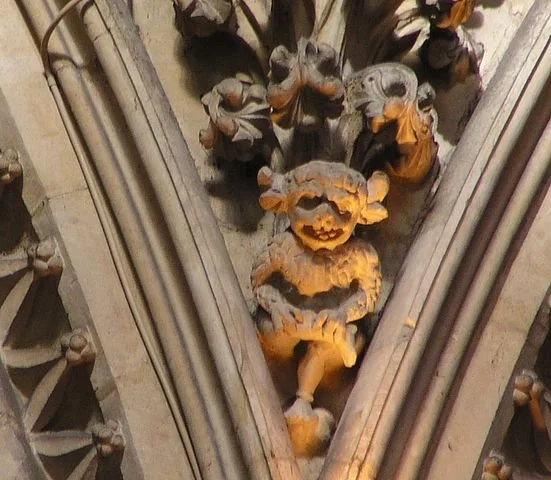
imp

Stone carving of a demonic creature on a cathedral pillar

The Lincoln Imp, a late 13th-century grotesque in Lincoln Cathedral

7 October 2025

We all know that an imp is a small devil or demon, or somewhat more playfully, a mischievous child. But it was not always so. Would you believe that imp originally meant a shoot of a plant, a sapling?

Imp is an old word, dating to Old English, and back then an impe was a small plant. Although the noun only appears once in the Old English corpus, in the late ninth-century translation of Pope Gregory the Great’s Cura pastoralis (Pastoral Care). The translation is generally credited to King Alfred the Great (reigned 871–99), although the degree of Alfred’s participation in the project is uncertain, and he certainly did not accomplish it without the aid of his tutors. The following passage is commentary on the biblical Song of Songs that uses imp to mean a shoot or graft of a plant:

Geheirað hwæt on Cantica Canitcorum is awriten, ðæt se brydguma scolde sprecan to ðære bryde: he cwæð, “Hlyst hider, ðu ðe eardasð on freondes orcgearde, ond gedoo ðæt ic mæge gehiran ðine stemne.” Ðæt is sio halige gesomnung Godes folces, ðæt eardað on æppeltunum, ðonne hie wel begað hira plantan & hiera impan, oð hie fulweaxne beoð.

(Hear what is written in the Song of Songs, that which the bridegroom should say to the bride: he says, “Listen here, you dwell in a friend’s garden, and make it so that I may hear your voice.” That is the holy congregation of God’s people, which dwells in the apple orchards, when they cultivate well their plants & their imps, until they are full grown.)

This is commentary on the Song of Songs 8:13, which reads in the Vulgate (the version that both Gregory and Alfred would have used):

quae habitas in hortis amici auscultant fac me audire vocem tuam

(You who dwell in the gardens, my friends are listening: make me hear thy voice.)

While the noun impe only appears once, it appears several more times as an element in place names, where it probably means sapling. There is also a verb form, impian, meaning to implant or graft the shoot of a plant, which also only appears once. These botanic senses are now obsolete.

By the late fourteenth century, imp had made the jump from flora to people and was being used to mean a child, especially the scion of a noble house. This transition can be readily seen in two examples, a few decades apart. The first, uses an extended metaphor of plant growth in reference to a prince. The poem, Seldom Seen Is Soon Forgot, was written c. 1377, on the occasion of the death of King Edward III. It says of Edward’s grandson, Richard II, who succeeded his grandfather when he was just ten years old:

Weor þat Impe ffully growe,
Þat he had sarri sap and piþ,
I hope he schulde be kud and knowe
ffor Conquerour of moni a kiþ.

(Were that imp fully grown,
so that he had pleasing sap and pith,
I hope he should be famous and known
as conqueror of many a nation.)

The anonymous poet’s hopes were not to be realized, as Richard II was a rather weak king. Compare that to this line about another prince written by Thomas Hoccleve c. 1411 in the envoy to his Regement of Princes, which lacks any overt botanical references:

O litell booke, who yafe the hardynesse
Thy wordës to pronounce in the presence
Of kyngës Impe and princes worthynesse
Syn thou all naked art of eloquence?

(Oh little book, who gave [you] the courage to pronounce your words in the presence of the king’s imp and the excellence of princes since you are all naked of eloquence?)

Hoccleve’s poem was written for the prince who would become Henry V, who as an adult would fulfill the earlier, anonymous poet’s hopes for a conqueror-prince.

It wasn’t until the sixteenth century that the word acquired its devilish connotation. It started to be used in phrases like imp of a serpent or imp of the devil. For example, a line in William Bonde’s 1526 Pylgrimage of Perfection reads:

Suche appereth as angelles, but in very dede they be ymps of serpentes, fayre in face, and their hertes full of poyson, flateryng with their tonges and syngyng with their tayles.

(Such appear as angels, but in very deed they are imps of serpents, fair of face, and their hearts full of poison, flattering with their tongues and singing with their tales.)

Such uses became so common that by the century’s end the qualifying phrase could be dropped and use of imp alone connoted demonic heritage. Reginald Scot’s 1584 The Discoverie of Witchcraft reads:

They haue so fraied vs with bull beggers, spirits, witches, urchens, elues, hags, fairies, satyrs, pans, faunes, sylens, kit with the cansticke, tritons, centaurs, dwarfes, giants, imps, calcars […]

(They have so frightened us with bull-beggars, spirits, witches, hunchbacks, elves, hags, fairies, satyrs, pans, fauns, silens, jack o’ lanterns, tritons, centaurs, dwarfs, giants, imps, conjurors […])

That’s how a budding plant became a little demon.

Discuss this post


Sources:

Alfred. The Old English Pastoral Care. R. D. Fulk, ed. Dumbarton Oaks Medieval Library 72. Cambridge: Harvard UP, 2021, 3.49, 404.

Bonde, William. Here Begynneth a Deuout Treatysse in Englysshe, Called the Pylgrimage of Perfection. London: Richard Pynson, 1526, 2.26, sig R1r–v. ProQuest: Early English Books Online.

Dictionary of Old English: A to Le, 2024, s.v. ? impe, ? impa, n., impian, v.

Hoccleve, Thomas. Hoccleve’s Works. III. The Regement of Princes. Frederick J. Furnivall, ed. Early English Text Society Extra Series 72. London: Kegan Paul, Trench, Trübner, 1897, lines 5440–43, 196. HathiTrust Digital Library.

Liberman, Anatoly. “Folklore and Etymology: Imps and Elves (or COVID-19 and backpain).” OUP Blog, 3 March 2021.

Middle English Dictionary, 4 March 2025, s.v. impe, n.

Oxford English Dictionary Online, 1899, s.v. imp, n.1.

Scot, Reginald. The Discoverie of Witchcraft. London: William Brome, 1584, 153. Archive.org.

“Seldom Seen Is Soon Forgot.” The Minor Poems of the Vernon MS, part 2. F. J. Furnivall, ed. Early English Text Society O.S. 117. London: Kegan Paul, Trench, Trübner, 1901, lines 89–92, 718. HathiTrust Digital Library.

Photo credit: Hongking, 2009. Wikimedia Commons. Public domain image.

tabby

A striped cat on top of a washing machine

Mackerel, a tabby cat

5 November 2025

Most of us know that a tabby cat is either a female house cat or one with a striped or brindled coat regardless of its sex. But tabby can also refer to an elderly woman. Where does the word come from? It has a convoluted and somewhat uncertain etymology.

The English word is borrowed from a number of European languages: the French tabis, in Old French atabis; the Spanish tabi; the Portuguese tabi; and the Italian tabi. These all in turn come from the medieval Latin attabi, which was taken from the Arabic ‘attābī, which is a reference to al-’Attābīya, a neighborhood of Baghdad. This quarter of the city is named for Attab ibn Asid, the first governor of Mecca following its conquest by Muhammad. Tabby, and its ancestors in these other languages, originally referred to silk taffeta, which was woven in the Baghdad neighborhood. The cloth was originally striped but later came to be used for cloth of a single color that was waved or watered.

But the senses of tabby meaning a female cat may have a distinct origin. While it most likely also comes from the idea of streaks of color, it may come from the name Tabitha.

Tabby appears in English as early as 1638 referring to the cloth. It appears in a letter from Thomas Verney to his father requesting items he needs to establish himself in Barbados:

Now for some necessaries concerning myself. As first, for one good cloth sute, and one taby or good stuff sute.

The connection to felines is in place by 1664, when it appears as an adjective in George Etherege’s play The Comical Revenge, or, Love in a Tub:

Laugh but one minute longer I will foreswear Thy company, kill thy Tabby Cat, and make thee weep For ever after.

The noun appears by 1774, when Oliver Goldsmith uses it in a description of civets in his History of the Earth:

This animal varies in colour, being sometimes streaked, as in our kind of cats called Tabbies.

The application of the adjective to older women appears as early as 1748 in Samuel Richardson’s novel Clarissa:

With horrible grave faces was I received. The two antiques only bowed their tabby heads; making longer faces than ordinary; and all the old lines appearing strong in their furrow’d foreheads and fallen cheeks.

Here tabby is referring to various shades of gray hair on the two women’s heads. But within a few years, the word was being used as a noun for elderly women. From George Colman’s 1761 play The Jealous Wife:

L[ady]. Free[love] Lud! lud! What shall I do with Them? Why do these foolish Women come troubling me now? I must wait on Them in the Dressing-Room, and You must execute the Card, Harriot, till They are gone. I’ll dispatch Them as soon as I can, but Heaven knows when I shall get rid of Them, for They are both everlasting Gossips; tho’ the Words come from her Ladyship, one by one, like Drops from a Sill, while the other tiresome Woman overwhelms Us with a Flood of Impertinence. Harriot, You’ll entertain his Lordship till I return. (Exit.

L[ord]. Trink[et]. ’Pon Honour, I am not sorry for the coming in of these old tabbies, and am much obliged to her Ladyship for leaving us such an agreeable Tête-à-Tête.

Har[riot] Your Lordship will find Me extreamly bad Company.

L. Trink. Not in the least, my Dear!

The sense of a female cat was in place by the early nineteenth century. Note that this comes quite a bit later than the application of tabby to women. Whereas the use in relation to women clearly comes from the idea of streaks of color, in this case gray hairs, the use in relation to female cats may come from the name Tabitha, in contrast to tomcat, from the name Thomas, used for male cats. We see this sense in an 1826 revision of James Townley’s play High Life Below Stairs of that year:

Lovel. Didn’t you hear a noise, Charles?

Free[man]. Somebody sneezed, I thought.

Lovel. (rises) There are thieves in the house. I’ll be among ’em. (takes a pistol)

Kitty. Lack-a-day! sir, it was only the cat. They sometimes sneeze for all the world like a Christian. Here, Jack, Jack; he has got a cold, sir; puss, puss.

Lovel. (going towards R. door) A cold, then I’ll cure him. Here, Jack, Jack; Puss, puss.

Kitty. Your honour won’t be rash. Pray, your honour, don’t. (opposing)

Lovel. Stand off! Here, Freeman; here’s a barrel for business, with a brace of slugs, and well primed as you see. Freeman, I’ll hold five to four—Nay, I’ll hold you two to one, I hit the cat through the key-hole of that pantry door.

Free. Try, try; but I think it impossible.

Lovel. I am a good marksman—a dead shot. (cocks the pistol, and points it at the pantry door) Now for it! One, two three. (a violent shriek, and the door is thrown open, all is discovered) Who the devil are all these? One, two, three, four. Why, Mrs. Kitty, your cat has kittened—two Toms and two Tabbies!

Philip. They are particular friends of mine, sir; servants to some noblemen in the neighbourhood.

The line reading “two Toms and two Tabbies” doesn’t appear in the original 1759 version of the play. In the scan of the 1763 printing in the HathiTrust Digital Library, the printed line ends with “four—”, after which someone, at some unknown date, has penciled in, “Pray Mrs. Kitty whose Cats are these?”

From the available evidence, we can’t say for certain why we call female cats tabbies. It may come from the sense of striped cats, or it may come from the name Tabitha, or perhaps both influenced the sense.

Discuss this post


Sources:

American Heritage Dictionary, fifth edition, 2022, s.v. tabby, n. & adj.

Colman, George. The Jealous Wife. London: J. Newbery, et al., 1761, 2.3, 38. Gale Primary Sources: Eighteenth Century Collections Online (ECCO).

Etherege, George. The Comical Revenge, or, Love in a Tub. London: Henry Herringman, 1664, 4.7, 65. ProQuest: Early English Books Online (EEBO).

Goldsmith, Oliver. An History of the Earth, and Animated Nature, vol. 3. London: J. Nourse, 1774, 3.390. Gale Primary Sources: Eighteenth Century Collections Online.

Oxford English Dictionary Online, 1910, s.v. tabby, n. & adj.

Richardson, Samuel. Clarissa. London: John Osborn, et al., 1748, 6.98. Gale Primary Sources: Eighteenth Century Collections Online (ECCO).

Townley, James. High Life Below Stairs, revised edition. London: Thoms Hailes Lacy, 2.1, 30. HathiTrust Digital Library. 1763 edition, HathiTrust Digital Library.

Verney, Thomas. Letter, 20 May 1638. In John Bruce, ed. Letters and Papers of The Verney Family. London: John Bowyer Nichols and Sons, 1853, 197. Archive.org.

Photo credit: Shadow460, 2009. Wikimedia Commons. Public domain image.


stiff upper lip

Red, 1939, British motivational poster with a crown and the words “Keep Calm and Carry On”

3 November 2025

Having a stiff upper lip is considered the quintessential British quality of resolution in the face of adversity. But surprisingly, the phrase itself is an American import.

The earliest use of the phrase that I’m aware of appears in a 6 November 1811 report on U.S. Congressional action, or rather inaction, in the buildup to the War of 1812:

There will be much talk and little business this session—War is out of the question, but it was resolved in caucus last Sunday evening to look big and keep a stiff upper lip.

And indeed, early uses of the phrase centered on the prospects of war between the United States and England. From the Trenton Federalist of 9 December 1811:

The committee of Congress, to whom was referred the subject of our Foreign Affairs, have brot [sic] in their report, and 6 resolutions at the end of it. Like the President in his message, this committee seem determined that there shall not be cause for charging them with a want of spirt. They come forth with a bold front and stiff upper-lip, and talk most woefully and indignantly against poor John Bull—So that now, if we have not war with old England in right good earnest, neither the President nor the committee on foreign relations, can be blamed.

And the full phrase keep a stiff upper lip makes its debut on 18 January 1812 in a restaurant advertisement for Stiff’s Oyster House that not only references the possibility of war but that also makes play on words with stiff, demonstrating that the phrase had rather widespread currency:

But, what a cheerful reflection it is, that in these perilous times we have one comfort left that all the nations of the earth combined cannot deprive us of! Notwithstanding the comet, eclipses, earthquakes and tempests, Indian wars and British orders in council, we have the pleasing certainty, that go when we will to Stiff’s Oyster-house, No. 22 Fayette street, we can get as good Liquors, Oysters and Terrapins as ever gladdened the heart of man. By [t]he bye, my fellow-citizens, let us keep a STIFF upper lip, for never since mortal man wore hair upon his head was there seen better TERRAPINS than is now at No. 22 Fayette street. Those who have any doubts on the subject, are respectfully invited to call and remove them as soon as possible, and instead of riding to Canada on their backs, take my advice and put them in their bellies.

THOMAS STIFF.
New Beer and Oyster House, No. 22, Fayette street

It would take some time for the phrase to cross the Atlantic. The earliest use of the phrase in a British publication that I have found is actually by the Nova Scotian humorist Thomas Chandler Haliburton, writing under the pen name Sam Slick. It appears in Cleave’s Gazette of Variety on 16 March 1839. In the years that follow, the phrase appears rather often in British papers, but always by North American writers.

In 1851 we get this nugget, which is a rewording of a piece from an American newspaper that had been reprinted several times in British papers. But in this instance, the editors have removed the Americanisms in the piece, with the exception of keep a stiff upper lip, and changed dollars to pounds. From London’s The Lady’s Newspaper of 5 April:

L. L. L. requests the following to be inserted as a bit of advice:—“Never make a poor mouth, but if you are wise you will always affect independence. If you are poor, don’t let folks know it, or they will discover in you ten thousand blemishes—a host of defects, which would never be discovered, or at least never talked about, if you kept a stiff upper lip, and carried yourself as if you had ten thousand pounds, instead of but ten, at your command.

And a few years later, we finally get the phrase used in an entirely British context. Again it’s in reference to a war, this time to the Crimean War. From the York Herald of 21 January 1854:

The electric telegraph will shortly be adopted in our possessions in Asia, and as Lord Palmerston had said, “so universal will telegraph communication become, that if the minister be asked in the House of Commons, whether war had broken out in India, he might answer, wait a minute, I will telegraph the Governor-General in Calcutta, and let you know.” Even now, however, we were enabled, said the lecturer, to communicate hundreds of miles, and tell our friends that the same noble lord had—but not before it was wanted—put a stiff upper lip to Russia.


Sources:

“The Committee of Congress.” Trenton Federalist (New Jersey), 9 December 1811, 3/2. Readex: America’s Historical Newspapers.

“Correspondence.” The Lady’s Newspaper (London), 5 April 1851, 185. Gale Primary Sources: Nineteenth Century UK Periodicals.

“From Our Correspondent” (6 November 1811). Philadelphia Gazette (Pennsylvania), 9 November 1811, 3/3. Readex: America’s Historical Newspapers.

“Mark! Read Learn and Digest.” Baltimore Whig (Maryland), 18 January 1812, 2/2. . Readex: America’s Historical Newspapers.

Oxford English Dictionary Online, 1916, s. v. stiff, adj., n., and adv.

“The Progress of the Nation.” York Herald (England), 21 January 1854, 6/5. Gale Primary Sources: British Library Newspapers.

Slick, Sam [Thomas Chandler Haliburton]. “Too Many Irons in the Fire.” Cleave’s Gazette of Variety, 16 March 1839, 4/2. Gale Primary Sources: Nineteenth Century UK Periodicals.

Image credit: UK Government, 1939. Wikimedia Commons. Public domain image.

hoax / hocus

Portrait of 8 men in early 20th-century dress gathered around a table examining a skull; other skulls lie on the table

Scientists examining the skull of Piltdown Man, perhaps the most notorious scientific hoax ever perpetrated

31 October 2025

Hoax comes to us as a variant of hocus, which in turn is from the incantation hocus pocus, used in stage magic. The word hoax first appears in the mid eighteenth century as a verb meaning to ridicule. It evidently was current in university slang for several decades before seeing its way into print. The earliest example I have found is in a poem written by a student at Oxford c. 1750 that was published in 1781:

Am I, or am I not imprudent,
In begging you to accept “The Student?”
Here lies the point—if good no wonder—
But how you hoax us, if we blunder!
    “Dame Oxford muster all her friends,
    Each duteous son assistance lends;
    All, all encourage him to print on,
    Alumn’ Westminst’, et Alumn’ Winton’,
    The Chartreau’ sons, and sons of Eton,
    (Thanks for my frank, and rhyme, to Clayton—
    No wonder poor ‘Syl. Urban’s’ beaten”—
    This will be said, Sir, if we shine—
But if we write one faulty line,
How will the critics then bespatter
With foul reproaches Alma Mater!

And the gerund form appears in the 1788 second edition of Francis Grose’s slang dictionary:

HOAXING. Bantering, ridiculing. Hoaxing a quiz; joking an odd fellow. University wit.

The noun appears several times in Mary Ann Hanway’s 1800 novel Andrew Stuart. There is this in the third volume of the work:

When attended by witnesses, I claim you as my wife, the deceived Peer, thus outwitted, will be obliged to relinquish the pursuit, and consent to come down a pretty large sum, to stop the clamours of an injured husband; for he dares not abide the hoax of his noble colleagues in sin, the furious reproaches of his Laurina, or the award of the Court of the King’s Bench, who would assuredly give me swinging damages, as it would make the third time of his name being registered in the archives of Doctors Commons, for such high crimes and misdemeanours; thereby adding celebrity, by his puissant name, to the increasing catalogue of most noble and right honourable seducers!

And in the fourth volume, when it is suggested that the character Elmira Stuart might consent to marry the protagonist, her cousin:

“I should not be surprised,” added Mr. Blundel, smiling significantly at the company, “if from the events of this morning, she should avow her intention of still retaining the name of Stuart.”—A consciousness of the allusion made Andrew blush deeply; for which he was obliged to stand the hoax of the jovial party, who insisted that all should drink success to the happy idea of their host in a bumper.

The sense we know today, that of a joke, deception, or fraud played on a person is in place about the same time. From Ann Plumptre’s 1801 novel Something New:

Mrs. Harrison, over whose countenance the bright sunshine of serenity had been gradually spreading itself ever since the compliment paid her by the Doctor, was by this time so much recovered as to be capable of thinking of a hoax again. Perceiving therefore an admirable opportunity for one here presented, she whispered me, “Let’s have a little fun with the Doctor.” Then turning to him she said, “Why, Doctor, I think you mentioned that you had got the sermon in your pocket. I don’t see why we should wait for Sunday, ca’n’t [sic] you read it to us now?”

But words rarely arise ex nihilo; they come from somewhere, and hoax is no exception. It is a variation of hocus, a noun meaning a trick or deception or a verb meaning to execute such a deception. That in turn is from the phrase hocus pocus, extending a metaphor of stage magician’s illusion to a deception or scam.

We see the noun hocus in a 3 February 1654 letter by John Thurloe, spymaster for Oliver Cromwell and secretary to the council of state during the Protectorate:

That his hocus was to seduce the scilley multitude, and juggle theire meanes into his pocket, appeared by the continuall gatherings at home and abroade (which wee thinke, is one chiefe reason, why those Journymen, that factiously joyne with him, doe follow his steps in exclaymeing against the government) that they might procure to themselves such like profitts, and why wee judged him a perfect hypocrite, was then related.

Use of hocus as a verb dates to at least 1675, when it appears in Richard Head’s Proteus redivivus, or, The Art of Wheeling or Insinuation:

Again, they complain of their trusting too, as well as your Worships; where lies the difference then since you are both Creditors; and were you in their condition, I question, though you now complain of their Knavery, whether you would not be as very Knaves as themselves; you rail at them, and they again at others. The Mercer cries, Was ever Man so Hocuss'd? however, I have enough to maintain me here, and cries, Hang sorrow, cast away care

Three years later, in 1678, Aphra Behn uses hocus as an adjective in her play Sir Patient Fancy, although that play would not appear in print for nearly a decade:

Alas! a Poet’s good for nothing now,
Unless he have the knack of conjuring too;
For ’tis beyond all natural Sense to guess
How their strange Miracles were brought to pass.
Your Presto Jack be gone, and come again,
With all the Hocus art of Legerdemain.

An open letter of 23 December 1701 addressed to newly elected members of Parliament continues the use of hocus:

All the Dust that is raised, with the stir and clutter of a War with France, is in earnest wholly design'd to blind your Eyes, and to keep you from searching. These State-Juglers wou’d by all means have you fix your Observation far enough from their Fingers; for there the slight is to be play’d, and a clear conveyance to be made of your Mony. So that when they set you upon your Guard against France, it were worth your looking about to see whether they are not then making a Property of you for themselves. But tho’ such Legerdemain Tricks and Stories may pass at Clubs and Coffee-houses, ‘tis hoped they will never be so fatally successful, as to make a Hocus of a House of Commons.

And John Floyer’s 1702 encomium to the virtues of a cold bath calls the belief that bathing in cold water is harmful a Guinea Hocus (i.e., a foolish hoax):

An Ingenious Man used to call this Fellow the Physick Town-Top, a Log of Wood, with a Brass Nose, that was lash’d and kept up by other Mens Mettle, more than his own, whose Excellency lies in a Row of silly worn out threadbare, chaw’d-over Stories and Jests, such as serve to make Fool’s laugh, and Wise Men shake their Heads. Such another Guinea Hocus as this, I was in Consultation with, as sort of a Town-Top too, tho’ not so very wooden, as the other.

This use of hocus would be picked by university students in the ensuing decades and transformed into hoax. The Oxford English Dictionary’s etymology for hoax refers to doubts as to this origin that arise because of a lack of citations of the use of hocus in the eighteenth century. But the OED entry is old, penned in 1898, and yet to be updated. Nowadays, with the digitization of books and other material from that era, we find many examples of hocus in the eighteenth century. So this origin stands on firmer ground than the OED currently intimates.

Discuss this post


Sources:

American Heritage Dictionary, fifth edition, 2022, s.v. hoax, n.

Behn, Aphra. “Prologue” to Sir Patient Fancy (1678). In Plays Written by the Late Ingenious Mrs. Behn, vol. 4. London: Mary Poulson, 1724, 4. Gale Primary Sources: Eighteenth Century Collections Online (ECCO).

Floyer, John. An Ancient Psychrolousia Revived: or, an Essay to Prove Cold Bathing Both Safe and Useful. London: Samuel Smith and Benjamin Walford, 1702, 297. Gale Primary Sources: Eighteenth Century Collections Online (ECCO).

Grose, Francis. A Classical Dictionary of the Vulgar Tongue, second edition. London: S. Hooper, 1788, s.v. hoaxing, sig. P2. Gale Primary Sources: Eighteenth Century Collections Online (ECCO).

Hanway, Mary Ann. Andrew Stuart, or the Northern Wanderer, London: Minerva Press, 1800, 3:319–20 and 4:107–08. Gale Primary Sources: Eighteenth Century Collections Online (ECCO).

Head, Richard. Proteus redivivus, or, The Art of Wheeling or Insinuation. London: W. D. 1675, 322. ProQuest: Early English Books Online.

A Letter to New Member of the Ensuing Parliament. London, 23 December 1701, 5. Gale Primary Sources: Eighteenth Century Collections Online (ECCO).

Oxford English Dictionary Online, 1898, s.v. hoax, n., hoax, v., hocus, v., hocus, n., hocus-pocus, n., adj., & adv., hocus-pocus, v.

Plumptre, Anne. Something New: or, Adventures at Campbell-House, vol. 2 of 3. London: A. Strahan, 1801, 2:179. Gale Primary Sources: Eighteenth Century Collections Online (ECCO).

Thurloe, John. “A Vindication against the Complaints of Mr. Rogers, address’d to Edward Dandy, Esq.” (3 February 1654). In A Collection of State Papers of John Thurloe, Esq., vol. 3 of 7. Thomas Birch, ed. London: Thomas Woodward, 1742, 137. Gale Primary Sources: Eighteenth Century Collections Online (ECCO).

“To a Friend” (c. 1750). In J. Nichols, ed. A Select Collection of Poems with Notes, vol. 7. London: 1781, 316. Gale Primary Sources: Eighteenth Century Collections Online (ECCO).

Image credit: John Cooke, 1915. Wikimedia Commons. Public domain image.