prorogation / prorogue

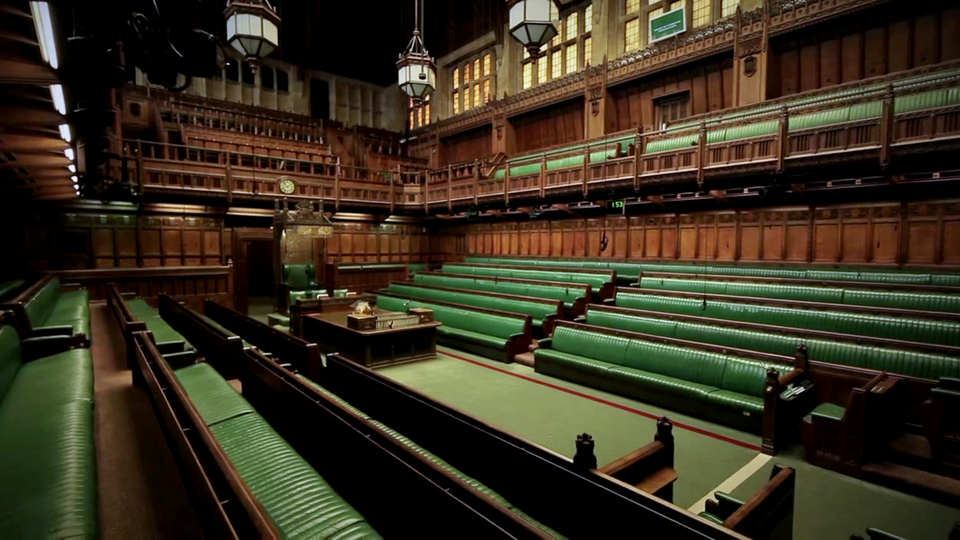
The empty chamber of the UK House of Commons

Chamber of the UK House of Commons

21 November 2025

Prorogation is an arcane parliamentary jargon term meaning the suspension of a session of parliament without formally dissolving it. Prorogation is a commonly used without much public notice in a pro forma manner in the few days leading up to a new session or just prior to parliament’s dissolution and a new election. But occasionally an attempt to prorogue a parliament is controversial and foments public protest. One such case was in the United Kingdom in September 2019 when the queen, at the request of Prime Minister Boris Johnson, prorogued parliament in the run-up to the UK’s Brexit from the European community. Another controversial case was in January 2010 when Canadian Prime Minister Stephen Harper asked the governor-general to prorogue parliament during the February Vancouver Winter Olympic Games. The prorogation was ostensibly to give time to consult on the economy but was viewed by the opposition as an attempt to stifle criticism of the government over the treatment of Afghan detainees and avoid a potential no-confidence vote.

These controversies are rather recent, but the word is much, much older. The noun prorogation and the verb to prorogue are borrowings from Anglo-Norman verb proroger and ultimately from the Latin legal verb prorogare meaning to prolong, defer, extend in office.

Prorogation appears in English at the beginning of the fifteenth century with the now obsolete sense of prolongation or extension. From a Scottish text written c. 1400:

If hit likes the kyng of Skotlond to swere to the prorogacioun of this trewes.

(If the king of Scotland desires to swear to the prorogation of this truce.)

By the middle of that century, the verb was being used to mean to postpone or defer. From the Rolls of Parliament for 1453:

The Kyng, by th’avise and assent of the Lordes Spirituels and Temporels in this present Parliament assemblyd, and by th’auctorite of the same, to th’entent that hasty purveaunce of good for the defence of this land myght be hadde, woll and grauntith to forbere and proroge, and to putte in suspence, th’execution of leviyng of the fyndyng of the seid XIII M. men Archers, and of yche of theym, for the space of II yeres next comyng after the Fest of Pasch next ensuing.

(The king, with the advice and assent of the Lords Spiritual and Temporal assembled in this present parliament, and by the authority of the same, with the intent that swift purveyance of good for the defense of the land might be attained, wills and grants to forbear and prorogue, and to put in suspense, the execution of the levying of the funding of the said 11,000 archers, and of each of them, for the space of 2 years coming after the next ensuring Easter.)

And by 1455, during the Wars of the Roses, the verb was being used in the sense of suspending parliament:

For asmoche as the holy Fest of Cristemas approchith so nygh, that rathir than the lond shuld be loste, it myght like the said Lieutenaunt and all the Lordes, this present Parliament to proroge, adjorne, or dissolve, so that entente that these said riottes and inconveniences myght be resisted.

(For as much as the holy feast of Christmas soon approaches, that rather than the land be lost, it might like the said Lieutenant and all the Lords, this present parliament prorogue, adjourn, or dissolve, with the intent that these said riots and inconveniences might be resisted.)


Sources:

Anglo-Norman Dictionary, AND Phase 4, 2013–17, s.v. proroger, v. https://anglo-norman.net/entry/proroger

Berger, Adolf. Encyclopedic Dictionary of Roman Law. Philadelphia: American Philosophical Society, 1953, s.v. prorogare, v. Brepols: Database of Latin Dictionaries.

du Cange, Dominus, et al. Glossarium mediae et infimae latinitatis. Niort: Léopold Favre, 1883-1887, s.v. prorogare, v. Brepols: Database of Latin Dictionaries.

Latham, Ronald E., David R. Howlett, and Richard K. Ashdowne, eds. Dictionary of Medieval Latin from British Sources. Oxford: Oxford UP, 2013, s.v. prorogare, v. Brepols: Database of Latin Dictionaries.

Oxford English Dictionary Online, June 2007, s.v. prorogation, n., prorogue, v.

Ramshorn, Ludwig. Lateinische Synonymik. Leipzig: Baumgärtner, 1831 and 1833, s.v. prorogare, v. Brepols: Database of Latin Dictionaries.

“Rotl. Parliament. XXXI & XXXII Henry VI” (1453). In Rotuli Parliamentorum, vol. 5 of 6. London: 1767–77, §34, 233/1. HathiTrust Digital Library.

“Rotl. Parliament. XXXIII Henry VI” (1455). In Rotuli Parliamentorum, vol. 5 of 6. London: 1767–77, §15, 285–86. HathiTrust Digital Library.

Photo credit: UK Parliament, 2012. Wikimedia Commons. Licensed under a Creative Commons Attribution 3.0 Unported license.

jones

B&W photo of a Bayer medicine bottle labeled “Heroin”

Bottle of heroin sold by Bayer, originally containing 5 grams, c. 1925

19 November 2025

The exact origin of jones, meaning an overwhelming yen or craving, is unknown. It obviously refers to the name Jones, but exactly how it arose and developed is uncertain, although its early use is primarily in American Black slang. 

The first known use of jones in this context is the 1962 edition of Maurer and Vogel’s Narcotics and Narcotic Addiction which glosses Jones as “a drug habit.” (The term does not appear in the 1954 first edition.) Three years later, Claude Brown’s 1965 Manchild In the Promised Land uses it in the sense of an addiction and also to mean the symptoms of heroin withdrawal:

I looked at her, and she said, “Yeah, baby, that’s the way it is. I’ve got a jones,” and she dropped her head.

“Well, anyway, come on out of the street.”

“I don’t care, Claude, I just had a bad time. You know a n[——]r named Cary who lives on 148th Street?”

“I don’t know him. Why?”

“He just beat me out of my last five dollars, and my jones is on me; it’s on me something terrible. I feel so sick.”

By 1970, it had generalized somewhat into any type of compulsive behavior. From Clarence Major’s Dictionary of Afro-American Slang from that year:

Jones: a fixation; a drug habit; compulsive attachment.

And Toni Cade Bambara uses it to describe a compulsion to hum in her 1971 short story My Man Bovanne:

Blind people got a hummin jones if you notice. Which is understandable completely once you been around one and notice what no eyes will force you into to see people, and you get past that first time, which seems to come out of nowhere, and it’s like you in church again with fat-chest ladies and old gents gruntin a hum low in the throat to whatever the preacher be saying.

The verb meaning to suffer from heroin withdrawal is also recorded in 1971, and by 1984 it was being used more generally to mean to crave or intensely desire.

Some sources relate the origin of jones to Great Jones Alley in New York City, which at one point was a place where junkies would gather to shoot up, but no evidence linking the term to the alley has been proffered. The term may also relate to the phrase keeping up with the Joneses, which dates to 1913, in that both relate to a desire for more, but again, this is mere speculation.

Discuss this post


Sources:

Bambara, Toni Cade. “My Man Bovanne” (1971). In Gorilla, My Love. New York: Random House, 1972, 3. Archive.org.

Brown, Claude. Manchild in the Promised Land. New York: Macmillan, 1965, 262. Archive.org.

Green’s Dictionary of Slang, accessed 19 October 2025. s. v. jones, n.1, jones, v.

Lighter, J. E., ed. Historical Dictionary of American Slang, vol. 2. New York: Random House, 1997, s.v. jones, n., jones, v., 312–13.

Major, Clarence. Dictionary of Afro-American Slang. New York: International Publishers, 1970, 71. Archive.org.

Maurer, David W. and Victor H. Vogel. “A Glossary of Terms Commonly Used by Underworld Addicts.” In Narcotics and Narcotics Addiction, second edition. Springfield, Illinois: Charles C. Thomas, 1962, s.v. Jones, 289–329 at 308. Archive.org. The 1954 first edition is available here.

Oxford English Dictionary Online, 1976, s.v. Jones, n.; March 2005, s.v. Jones, v.

Photo credit: Mpv_51, 2005. Wikimedia Commons. Public domain image.

rapture

Painting of a bearded, haloed man in classical dress being carried aloft into heaven by angels

Louis Licherie, “The Rapture of Saint Joseph,” oil on canvas, before 1687

17 November 2025

Most people, at least in the United States, are familiar with the word rapture as it relates to the apocalyptic Christian doctrine. But that’s a relatively recent development in theology, starting in the eighteenth century and only picking up steam in the nineteenth, and it is one that is largely restricted to American evangelical churches. The word, however, is much older and its original senses are more familiar globally.

The noun rapture comes from the medieval Latin raptura, appearing in Anglo-Latin in the eighth century, which is the past participle of the verb rapio, meaning to snatch, seize, pillage. The Latin verb is also the source of our verb to rape. And many of the early uses of rapture in English are in reference to the abduction and raping of women.

The earliest use of rapture recorded by the Oxford English Dictionary is from George Chapman’s 1594 poem Shadow of Night. It appears in the poem’s dedication to his friend Mathew Roydon:

It is an exceeding rapture of delight in the deepe search of knowledge, (none knoweth better then thy selfe sweet Mathew) that maketh men manfully indure th’extremes incident to that Herculean labour.

Chapman, as we shall see, was extraordinarily fond of the word, uses it here in the sense of a condition of delight or enthusiasm. This poem was Chapman’s first significant literary work. He would go on to become famous for being the first to publish complete English translations of Homer’s Iliad and Odyssey. (When I was a student at the University of Toronto, the English Department’s softball team was named Chapman’s Homers, the second-best softball team name ever, bested only by the name of the Centre for Medieval Studies’s team, the Papal Bulls.)

But the word has a darker sense, that of abduction and rape, which is just as old as the sense of a state of delight. Francis Sabie, in his 1595 Fissher-mans Tale, writes:

Oh then what massacres of them we made,
Ful thirty thousand Turks we slue before
They entred in the ports of Belo towne,
We rushed in before they shut the gates.
Then cride Mathias, Priams famous towne,
Nere bought so deare the rapture of faire Hellen,
As Belo shall now my Lucinas rape.

And Chapman uses it to refer to sexual violation in his c. 1615 translation of the Odyssey:

For, should ye kill me, in my offred wreake,
I wish it rather; and my death would speake
Much more good of me, then to liue and see,
Indignity, vpon indignity:
My Guests prouok’t with bitter words and blowes;
My women seruants, dragg'd about my house
To lust, and rapture. 

(I warned you that Chapman was extraordinarily fond of the word. He uses it eleven times in his translation of the Odyssey alone.)

The idea of rapture being a carrying off to heaven is almost as old. Chapman uses the phrase divine rapture to refer to the transport of the mind into ecstasy. He does this in the dedication of his 1598 publication of his translation of the description of Achilles’s shield from the eighteenth book of the Iliad

Spondanus, one of the most desertfull Commentars of Homer, cals all sorts of all men learned to be iudicial beholders of this more then Artificiall and no lesse then Diuine Rapture; then which nothing can be imagined more full of soule and humaine extraction.

(The Oxford English Dictionary has this citation, but it misidentifies the source as Chapman’s Seauen Bookes of the Iliades of Homere from that same year.)

Chapman’s use in that dedication is still more of transport of the mind to ecstasy than it is a physical carrying off to the heavens, but he uses it in this latter sense in this 1609 poem Euthymiae Raptus; or the Teares of Peace:

Nor how to Humane loue (to Earth now giuen)
A lightening stoop't, and rauisht him to heauen,
And with him Peace, with all her heauenly seede:
Whose outward Rapture, made me inward bleed.

The Christian doctrine of the rapture does not appear until the eighteenth century. We see it in Thomas Broughton’s 1768 A Prospect of Futurity:

I would observe likewise, that, as the Coming of Christ and the Resurrection appear to be coincident Events, and the Change of the living to be the Work of a Moment; it is reasonable to think, that the Change of those, who shall be caught up in the Clouds to meet the Lord in the Air, will be effected at the Instant of, or during their Rapture. The natural Bodies, they had at the Sound of the Trump, will become Spiritual Bodies by the Time of their Junction with the glorious Retinue of their descending Redeemer.

While there is some discussion of the bodily ascension into heaven of the believers among eighteenth-century theologians, the full flowering of the doctrine wouldn’t appear until the nineteenth century and the writings of the dispensationalist theologian John Nelson Darby. In his 1848 An Examination of the Statements Made in the Thoughts on the Apocalypse, by B. W. Newton, Darby writes:

The last paragraph of this chapter first states, as already noticed, without any proof at all, that there are just exactly the two things: Christ secretly exercising the power of God’s throne; or coming forth in the exercise of the power of His own peculiar kingdom, without any transitional state or other condition of things, the one beginning in the instant the other ends. Whereas it is certain that the immensely important fact of the rapture of the church takes place between the two, whatever the interval, and that Christ cannot receive the power of His own peculiar kingdom below, till this has taken place. Nor can this rapture take place till after He has left the throne, from whence it is evident the harvest cannot either (at any rate an important part of it).

The doctrine that the saved will be bodily taken up into heaven has no place in Roman Catholic, Orthodox, or the mainline Protestant churches.

Back in 2019, I encountered another use of rapture, one based on the theological concept but used in a completely secular context, that is the exodus from the San Francisco Bay Area to the Burning Man festival. A friend of mine who lives in Berkeley, California posted this on her Facebook feed:

Anyone not getting raptured want to go to Nerd Nite East Bay on Monday?

After someone asked what she was talking about, she went on to explain in a comment:

raptured = the burning man rapture, or what happens to the Bay Area when everyone goes to burning man. Nerd Nite east bay is a monthly night of entertaining science-based presentations. You know, for nerds.

Burning Man, for those unaware, is a week-long festival held in the Black Rock Desert of Nevada at the end of August. Tens of thousands of people attend each year. The capstone event of the festival is the burning of a giant, wooden effigy of a man, hence the name. I was very familiar with Burning Man—I’ve never attended myself, but having lived in the Bay Area, I knew many people who went each year—but before her post I’d never heard rapture used to describe the emptying out of the Bay Area each year.

So there you have it. Ecstasy, rape, apocalypse, and Burning Man, all in one word.

Discuss this post


Sources:

Broughton, Thomas. A Prospect of Futurity. London: T. Cadell, 1768, 229. Gale Primary Sources: Eighteenth Century Collections Online (ECCO).

Chapman, George. Achilles Shield. London: John Windet, 1598, sig. A3r. ProQuest: Early English Books Online (EEBO).

———. Euthymiæ raptus. London: Humphrey Lownes, 1609, sig. Fv–F2r. ProQuest: Early English Books Online (EEBO).

———. Homer’s Odysses. London: Richard Field and W. Jaggard for Nathaniell Butter, 1615, sig. Ee2r. ProQuest: Early English Books Online (EEBO).

———. Σκìα Νυκτòς. Shadow of Night. London: Richard Field for William Ponsonby, 1594, sig. A.2. ProQuest: Early English Books Online (EEBO).

Darby, John Nelson. “An Examination of the Statements Made in the ‘Thoughts on the Apocalypse," by B. W. Newton” (1848). In The Collected Writings of J. N. Darby, vol. 8. William Kelly, ed. Kingston-on-Thames, England: Stow Hill Bible and Tract Depot, 1971, 1–320 at 16. Archive.org.

Latham, Ronald E., David R. Howlett, and Richard K. Ashdowne. Dictionary of Medieval Latin from British Sources. Oxford: Oxford UP, 2013, s.v. raptura, p.ppl. Brepols: Database of Latin Dictionaries.

Lewis, Charlton T. and Charles Short. A Latin Dictionary. Oxford: Oxford UP, 1879, s.v. rapio, v., raptus, n. Brepols: Database of Latin Dictionaries.

Oxford English Dictionary Online, December 2008, s.v. rapture, n., rapture, v.

Sabie, Francis. The Fissher-mans Tale. London, Richard Johnes, 1595, sig. Cv. ProQuest: Early English Books Online (EEBO).

Image credit: Louis Licherie (1629–87). Wikimedia Commons. Public domain image.

computer / compute

A Black woman standing in front of an electronic, mainframe computer

Mary Jackson in 1977. Jackson was one of the human computers who performed calculations for NASA’s first spaceflights. Jackson was one of the main characters in the 2016 book and film Hidden Figures.

14 November 2025

Computer has a rather straightforward etymology, although its original meaning may be a bit surprising. The word was originally applied to people, not machines. And in the modern era before the advent of electronic computers, many of these human computers were women, as calculation was considered mundane and repetitive work, beneath the dignity of men to perform, despite the fact that such calculations were often highly complex, requiring a high degree of mathematical skill.

Computer is derived from the verb to compute + -er, a standard suffix that denotes a person that does the task of the attached verb. The verb to compute comes to us from Norman French verb computer and that in turn from the Latin computare, both meaning to calculate. The verb appears in English by the late sixteenth century. Compute can also be used as a noun meaning a calculation. This sense has a slightly different etymology, deriving directly from the Latin computus. The English noun compute is recorded about a century before the verb in reference to a computus manualis, a treatise on calculating where the church’s feast days fall on the calendar. And in Anglo-Latin, dating from the eighth century, computus could be used to refer to such chronological calculations.

We see the verb to compute used in a 1579 poem titled Incontinencye by Anthony Munday. Note that Munday is using the verb in reference to a calendrical calcuation:

If men respect their fickle date of time,
Novv in delight, then drovvnd in dark annoy.
Computing Age vvith their vnbrideled time,
Of all estates hovv brittle is their Ioy.

The noun computer, meaning a person who calculates, appears by the early seventeenth century. From Richard Braithwaite’s 1613 Yong Mans Gleanings:

What art thou (O Man) and from whence hadst thou thy beginning? What matter art thou made of, that thou promisest to thy selfe length of daies: or to thy posterity continuance. I haue read the truest computer of Times, and the best Arithmetician that euer breathed, and he reduceth thy dayes into a short number: The daies of Man are threescore and ten.

Computer was being applied to machines by the mid nineteenth century. From Phemie’s Temptation, an 1869 novel by Marian Harland (the pen name of Mary Virginia Terhune):

She despatched the change due the purchaser by Lucy Harris, the girl who had sold the lace, and  plunged anew into the column of figures.

“You have offended Miss Mallory, Phemie!” the saleswoman was so ungrateful as to remark by and by, in passing. [...]

Phemie made no reply. Her pen was slowly traversing the length of the page, at an elevation of a quarter of an inch above the paper, her eyes following the course of the nib, as if it were the index of a patent computer.

The use of the modifier patent indicates that this mechanical sense is relatively new, and that readers would be accustomed to thinking of computers as people, not machines.

The use of computer to refer to a programmable, electronic, calculating machine appears shortly after World War II. The exact date is uncertain. During the war, the US and Britain had made use of calculating machines to crack Axis codes, among other uses, and the word computer was used to denote these machines. Most were mechanical apparatuses, but a few were electronic, although not yet fully programmable like a present-day electronic computer. In the early citations of the word’s use to denote an electronic machine, it’s often difficult to determine if the word is used for a mechanical or an electronic device.

For example, in 1945 mathematician John von Neumann wrote of the plans for EDVAC, one of the first electronic computers:

2.1 In analyzing the functioning of the contemplated device, certain classificatory distinctions suggest themselves immediately.

2.2. First: Since the device is primarily a computer, it will have to perform the elementary operations of arithmetic most frequently. These are addition, subtraction, multiplication and division.

Here von Neumann’s use of computer is in the sense of a mechanical computer, saying the electronic device would primarily serve the function of a mechanical device. But in 1946, Bell Labs researcher George Stiblitz wrote:

Now what kinds of problems must we expect to deal with in an automatic computer? No one person can answer this question fully, because of the enormous fields of possibilities. In general we may say that an automatic computer is best adapted to deal with repetitive problems, where many sets of data are entered into a single set of formulas, one after the other. Just how large a number is “many” and how complicated the set of formulas may be are things with depend intimately upon the design of the particular computer used. If the computer is such that new formulas are easily set up in it, it may be economical to use it in the solution of 5 or 10 problems.

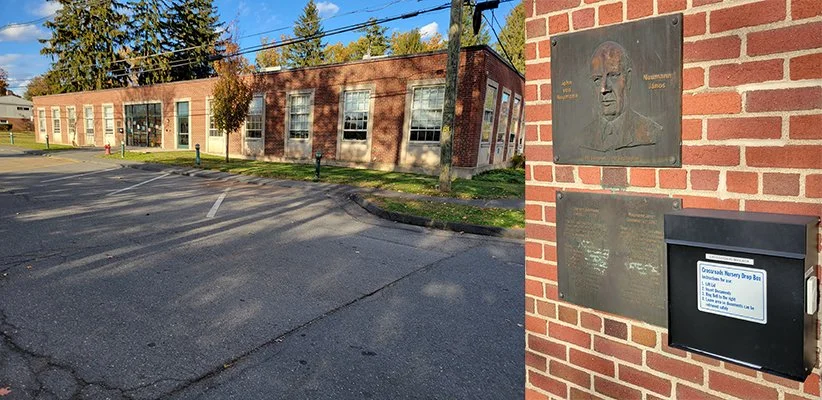
Montage of a photo of a brick building and of detail showing plaques commemorating the 2003 centenary of von Neumann’s birth

Building on the Institute for Advanced Study campus in Princeton that once housed the IAS Machine and is now used as a daycare center, going from baby machines to baby people

Here Stiblitz is referring to a programmable, electronic device. And by 1947 the term digital computer appeared in the journal Mathematical Tables and Other Aids to Computation in reference to another early electronic computer, the IAS Machine, which was designed by von Neumann, among others:

We are engaged at the RCA Laboratories in the development of a storage tube for the inner memory of electronic digital computers. This work is a part of our collaboration with the Institute for Advanced Study in the development of a universal electronic computer.

But by 1950, computer was being used without modification, being widely understood to refer to the programmable electronic devices we’re familiar with today. From an article by Claude Shannon on the design of a computer program to play chess published in Philosophical Magazine of that year:

This paper is concerned with the problem of constructing a computing routine or “program” for a modern general purpose computer which will enable it to play chess.


Sources:

Anglo-Norman Dictionary, AND2 Phase 1 (A–E), 2000–06, s.v. computer, v., comput, n.

Braithwaite, Richard. The Yong Mans Gleanings. London: John Beale for Benjamin Lightfoote, 1614, 1. ProQuest: Early English Books Online (EEBO).

Harland, Marion (Mary Virginia Terhune). Phemie’s Temptation. New York: Carleton, 1869, 12. HathiTrust Digital Library.

Latham, Ronald E., David R. Howlett, and Richard K. Ashdowne. Dictionary of Medieval Latin from British Sources. Oxford: Oxford UP, 2013, s.v. computus, n. Brepols: Database of Latin Dictionaries.

Lewis, Charlton T. and Charles Short. A Latin Dictionary. Oxford: Oxford UP, 1879, s.v. computus, n. Brepols: Database of Latin Dictionaries.

Munday, Anthony. “Incontinencye.” The Mirrour of Mutabilitie. London: John Allde, 1579, sig. I.3v. ProQuest: Early English Books Online (EEBO).

Oxford English Dictionary Online, June 2008, s. v. computer, n., compute, v., compute, n.

Rajchman, Jan A. “Technical Developments: The Selection—A Tube for Selective Electrostatic Storage.” In Raymond Clare Archibald and Derrick Henry Lehmer, Mathematical Tables and Other Aids to Computation, 2.20, October 1947, 359–61 at 359. Archive.org. https://archive.org/details/sim_mathematics-of-computation_1947-10_2_20/page/358/mode/2up

Shannon, Claude. “Programming a Computer for Playing Chess” (8 November 1949). Philosophical Magazine: A Journal of Theoretical Experimental and Applied Physics, 41.314, March 1950, 256–75 at 256. Archive.org.

Stibitz, George. “Introduction to the Course on Electronic Digital Computers” (8 July 1946). In Martin Campbell-Kelly and Michael R. Williams, eds. The Moore School Lectures, vol. 9. Charles Babbage Institute Reprint Series for the History of Computing. Cambridge: MIT Press, 1985, 1–16 at 12.

von Neumann, John. First Draft of a Report on the EDVAC (30 June 1945). Stanford, California: Stanford University, 1992, 1. Archive.org.

Image Credit: Unknown photographer / NASA, 1977. Wikimedia Commons. Public domain photo.

club sandwich

Photo of a turkey club sandwich served on a plate

12 November 2025

The club sandwich, or club house sandwich, as it is usually prepared today, consists of three slices of bread, between which is layered turkey (or sometimes chicken), ham or bacon, lettuce, tomato, and mayonnaise. It is typically served quartered and held together by cocktail sticks.

But why club? How did it get its name? We don’t know for sure, but the sandwich probably originated in one or another American social club or perhaps on the club cars of trains in the closing years of the nineteenth century. But descriptions of early club sandwiches are of a much simpler sandwich, basically just an ordinary chicken or turkey sandwich. But within a few years, the sandwich evolved and became increasingly complex, until it became the dish commonly served today.

Credit for the club sandwich usually goes to the Union Club in New York City, but the earliest known reference to a club sandwich involves the Bohemian Club in San Francisco from the San Francisco Daily Examiner of 29 July 1888:

“Say, Mr. Ferrin, hadn’t you better point that rifle the other way?” mildly suggested the artist as he hid himself behind a Bohemian Club sandwich.

This, however, may be a reference to a sandwich obtained at the Bohemian Club rather than the name of a type of sandwich. The artist in question is a newspaper sketch artist and the Bohemian Club started out as a club for journalists.

And unless a recipe or detailed description is given, it’s often difficult to tell whether the moniker club sandwich refers to a type of sandwich or simply to any sandwich served at a particular club. Here is an example of any sandwich that is served at a particular club in Pennsylvania’s Pittsburg [sic] Press of 26 January 1890:

At noon the young reporter showed up his natural newspaper abilities by demolishing a Press club sandwich, a questionable portion of a chicken from an unknown restaurant, and for a relish actually startled the old-timers by devouring and seemingly digesting a large-sized water bug.

We see the club sandwich associated with the Union Club in a snippet found in New York’s The World of 18 November 1889:

Have you tried a Union Club sandwich yet? Two toasted slices of Graham bread, with a layer of turkey or chicken and ham between them, served warm.

Recipes for the Union Club sandwich were widely printed in newspapers across the United States in 1889–90, which is probably why that social club is often cited as the origin. Here is one such example from the Omaha Daily World-Herald of 10 December 1889:

THE UNION CLUB SANDWICH

The Secret of Making the Delicacy Is Now Public Property

The secret of the “Union club sandwich,” a delicacy known only to the members of that particular organization, has at length been made public. The recipe is as follows:

Take two thin slices of Graham bread, cut them and toast them well. Between the bread place a layer of chicken, ham or turkey and serve warm.

The combination is said to be highly palatable, and the general public will no longer have to wait six years, pay $1,000 initiation fee and annual dues of $75 before they are privileged to taste of this delectable morsel.

So by 1889 the Union Club sandwich was the name of a particular type of sandwich. And within a few years the club sandwich had taken its now familiar three-decker form, at least in some restaurants. From Nebraska’s Blue Valley Blade of 18 May 1904:

Ed Howe’s lecture entertainment is like a three story club house sandwich; it is in three substantial layers with the most delectable parts in between. Howe furnished the real meaty morsels of the entertainment.


Sources:

Auffrey, Richard. “A History of the Club Sandwich.” The Passionate Foodie (blog), 22 & 23 February 2022. Part 1. Part 2.

“Ed. Howe Lectures.” Blue Valley Blade (Seward, Nebraska), 18 May 1904, 6/5. Newspapers.com.

“Fish Destroyers.” Daily Examiner (San Francisco, California), 29 July 1888, 11/7. ProQuest Newspapers.

Lowenthal, Rich. “Re: [ADS-L] ‘club sandwich’ antedating, 1888. American Dialect Society Email List (ADS-L), 12 October 2025.

Oxford English Dictionary, June 2024, s.v. club sandwich, n.

Popik, Barry. “Club Sandwich (Club House Sandwich; Clubhouse Sandwich).” Barrypopik.com, 26 September 2007.

“Spotlets.” The World (New York City), 18 November 1889, 2/2. NewspaperArchive.com.

“The Union Club Sandwich.” Omaha Daily World-Herald (Nebraska), 10 December 1889, 2/4. Readex: America’s Historical Newspapers.

“Was Thoroughly at Home.” Pittsburg Press (Pennsylvania, 26 January 1890, 8/4. ProQuest Newspapers.

Photo credit: Erik Forsberg, 2015. Wikimedia Commons. Licensed under a Creative Commons Attribution-Share Alike 2.0 Generic license.