woo-woo

Photo of a clockface bearing astrological symbols

Clockface displaying astrological symbols on the Torre dell'Orologio (clocktower) in the Piazza San Marco, Venice

8 December 2025

Ghosts, magic crystals, faeries, homeopathy, Bigfoot, astrology, and the like are all examples of woo-woo or woo. But why are they called that? When and where does the term come from?

The Oxford English Dictionary and Green’s Dictionary of Slang both say that woo-woo is onomatopoeia for a ghostly sound associating such beliefs with mysticism and belief in ghostly hauntings. While this origin is certainly possible, the earliest known use of the term militates against this somewhat. That use is in Philip J. Farmer’s 1971 science fiction story, “Only Who Can Make a Tree?” where the term is used simply to mean crazy, insane:

She’s nuts, out of her skull, real woo-woo, you know. But a brilliant idea man! She’s the one thought of the moths.

1971 places this use at the beginning of New Age movement, and Farmer may be using woo-woo with that in mind, but the story’s context doesn’t evoke the ideas usually associated with that movement.

We see woo-woo associated with mystical or alternative beliefs in a 21 October 1984 article about New Age music in the Philadelphia Inquirer:

George Winston, who practices yoga and currently has three albums on the jazz charts […], has jokingly called this crowd the “woo-woos.” In a 1983 interview in the New Age Journal, Winston, asked if he knew who comprised his audience, answered that there were some classical fans, some jazz, some pop and “all the woo-woos.”

“You know,” he added, “there’s real New Age stuff that has substance, and then there’s the woo-woo. A friend of mine once said, ‘George, you really love these woo-woos, don’t you?’ and I said ‘Yes, I do love them,’ and I do. I mean, I’m half woo-woo myself.

And such beliefs are more directly associated with the term in this 20 June 1986 article in the Seattle Times:

Of course, not everyone who thinks that science doesn’t tell all would think it’s reasonable to believe, as Gibson does, that one can program crystals with thought energy. But Gibson says there is ample evidence—both scientific and subjective—that crystals can help in healing and transformation.

“You can say it’s woo-woo,” she says with a laugh. “But it works. I go with what works.”

And even if it doesn’t work, that’s not any reason to dismiss a practice entirely, she says.

Although some believers use the term in a joking manner, woo-woo is inherently derogatory and dismissive. Why this is so can be seen in this use of the term in the Washington Post of 23 July 2001:

It’s tough to compare one era’s stock of ooga-booga with another’s. In the 1200s, scholars researched the size, shape and precise location of Hell, as well as how many angels could fit on the head of a pin.

Today’s supply of woo-woo is certainly remarkable, however. At no time in human history has scientific rationality so thoroughly underpinned our society and the world’s economy.

That the term comes from the traditional sound of ghostly emanations remains the most likely explanation for the term’s origin, but this is not certain. Other explanations have been proffered, albeit without evidence.  Some have suggested that woo-woo is imitative of the sound of a theremin, used to provide the musical score to many classic sci-fi and horror films. That explanation, though, is just a variant on the ghostly emanation explanation. One need not bring theremins into the discussion. Others have suggested that it is derivative of Curly’s, of Three Stooges fame, iconic cry of woob, woob, woob, perhaps used by mental health workers to classify the rantings of their patients. That would fit with the 1971 denotation of crazy, insane, but there is no evidence of mental health workers using the term in this context.

Discuss this post


Sources:

Barrett, Grant. The Official Dictionary of Unofficial English. New York: McGraw-Hill, 2006, s.v. woo-woo. (Also at A Way with Words).

Farmer, Philip Jośe. “Only Who Can Make a Tree?” Fantasy and Science Fiction, November 1971,46–55 at 48/1. Archive.org.

Garreau, Joel. “Science’s Mything Links.” Washington Post, 23 July 2001, C1–C2. ProQuest Newspapers.

Green’s Dictionary of Slang, accessed 7 November 2025, s.v. woo-woo, n.

Ostrum, Carol M. “In the Spirit: New Age Adherents Follow a Personal Path,” Seattle Times (Washington), 20 June 1986, E2/3. Readex: America’s Historical Newspapers.

Oxford English Dictionary Online, September 2021, s.v. woo-woo, adj. & n.

Rea, Stephen X. “The New Age Sound: Soothing Music by Sincere Artists,” Philadelphia Inquirer (Pennsylvania), 21 October 1984, 16-I/1. ProQuest Newspapers.

Photo credit: Peter J StB Green, 2006. Wikimedia Commons. Licensed under the Creative Commons Attribution 3.0 Unported license.

quid pro quo

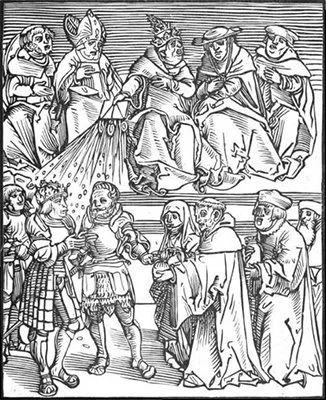
Woodcut of medieval ruler giving a church official a bag of coin while the pope, above, dispenses rays of power

c. 1500 woodcut of the pope granting temporal power to a ruler in exchange for cash

5 December 2025

One often hears quid pro quo in reference to backroom political deals or cases of bribery and corruption. The Latin term literally means “this for that,” but when did it appear and what does it mean in English?

The catchphrase arose in post-classical Latin in the fourth century CE. An early appearance in English is in the 1535 translation of Erasmus’s A Lytle Treatise of the Maner & Forme of Confession in the context of substituting one medicine for another:

But yet poticaries and phisions do more greuously offende / than do these persones now rehersed, which haue a prouerbe amonge them, quid pro quo, one thynge for another. They do otherwhyles sell this thynge, for that thy[n]g / they do minister stuffe that is rotten, and without any vertue or strengthe / yea & nowe hurtfull / in steade of remedy and helpefull medecine.

These lines were inserted by the translator and do not appear in Erasmus’s Latin original. The sense of quid pro quo meaning a substitution is now rare.

Quid pro quo meaning a thing given in return for something else appears a few decades later, around 1560, in the Hereford Municipal Manuscripts:

Only in equitie and concyence considinge that yor orator hath not quid p[ro] quo.

And the sense meaning the action of giving something for a consideration in return appears by 1640 in James Howell’s Dendrologia:

The golden chaine of policy hath beene alwayes held to be, That the defense of a kingdome is the office of the Prince, the honour of the Peeres, the service of the Souldier, and the charge of the subject, for Qui sentit commodum, sentire debet & onus [He who feels the advantage must also feel the burden].

Adde hereunto, that alleageance is an act of reciprocation; as it bindes the King to protect, so it ties the subject to contribute, and by this correspondence there is a quid pro quo.

In present-day use, quid pro quo often appears in a legal context. There is quid pro quo corruption, that is the exchange of an official act in return for something of value, in other words, bribery. And since 1982, American jurisprudence has recognized the concept of quid pro quo sexual harassment, in which a supervisor provides employment, promotion, or some other advantage at work in return for an employee performing sexual acts. This is contrasted with hostile-environment sexual harassment, in which an employee is subject to severe or pervasive, unwelcome sexual words or behavior.

But in general, a quid pro quo transaction is not, in and of itself, illegal or unethical. We all perform them routinely. Most business transactions, for example, are quid pro quos—a purchase where the shopper receives a product in return for giving the merchant money. But since such exchanges are so routine, the phrase tends to only appear in negative contexts.

Discuss this post


Sources:

Erasmus, Desiderius. A Lytle Treatise of the Maner & Forme of Confession. London: Johan Byddell for William Marshall, 1535, sig. M7v–r. ProQuest: Early English Books Online (EEBO).

Garner, Bryan A., ed. Black’s Law Dictionary, twelfth edition, 2024, s.v. quid pro quo; corruption; sexual harassment. Thomson Reuters Westlaw.

Howell, James. Dendrologia: Dodona's grove, or, the vocall forrest. London: Thomas Badger for H. Mosley, 1640, 211–212. ProQuest: Early English Books Online (EEBO).

Oxford English Dictionary Online, December 2007, s.v. quid pro quo, phr. & n.

Image credit: Lucas Cranach, the elder (1472–1553, “Antichristus,” Wikimedia Commons. Public domain image.

OK Boomer

Internet meme featuring the image of the Doge dog with the label “OK Boomer”

3 December 2025

Ok Boomer is a dismissive reply by a young person directed at a Baby Boomer (or Gen Xer—the traditional generational boundaries are not always observed in the wild). The phrase is rather disrespectful of their elders, but after years of being blamed for not getting “real” jobs when the only available ones are at Starbucks or driving for Uber; for not buying houses while being saddled with crippling, student-loan debt; for the demise of various and sundry industries because they spend what little money they have on avocado toast; and for being selfish and self-absorbed while dying on foreign battlefields in the longest wars in America’s history, which were, incidentally, started by Baby Boomers, can one really fault Millennials and Gen Zers for being dismissive? OK Boomer, in two words, sums up the sentiment that Boomers have been a privileged and coddled generation who never faced tough times like today’s younger generations do and are thus out of touch and not worth listening to.

(Full disclosure: I’m a Boomer. But having been born in 1963, at the tail-end of the generation, I identify more with Gen Xers.)

Like most such memes and slang, finding the exact origin is impossible. The earliest usage I’m aware of is from 2 September 2015 when the following exchange between anonymous poster appeared on 4chan:

Who else cucked by student loans here? Pls no shitposting, Eurofriends

Maybe you should have gone to a school within your means and worked to support yourself

Lol ok boomer :)

After this, the phrase appeared sporadically on various internet discussion boards and social media until 14 January 2019 when an anonymous meme creator uploaded a meme that paired the phrase with the iconic Doge image (see the above image).

The phrase got its first entry in Urbandictionary.com on 17 September 2019:

Ok boomer

When a baby boomer says some dumb shit and you can't even begin to explain why he's wrong because that would be deconstructing decades of misinformation and ignorance so you just brush it off and say okay.

Boomer: Kids nowadays are so allergic back in my day we just ate bees and wiped our asses with poison ivy.

Non-boomer: Ok boomer

One can still hear the phrase, but its incidence of use dropped precipitously after 2020.

Discuss this post


Sources:

Anonymous. 4chan/r9k/, 2 September 2015. Desuarchive.org.

Davies, Mark. Corpus of News on the Web (NOW), accessed 4 November 2025.

Sami Nozomi and LiterallyAustin. “OK Boomer.” Knowyourmeme.com, 30 December 2024.

Urbandictionary.com, 17 September 2019, s.v. Ok boomer.

turkey (bird)

A tom turkey, Meleagris gallopovo, displaying during mating season

A tom turkey, Meleagris gallopovo, displaying during mating season

23 November 2020

Through a series of mistaken identities, Meleagris gallopovo, which graces many an American Thanksgiving table, shares the name turkey with its cousin species Meleagris ocellata. The common turkey ranges from Mexico to southeastern Canada, while the oscellated turkey is confined to the Yucatan in Mexico.

The name turkey comes from a conflation with another bird of the of Galliformes order, the guineafowl. That bird, which is native to Africa and hence its name, comprises a number of species in the family Numididae. Although they are rather distant cousins, the guineafowl and the turkey resemble one another and can be easily confused by laypeople.

It is commonly thought that guineafowls were given the name turkey because the bird was introduced to Western Europe by Turkish merchants in the mid sixteenth century, although there is little evidence to support this. Regardless, in the sixteenth century Europeans associated the bird with that country for some reason or another. In 1541, Archbishop of Canterbury Thomas Cranmer promulgated a protocol on what should be served at official meals which refers to turkey cocks, a probable reference to guineafowl:

It was also provided, that of the greater fyshes or fowles there should be but one in a dishe, as crane, swan, turkeycocke, hadocke, pyke, tench; and of lesse sortes but two, viz. capons two, pheasantes two, conies two, wodcockes two.

A few years later, in 1542, the second edition of Thomas Elyot’s Bibliotheca Eliotae makes an unambiguous reference to guineafowl as turkeys:

Meleagrides, byrdes, whiche we doo call hennes of Genny, or Turkie hennes.

A helmeted guineafowl, Numida meleagris, at Serengeti National Park, Tanzania

A helmeted guineafowl, Numida meleagris, at Serengeti National Park, Tanzania

When European explorers encountered the North American bird, they gave it the name of the similar-looking bird they were familiar with. There are two references to turkeys in Richard Eden’s 1555 translation of Peter Martyr d'Anghiera’s Latin Decadas del nuevo mundo (Decades of the New World). Both of these references occur in the marginalia. The first of these is a reference to the birds found along the shores of the Gulf of Paria, in what is now Venezuela. The text reads:

With the golde and frankensence whiche the presented to owre men, they gaue them also a greate multitude of theyr peacockes,bothe cockes and hennes, deade and alyue, aswell to satisfie theyr present necessitie, as also to cary with theym into Spayne for encrease.

And in margin is printed:

Peacockes which wee caule Turkye cockes.

And later, describing an incident near Cozumel in the Yucatan, Eden writes:

Owre men wente and they came accordynge to their promisse and brought with them eyght of their hennes beynge as bygge as peacockes, of brownyshe coloure, and not inferiour to peacockes in pleasaunte tast.

And again, there is a marginal note which here reads:

Turky hens

In both cases, d’Anghiera’s original Latin uses pavo or peacock—like the peacock, the turkey has multi-colored feathers and a fanned tail, so there is a vague resemblance. Eden does a word-for-word translation in the main text but adds the marginal notes to indicate that it is actually a different bird. But just as d’Anghiera conflated the newly discovered bird with the peacock, Eden conflated it with the guineafowl.

That’s how a series of mistakes led to us eating turkey on Thanksgiving.

Discuss this post


Sources:

Anghiera, Pietro Martire. De rebus oceanicis & orbe nouo decades tres. Basil: Ioannem Bebelium, 1533, 38, 72. Archive.org.

Constitutio Thomae Cranmeri (1541), in Wilkins, David. Concilia magnae Britanniae et Hiberniae, vol. 3 of 4. London: R. Gosling, 1737, 862. HathiTrust Digital Library.

Eden, Rycharde. The Decades of the New Worlde. London: William Powell, 1555, 79r, 158v. Early English Books Online (EEBO).

Elyot, Thomas. Bibliotheca Eliotae, second edition. London: Thomas Berthelet, 1552. Early English Books Online (EEBO).

Oxford English Dictionary Online, 1989, s.v. turkey, n.2, turkey-hen, n., turkey-cock, n.

Image credit: Turkey: unknown photographer, c. 2009, public domain image; guineafowl: unknown photographer 2007, used under the Creative Commons Attribution 3.0 Unported license.

hairbag (slang)

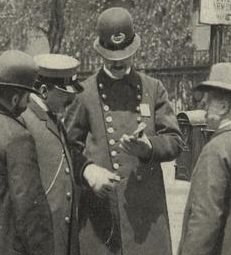
B&W photo of a policeman in 1890s uniform talking to three other men

An 1899 New York City policeman giving directions to three men

1 December 2025 [Edit, same day: added 1958 NYT example]

What is a hairbag? And is it a bad thing?

The term has been New York City police slang for a veteran officer since at least 1958, when it was recorded in two glossaries of police slang. The first appears in a New York Times Magazine piece on 14 March 1958:

Hair bag—A veteran policeman, especially knowledgeable about the inner workings of the Police Department.

The second glossary is in the October issue of Spring 3100, a New York Police Department magazine. That glossary defines a hair bag as “a veteran policeman.” And a New York Times article from 15 February 1970 defines it as “a veteran patrolman, also a patrolman with backbone.”

While these early definitions are positive, the term has subsequently generally been a negative one. For instance, Edward Droge’s 1973 The Patrolman: A Cop’s Story says:

My partner that night, a lethargic old ‘hairbag’ (old-timer) who could not be aroused by Raquel Welch.

And William Heffernan’s 2003 novel A Time Gone By has this:

Donahue was a sergeant closing in on his thirty years—an old hairbag in department lexicon, a term used to describe an aging and often useless cop who was just biding his time until he could get out.

A 9 November 2019 New York Times article has this to say about the term:

For as long as anyone can remember, younger officers in the New York Police Department have referred to their elders as “hairbags”—usually behind their backs.

It’s an archaic bit of slang with obscure origins. In police parlance, “the bag” means “the uniform.” So some officers believe “hairbag” is a riff on a longtime officer’s uniform—so old it has become hairy—and describes veterans who know what the police call “The Job” inside out.

Others think the phrase is an insult that comes from the practice, perhaps apocryphal, of officers using a haircut as an excuse for leaving their posts. This theory holds that sergeants used to demand a bag of hair trimmings as proof, and eventually burned-out officers who shirked work came to be known as “hairbags.”

It’s questionable whether either of these explanations are true. The one about haircuts is especially suspect.

And of course, hairbag can also mean a bag for holding and storing a wig or a bag made out of hair, but the etymology of those senses is obvious.

Discuss this post


Sources:

Burnham, David. “Police (Cops?) Have Slanguage of Own.” New York Times, 15 Feb 1970, 65/4. ProQuest Newspapers.

Goldstein, Joseph and Ali Watkins. “Before There was ‘O.K. Boomer,’ the City’s Police Had ‘Hairbag.’” New York Times, 9 Nov 2019, A21/1. ProQuest Newspapers.

Green’s Dictionary of Slang, accessed 2 November 2025, s. v. hair, n.

Heffernan, William. A Time Gone By. New York: Simon & Schuster, 2003, 27. Archive.org.

Lighter, J. E., ed. Historical Dictionary of American Slang (HDAS), vol. 2 of 2. New York: Random House, 1997, s.v. hairbag, n.

“Police Cant…Oh Yes They Can!” Spring 3100, October 1958, 5–10 at 9/1. John Jay College of Criminal Justice, Lloyd Sealy Library Digital Collections.

Wells, George V. “Station House Slang.”  New York Times Magazine, 14 March 1958, 14. ProQuest Historical Newspapers.

Image credit: unknown photographer, 1899. Wikimedia Commons. Public domain photo.