impeach / impeachment

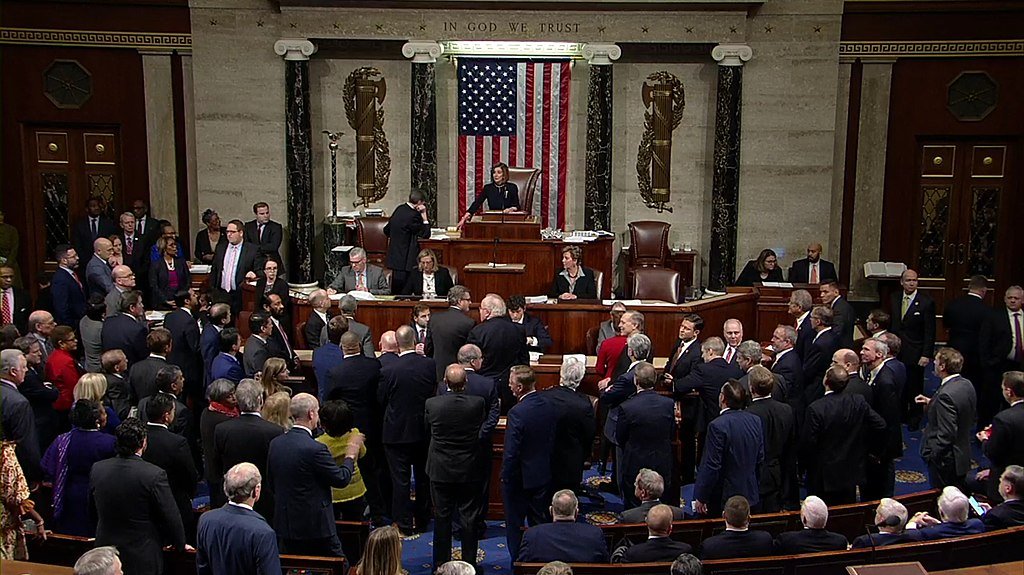
Photo of the US House of Representatives, with representatives crowding into the well of the House

The US House of Representatives voting to adopt articles of impeachment against Donald Trump, 18 December 2019

12 December 2025

The verb to impeach has a straightforward and unsurprising etymology, but the noun impeachment has an unusual twist.

The English verb to impeach is a late fourteenth century borrowing from the Anglo-Norman empescher. This French verb comes from the medieval Latin impedicare, meaning to entangle or hinder, and impetere, meaning to attack, with a secondary meaning of to initiate legal charges against someone.

Note that the Latin root is ped-, meaning foot, which is etymologically related to the English word fetter. But fetter comes down to us today via a different path, from the Old English feter. The difference between ped- and fet- is explained by Grimm’s law: the Proto-Indo-European /p/ changes to /f/ and the /d/ to /t/ in the Germanic languages, while they remain the same in Latin and the Romance languages. The root ped-, of course, means foot, and to fetter is to tie one’s feet. The verb to impede uses the same underlying metaphor, although that verb is an early modern borrowing from the Latin impedire.

And the original meanings in English were the same as the French. We see both senses in Wycliffite tract, The Grete Sentence of Curs Expounded, c. 1383 in passages that address the privilege of sanctuary, in which those accused of crimes could avoid secular punishment by residing in a church. In this first passage, the verb has a primary sense of to hinder or impede, but it is being used in a legal context:

Also grete houses of religion, as Westmynstre, Beverle, and oþere, chalengen, usen, and meyntenen þis privylegie, þat whatevere þef or felon come to þis holy hous of religion, he schal dwelle þere alle his lif, and no man enpeche hym, þouȝ he owe pore men moche good and have ynouȝ to paye it.

(Also, great houses of religion, such as Westminster, Beverley, and others, claim, use, and maintain this privilege, so that whatever thief or felon comes to this holy house of religion, he shall dwell there all his life, and no man impeach him, though he owes poor men much wealth and has enough to pay for it.)

And that same Wycliffite text uses the verb in the sense of accusing someone of a crime:

Also, þei chalengen fraunchise and privylegie in many grete chirches, þat wickid men, opyn þeves, mansleeris, þat han borwed here neiȝboris goodis and ben in power to paie and make restitucion, þere schullen dwelle in seyntewarie, and no man empeche hem bi processe of lawe, ne ooþ sworn on Goddis body and used.

(Also, they challenge the freedom and privilege in many great churches, that wicked men, known thieves, manslaughterers, that have taken their neighbor’s goods and are able to pay and make restitution, should dwell there in sanctuary, and no one impeach them by process of law, nor by an oath sworn and spoken on God’s body.)

Another sense of impeach that is often used in legal circles is to challenge, discredit, or disparage, as in to impeach a witness. This sense dates to at least 1600 when it appears in Shakespeare’s A Midsummer Night’s Dream, 2.1, in which Demetrius says to Helena:

You doe impeach your modestie too much,
To leaue the Citty, and commit your selfe
Into the hands of one that loues you not,
To trust the opportunity of night,
And the ill counsell of a desert place,
With the rich worth of your virginity.

The noun impeachment follows a similar development of its senses, but it has a twist in its etymology. The Old French empeschment was borrowed back into Latin during the medieval era, where it appears as impechementum. This is an instance of Latin borrowing a word from a later language. Most French words stem from Latin, but you don’t often see it work in the other direction.

Impeach and impeachment have a distinct sense in American political usage, where it is a political process, rather than one of criminal justice. In the United States, the House of Representatives has the sole power of impeachment of federal officials, that is the bringing of charges against an official, and the Senate is the tribunal that adjudicates the charges and, if found guilty, removes the official from office. Three presidents (Andrew Johnson, 1868; Bill Clinton, 1998; and Donald Trump, in 2019 and again in 2021) have been impeached and one (Richard Nixon, 1974) resigned before the House could impeach him. None were convicted by the Senate. Fifteen federal judges have also been impeached, eight of whom were convicted by the Senate and removed from office with one resigning before the Senate could convict, the most recent conviction being in 2010.

One final note, many people use impeach to mean remove an official from office. Technically, impeachment is just the bringing of charges by the House; removal requires a trial before the Senate. This sense of impeach meaning to remove from office isn’t in any of the standard dictionaries and is incorrect from a legal perspective, but linguistically it is a correct usage because so many people use it in that sense.

Discuss this post


Sources:

American Heritage Dictionary, fifth edition, s.v. impeach.

Anglo-Norman Dictionary, AND2 Phase 1, 2000–06, s.v. empescher, v.

Dictionary of Medieval Latin from British Sources, Oxford: Oxford UP, 2013, s.v. impedicare, v., impetere, v. Brepols: Database of Latin Dictionaries.

“The Grete Sentence of Curs Expounded.” In Thomas Arnold, ed. Select English Works of John Wyclif, vol. 3 of 3. Oxford: Clarendon Press, 1871, 294 and 316–17. HathiTrust Digital Library.

Merriam-Webster.com, 5 November 2025, s.v., impeach, v.

Middle English Dictionary, 8 October 2025, s.v. empechen, v., apechen, v.

Oxford English Dictionary Online, 1889, s.v. impeach, v., impeach, n., impeachment, n., impede, v.; 1895, s.v. fetter, n., fetter, v.1

Shakespeare, William. A Midsommer Nights Dreame. In Mr. William Shakespeares Comedies, Histories, & Tragedies (First Folio). London: Isaac Jaggard and Edward Blount, 1623, 149/2. Folger Shakespeare Library.

hobbit

10 December 2025

In a hole in the ground there lived a hobbit.

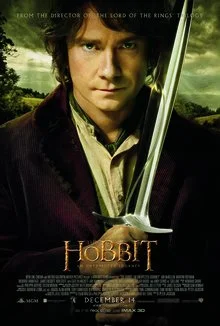
Movie poster depicting actor Martin Freeman, playing the hobbit Bilbo Baggins, holding a sword

Movie poster for Peter Jackson’s 2012 film The Hobbit: An Expected Journey

So begins J. R. R. Tolkien’s 1937 novel The Hobbit. A hobbit, as anyone who doesn’t live in a hole in the ground knows, is a small humanoid creature with hairy feet and a fondness for pipe-weed. The two most famous hobbits, Bilbo and Frodo Baggins, are the protagonists of that novel and of Tolkien’s later The Lord of the Rings. But contrary to what most people believe, Tolkien may not have coined the term hobbit.

There is an earlier example of hobbit from the folklore of the north of England, where it is a name for a type of spirit or mythical creature. The word is recorded in the Denham Tracts, a series of privately published compilations of folklore by Michael Denham, produced between 1846–59. In the closing years of the nineteenth century, the tracts were edited and republished by the Folklore Society. Denham gives no description of what a hobbit is, only the name in a long list of such names:

…boggleboes, bogies, redmen, portunes, grants, hobbits, hobgoblins, brown-men…

The question is whether or not Tolkien was familiar with the Denham Tracts and whether he, perhaps unconsciously, was influenced by the name appearing on this list, or if he coined the word independently. We have no evidence that Tolkien read the Denham Tracts, although he certainly had access to them, and they are the type of thing he, with his interest in creating a mythic corpus for English culture, might have read. Tolkien did not borrow any other of the names in this list, so that indicates that if he was familiar with the list, any borrowing of hobbit was probably unconscious on his part.

The conventional wisdom is that Tolkien’s use of hobbit is a combination of hob- + [rab]bit. Hob is most likely a nickname for Robert and appears in a number of names of spirits and creatures, such as hobgoblin and hob-thrush. A form of Robert also appears in the name Robin Goodfellow, a name known to us today chiefly from Shakespeare’s A Midsummer Night’s Dream, but which was used generally as a name for a sprite or fairy.

For his part, Tolkien never claimed to have coined the word. The closest he came was in a 1968 BBC interview in which he said that during a long and boring stint of grading student papers, c. 1930, he came across an exam book where a student had left one page blank. On it he scribbled the iconic line, “In a hole in the ground there lived a hobbit.” He also, in Appendix F to The Lord of the Rings, gives a fictional etymology for hobbit:

Hobbit was the name usually applied by the Shire-folk to all their kind. Men called them Halflings and the Elves Periannath. The origin of the word hobbit was by most forgotten. It seems however to have been at first a name given to the Harfoots by the Fallohides and Stoors, and to be worn-down form of a word preserved more fully in Rohan: holbytla “hole-builder.”

In the Lord of the Rings, Tolkien’s language of Rohan is not one that he invented. Rather, all the examples of that language are taken directly from Old English. In this case, the word is said to derive from the Old English words hol (“hole”) and bytla (“builder”). Later in the appendix, Tolkien extends this fictional etymology:

Hobbit is an invention. In the Westron the word used, when this people was referred to at all, was banakil “halfling.” But at this date the folk of the Shire and of Bree used the word kuduk, which was not found elsewhere. Meriadoc, however, actually records that the King of Rohan used the word kûd-dûkan “hole-dweller.” Since, as has been noted, the Hobbits had once spoken a language closely related to that of the Rohirrim, it seems likely that kuduk was a worn-down form of kûd-dûkan. The latter I have translated, for reasons explained, by holbytla; and hobbit provides a word that might well be a worn-down form of holbytla, if the name had occurred in our own ancient language.

Of course, we should not confuse this fictional etymology with the real one. But Tolkien’s fictional creation did inspire the naming of a real-world hobbit.

In 2003, the remains of what appears to be a diminutive species of hominin were found on the Indonesian island of Flores. Officially dubbed Homo floresiensis, by 2004 they had become known popularly as hobbits because of their size. There is this description of the discovery and naming from a 27 October 2004 National Public Radio (NPR) report in which one particular individual has been given the name Hobbit:

PETER BROWN (Anthropologist): If a Neanderthal walked down the street wearing, you know, standard human clothes, you wouldn't be all that surprised, particularly if they're wearing a hat. But there's no way one of these small critters could walk down a street and you wouldn't be surprised. They're extremely different.

CHRISTOPHER JOYCE (Reporter): Yet still part of a human tribe, the scientists argue. They made tools and hunted dwarf elephants, but were physically unlike modern pygmies. The scientists call this species Homo floresiensis, and the first skeleton they found Hobbit. 

And there is this from the Canadian CTV News, also from 27 October 2004, that uses hobbit as another name for Homo floresiensis:

JOHN VENNAVALLY-RAO (Reporter): In J. R. R. Tolkien’s “Lord of the Rings,” he imagined a species of tiny people called hobbits just half the size of a human. But it may have been a case of art imitating life. In this cave on a remote island, scientists have unearthed the ancient bones of a real lost tribe of little people.

RICHARD ROBERTS (University of Wollongong Australia): Here's one of the arm bones of a hobbit. As you can see, it's half the size of my arm and everything else was half size on the hobbit. Half our height. And until this discovery, last year, no one had imagined that humans could be that small in the recent past.

There is debate in the scientific community whether the remains are a sample of Homo erectus affected by insular dwarfism or if they are a distinct species of earlier hominin, such as Homo habilis, that migrated to the island from Africa. Homo floresiensis is thought to have lived on the island from about one million to 50,000 years ago.

While Tolkien may not have coined the word hobbit, he certainly did invent the concept of hobbits as we know them, and we should justly thank him for that inspired leap of imagination.

Discuss this post


Sources:

All Things Considered, 27 October 2004. National Public Radio (NPR). ProQuest.

BBC Archive. “1968: Tolkien on Lord of the Rings.” YouTube.

“Bones of New Human Dwarf Species Found,” CTV News (Scarborough, Ontario), 17 October 2004. ProQuest.

Denham, Michael A. “Folklore, or Manners and Customs, of the North of England.” In The Denham Tracts, vol. 2. Hardy, James, ed. The Folklore Society. London: David Nutt, 1895, 79. HathiTrust Digital Library.

Dictionary of Old English: A to Le, 2024, s.v. hol, n., bylda, bylta, n.

Oxford English Dictionary Online, September 2025, s. v. hobbit, n., hob, n.1, hob-thrush, n.

Tolkien, J. R. R. The Hobbit (1937), revised edition. New York: Ballantine, 1982, 1.

———. “Appendix F.” The Return of the King (1955). New York: Ballantine, 1965, 456, 465.

Image credit: Warner Bros., 2012. Wikipedia. Fair use of a low-resolution copy of a copyrighted image to illustrate the topic under discussion.

woo-woo

Photo of a clockface bearing astrological symbols

Clockface displaying astrological symbols on the Torre dell'Orologio (clocktower) in the Piazza San Marco, Venice

8 December 2025

Ghosts, magic crystals, faeries, homeopathy, Bigfoot, astrology, and the like are all examples of woo-woo or woo. But why are they called that? When and where does the term come from?

The Oxford English Dictionary and Green’s Dictionary of Slang both say that woo-woo is onomatopoeia for a ghostly sound associating such beliefs with mysticism and belief in ghostly hauntings. While this origin is certainly possible, the earliest known use of the term militates against this somewhat. That use is in Philip J. Farmer’s 1971 science fiction story, “Only Who Can Make a Tree?” where the term is used simply to mean crazy, insane:

She’s nuts, out of her skull, real woo-woo, you know. But a brilliant idea man! She’s the one thought of the moths.

1971 places this use at the beginning of New Age movement, and Farmer may be using woo-woo with that in mind, but the story’s context doesn’t evoke the ideas usually associated with that movement.

We see woo-woo associated with mystical or alternative beliefs in a 21 October 1984 article about New Age music in the Philadelphia Inquirer:

George Winston, who practices yoga and currently has three albums on the jazz charts […], has jokingly called this crowd the “woo-woos.” In a 1983 interview in the New Age Journal, Winston, asked if he knew who comprised his audience, answered that there were some classical fans, some jazz, some pop and “all the woo-woos.”

“You know,” he added, “there’s real New Age stuff that has substance, and then there’s the woo-woo. A friend of mine once said, ‘George, you really love these woo-woos, don’t you?’ and I said ‘Yes, I do love them,’ and I do. I mean, I’m half woo-woo myself.

And such beliefs are more directly associated with the term in this 20 June 1986 article in the Seattle Times:

Of course, not everyone who thinks that science doesn’t tell all would think it’s reasonable to believe, as Gibson does, that one can program crystals with thought energy. But Gibson says there is ample evidence—both scientific and subjective—that crystals can help in healing and transformation.

“You can say it’s woo-woo,” she says with a laugh. “But it works. I go with what works.”

And even if it doesn’t work, that’s not any reason to dismiss a practice entirely, she says.

Although some believers use the term in a joking manner, woo-woo is inherently derogatory and dismissive. Why this is so can be seen in this use of the term in the Washington Post of 23 July 2001:

It’s tough to compare one era’s stock of ooga-booga with another’s. In the 1200s, scholars researched the size, shape and precise location of Hell, as well as how many angels could fit on the head of a pin.

Today’s supply of woo-woo is certainly remarkable, however. At no time in human history has scientific rationality so thoroughly underpinned our society and the world’s economy.

That the term comes from the traditional sound of ghostly emanations remains the most likely explanation for the term’s origin, but this is not certain. Other explanations have been proffered, albeit without evidence.  Some have suggested that woo-woo is imitative of the sound of a theremin, used to provide the musical score to many classic sci-fi and horror films. That explanation, though, is just a variant on the ghostly emanation explanation. One need not bring theremins into the discussion. Others have suggested that it is derivative of Curly’s, of Three Stooges fame, iconic cry of woob, woob, woob, perhaps used by mental health workers to classify the rantings of their patients. That would fit with the 1971 denotation of crazy, insane, but there is no evidence of mental health workers using the term in this context.

Discuss this post


Sources:

Barrett, Grant. The Official Dictionary of Unofficial English. New York: McGraw-Hill, 2006, s.v. woo-woo. (Also at A Way with Words).

Farmer, Philip Jośe. “Only Who Can Make a Tree?” Fantasy and Science Fiction, November 1971,46–55 at 48/1. Archive.org.

Garreau, Joel. “Science’s Mything Links.” Washington Post, 23 July 2001, C1–C2. ProQuest Newspapers.

Green’s Dictionary of Slang, accessed 7 November 2025, s.v. woo-woo, n.

Ostrum, Carol M. “In the Spirit: New Age Adherents Follow a Personal Path,” Seattle Times (Washington), 20 June 1986, E2/3. Readex: America’s Historical Newspapers.

Oxford English Dictionary Online, September 2021, s.v. woo-woo, adj. & n.

Rea, Stephen X. “The New Age Sound: Soothing Music by Sincere Artists,” Philadelphia Inquirer (Pennsylvania), 21 October 1984, 16-I/1. ProQuest Newspapers.

Photo credit: Peter J StB Green, 2006. Wikimedia Commons. Licensed under the Creative Commons Attribution 3.0 Unported license.

quid pro quo

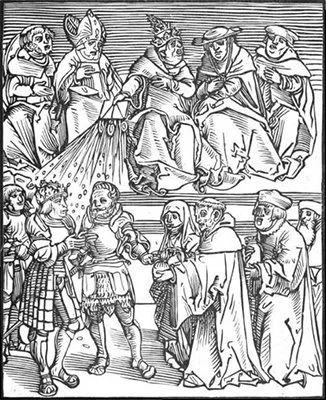
Woodcut of medieval ruler giving a church official a bag of coin while the pope, above, dispenses rays of power

c. 1500 woodcut of the pope granting temporal power to a ruler in exchange for cash

5 December 2025

One often hears quid pro quo in reference to backroom political deals or cases of bribery and corruption. The Latin term literally means “this for that,” but when did it appear and what does it mean in English?

The catchphrase arose in post-classical Latin in the fourth century CE. An early appearance in English is in the 1535 translation of Erasmus’s A Lytle Treatise of the Maner & Forme of Confession in the context of substituting one medicine for another:

But yet poticaries and phisions do more greuously offende / than do these persones now rehersed, which haue a prouerbe amonge them, quid pro quo, one thynge for another. They do otherwhyles sell this thynge, for that thy[n]g / they do minister stuffe that is rotten, and without any vertue or strengthe / yea & nowe hurtfull / in steade of remedy and helpefull medecine.

These lines were inserted by the translator and do not appear in Erasmus’s Latin original. The sense of quid pro quo meaning a substitution is now rare.

Quid pro quo meaning a thing given in return for something else appears a few decades later, around 1560, in the Hereford Municipal Manuscripts:

Only in equitie and concyence considinge that yor orator hath not quid p[ro] quo.

And the sense meaning the action of giving something for a consideration in return appears by 1640 in James Howell’s Dendrologia:

The golden chaine of policy hath beene alwayes held to be, That the defense of a kingdome is the office of the Prince, the honour of the Peeres, the service of the Souldier, and the charge of the subject, for Qui sentit commodum, sentire debet & onus [He who feels the advantage must also feel the burden].

Adde hereunto, that alleageance is an act of reciprocation; as it bindes the King to protect, so it ties the subject to contribute, and by this correspondence there is a quid pro quo.

In present-day use, quid pro quo often appears in a legal context. There is quid pro quo corruption, that is the exchange of an official act in return for something of value, in other words, bribery. And since 1982, American jurisprudence has recognized the concept of quid pro quo sexual harassment, in which a supervisor provides employment, promotion, or some other advantage at work in return for an employee performing sexual acts. This is contrasted with hostile-environment sexual harassment, in which an employee is subject to severe or pervasive, unwelcome sexual words or behavior.

But in general, a quid pro quo transaction is not, in and of itself, illegal or unethical. We all perform them routinely. Most business transactions, for example, are quid pro quos—a purchase where the shopper receives a product in return for giving the merchant money. But since such exchanges are so routine, the phrase tends to only appear in negative contexts.

Discuss this post


Sources:

Erasmus, Desiderius. A Lytle Treatise of the Maner & Forme of Confession. London: Johan Byddell for William Marshall, 1535, sig. M7v–r. ProQuest: Early English Books Online (EEBO).

Garner, Bryan A., ed. Black’s Law Dictionary, twelfth edition, 2024, s.v. quid pro quo; corruption; sexual harassment. Thomson Reuters Westlaw.

Howell, James. Dendrologia: Dodona's grove, or, the vocall forrest. London: Thomas Badger for H. Mosley, 1640, 211–212. ProQuest: Early English Books Online (EEBO).

Oxford English Dictionary Online, December 2007, s.v. quid pro quo, phr. & n.

Image credit: Lucas Cranach, the elder (1472–1553, “Antichristus,” Wikimedia Commons. Public domain image.

OK Boomer

Internet meme featuring the image of the Doge dog with the label “OK Boomer”

3 December 2025

Ok Boomer is a dismissive reply by a young person directed at a Baby Boomer (or Gen Xer—the traditional generational boundaries are not always observed in the wild). The phrase is rather disrespectful of their elders, but after years of being blamed for not getting “real” jobs when the only available ones are at Starbucks or driving for Uber; for not buying houses while being saddled with crippling, student-loan debt; for the demise of various and sundry industries because they spend what little money they have on avocado toast; and for being selfish and self-absorbed while dying on foreign battlefields in the longest wars in America’s history, which were, incidentally, started by Baby Boomers, can one really fault Millennials and Gen Zers for being dismissive? OK Boomer, in two words, sums up the sentiment that Boomers have been a privileged and coddled generation who never faced tough times like today’s younger generations do and are thus out of touch and not worth listening to.

(Full disclosure: I’m a Boomer. But having been born in 1963, at the tail-end of the generation, I identify more with Gen Xers.)

Like most such memes and slang, finding the exact origin is impossible. The earliest usage I’m aware of is from 2 September 2015 when the following exchange between anonymous poster appeared on 4chan:

Who else cucked by student loans here? Pls no shitposting, Eurofriends

Maybe you should have gone to a school within your means and worked to support yourself

Lol ok boomer :)

After this, the phrase appeared sporadically on various internet discussion boards and social media until 14 January 2019 when an anonymous meme creator uploaded a meme that paired the phrase with the iconic Doge image (see the above image).

The phrase got its first entry in Urbandictionary.com on 17 September 2019:

Ok boomer

When a baby boomer says some dumb shit and you can't even begin to explain why he's wrong because that would be deconstructing decades of misinformation and ignorance so you just brush it off and say okay.

Boomer: Kids nowadays are so allergic back in my day we just ate bees and wiped our asses with poison ivy.

Non-boomer: Ok boomer

One can still hear the phrase, but its incidence of use dropped precipitously after 2020.

Discuss this post


Sources:

Anonymous. 4chan/r9k/, 2 September 2015. Desuarchive.org.

Davies, Mark. Corpus of News on the Web (NOW), accessed 4 November 2025.

Sami Nozomi and LiterallyAustin. “OK Boomer.” Knowyourmeme.com, 30 December 2024.

Urbandictionary.com, 17 September 2019, s.v. Ok boomer.