turkey (bird)

A tom turkey, Meleagris gallopovo, displaying during mating season

A tom turkey, Meleagris gallopovo, displaying during mating season

23 November 2020

Through a series of mistaken identities, Meleagris gallopovo, which graces many an American Thanksgiving table, shares the name turkey with its cousin species Meleagris ocellata. The common turkey ranges from Mexico to southeastern Canada, while the oscellated turkey is confined to the Yucatan in Mexico.

The name turkey comes from a conflation with another bird of the of Galliformes order, the guineafowl. That bird, which is native to Africa and hence its name, comprises a number of species in the family Numididae. Although they are rather distant cousins, the guineafowl and the turkey resemble one another and can be easily confused by laypeople.

It is commonly thought that guineafowls were given the name turkey because the bird was introduced to Western Europe by Turkish merchants in the mid sixteenth century, although there is little evidence to support this. Regardless, in the sixteenth century Europeans associated the bird with that country for some reason or another. In 1541, Archbishop of Canterbury Thomas Cranmer promulgated a protocol on what should be served at official meals which refers to turkey cocks, a probable reference to guineafowl:

It was also provided, that of the greater fyshes or fowles there should be but one in a dishe, as crane, swan, turkeycocke, hadocke, pyke, tench; and of lesse sortes but two, viz. capons two, pheasantes two, conies two, wodcockes two.

A few years later, in 1542, the second edition of Thomas Elyot’s Bibliotheca Eliotae makes an unambiguous reference to guineafowl as turkeys:

Meleagrides, byrdes, whiche we doo call hennes of Genny, or Turkie hennes.

A helmeted guineafowl, Numida meleagris, at Serengeti National Park, Tanzania

A helmeted guineafowl, Numida meleagris, at Serengeti National Park, Tanzania

When European explorers encountered the North American bird, they gave it the name of the similar-looking bird they were familiar with. There are two references to turkeys in Richard Eden’s 1555 translation of Peter Martyr d'Anghiera’s Latin Decadas del nuevo mundo (Decades of the New World). Both of these references occur in the marginalia. The first of these is a reference to the birds found along the shores of the Gulf of Paria, in what is now Venezuela. The text reads:

With the golde and frankensence whiche the presented to owre men, they gaue them also a greate multitude of theyr peacockes,bothe cockes and hennes, deade and alyue, aswell to satisfie theyr present necessitie, as also to cary with theym into Spayne for encrease.

And in margin is printed:

Peacockes which wee caule Turkye cockes.

And later, describing an incident near Cozumel in the Yucatan, Eden writes:

Owre men wente and they came accordynge to their promisse and brought with them eyght of their hennes beynge as bygge as peacockes, of brownyshe coloure, and not inferiour to peacockes in pleasaunte tast.

And again, there is a marginal note which here reads:

Turky hens

In both cases, d’Anghiera’s original Latin uses pavo or peacock—like the peacock, the turkey has multi-colored feathers and a fanned tail, so there is a vague resemblance. Eden does a word-for-word translation in the main text but adds the marginal notes to indicate that it is actually a different bird. But just as d’Anghiera conflated the newly discovered bird with the peacock, Eden conflated it with the guineafowl.

That’s how a series of mistakes led to us eating turkey on Thanksgiving.

Discuss this post


Sources:

Anghiera, Pietro Martire. De rebus oceanicis & orbe nouo decades tres. Basil: Ioannem Bebelium, 1533, 38, 72. Archive.org.

Constitutio Thomae Cranmeri (1541), in Wilkins, David. Concilia magnae Britanniae et Hiberniae, vol. 3 of 4. London: R. Gosling, 1737, 862. HathiTrust Digital Library.

Eden, Rycharde. The Decades of the New Worlde. London: William Powell, 1555, 79r, 158v. Early English Books Online (EEBO).

Elyot, Thomas. Bibliotheca Eliotae, second edition. London: Thomas Berthelet, 1552. Early English Books Online (EEBO).

Oxford English Dictionary Online, 1989, s.v. turkey, n.2, turkey-hen, n., turkey-cock, n.

Image credit: Turkey: unknown photographer, c. 2009, public domain image; guineafowl: unknown photographer 2007, used under the Creative Commons Attribution 3.0 Unported license.
hairbag (slang)

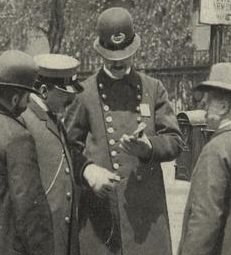
B&W photo of a policeman in 1890s uniform talking to three other men

An 1899 New York City policeman giving directions to three men

1 December 2025 [Edit, same day: added 1958 NYT example]

What is a hairbag? And is it a bad thing?

The term has been New York City police slang for a veteran officer since at least 1958, when it was recorded in two glossaries of police slang. The first appears in a New York Times Magazine piece on 14 March 1958:

Hair bag—A veteran policeman, especially knowledgeable about the inner workings of the Police Department.

The second glossary is in the October issue of Spring 3100, a New York Police Department magazine. That glossary defines a hair bag as “a veteran policeman.” And a New York Times article from 15 February 1970 defines it as “a veteran patrolman, also a patrolman with backbone.”

While these early definitions are positive, the term has subsequently generally been a negative one. For instance, Edward Droge’s 1973 The Patrolman: A Cop’s Story says:

My partner that night, a lethargic old ‘hairbag’ (old-timer) who could not be aroused by Raquel Welch.

And William Heffernan’s 2003 novel A Time Gone By has this:

Donahue was a sergeant closing in on his thirty years—an old hairbag in department lexicon, a term used to describe an aging and often useless cop who was just biding his time until he could get out.

A 9 November 2019 New York Times article has this to say about the term:

For as long as anyone can remember, younger officers in the New York Police Department have referred to their elders as “hairbags”—usually behind their backs.

It’s an archaic bit of slang with obscure origins. In police parlance, “the bag” means “the uniform.” So some officers believe “hairbag” is a riff on a longtime officer’s uniform—so old it has become hairy—and describes veterans who know what the police call “The Job” inside out.

Others think the phrase is an insult that comes from the practice, perhaps apocryphal, of officers using a haircut as an excuse for leaving their posts. This theory holds that sergeants used to demand a bag of hair trimmings as proof, and eventually burned-out officers who shirked work came to be known as “hairbags.”

It’s questionable whether either of these explanations are true. The one about haircuts is especially suspect.

And of course, hairbag can also mean a bag for holding and storing a wig or a bag made out of hair, but the etymology of those senses is obvious.

Discuss this post


Sources:

Burnham, David. “Police (Cops?) Have Slanguage of Own.” New York Times, 15 Feb 1970, 65/4. ProQuest Newspapers.

Goldstein, Joseph and Ali Watkins. “Before There was ‘O.K. Boomer,’ the City’s Police Had ‘Hairbag.’” New York Times, 9 Nov 2019, A21/1. ProQuest Newspapers.

Green’s Dictionary of Slang, accessed 2 November 2025, s. v. hair, n.

Heffernan, William. A Time Gone By. New York: Simon & Schuster, 2003, 27. Archive.org.

Lighter, J. E., ed. Historical Dictionary of American Slang (HDAS), vol. 2 of 2. New York: Random House, 1997, s.v. hairbag, n.

“Police Cant…Oh Yes They Can!” Spring 3100, October 1958, 5–10 at 9/1. John Jay College of Criminal Justice, Lloyd Sealy Library Digital Collections.

Wells, George V. “Station House Slang.”  New York Times Magazine, 14 March 1958, 14. ProQuest Historical Newspapers.

Image credit: unknown photographer, 1899. Wikimedia Commons. Public domain photo.

meme

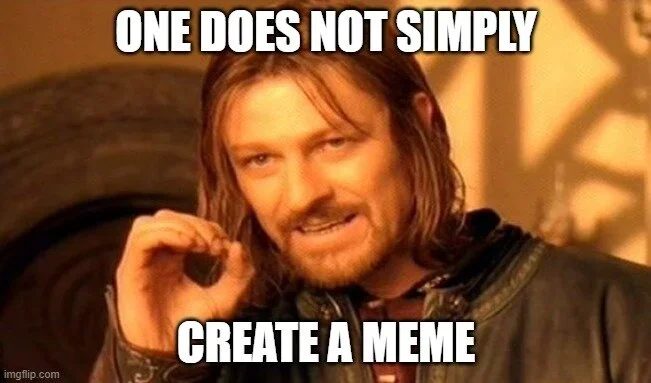
Photo of Sean Bean as Boromir from the Lord of the Rings with the words “One does not simply create a meme” overlaid

28 November 2025

Most of us are familiar with memes, those images with varying text that propagate, often virally, through the internet, but where does the word meme come from?

It may be surprising to many, but the word meme was coined by biologist and famed promoter of atheism Richard Dawkins in 1976. Dawkins was trying to label those bits of culture that spread and become iconic. He considered these bits of culture to be analogous to biological genes. From his book The Selfish Gene:

The new soup is the soup of human culture. We need a name for the new replicator, a noun which conveys the idea of a unit of cultural transmission, or a unit of imitation. “Mimeme” comes from a suitable Greek root, but I want a monosyllable that sounds a bit like “gene.” I hope my classicist friends will forgive me if I abbreviate mimeme to meme If it is any consolation, it could alternatively be thought of as being related to “memory,” or to the French word même. It should be pronounced to rhyme with “cream.”

Examples of memes are tunes, ideas, catch-phrases, clothes fashions, ways of making pots or of building arches. Just as genes propagate themselves in the gene pool by leaping from body to body via sperm or eggs, so memes propagate themselves in the meme pool by leaping from brain to brain via a process which, in the broad sense, can be called imitation.

It wasn’t until around 1998 that meme was applied to the internet images we know today. While this is a more specific application of Dawkins’s original sense, it is true to general principles: they are cultural units; they spread, with successful ones outcompeting less prolific ones; and, like biological genes, they can mutate (the changing text that overlays the images).

Determining what was the first internet meme is an impossible task, but the first citation in this newer, more specific, sense in the Oxford English Dictionary (OED) is from the CNN program Science and Technology Week of 24 January 1998, in reference to the computer-generated animation of a dancing baby that had appeared on the television show Ally McBeal that month:

GREG LEFERVE, CORRESPONDENT (voice-over): Who is this tyke, slashing his air guitar, dancing the boogaloo (ph) and haunting "Ally McBeal?" He's a figment of Michael Girard's imagination.

MICHAEL GIRARD, UNREAL PICTURES: The dancing baby actually goes actually goes back to an initial cha-cha motion that I created as a demo file years ago.

LEFERVE: Girard created the baby to show off his animation software. It worked. Now, zillions of the copies of the diapered dancer animate computer screens across the Internet.

JANELLE BROWN, WIRED NEWS: And the next thing you know, his friends have forwarded it on and it's become a net meme.

LEFERVE: Net meme -- the Wired Style guide calls a meme a "contagious idea." Right, like the kids of the South Park Comedy Series, Japan's "Real Idol" and Max Headroom before them. Hollywood seized on the baby as a plot device in the "Ally Mcbeal" show.

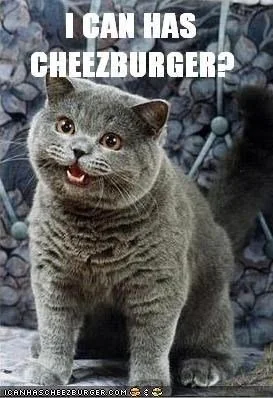
Photo of a cat with the words “I can has cheezburger?” overlaid

The Dancing Baby was certainly a graphic image propagated over the internet, but it was not what most people mean today when they refer to a meme, that is a recognizable image with new text overlaid on top. Memes as we know them today started gaining traction in 2007 with the Lolcat “I can has cheezburger?” meme. This probably wasn’t the first meme in this format, but the explosion of this type of meme on the internet dates to its appearance and spread.

From Richard Dawkins to Ally McBeal to internet phenomenon, not a bad start for a short, little word.

Discuss this post


Sources:

Dawkins, Richard. The Selfish Gene (1976), Oxford: Oxford UP, 2016. 219. Archive.org.

Lefevre, Greg and Ann Kellan. “Dancing Baby on the Internet.” CNN Science and Technology Week, 24 January 1998. Nexis Uni.

Oxford English Dictionary Online, June 2001, s.v. meme, n.; March 2002, s.v. mimesis, n.

Image credits: Boromir: “One does not simply create a meme”, David Wilton, 2019, generated with imgflip.com; “I can has cheezberger?”, 11 January 2007, icanhas.cheezburger.com. Fair use of copyrighted images to illustrate the topic under discussion.

smoot

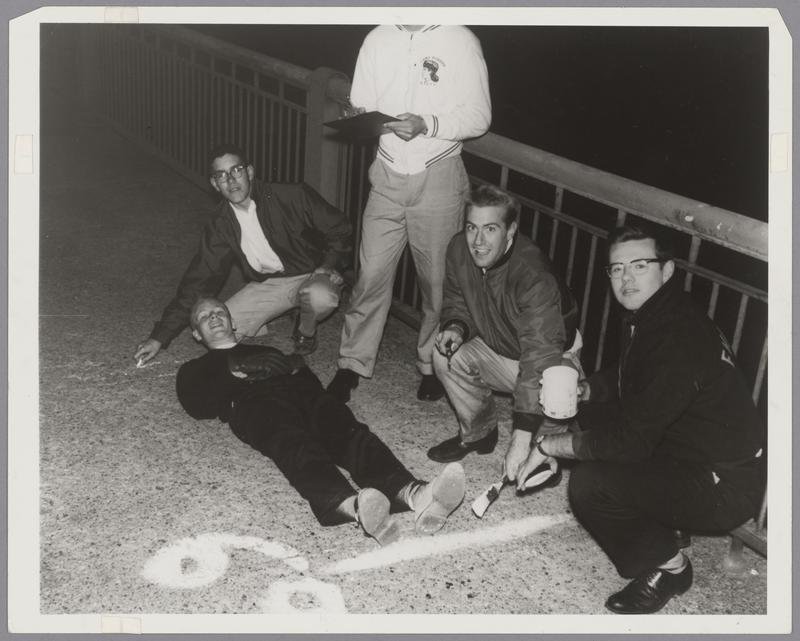
B&W photo of 5 young men measuring the length of a bridge by having one of them lie down while the others mark the distance

Measuring Harvard Bridge in smoots

26 November 2025

I usually don’t write up novelty words, but smoot has a neat ironic twist that is impossible to ignore. A smoot is a unit of linear measure equal to 1.7018 meters (5 feet, 7 inches). It is named after Oliver Reed Smoot, Jr. (b. 1940).

The smoot grew out of a university fraternity prank. In October 1958, members of the Lambda Chi Alpha fraternity at the Massachusetts Institute of Technology (MIT) used Smoot, who was one of their pledges, as a measuring stick to determine the length of the Harvard Bridge over the Charles River, which connects the MIT campus in Cambridge to Boston. Smoot was required to lay down while his fellow pledges marked each increment with chalk. (They had planned to use a length of string, ten smoots long, for the measurement, but a fraternity brother required they actually use Smoot himself.) The bridge measures 364.4 smoots, plus or minus one εar (properly spelled with an epsilon to indicate possible error in the measurement). To this day, undergraduates at MIT maintain marks on the bridge that indicate the length in ten smoot increments.

The ironic twist is that Smoot would go on to become the chair of the American National Standards Institute (2001–02) and president of the International Organization for Standardization (ISO, 2003–04).

Discuss this post


Sources:

American Heritage Dictionary, fifth edition, 2022, s.v. smoot, n.

Durant, Elizabeth. “Smoot’s Legacy.” MIT Technology Review, 23 June 2008.

Gillooly, Patrick. “Smoot Reflects on His Measurement Feat as 50th Anniversary Nears.” MIT News, 24 September 2008.

Photo credit: Unknown Photographer, 1958. MIT Museum. Fair use of a copyrighted image to illustrate the topic under discussion.

terror / terrorism / terrorist

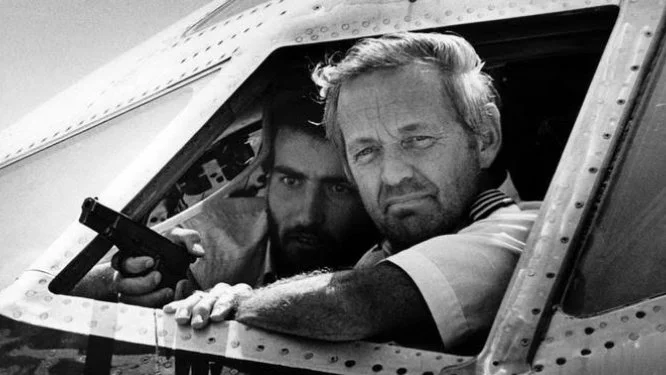
B&W photo of two men looking out the window of a airliner cockpit, one in a pilot’s uniform, the other holding a pistol

John Testrake, captain of the hijacked TWA Flight 847, and one of the hijackers in Beirut, June 1985

24 November 2025

Terrorism is not simply a modern phenomenon; it’s existed since time immemorial. But it wasn’t until the French Revolution that it was given its name.

Its root, terror, dates to the fifteenth century in English use. It is a borrowing from the Anglo-Norman terrour and the Latin terror, which were both used to mean extreme fear or dread. The word starts appearing in English texts by the end of the fourteenth century, when it appears in a Scottish poetic life of St. George that was composed sometime before 1400 with a manuscript witness from c. 1480:

for he wes anerly þat ane
þat of criste þe treutht had tan,
þat but rednes ore terroure
of goddis son wes confessoure.

(For he was only the one that the truth of Christ had taken, that for shame and terror of God’s son he was a confessor.)

So for several centuries terror had the basic meaning that we know today, extreme fear.

The political use of the term came with the postrevolutionary Jacobins, whose rule of France in 1793–94 is known as The Terror. In this historical use it is usually capitalized. This label appears in English by 1798 in the diary of Theobald Wolfe Tone for 26 April 1798, who equated the depredations of the Jacobins with the English in Ireland:

I see in the Paris papers today extracts from the English ones of a late date by which it appears, as I suspected, that the news of an insurrection in Ireland was at least premature. Nevertheless things in that country seem to be drawing fast to a close; there is a proclamation of Lord Camden's, which is tantamount to a declaration of war, and the system of police (if police it can be called) is far more atrocious than ever it was in France, in the height of the Terror.

So terror became associated with violent actions of a state in the oppression of its people. For instance, there is this more recent example from the New York Review of Books of 20 December 2007:

The legacy of the first Ming emperor was cast into rigid institutions (which themselves unconsciously reflected the brutalization that had been inflicted on Chinese political life under Mongol rule): the great tradition of the civil service was perverted and turned into a regime that contained the seeds of its own destruction. State terror was practiced on a staggering scale; the huge political trials staged by the Ming despot against his imaginary enemies suggest a sort of eerie preview of the great Stalinist purges that were to take place in our age.

But terrorism is usually associated with a related, but different sense. That is the use of violence by a non-state actor to achieve a political end. Sometimes such terrorism is sanctioned by a government and carried out by paramilitary forces. Again, this a borrowing from French, although modern French this time: terrorisme. An early use of terrorism in English is by Thomas J. Mathias in his 1796 satirical poem The Pursuits of Literature. The word appears in a footnote. I don’t have access to a scan or copy of the original May 1796 printing, but the footnote and word are in the third edition the following year. But here, terrorism seems to be used in reference to government action, albeit perhaps illegal or extrajudicial violence:

Since the passing of the Bills (in 1795) against treason, seditious meetings, assemblies, lectures, harangues, &c. John Thelwall read during the Lent season, 1796, what he termed Classical Lectures, and most kindly and affectionately pointed out the defects of all the ancient governments of Greece, Rome, Old France, &c. &c. and the causes of rebellion, insurrection, regeneration of governments, terrorism, massacres, or revolutionary murders; without the least hint or application to England and its constitution. Shewing how the Gracchi were great men, and so, by implication, the Bedfords, the Lauderdales, &c.—I must own, I fear nothing from such Lectures.

Thelwell was a radical English orator who was tried and acquitted of treason in 1794. The following year, in order to avoid censorship and another treason charge, he started using ancient history, without reference to current English politics, as the subject of his speeches.

Within a decade of the printing of that poem, we see terrorist applied to individuals who use violence for political ends. In the following we see it used in reference to the suppression of the Irish Rebellion of 1798 by Charles Cornwallis, who while he proved himself an able colonial administrator in Ireland and India, is perhaps best known today for his surrender of British forces to George Washington in 1781. This description of Cornwallis’s actions in Ireland is from Francis Plowden’s 1806 Historical Review of the State of Ireland:

It had been lamented by many, that the Marquis Cornwallis, a viceroy of military talent, of benevolence, and humanity, and above all, of political firmness to resist and keep down the fatal influence of those, who had extorted the bloody system from his predecessor, should not have been sent sooner to that distracted kingdom. But the affected zeal for the constitution, the artful misrepresentation of facts, and the undaunted fierceness of those terrorists, had too long usurped the power of the viceroy, and abused the confidence of the British cabinet. It was, however, some atonement to poor suffering Ireland, that an appointment was at last made of a nobleman, supereminently fitted to heal her wounds, by a system of measures diametrically contrary to those which had inflicted and inflamed them. Within very few days after his lordship's arrival in Dublin, a proclamation was issued, authorizing his majesty's generals to give protection to such insurgents as, being simply guilty of rebellion, should surrender their arms, abjure all unlawful engagements, and take the oath of allegiance to the king.

To end on a lighter note, the noun terror is also used to mean a troublesome person, especially a young child. This sense dates to the late nineteenth century. Here is a rather misogynist example that appeared in the magazine London Society in 1876:

There are moments when a man’s wife is simply awful. Snugly intrenched behind the unassailable line of defence, duty, and with such “Woolwich Infants” as her children to hurl against you, which she does in a persistent remorseless way, she is a terror.

(Woolwich Arsenal in southeast London has manufactured ammunition for the British forces since the beginning of the nineteenth century.)

This sense of terror is often found in the phrase holy terror, referring to a troublesome child. Here is an example from 1883 using the phrase to refer to Peck’s Bad Boy, a fictional, young prankster created by newspaperman George W. Peck:

“Well, have you read ‘Peck’s Bad Boy’!”

To reply in the negative was to ruin your literary reputation and make you an object of pity and commiseration.

News agents on the Railroad cars found it almost impossible to meet the demand of those who yearned to become acquainted with this “holy terror.”

Discuss this post


Sources:

Anglo-Norman Dictionary, AND2 Phase 6, 2022–25, terrour, n.

Lewis, Charlton T. and Charles Short. A Latin Dictionary. Oxford: Oxford UP, 1879, s.v. terror, n. Brepols: Database of Latin Dictionaries.

Leys, Simon. “Ravished by Oranges.” New York Review of Books, 20 December 2007. NYRB Online.

Mathias, Thomas James. Pursuits of Literature: A Satirical Poem. Part II, third edition, revised. London: T. Becket, 1797, 21. HathiTrust Digital Library.

Middle English Dictionary, 8 October 2025, s.v. terrour, n.

Oxford English Dictionary Online, September 2011, s.v. terror, n. & adj., terrorism, n., terrorist, n. & adj.; 1899, s.v. holy, adj. & n.

Peck, George Wilbur. “Introduction.” Mirth for the Million. Peck’s Compendium of Fun. San Francisco: A. L. Bancroft, 1883, viii. HathiTrust Digital Library.

Plowden, Francis. An Historical Review of the State of Ireland, vol. 5 of 5. Philadelphia: William F. McLaughlin and Bartholomew Graves, 1806, 44–46. HathiTrust Digital Library.

“St. George.” In Metcalfe, W. M., ed. Legends of the Saints in the Scottish Dialect of the Fourteenth Century, vol. 2. Scottish Text Society. Edinburgh: William Blackwood and Sons, 1896, lines 699–702, 196. fol. 264v. Cambridge, University Library, MS Gg. 2.6. HathiTrust Digital Library.

“Simpson’s Snipe.” London Society, Holiday issue 1876, 13–20 at 13/2. HathiTrust Digital Library.

Tone, Theobald Wolfe. “Diary entry, 26 April 1798.” In T. W. Moody, R. B. McDowell, and G. J. Woods, eds. The Writings of Theobald Wolfe Tone, 1763–98, vol 3. Oxford: Oxford UP, 2007, 245. Oxford Scholarly Editions Online.

Photo credit: Unknown photographer, US Federal Aviation Administration (FAA), 1985. Wikimedia Commons. Public domain photo.