keener

Photo of a young boy raising his hand in class

24 December 2025

Having been born and raised in the United States, I was unaware of the slang noun keener until I came to the University of Toronto. Keener (keen + -er) is Canadianism used to denote enthusiastic and over-eager students and is mildly derogatory. One hears instructors uttering phrases like “I assigned extra reading, knowing that only the keeners would actually do it.” And instructors are ambivalent about the keeners. On the one hand, their enthusiasm is appreciated, but on the other that same enthusiasm can become tiresome. The joy of having a bright, motivated student who strives to get an A wears off after the seventh frantic email on the night before an essay is due.

This Canadian slang term dates to at least 1973, when it appears in a 21 July article in the Winnipeg Free Press about a playground where children are given tools and encouraged to build their own treehouses and play forts:

The hammers and saws and other tools are kept locked up in a portable shack at the park until the two playground supervisors arrive in the morning, but they usually find a number of keeners already working on various projects using tools brought from home.

There is an older, better attested slang sense of keener meaning a sharp, alert individual, one who drives a hard bargain. This is an Americanism that dates to at least 1839. Citations of this sense in slang dictionaries tend to stop around the turn of the twentieth century, but given that keener is formed from the adjective keen and the common suffix -er, there is no reason to think that people stopped using it, and the term was undoubtedly independently recoined on many occasions. The current Canadian usage may be a continuation and specialization of this older sense, or it may be an independent coinage.

The slang term is unrelated to the word meaning one who sings a lament for the dead. English use of that keener dates to the eighteenth century and is from the verb to keencaoin- in Irish, meaning to wail or lament

Discuss this post


Sources:

Canadian Oxford Dictionary, second edition, 2004, s.v. keener, n. Oxford Reference Premium Collection.

Dictionary of Canadianisms on Historical Prinicples (DCHP-2), October 2016, s.v. keener, n.

FitzRandolph, Katie. “Girl’s Wish Comes True in W. K. Adventure Spot,” Winnipeg Free Press (Manitoba), 21 July 1973, 3/4. NewspaperArchive.com.

Green’s Dictionary of Slang, accessed 19 November 2025, s.v. keener, n.

Oxford English Dictionary Online, 1901, s.v. keener, n.1, keen, adj. and adv.; 1933, s.v. keener, n.2.

Photo credit: Steve Hillebrand/US Fish & Wildlife Service, before 2013. Wikimedia Commons. Public domain image.

bald-faced / boldfaced / barefaced

Colored drawing of Pinocchio with a long nose

22 December 2025

Is a lie bald-faced, bold-faced, or barefaced?

Of the three, barefaced is the oldest by about half a century. The underlying metaphor is that of being beardless, that is open and undisguised. But from its earliest use barefaced has also been linked to being shameless. It appears as early as 1533, when Thomas More used it in reference to the heresy that transubstantiation meant that the eucharist had the form as well as the essence of flesh:

Doth any man that receyueth the blessed sacrament, thynke (as ye Iewes thought) that the flesshe of Chryste that he receyueth, is in forme of fleshe, cut out in gobbettes as shepys fleshe is sold in the shamells, and not in forme of brede? If mayster masker were now bare faced hym selfe, he were wonderfull shamelesse yf he coulde endure to loke any man in the face for shame.

Bald-faced also dates to the sixteenth century, but only in the sense of a white-faced cow or horse. We see “bald faced buckes” in a 1596 work by John Harington. The metaphorical use to mean undisguised or shameless comes over a century later, the mid eighteenth century, when it appears in William Villiers’s 1761 Letter to Miss F—d:

I will, however, let you into a Secret, to prevent you wondering at this renouncing Faculty in your Family: It is a Family Failing: Your U—e in Jamaica has renounced you all. He left England to avoid such Connections; and where he is, denies being any Ways related to the O—d B—y Sollicitor, or to your Kinsman Dr. Chalk-liker; and though they all know his bald-faced Affinity, yet his present Station puts him one Remove above being told so.

The third, boldfaced also dates to the late sixteenth century, appearing in William Rainolds’s 1583 defense of the Catholic translation of the New Testament published in Rheims:

This is his accusation of vs (good reader) vttered as thou seest in such terrible vvordes, as if some counterfaite Aiax Mastigophorus, or Hercules Furens, or some tragical Tereus or Thyestes, after the eating of their ovvne children, vvere raging vpon a scaffold. Here thou hast, The creation of the vvorld, Vnaccustomed and monstrous noueltie, Prophane corruptions, and outragius boldnes, Neuer heretikes at any time did the like violence and iniurie to the sacred testament of Christ Iesus, The vvord of God mocked and contemned, Madnes and desperatnes of the Papistes. and so forth, as if we were giltie of (or himself as boldfaced as he is, durst obiect vnto vs) any one of those wicked, Prophane, Heretical, & Turkish corruptio[n]s, of which we haue proued him & his brethre[n] to haue co[m]mitted many. 

But if you are trying to convey shamelessness or impudence, as in bald-/bare-/bold-faced lie, which should you use? Both Merriam-Webster and Bryan Garner state that bald-faced lie, written with a hyphen, is the more common form in edited prose nowadays. And this conclusion is supported by the Corpus of Contemporary American English (COCA), the News on the Web (NOW) Corpus, and Google nGrams.

Bold-faced frequently appears in unedited prose, albeit still not as frequently as bald-faced, but you should probably avoid using it unless you’re writing about fonts and typefaces.

Discuss this post


Sources:

Davies, Mark. Corpus of Contemporary American English (COCA), accessed 18 November 2025. https://www.english-corpora.org/coca/

———. NOW Corpus (News on the Web), accessed 18 November 2025.

Garner, Bryan A. Garner’s Modern American Usage, third edition. Oxford: Oxford UP, 2009, s.v. bald-faced; barefaced; boldface(d).

Harington, John. An Apologie. R.Field, 1596, sig. O1v. ProQuest: Early English Books Online (EEBO)

Merriam-Webster. “Is that Lie ‘Bald-faced’ or ‘Bold-faced’? And What about ‘Barefaced’?” Merriam-Webster.com, 15 July 2025.

More, Thomas. The Answere to the Fyrst Parte of the Poysened Booke, Which a Nameless Heretyke Hath Named the Souper of the Lorde. London: W. Rastell, 1533, chap. 7, sig. r7v–r8r. ProQuest: Early English Books Online (EEBO).

Oxford English Dictionary Online, 1885, barefaced, adj.; 1887, s.v. bold-faced, adj.; 1933, bald-faced, adj.

Rainolds, William. A Refutation of Sundry Reprehensions, Cauils, and False Sleightes. Paris: For Richard Verstegan(?), 1583, 445. ProQuest: Early English Books Online (EEBO).

Villiers, William. A Letter to Miss F—d. London: 1761, 16. Gale Primary Sources: Eighteenth Century Collections Online (ECCO).

Image credit: Giorgio Scapinelli, 2016. Wikimedia Commons. Licensed under the Creative Commons Attribution 3.0 Unported license.

nones (religious)

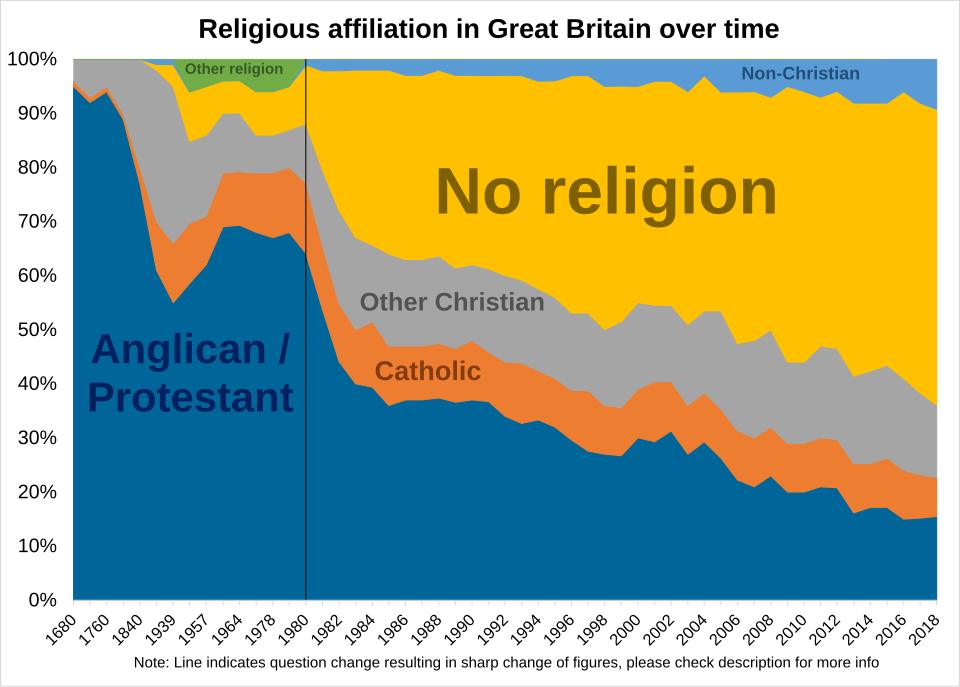
Graph showing marked rise over time in the UK in those claiming “no religion” and a decline in “Anglican/Protestant”

19 December 2025

In recent years, there have been many news reports touting the fact that the fastest growing religious group in the United States is the nones. Who are the nones? And when did we start using the term?

The nones are people who are not affiliated with any organized religion. The group includes atheists and agnostics, but it also includes those who are “spiritual but not religious,” people who believe in some kind of divine being or spiritual existence but who don’t ascribe to an organized faith tradition. The term nones has become rather common in recent years, but it was coined over fifty years ago.

None dates to at least 1967 when it was used in a paper, The Religious “Nones”: A Neglected Category, by sociologist Glenn M. Vernon. The paper was circulated in mimeographed form and published the following year:

The language which any group uses inevitably betrays evaluation, even when only description is intended, and much more than referent identification may be implied by a particular label. This appears to be the case with the “none” label, as when it designates the last category, following “Catholic, Jew . . .,” in a list headed by “Religion.” It provides a negative definition, specifying what a phenomenon is not, rather than what it is. Intentionally or not, such a use implies that only those affiliated with a formal group are religious. In fact, the label “No religion” is used in the 1957 U. S. Census and by some researchers to identify those who do not belong to a formal church.

By way of contrast, the social scientist classifies as “independent” those who do not report affiliation with a particular political party. The use of the “independent” label suggests that the lack of political party affiliation does not mean that one is apolitical or has no political convictions. He is still viewed as a political person. Perhaps this is because the act of voting serves as the primary validation of political participation. There is no comparable religious phenomenon, no clearly recognized religious behavior other than membership, attendance, or other identification with a formal religious group. Thus, “none” is used in religious research, designating no religious affiliation, but also adding the gratuitous implication of a nonreligious person.

And Vernon attaches footnotes to these paragraphs that read:

Frequently included under this label are atheists, agnostics, those with “no preference,” those with no affiliation, and also members of small groups and others who, for one reason or another, do not fall within the classification scheme being used and who more properly belong in a residual or “other” category.

And:

At times other terms such as “free thinker” and “non-affiliated” have been used. Norman Thomas used the label “Independent Christian” in a classification of conscientious objectors in his book The Conscientious Objector in America.

The second of these papers is Vernon’s 1968 Marital Characteristics of Religious Independents, in which he writes:

When the sociologist of religion reports his research, he at times includes a somewhat residual category of “none” under which is frequently included such diverse individuals as atheists, agnostics, those with “no preference,” those with “no affiliation” as well as practicing and/or believing “nones”—those without affiliation who engage in ritual behavior and/or accept premises incorporated in the beliefs of the affiliated religionists. These are the “religious nones” to which previous attention has been called.

Despite the wording, I’ve found no evidence in the sources he cites of anyone else using the term nones. As this paper was actually published before the first, the “previous attention” seems to be a reference to the mimeographed version of his first paper. The word none had been used elsewhere in surveys as a possible response when asking the question of religious affiliation prior to Vernon’s two articles, but they did not use it as a noun labeling a category of religious (non-)affiliation. While this is hardly ironclad evidence that he coined the term, it seems probable that he did.

None of the above has anything to do with the Christian liturgical term none (or nones), referring to the ninth hour of the day or the prayers that were to be offered at that hour, which has an entirely different origin. The liturgical term is borrowed from the Latin nona and the French none. This none roughly corresponds to three p.m., the ninth hour of daylight. This use in English-language discourse dates to the early sixteenth century and, of course, much earlier in Anglo-Latin.

Discuss this post


Sources:

I’d like to thank Garson O’Toole of the Quote Investigator website and Peter Reitan for assistance in my research on this term.

Latham, Ronald E., David R. Howlett, and Richard K. Ashdowne, eds. Dictionary of Medieval Latin from British Sources, Oxford: Oxford UP: 2013, s.v. nonus, n. Brepols: Database of Latin Dictionaries.

Oxford English Dictionary Online, December 2003, s.v. none, n. and nones, n.3.

Vernon, Glenn M. “Marital Characteristics of Religious Independents.” Review of Religious Research, 9.3, Spring 1968, 162–70 at 162/1. JSTOR.

———. “The Religious ‘Nones’: A Neglected Category.” Journal for the Scientific Study of Religion, 7.2, Autumn 1968, 219–29 at 219–20. JSTOR.

Image credit: Tweedle, 2023. Wikimedia Commons. Licensed under the Creative Commons Attribution-Share Alike 4.0 International license.

race / racism

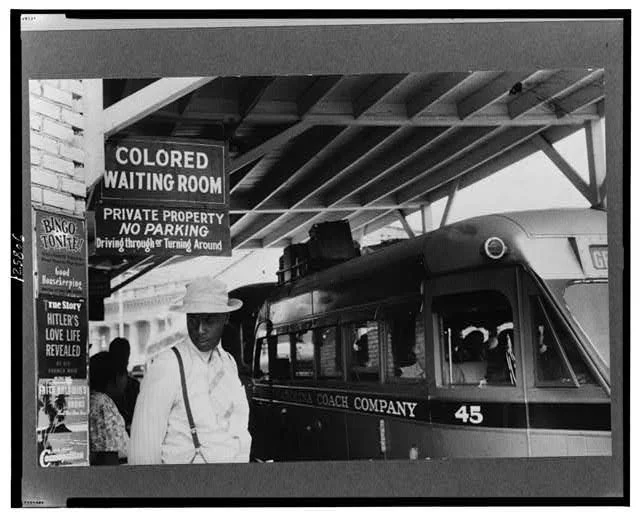
B&W photo of a Black man standing under a sign that reads, “Colored Waiting Room”; a bus is in the background

Bus station, Durham, North Carolina, 1940

17 December 2025

Race and racism permeate nearly every aspect of present-day American culture. Yet the concept of race as most people perceive it today is a relatively new one. While demonizing the “other” and the idea of grouping people by kinship dates to antiquity, grouping people by skin color only dates to the early modern era, and the systematic classification of people into defined races wasn’t reified until the eighteenth century, although it did not spring up de novo. Geraldine Heng, Cord Whitaker, and other scholars of race in the medieval period have shown that the seeds of our present-day concept of race date to medieval Europe. Likewise, the word race itself has its roots in medieval writing.

The common, present-day understanding of race is that it is a classification based largely but not exclusively on skin color, and that racism is an animus directed against people of a different race. This definition of racism focuses on the motivation of the racist individual. But scholars of critical race theory have expanded definitions of the words, using race to refer to any classification of people by what is perceived to be an essential difference between groups and racism as the use of such difference to systematize power differentials between those groups. The essential difference can be skin color, but it can also be religion, national origin, sexual orientation, etc. This second definition ignores the motivation and focuses on the effect. Cord Whitaker, for example, writes:

Race sets one group of people identifiable by some distinctive trait and sets them beside another group with a different iteration of that trait—dark skin versus light skin, for an obvious example, or Catholicism versus Protestantism, for a less obvious though equally salient example—in order to make a point about hierarchy.

The specific traits that differentiate races can vary from place to place and era to era. Geraldine Heng writes:

In principle, race theory—whose brilliant practitioners are among the academy’s most formative and influential thinkers—understands, of course, that race has no singular or stable referent: that race is a structural relationship for the articulation and management of human differences, rather than a substantive content.

Critical race theorists define racism as any policy or institution that increases power differentials and inequalities between such races regardless of the motivations of the people advocating those policies. Therefore, even a so-called “color-blind” policy can be racist if it negatively affects people of color disproportionately. For example, a requirement to show government ID in order to vote, ostensibly enacted to combat perceived voter fraud, would be racist if whites are more likely to possess such IDs than are people of color.

Conversely, Ibram X. Kendi defines antiracism as:

a powerful collection of policies that lead to racial equity and justice and that are substantiated by ideas of racial equality.

So, a policy like affirmative action in the U.S. is antiracist because it reduces such power differentials, while policies that prevent “reverse racism” are actually racist because the seek to perpetuate existing, racially structured differentials in power.

As to where the word race comes from, that is only partially known; there is no Greek or clear Latin root to which it can be connected, but we can trace the word back to the late medieval period. Complicating things is the fact that late medieval uses of the word move in circles from language to language as texts are translated from one to another, so the etymological trail is rather muddled. But here is what we do know.

The earliest known appearance of the word is in the form raza in Italian from c. 1300, but this is in a translation from the French Faits des Romains in a discussion about Caesar’s horse:

l’uomo diceva che re Nicodeme di Bettinia li ‘l dono, e altri affermavano ch’elli fu nato in suo raza.

(The man said that King Nicodemus of Bettina gave him the gift, and others affirmed that he was born of his race.)

The original French, from c. 1213 uses the word haras:

Li un dien[t] que Nicomedes li dona, li autre afferment que il fu nez en son haras.

(One says that Nicodemus gave it to him; another affirms that it was born of his brood herd.)

In the Italian text raza (modern razza and modern Spanish raza) is translating the French haras, meaning a lineage of horses. (The word means stud-farm in modern French.) The English word haras, attested to before 1300, with the same meaning, also comes from the French.

The word race itself is first recorded in French in the 1481 poem “The Hunt” by Jacques de Brézé:

Contre eulx [les cerfs] avez bonne querelle,
Vostre race est leur ennemye!

(Against them [the deer] you [the hounds] have a good quarrel,
Your race is their enemy!)

So, the word originally applied to animals and was only later applied to humans, c. 1480 in the French Mystère du vieil Testament, where it is used to translate the Latin generatio (generation). In 1494 Simon de Phares in his Recueil des plus Célèbres astrologues (Collection of the Most Famous Astrologers) uses it to describe one of the astrologers, saying he is:

de la race entre les Juifs

(of a race of the Jews).

Here Simon is using race to refer to one of the tribes of Israel.

Where the Italian and French words come from is uncertain, but it’s most likely from the the Arabic faras, meaning horse.

As for English, the word race first appears in the early sixteenth century referring to a stud or breeding herd of horses. It could be a borrowing from the French or a parallel development within English from haras. By mid century, race was being applied to humans. In early English use, race refers to an extended family unit, people who share a common ancestral descent, making it a synonym of the older English word kin. The earliest use of race referring to people recorded by the Oxford English Dictionary is from Henry Howard’s, the earl of Surrey’s, translation of Virgil’s Aeneid. We don’t know exactly when Howard did his translation, but he ran afoul of Henry VIII and was beheaded in January 1547, so the translation obviously predates that:

I craue of God, and our streames to their fluddes,
Armes vnto armes, and offspring of eche race
With mortal warr eche other may fordoe.

(Henry VIII died nine days after Howard’s execution. Howard’s father, the duke of Norfolk, also under a death sentence, survived the king, and his death sentence was commuted. So, the poet suffered from bad timing.)

Howard uses race here to translate Virgil’s nepos, or descendent, so what he means by the word is clear when one examines the Latin original, but it’s not clear if one just looks at the English with a present-day eye. The next citation in the OED gives a clearer sense of the meaning being restricted to a specific family group. From John Ponet’s 1556 Shorte Treatise of Politike Power writing about the Roman emperor Caligula:

First by like that thempire [sic] should not goo out of his owne race, he coupleth not with one, but with all his susters, like bitche and dogge.

But the definition of race quickly expanded to refer to a larger tribe, nation, or people linked by common descent. From the 1572 letter by one I. B. discussing the state of Ireland:

The Englishe race ouerrunne and daily spoiled, seeing no punishment of malefactors did buy their owne peace, alied and fostred themselues with the Irishe, and the race so nourished in the bosome of the Irishe, perceiuing their immunitie from lawe and punishmente degenerated : choosing rather to maintain themselues in the Irish mans beastly libertie, tha[n] to submit themselues and to liue there alone, and not the Irish in the godly awe of the lawes of England.

By the seventeenth century, race was being used to refer to an even wider ethnic classification based largely on skin color, albeit an informal and unsystematic one. There is this description of the people of the city of Goave on Hispaniola (now in modern Haiti) in a 1684 translation of Alexandre Exquemelin’s De Americaensche Zee-Roovers (The Buccaneers of America):

These are for the most part a mungrel sort of people of several Bloods. Some of which are born of white European people and Negros, and these are called Mulatos. Others are born of Indians, and white people; and such are termed Mesticos. But others are begotten of Negros, and Indians, and these also have their peculiar Name, being called Alcatraces. Besides which sorts of people, there be several other species, and races, both here and in other places of the West Indies. Of whom this account may be given, that the Spaniards love better the Negro Women, in those Western parts, or the tawny Indian Females, than their own white European race.

But the use of race to refer to the systematic classification of people by their distinct physical characteristics doesn’t appear until the late eighteenth century and the advent of what we now call scientific racism. Oliver Goldsmith, in his 1774 A History of the Earth and Animated Nature, in which he divided humanity into six distinct races, appears to be the first to use race in this sense:

The second great variety, in the human species, seems to be that of the Tartar race […] The Tartar country, taken in general, comprehends the greatest part of Asia; and is, consequently, a general name given to a number of nations, of various forms and complexions.

But Goldsmith was not first to systematize the classification of humans into what we would now call races. That idea belongs to Carl Linnaeus, who a few decades earlier, in his 1758 Systema Naturae, divided humanity into four groups: Americanus, Europaeus, Asiaticus, and Afer (African). Unlike those who would follow him, Linnaeus does not explicitly assign a qualitative ranking to these groups, which he defines primarily by geography rather than skin color. Although he does give qualitative descriptions of the four groups which implicitly create a value ranking: Native American—regitur consuetudine (ruled by habit); European—regitur ritibus (ruled by custom); Asian—regitur opinionibus (ruled by belief); and African—regitur arbitrio (ruled by caprice).

It is Johann Friedrich Blumenbach’s De generis humani varietate nativa (On the Natural Variety of Mankind) that first explicitly articulated the modern concepts of race and racism. Blumenbach originally published the work in 1775, dividing humanity into Linnaeus’s four groups, but in the third edition of 1795 he added a fifth group, the Malay, which included Pacific Islanders and Australian Aborigines. (Also, this 1795 edition, also written in Latin, is the first to use the term Caucasian as a label for whites—based on Blumenbach’s notion that Eden and Adam and Eve, who in his schema were of course white, were located in the Caucasus region. Blumenbach believed the people of that region adhered most closely to his ideal of human beauty.) More crucially, he qualitatively ranked the five groups, with Caucasians at the top, and the others being increasingly degenerate forms of humanity in two lineages: Native American and then Asian, and Malay and then African. Blumenbach also founded the now discredited discipline of craniometry and based his classification system in large part on his studies of human skulls.

While neither Linnaeus nor Blumenbach, writing in Latin, used the word race, their ideas would form the foundation of present-day racism. And Blumenbach’s five categories survive in the present-day racial categories used by the U.S. Census, which try to align with the popular American idea of what constitutes race:

White—A person having origins in any of the original peoples of Europe, the Middle East, or North Africa.

Black or African American—A person having origins in any of the Black racial groups of Africa.

American Indian or Alaska Native—A person having origins in any of the original peoples of North and South America (including Central America) and who maintains tribal affiliation or community attachment.

Asian—A person having origins in any of the original peoples of the Far East, Southeast Asia, or the Indian subcontinent including, for example, Cambodia, China, India, Japan, Korea, Malaysia, Pakistan, the Philippine Islands, Thailand, and Vietnam.

Native Hawaiian or Other Pacific Islander—A person having origins in any of the original peoples of Hawaii, Guam, Samoa, or other Pacific Islands.

The Census Bureau qualifies its categories and their definitions:

The Census Bureau collects racial data in accordance with guidelines provided by the U.S. Office of Management and Budget (OMB), and these data are based on self-identification.

The racial categories included in the census questionnaire generally reflect a social definition of race recognized in this country, and not an attempt to define race biologically, anthropologically or genetically

Still, even using their own definitional criteria, there are problems with the Census Bureau’s categories. Hispanic/Latinx is not a racial category according to the Bureau—although many, if not most, Americans would classify it as such—with the Bureau saying, “people who identify their origin as Hispanic, Latino, or Spanish may be of any race.” Arabs, Iranians, and other peoples of the Middle East are classified as white by the Census Bureau, but few Americans would consider them as belonging to the same ethnic group as people from northern Europe. Likewise, Asian is a very broad category, and few would consider someone from China to be of the same ethnic group as someone from India. How Australian Aborigines should classify themselves under this system is unclear—there probably aren’t many Aborigines in the United States, but the country is a big one and there are undoubtedly some who reside here. And the caveat of “who maintains tribal affiliation or community attachment” for American Indians creates problems. What about the case where one sibling maintains such an affiliation and the other doesn’t? Are they of different races? Since the Census gathers such data based on self-identification, as a practical matter the Bureau records whatever race people say they are, but these issues just go to show the difficulties in trying to pin down a socially constructed system of categorization.

While our modern definition of race dates to the eighteenth century, the word racism is much newer—although racist practices date back to antiquity. The modern word is preceded by the term racialism, which makes its appearance in the late nineteenth century. From the Michigan City Dispatch of 24 June 1880:

There is a certain innate sentiment which ranks in a cataloguing of the mental impulses with patriotism, which we might term racialism. On account of that inborn and inbread [sic] sentiment we all incline to consider the caucasian superior to the other races of the genus homo.

The term racialist makes its appearance a few decades later. From a 1908 journal article entitled The Racial Interpretation of History and Politics:

M. Finot is able to point out, not only discrepancies between the methods of different observers in respect of the same physical characteristic, but between the estimates formed by various recent and contemporary racialists of the importance of particular marks. Thus dolichocephaly and brachycephaly, which according to M. Vacher de Lapouge, will be the watchwords of the Armageddon of the twentieth century, are, according to Broca, Manouvrier and others, among the least important differences between human beings.

Both of these terms have faded from use, being replaced by racism and racist. The earliest use of racism in the OED is by Richard Henry Pratt, founder of the Carlisle Indian Industrial School at Carlisle, Pennsylvania, speaking at the 20th annual meeting of the of the Lake Mohonk Conference of Friends of Indian in 1902:

Segregating any class or race of people apart from the rest of the people kills the progress of the segregated people or makes their growth very slow. Association of races and classes is necessary in order to destroy racism and classism.

Pratt is more famous for his articulation of the mission of the Carlisle School he founded: “kill the Indian; save the man.” Pratt inveighed against racism, but ironically his methods of fighting racism through forced assimilation were racist to their core. Pratt’s racism is an example of the definition used by critical race theorists in that his motivations were based on a belief in equality between the races (at least between Native Americans and whites), but his policies of stripping Native Americans of their culture were genocidal.

The noun racist appears by 1919 in an article by Julio R Barcos in the December issue of the journal Inter-America:

Our poor “American” race is, as we all know, in the depths: hunger, anaemia, syphilis, alcohol, tuberculosis, are the hydra of a hundred heads that is devouring its best energies without this fact concerning or troubling, in the least, the consciences of any of our literary “racists,” including the great Rodó. […] Race prejudice is unworthy of thought of the spiritual height of Rodó’s. To uphold and to propagate the idea of the superiority of the Latin-American over the Anglo-American is to fall into theories like those of Gobineau, sent to be pigeonholed by anthropological science.

And there is this use of the word in Henri Lichtenberger’s 1923 Relations between France and Germany in a description of the Nazi party:

A campaign was even planned to expel from the Nationalist party the agitators of the extreme right known as “Germanists” or “racists,” a group (deutschvolkische) whose foremost leaders are Wulle, Henning and von Graefe, and whose secret inspirer is supposed to be Ludendorff.

So, while people have been stigmatizing and demonizing the “other” since time immemorial, the terms race and racism and the criterion (i.e., skin color) used to distinguish “us” from “them” are modern. And it’s important to recognize that there are two related, but distinct definitions of race and racism in use today, and when engaging with the subject, one must understand which of the definitions one’s interlocutor is using, the one defined by motivation or the one defined by effect.

Discuss this post


Sources:

Anglo-Norman Dictionary, AND2 Phase 2, 2006–08, s.v. haras.

Barcos, Julio R. “Our Professors of Idealism in America.” Inter-America, 3.2, December 1919, 84–102 at 89/1. HathiTrust Digital Library.

Barrows, Isabel C., ed. Proceedings of the Twentieth Annual Meeting of the Lake Mohonk Conference of Friends of the Indian, 1902. New York: Lake Mohonk Conference, 1903.134. HathiTrust Digital Library.

Blumenbach, Johann Friedrich. De generis humani varietate nativa. Göttingen: Vandenhoek et Ruprecht, 1795, xxiii–xxvi. Archive.org.

Esquemelin, Alexandre O. Bucaniers of America. London: William Crooke, 1684, 28. ProQuest: Early English Books Online (EEBO).

Flutre, L. Fernand and Cornelis Sneijders de Vogel. Li fet des Romains, vol. 1 of 2. Paris: E. Droz, 1935, 726.

Goldsmith, Oliver. An History of the Earth, and Animated Nature, vol. 2. London: J. Nourse, 1774, 219. Gale Primary Sources: Eighteenth Century Collections Online (ECCO).

Gould, Stephen Jay. “The Geometer of Race.” Discover, November 1994.

Heng, Geraldine. The Invention of Race in the European Middle Ages. Cambridge: Cambridge UP, 2018, 19.

Howard, Henry, Earl of Surrey. Certain Bokes of Virgiles Aeneis Turned into English Meter. London: Richard Tottel, 1557, sig. G1r, lines 841–43. ProQuest: Early English Books Online (EEBO).

I. B. Letter Sent by I.B. Gentleman Vnto His Very Frende Maystet R.C. Esquire. London: Henry Binneman for Anthony Kitson, 1572,  B1r. ProQuest: Early English Books Online (EEBO).

Kendi, Ibram X., How to Be an Antiracist, New York: One World, 2019, 33.

Liberman, Anatoly, “The Oxford Etymologist Looks at Race, Class and Sex (but not Gender), or, Beating a Willing Horse,” OUPBlog, 22 April 2009.

Lichtenberger, Henri. Relations Between France and Germany. Washington, DC: Carnegie Endowment for International Peace, 1923, 53. HathiTrust Digital Library.

Linnaeus, Carl. Systema natura, vol. 1. Stockholm: Lars Salvius, 1758, 20–22. Archive.org.

Michigan City Dispatch (Indiana), 24 June 1880, 2/2. NewspaperArchive.com.

de Miramon, Charles. “Noble Dogs, Noble Blood: The Invention of the Concept of Race in the Late Middle Ages.” In The Origins of Racism in the West. Edited by Miriam Eliav-Feldon, Benjamin Isaac, and Joseph Ziegler. Cambridge UP, 2009, 200–16.

Oxford English Dictionary Online, 1989, s.v. haras, n.; June 2008, s.v. race, n.6, race, n.5, racism, n., racist, n., racialism, n., racialist, n.

Ponet, John. A Shorte Treatise of Politike Power. Strasbourg: Heirs of W. Köpfel, 1556, sig. B7r. ProQuest: Early English Books Online (EEBO).

Roberts, W. J. “The Racial Interpretation of History and Politics.” International Journal of Ethics, 18.4, July 1908, 475–92 at 484–85. HathiTrust Digital Library.

U.S. Census Bureau, “Race.” 20 December 2024.

Whitaker, Cord. Black Metaphors: How Modern Racism Emerged from Medieval Race-Thinking. Philadelphia: U of Pennsylvania Press, 2019, 50.

Photo credit: Jack Delano/US Farm Security Administration, 1940; https://commons.wikimedia.org/wiki/File:Jim_Crow_Laws.jpg; Library of Congress; public domain photo.

misdemeanor / high misdemeanor

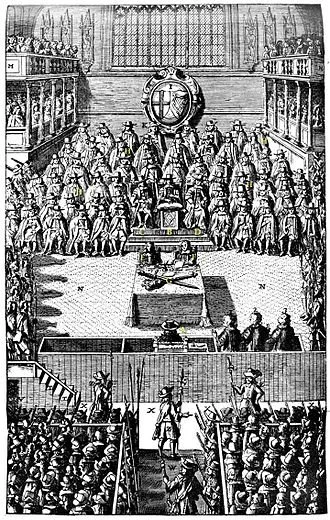
Engraving of the House of Commons chamber filled with men and a hatted man sitting, back to the viewer, in a dock at the center

1684 engraving depicting the 1649 trial of King Charles I for treason and high misdemeanors

15 December 2025

As even non-lawyers know, in current U.S. legal parlance a misdemeanor is a less serious crime, whereas more serious crimes are classified as felonies. But what is the origin of the term? And how did it come to be used in the context of presidential impeachments in the phrase high crimes and misdemeanors?

Demeanor means conduct, so a misdemeanor is literally bad conduct. It comes from the verb to demean, meaning to conduct, to transact business and to behave oneself. Both senses of demean date to the 14th century. In Old French, the verb dates to the eleventh century, where it appears in La Chanson de Roland.

The original sense of misdemeanor is an offense that is punishable by forfeiture of property rather than imprisonment. The word dates to 1487 in the gerundial form misdemeaning, when Henry VII directed that an annuity that had been granted to one John Morris be given to someone else because Morris had supported Henry’s Yorkist enemies:

It pleased your Highnesse to directe your L[ord]res Missyve unto your said Oratours, the Abbott and Covent, to graunte the said Corrodie to oon John Wilkynson; bi force of whiche, your seid Oratours made their Graunte under their Covent Seale unto the seid John Wilkynson, hoping and trustyng, that they shuld have be discharged of the said Corrodye, rather made and graunted to the said John Morys, remembring and considering, that he had it, was by the nomination and desire of your said grete enemy’ and also for othre misdemenyng of the said John Morys ayenst your Highnesse, at the tyme of your said moost gracious aryvall and comyng into your said Realme.

The form misdemeanor appears in a 1503–04 law code, Act 19 Hen. VII, c. 12:

And that the Lord of ev[er]y lete within this Realme and the Shirif in his Tourne have auctorite to enquire thereof, and of all the seid defaut[e] and mysdemeanours in his Lete and Tourne.

In later use, a misdemeanor could result in imprisonment, albeit for a lesser period than a felony. The distinction between felonies and misdemeanors in British law was abolished in 1967, but it is retained in the United States.

An ordinary misdemeanor is not to be confused with a high misdemeanor, which is a legal horse of a different color. High misdemeanor is a largely archaic term except for one important context, the impeachment of officers, including the president, and judges of the United States. Article II of the U.S. Constitution states:

The President, Vice President and all civil Officers of the United States, shall be removed from Office on Impeachment for, and Conviction of, Treason, Bribery, or other high Crimes and Misdemeanors.

So a high misdemeanor is very serious misconduct, not a minor offense. The phrase appears as early as 1614 when Francis Bacon, serving as attorney general of England and Wales, defined a conspiracy to commit a felony as a high misdemeanor:

Wheresoeuer an offence is capitall or matter of fellony, if it be acted and performed, there the conspiracy, combination, or practise tending to the same offence is punishable as a high misdemeanor, although they neuer were performed.

By 1660, high misdemeanor was being used in a political context, to wit the charges that had been leveled against King Charles I in January 1649, the said high misdemeanors being Charles’s crimes that did not amount to the more serious crime of treason. From the account of the 1660 trial of the men charged with his regicide:

That day my Lord, Mr. Cook told the Court that he charged the Prisoner at the bar (meaning the KING) with Treason and high misdemeanors, and desired that the Charge might be read: the Charge was this, That he had upheld a Tyrannical Government &c. and did then press that the prisoner might give an answer to that: and that very earnestly.

Blackstone’s 1769 Commentaries on the Laws of England gives the phrase more definition and notes that high misdemeanors are to be tried in parliament rather than the ordinary courts of law:

II. Misprisions, which are merely positive, are generally denominated contempts or high misdemesnors; of which

1. The first and principal is the mal-administration of such high officers, as are in public trust and employment. This is usually punished by the method of parliamentary impeachment: wherein such penalties, short of death, are inflicted, as to the wisdom of the house of peers shall deem proper; consisting usually of banishment, imprisonment, fines, or perpetual disability.

When writing the U.S. Constitution, the framers were relying on this English legal tradition. The passage regarding impeachment was revised several times, and this gives us today a fairly good idea of what the framers meant by the term high misdemeanor. The original draft included only “treason and bribery” in the list of offenses. George Mason thought this too limiting and suggested the list be replaced by the word “maladministration,” ala Blackstone. But the framers thought that too broad a criterion, which would lead to impeachment for differences over policy and make the president subservient to the Senate. So, Mason suggested the present language, which was accepted. The US Constitution gives the House of Representatives the power to impeach and the Senate the power to try such offenses.

A high misdemeanor does not have to be a crime—the use of the phrase in the Constitution predates the U.S. Criminal Code, so that can’t be what the framers meant. And several federal judges were impeached in the nineteenth century for being intoxicated while on the bench, with the first one being in 1803, when many of the framers were still serving in the House and Senate and presumably understood what they had intended the phrase to mean. Being drunk on the bench is improper behavior, to be sure, but hardly a crime. In the American context, a high misdemeanor is, perhaps, better defined as a violation of the public trust or one’s oath of office. Alexander Hamilton, in Federalist 65, writes of high misdemeanors:

A well-constituted court for the trial of impeachments is an object not more to be desired than difficult to be obtained in a government wholly elective. The subjects of its jurisdiction are those offenses which proceed from the misconduct of public men, or, in other words, from the abuse or violation of some public trust. They are of a nature which may with peculiar propriety be denominated POLITICAL, as they relate chiefly to injuries done immediately to the society itself. The prosecution of them, for this reason, will seldom fail to agitate the passions of the whole community, and to divide it into parties more or less friendly or inimical to the accused. In many cases it will connect itself with the pre-existing factions, and will enlist all their animosities, partialities, influence, and interest on one side or on the other; and in such cases there will always be the greatest danger that the decision will be regulated more by the comparative strength of parties, than by the real demonstrations of innocence or guilt.

The delicacy and magnitude of a trust which so deeply concerns the political reputation and existence of every man engaged in the administration of public affairs, speak for themselves. The difficulty of placing it rightly, in a government resting entirely on the basis of periodical elections, will as readily be perceived, when it is considered that the most conspicuous characters in it will, from that circumstance, be too often the leaders or the tools of the most cunning or the most numerous faction, and on this account, can hardly be expected to possess the requisite neutrality towards those whose conduct may be the subject of scrutiny.

The convention, it appears, thought the Senate the most fit depositary of this important trust. Those who can best discern the intrinsic difficulty of the thing, will be least hasty in condemning that opinion, and will be most inclined to allow due weight to the arguments which may be supposed to have produced it.

History has borne out Hamilton’s assessment that such trials in a democratic republic would be decided by factionalism rather than actual guilt. Although the conclusion that the Senate would be above such factionalism has proven laughably wrong. There have been four presidential impeachments in US history: Andrew Johnson (1868), Bill Clinton (1998), and Donald Trump (2019 and 2021)—Nixon resigned before the House impeached him. Clinton and Trump were both acquitted because those in their party voted for acquittal. Ten senators of Johnson’s party voted for acquittal, which passed by one vote, but only because they had been bribed with cash and political favors.

Given this history, perhaps then-Representative Gerald Ford was correct when in 1970 he said an impeachable offense, and therefore a high misdemeanor, is “whatever a majority of the House of Representatives considers to be at a given moment in history.” Ford, of course, would later become president after Nixon resigned from office.

Discuss this post


Sources:

Bacon, Francis. Charge of Sir Francis Bacon Knight, His Maiesties Attourney Generall, Touching Duells. London: Robert Wilson, 1614, 46–47. ProQuest: Early English Books Online (EEBO).

Blackstone, William. Commentaries on the Laws of England, third edition, vol. 4. Dublin: 1770. 121. Gale Primary Sources: Eighteenth Century Collections Online (ECCO).

Ford Gerald. Congressional Record—House, 91st Congress, 2nd Session, vol. 116, part 9, 15 April 1970, 11913. Congress.gov.

An Exact and Most Impartial Accompt of the Indictment, Arraignment, Trial, and Judgment (According to Law) of the Twenty Nine Regicides (1660). London, 1679, 142. HathiTrust Digital Library.

Hamilton, Alexander (Publius). “The Fœderalist, No. 64.” New York Packet, 7 March 1788, 2/3. Readex: America’s Historical Newspapers. Also, a transcript is available at the Library of Congress. (In its original publication, this paper is numbered Federalist 64. Modern convention accounts it as 65.)

“19 Hen. VII. c. 12.” In The Statutes of the Realm, vol. 2 of 11. London: Dawsons, 1816, 656. HathiTrust Digital Library.

Oxford English Dictionary Online, June 2002, s.v. misdemeanour, n.; misdemeaning, n., misdemean, v.1, misdemeaning, adj.; 1989, s.v. demeanour, n.; demean, v.1.

Rotuli Parliamentorum (Rolls of Parliament), vol. 6 of 6. London: 1767–77, 389. HathiTrust Digital Library.