scrapple

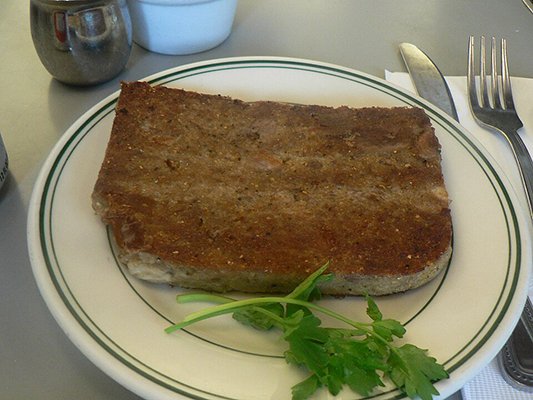
A slice of fried scrapple served on a plate with a sprig of parsley

5 January 2026

Scrapple is a mush of pork scraps—hence the name—cornmeal, and sometimes buckwheat flour. It is typically fried and served as a breakfast meat.It can be found in the Mid-Atlantic United States, from South Jersey to North Carolina. The Pennsylvania German name for it is Panhas.

The earliest reference to scrapple that I have found is in an 1841 list of products for sale in a Philadelphia market:

Blood Pudding.         7a 8
Souse Cheese, lb.        5a 12¼
Scrapple, per lb.          5a 6

And here is an 1853 recipe for preparing it that appeared in a Vermont, of all places, newspaper:

SCRAPPLE. This is generally made of the head, feet, and any pieces which may be left after having made sausage meat. Scrape and wash well all the pieces designed for the scrapple, put them in a pot with just enough water as will cover them. Add a little salt, and let them boil slowly till the flesh is perfectly soft, and the bones loose. Take all the meat out of the pot, pick out the bones, cut it up fine, and return it to the liquor in the pot. Season it with pepper, salt, and rubbed sage, to the taste. Set the pot over the fire, and just before it beings to boil, stir in gradually as much Indian meal as will make it as thick as mush. Let it boil a few minutes, take it off, and pour it in pans. When cold, cut it in slices, flour it, and fry it in hot lard, or sausage fat. Some prefer buckwheat meal; this is added in the same manner as the Indian. Indian meal is preferable, as it is not so solid as buckwheat. Sweet marjoram may be added with the sage, if preferred.

While scrapple is not to everyone’s taste, there are aficionados of the dish. One, a John Leadbeater, even composed a song about it and similar meat products that was published in 1850. It is to be sung to the tune of the Star-Spangled Banner:

THE MYSTERIOUS LOOM.
TUNE—Star Spangled Banner.

Oh say have you heard of the mysterious loom,
In which the famed, “Jarsey Sasuage” [sic] is wove,
Which is work’d in some dark greasy room,
The family heir-loom,—a token of love.
          The “sausage meat” nice,
          Is gone in a trice,
Producing a “link” that will hunger suffice,
Then here’s to that “loom,” whose work when begun,
Uses up the poor porkers, Father, Mother and Son.

Then here is the cheese, that is made of hogsheads,
And scrapple of jelly and fine Indian Meal,
A smile o’er the face of the weaver it sheds,
No pain for his victims he ever does feel.
          Nor thinks of the slain,
          Who his warp doth maintain,
He has but one object, a living to gain.
Then here's to that loom, whose work when begun,
Uses up the poor porkers, Father, Mother, and Son.


Sources:

Dictionary of American Regional English, 2013, s.v. scrapple, n., panhas, n.

Leadbeater, John. “The Mysterious Loom.” Literary Remains of John Leadbeater, Jr. Philadelphia: 1850, 93. HathiTrust Digital Library.

“Miscellany: Domestic Economy.” Vermont Chronicle (Windsor, Vermont), 20 December 1853, 4/2. Readex: America’s Historical Newspapers.

Oxford English Dictionary Online, 1911, s.v. scrapple, n.2.

“Retail Prices in Market—Oct 20, 1841.” Public Ledger (Philadelphia), 21 October 1841, 1/5. Readex: America’s Historical Newspapers.

Photo credit: Stu Spivack, 2006. Wikimedia Commons. Flickr. Licensed under the Creative Commons Attribution-Share Alike 2.0 Generic license.
voluntary / volunteer

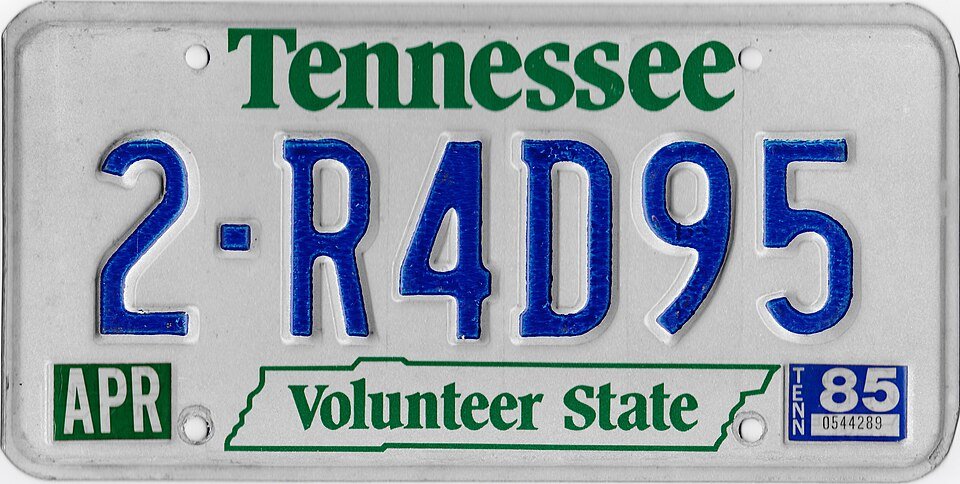
1985 Tennessee license plate with the motto “Volunteer State”

2 January 2026

The adjective voluntary has a rather straightforward etymology. It comes from the Latin voluntarius, meaning willing, of one’s own choice, via the Old French voluntaire. The Latin noun voluntas means will or desire.

The first English incarnation of the word is the noun volunte, meaning will or desire, a direct import of the Old French volonte, which in turn is from the Latin noun. It first appears in a poem called Of Arthour and of Merlin in the Auchinleck manuscript, which was copied c. 1330:

A forseyd deuel liȝt adoun
& of þat wiif made a conioun
To don alle his volunte

(The aforementioned devil sought after and of that woman made a useful idiot who would do his volunte [i.e., will] entirely)

This noun had faded from use by the early sixteenth century. The noun will, from Old English, had won out over the Latin word, but the Latin root stuck around in other uses.

One of these uses is the adjective voluntary, also borrowed from the Old French voluntaire. The English word had appeared by c. 1380 when Chaucer uses it in his Boece, a translation of Boethius’s Consolation of Philosophy:

And yif this thing be oonys igrauntid and resceyved (that is to seyn, that there nis no fre wil), thanne schewith it wel how gret destruccioun and how gret damages ther folwen of thingis of mankynde. For in idel be there thanne purposed and byhyght medes to good folk, and peynes to badde folk, syn that no moevynge of fre corage voluntarie ne hath nat disservid hem (that is to seyn, neither mede ne peyne).

(And if this thing be once granted and received (that is to say, that there is no free will), it shows well how great destruction and how great damages follow from the things of mankind. For in vain would be the intended and promised rewards for good folk and punishments for bad folk, since there is no voluntary moving of free hearts nor have they deserved them (that is to say, neither reward nor punishment).

(Benson, in the Riverside Chaucer, inserts an and between corage and voluntarie, which would make the latter a noun meaning will. That editorial intervention seems unnecessary to me; it reads perfectly well as an adjective.)

The noun volunteer, however, doesn’t appear until the Early Modern era. This noun originally had a military connotation, meaning someone who willingly entered into military service. It’s first recorded in Walter Raleigh’s The Life and Death of Mahomet, of uncertain date but obviously written before Raleigh’s death in 1618:

Mura (as hee was glad for the generall cause of these good successes, yet emulating Tarif) raised in his government an army of 25000 foote; 6000 horse and voluntiers infinite accomodated with all provisions meet for a war.

Within a few decades the word was being used in non-military contexts. In 1648, Thomas Gage wrote of Spanish religious missions being sent to the New World in his The English-American His Travail by Sea and Land:

Yearly are sent thither Missions (as they call them) either of Voluntiers, Fryers Mendicants, Priests or Monkes, or else of forced Jesuites.

The verb to volunteer is in place by 1643, when it appears in a description of the First Battle of Newbury in the English Civil War:

Officers of note hurt there, were Colonell Darcy, George Lisle, and Ned Villiers, and the Lord Viscount Falkland (volunteering it with too much bravery) unfortunately killed.

Finally, Tennessee’s nickname of the Volunteer State comes from the 1847 Mexican-American War. A call for 2,800 volunteers for military service yielded some 30,000 recruits from the state. The nickname is recorded as early as 1853.

Discuss this post


Sources:

Chaucer, Geoffrey. Boece. In Larry D. Benson, ed. The Riverside Chaucer, third edition. Boston: Houghton Mifflin, 1987, 5pr3, lines 152–61, 460b.

Digby, George, Earl of Bristol. A Trve and Impartiall Relation of the Battaile betwixt His Majesties Army and that of the Rebells neare Newbury in Berk-shire, Sept. 20, 1643. Oxford: L. Lichfield, 1643, 7. ProQuest: Early English Books Online (EEBO).

Gage, Thomas. The English-American His Travail by Sea and Land: or, a New Survey of the West-Indies. London: R. Coates, 168, 3. ProQuest: Early English Books Online (EEBO).

Middle English Dictionary, 8 October 2025, s.v. voluntari(e, adj., volunte, n.

“Of Arthour & of Merlin,” lines 679–81, before c. 1330. Edinburgh, National Library of Scotland, Advocates 19.2.1, fol. 205ra.

Oxford English Dictionary Online, 1920, s.v. volunteer, n. & adj., volunteer, v., voluntary, adj., adv., & n.

Raleigh, Walter. The Life and Death of Mahomet, The Conquest of Spaine, together with the Rysing and Ruine of the Sarazen Empire (before 1618). London: Ralph Hodgkinson for Daniel Frere, 1637. 79–80. ProQuest: Early English Books Online (EEBO).

Image credit: Awmcphee, 2016. Wikimedia Commons. Public domain image.

redskin / red man

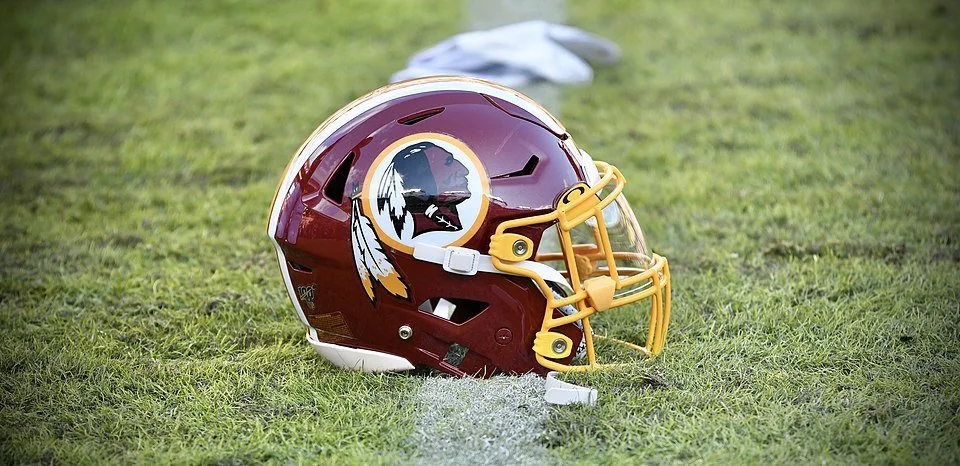
Photo of a maroon football helmet sitting on a football field that bears a profile image of a Native American man

Washington Redskins football helmet, 2019

31 December 2025

Redskin, a disparaging term for a Native American, is over two and a half centuries old. It is first recorded in a transcript and translation of a speech given by Chief Maringouin, of the Illinois people, on 26 August 1769. It was interpreted by a Frenchman from the Illinois language and transcribed and translated into English by William Johnson:

I shall be pleased to have you come to speak to me yourself if you pity our women and our children; and, if any redskins do you harm, I shall be able to look out for you even at the peril of my life.

The French that redskin is translated from is peaux Rouges, and if the translation into French is accurate, the original Illinois word would probably have been *e•rante•wiroki•ta (person with red skin), but we don’t have a record of the original Illinois words.

The term red man is older, dating to 1740, when it appears in the journal of John Wesley, and the French homme rouge dates to at least 1725. And the English use of the adjective red to refer to Native Americans is older still, dating to an appearance in the journal of Colonel George Chicken on 31 October 1725:

They have heard the Talk of the White people for this many Years and that they have been down to the English Sevl times and heard the talk there and that they desire always to be at peace wth the White people and desire to have their own way and to take revenge of the red people and that it was their Young people that first broak out Warr with the White people.

Like many ethnic slurs, redskin and red man did not start out as derogatory, but they acquired the disparaging connotation over time. Tales that the term redskin refers to the practice of scalping or the use of red dye by native peoples are false.

Until 2020, the Washington, DC National Football League team was known as the Redskins. The name was not originally intended to be disparaging and is part of the long and problematic tradition of using Native Americans as mascots of sports teams. Other examples in this genre include the NFL’s Kansas City Chiefs, and baseball’s Atlanta Braves and Cleveland Indians (which changed its name to the Guardians in 2021), not to mention my own high school teams, which were the Toms River South Indians. But while the Redskins name was never intended to be so, it is nevertheless considered offensive by many Native Americans. Following its dropping of the name, the Washington team was briefly known as simply the Washington Football Team before being dubbed the Commanders in 2022.

Discuss this post


Sources:

Chicken, George. “Journal of Colonel George Chicken’s Mission from Charleston to the Creeks.” In Travels in the American Colonies, Newton D. Mereness, ed. New York: Macmillan, 1916, 169. HathiTrust Digital Library.

Johnson, William. The Papers of Sir William Johnson, v. 7, Albany: University of the State of New York, 1931, 133–38. HathiTrust Digital Library.

Nunberg, Geoffrey, “When Slang Becomes a Slur,” The Atlantic, 23 June 2014.

Oxford English Dictionary Online, September 2009, s.v. redskin, n., red man, n., red, adj. & n. (& adv.).

Photo credit: Joe Glorioso, 2019. Wikimedia Commons. Flickr. Licensed under the Creative Commons Attribution-Share Alike 2.0 Generic license.

neither confirm nor deny / Glomar response

Photo of a large ship with a very large crane on its deck

USNS Glomar Explorer, undated photo

29 December 2025

When a US government official neither confirms nor denies the existence of a classified program it is called a Glomar response or a Glomar denial. This label has its origins in one of the most fascinating incidents of the US-Soviet Cold War, but the wording neither confirm nor deny is much, much older, dating to at least 1840.

In March 1968, the Soviet K-129 Golf-class ballistic missile submarine sank 1,500 miles off the coast of Hawaii. The wreck was at a depth of 16,000 feet (4,900 meters). Soviet efforts to recover the submarine failed, and the CIA and US Navy subsequently funded the construction of the ship Global Marine Explorer or Glomar Explorer by billionaire Howard Hughes. The cover story was that the ship would be used to mine manganese from the ocean floor. In 1974 the ship managed to lift the hull of the Soviet submarine from the ocean floor, but the submarine broke up in the process, and the Glomar Explorer only recovered a portion of the sub. Allegedly, various cryptographic materials, two nuclear torpedoes, and six corpses were in the recovered portion. The bodies of the Soviet sailors that were recovered were buried at sea with full honors by the US Navy.

The story became public in the pages of the Los Angeles Times in 1975. Subsequent Freedom of Information Act (FOIA) requests by reporters for documents on the incident were met with the response that the government could neither confirm nor deny the incident took place. Hence the labels Glomar response and Glomar denial became attached to the phrase.

But the earliest use in print of either label that I can find is in the 1998 Code of Federal Regulations (CFR), which reads:

In addition, this exemption shall be invoked when the following situations are apparent:

(a) The fact of the existence or non-existence of a record would itself reveal classified information. In that situation, naval activities shall neither confirm nor deny the existence or non-existence of the record being requested. A “refusal to neither confirm nor deny” response must be used consistently, not only when a record exists, but also when a record does not exist. Otherwise, the pattern of using a “no record” response when a record does not exist, and a “refusal to neither confirm nor deny” when a record does exist will itself disclose national security information. That kind of response is referred to as a “Glomar” denial.

The phrasing Glomar response can be found in 2003 version of the CFR:

Glomar Response. In the instance where a [Department of the Navy] activity receives a request for records whose existence or nonexistence is itself classifiable, the DON activity shall refuse to confirm or deny the existence or non-existence of the records. This response is only effective as long as it is given consistently. If it were to be known that an agency gave a “Glomar” response only when records do exist and gave a “no records” response otherwise, then the purpose of this approach would be defeated.

But the phrase neither confirm nor deny predates the Cold War by over a century. It’s a standard journalistic phrase used for all sorts of denials, by the government and by others. The earliest example I have found is from Philadelphia’s  National Gazette and Literary Register of 1 May 1828 in which the editor of the paper, referred to in the third person, invokes the phrase in response to his knowledge of possible corruption on the part of President John Quincy Adams and Senator Daniel Webster:

He therefore, individually, neither confirms nor denies any of the particular allegations and conjectures in the present case; and he will not undertake to reason with persons that consider silence as assent, when sinister appeals are made from quarters to which no deference is due.

Various popular and journalistic accounts of the Glomar incident credit the CIA FOIA office for inventing the neither confirm nor deny phrase, but this not the case. The CIA simply used a standard journalistic catchphrase; it is only the labels Glomar response and Glomar denial that stem from the Cold War incident, and these first appear in print decades after the incident.

Discuss this post


Sources:

32 CFR § 701.11. US Government Printing Office, 1 July 2003.

32 CFR § 701.22. US Government Printing Office, 1 July 1998.

National Gazette and Literary Register (Philadelphia), 1 May 1828, 2/2. Readex: America’s Historical Newspapers.

Photo credit: US Government photo, unknown date. Wikimedia Commons. Public domain image.

breaking bad

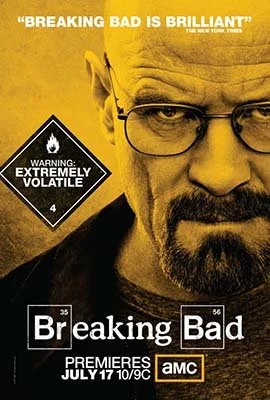
Promotional image for season 4 of the TV series Breaking Bad featuring an image of actor Bryan Cranston glaring at the camera

26 December 2025

The popular US television show Breaking Bad (2008–13) is about a high-school chemistry teacher in Albuquerque who, after being diagnosed with lung cancer and with the assistance of an ex-student turned failed drug dealer, begins to cook and sell crystal meth. While the show has been popular with both audiences and critics, the title has baffled many. What does breaking bad mean? Where does the phrase come from?

The answers to these questions are not surprising but digging the answer out of reference books is somewhat difficult, because for most of its life to break bad was not a catchphrase, but simply a normal verb phrase, consisting of a verb coupled with a variety of adjectives. One could break bad, but one could also break good, or break lucky, or break better, etc. It wasn’t until the 1960s that to break bad developed into a fixed phrase, with a sense of to become angry or belligerent, in Black slang. And in the series, White's turn to criminality and violence indicates that the title stems from this Black slang usage.

The use of break in various contexts of something emerging or becoming apparent dates to the seventeenth century. Today we often speak of breaking news, and this phrasing dates to Thomas Middleton’s c. 1615 play The Witch which contains the line “What news breakes there?”

The use of break in cricket to mean a ball that changes its trajectory dates to the late nineteenth century. We have this example from a 6 October 1884 article describing an interview with famed cricketer W. G. Grace:

He says that a fast bowler can “break” both ways, but admits this cannot be done with precision.

And it appears in American baseball slang by the end of the century when it is used by The Chicago Daily News on 8 October 1899:

Katoll is spoken of as the possessor of a sizzling curve that comes up with a phenomenal burst of speed and breaks lightning fast.

And break wrong starts being used in a more general sense by baseballers not long after. From the Detroit Free Press of 9 June 1901:

The unexpectedly poor showing of the Tigers in the series with the eastern teams on the home grounds should not make the followers of the team lose faith in their favorites. The team was laboring under many disadvantages and everything seemed to break wrong for them.

And this the following week in the Rockford, Illinois Morning Star of 15 June 1901:

But for eight innings everything seemed to break wrong for the locals.

Shortly after this, various forms of break good/right/lucky start appearing. Such examples of the verb to break paired with various adjectives can be found right up to the present day. But the use of break bad as a fixed phrase isn’t recorded until the 1960s, when it starts appearing in African-American slang with the sense of to become aggressive or angry. Claude Brown’s 1965 novel Manchild in the Promised Land has:

Down home, when they went to town, all the n[——]rs would just break bad, so it seemed. Everybody just seemed to let out all their hostility on everybody else.

The earlier uses of break bad are primarily in the sense of things taking an unfortunate turn, of bad luck, with criminality, anger, and violence becoming attached to the phrase when it becomes a fixed locution in Black slang.

Discuss this post


Sources:

Brown, Claude. Manchild in the Promised Land. New York: Macmillan, 1965, 302. Archive.org.

Dickson, Paul. The Dickson Baseball Dictionary, third edition. New York: W. W. Norton, 2009, s.v. break, break ball, 134.

Green’s Dictionary of Slang, accessed 22 November 2025, s.v. break, v.2.

“Kiernan’s Krew Beaten in Tenth.” Morning Star (Rockford, Illinois), 15 June 1901, 4/3. Readex: America’s Historical Newspapers.

“An Interview with Dr. W. G. Grace.” Huddersfield Daily Chronicle (West Yorkshire), 6 October 1884, 4/2. Gale Primary Sources: British Library Newspapers.

Middleton, Thomas. The Witch. London: J. Nichol, 5.3, 106. Gale Primary Sources: Eighteenth Century Collections Online (ECCO). The play existed only in manuscript form for over 150 years before it was published in 1778. The manuscript is Oxford, Bodleian Library, MS Malone 12.

Oxford English Dictionary Online, March 2024, s.v. break, v.

“Whirl of the Sporting World.” Detroit Free Press (Michigan), 9 June 1901, 10. ProQuest Newspapers.

Image credit: Sony Pictures Television/AMC, 2011. Fair use of a low-resolution copy of a copyrighted work to illustrate the topic under discussion.