raccoon / trash panda

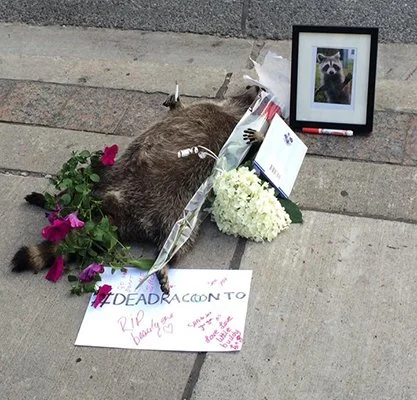
Photo of dead raccoon on a sidewalk with flowers, notes of condolence, and a photo arrayed about the corpse

Conrad, the Raccoon

23 January 2026

Raccoons (Procyon lotor) are medium-sized (11–57 lbs / 5–26 kg), North American mammals with dexterous paws, a facial mask, and ringed tail. They are originally native to deciduous forests, but have adapted extremely well to urban areas, living in close proximity to humans, where they are often, despite their cuteness, considered a pest.

The word raccoon has a rather straightforward etymology. The word is from the Virginia Algonquian dialect word aroughcun or aroughcoune. Its first known use in English is in John Smith’s, 1608 True Relation of events in the early days of the Virginia colony. The word appears in a description of the native American chief Powhatan, the father of Pocahontas:

Arriuing at Weramocomoco their Emperour, proudly lying vppon a Bedstead a foote high vpon seune or twelue Mattes, richly hung with manie Chaynes of great Pearles about his necke, and couered with a great Couering of Rahaughcums.

Early spelling of the word varied considerably, with three main forms of the word being rahaugcumarocoun, and raccoone. The spelling standardized around the last in the eighteenth century. Up until the twentieth century, spelling racoon with one <c> was common.

More recently, the slang name trash panda has been applied to the creatures, due to their propensity to raid trash bins for food and their resemblance to either the Asian red panda (Ailurus fulgens), which it resembles rather closely, or the giant panda (Ailuropoda melanoleuca), which it does not resemble other than the eye mask. (Pandas and raccoons are not related.) The slang term appears to have originated in Canada, or at least that’s where early uses predominate.

The earliest unambiguous use of trash panda that I’m aware of is a 24 February 2015 tweet that reads:

Orca=Sea Panda
Penguin=Ice Panda
Possum=Rat Panda
Badger=Striped Panda/Hufflepanda
Raccoon=Night Panda/Trash Panda
Skunk=Sulfur Panda
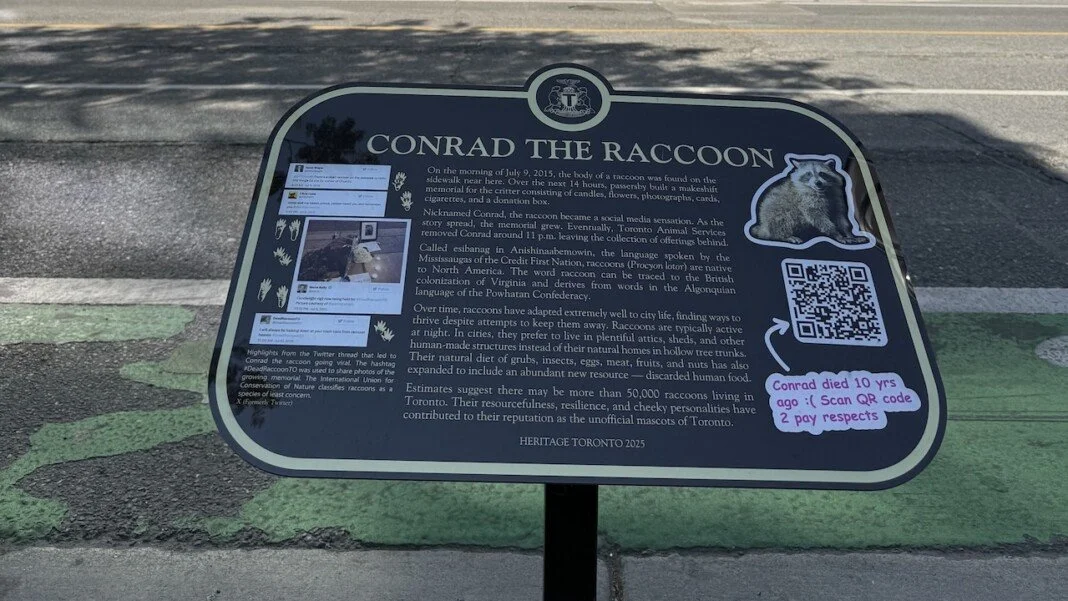
Heritage Toronto plaque containing the story of Conrad, the raccoon, photos, and a QR code for people to pay their respects

Memorial plaque dedicated to Conrad, the raccoon, established on the tenth anniversary of his death

And use of trash panda exploded a few months later in relation to the 9 July 2015 demise of Conrad, a Toronto raccoon. (Raccoons are extremely common in that city.) Early that day, the body of a dead raccoon on the sidewalk along Yonge Street—a major downtown thoroughfare—was reported to animal control, which was slow in coming to pick it up. (The agency’s explanation for the tardiness was that they place a priority on trapped and distressed animals, which is only right.) In the meantime, residents created a memorial around the raccoon, whom they dubbed Conrad. Flowers, notes of condolences, candles, and a framed photo of a raccoon were arrayed around Conrad’s corpse. News of the memorial exploded on social media and on the local news. Later that evening, animal control finally arrived to dispose of poor Conrad’s mortal remains.

And trash panda got an entry in Urbandictionary on 2 August 2015:

trash panda
A raccoon
Those damn trash pandas keep tearing up my garbage bags.

There are some earlier, ambiguous uses of trash panda, which may or may not refer to the mammal. There are a few earlier tweets that have collocations of trash + panda but whose context cannot be determined, and a few Twitter users had the phrase in their handles. A musical group with the name Trash Panda and the Plywood Carousel Rejects was reported as performing in Saint John, New Brunswick in January 2007. And Michael Shilling’s 2009 novel Rock Bottom has the following lines:

Now the box was impaled on her heel. She shook her foot, but it wouldn’t come off, hanging there like a little baby trash panda.

There’s no further elaboration in the book as to what is meant, but my guess is that it is not a reference to a raccoon but rather to a piece of trash that is clinging like a baby panda does to its mother.

Discuss this post


Sources:

@Pandabbadon. Twitter.com (now X.com), 24 February 2015.

Oxford English Dictionary Online, June 2008, s.v. raccoon, n.

Shilling, Michael. Rock Bottom. New York: Back Bay Books, 2009, 109. Archive.org.

Smith, John. A Trve Relation of Such Occurrences and Accidents of Noate as Hath Hapned in Virginia Since the First Planting of that Collony. London: John Tappe, 1608, sig. Cv. ProQuest: Early English Books Online (EEBO).

“Today and Tomorrow.” Telegraph-Journal (Saint John, New Brunswick), 30 January 2007, D2. ProQuest Newspapers.

Urbandictionary.com, 2 August 2015, s.v. trash panda.

Photo credits: Conrad, the raccoon, @ladydi1116, Twitter.com (now X.com), 9 July 2015, fair use of a copyrighted image to illustrate the topic under discussion; Memorial plaque, Streetsoftoronto.com, 2025, fair use of a copyrighted image to illustrate the topic under discussion.
bootleg

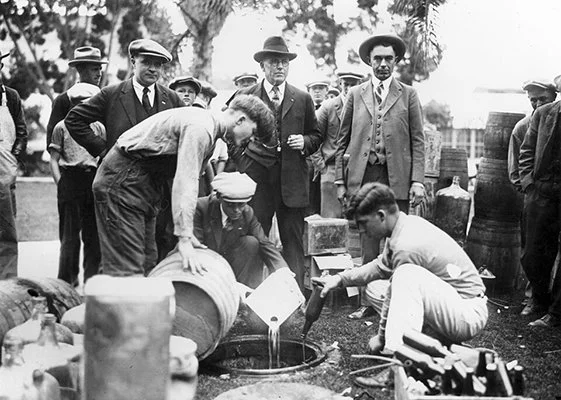
B&W photo of three men pouring liquor into a sewer while a group of other men look on; all are wearing 1920s-era clothing

Men, under the supervision of the Orange County, California sheriff, destroying bootleg liquor, c. 1925

19 January 2026

Bootleg marks a product that is either inferior or illicitly produced. But why bootleg and when did the term come into being?

Literal use of bootleg to refer to the part of a boot that covers the lower leg dates to the sixteenth century. And it is commonly thought that bootleg liquor is so named because smugglers would hide bottles of illegal booze in their boots. That explanation is possible, but the early evidence points to another reason, that the term comes from mixing alcohol with adulterants, including boot leather, to give it the appearance of flavor of aged liquor. Bootleg liquor is also associated with the Prohibition era, but while the ban on liquor in the 1920s boosted its use, the term is quite a bit older.

The earliest known use of bootleg in reference to liquor is from a satirical piece in New York’s  Subterranean and Working Man’s Advocate of 16 November 1844 mocking the Whig party for losing the 1844 presidential election, in which Democrat James K. Polk narrowly defeated Whig Henry Clay:

GREAT AUCTION SALE.

Will be sold at the Whig Head Quarters in this city, on the first fine day, the following ALL IMPORTANT ARTICLES for carrying an Election. They are the effects of the late Whig Party. To the “Natives,” or any other New Party, they would prove an invaluable acquisition, and to any such they will be sold (at private sale) very cheap.

Lot 1. 4 Living Eagles, that from long practice in the processions of all political parties, know how to carry their heads in any party, no matter how crooked its principles.

   “  2. 9 Puncheons of Old Rum (real New England ‘boot-leg,’) the balance of a very large stock that has gone off very freely.

   “  3. […]

The Whigs lost the election in 1844 but would have subsequent victories and not actually dissolve until ten years later, following their defeat in the 1852 presidential election, in which Democrat Franklin Pierce crushed Whig Winfield Scott and saw the beginnings of the rise of the Republican party.

Nineteen years after that first known use and on the other side of the country we get the following from California’s Knight’s Landing News of 24 October 1863 which points to adulteration with boot leather, among other unsavory ingredients, as being the metaphor underlying the term:

“GOOD LIQUOR” AT TROY.—In a suit recently brought before a Justice’s Court in Troy, involving a matter of liquor, the defendant further answering says that the liquor plaintiff seeks to recover for, was nothing more than twenty-two cent whisky colored with logwood, tanbark, tincture of bedbugs, old boot-legs and copperas; that he sold this vile stuff at retail to his customers; that they died—to his damage two hundred dollars.

We see bootleg applied to something other than liquor, in this case coffee, in Philadelphia’s Evening Telegraph of 1868. The article in question is about New York and indirectly associates the stuff with boots:

The bootblacks of the Park are of an eminently confiding and convivial nature. The one with whom I had the pleasure of conversing, informed me on the first moment of our acquaintance that he always dined at Delmonico’s when he came to the city, and that his favorite repast consisted of boot-leg coffee and double-breasted doughnuts.

And this piece about the prison conditions that appeared in the New York Herald of 26 July 1872 again associates the coffee given to prisoners with black boot leather:

“What do you get for supper?”
“Bread and coffee. The coffee is as black and filthy as I ever saw. The old stagers up there call it
‘BOOT LEG’
and it is about as black as that. It’s infernal stuff, I tell you.”

With Prohibition in the United States in the 1920s, not only did the use of bootleg liquor become more common, but we also start to see many other types of inferior or illicit products being labeled as bootleg, such as bootleg milk and bootleg jazz records.

So the metaphor underlying the term is uncertain, but the available evidence points to boot leather being used to adulterate liquor and coffee as the origin.

Discuss this post


Sources:

“Good Liquor at Troy.” Knight’s Landing News (California), 24 October 1863, 1/5. Archive.org.

“Great Auction Sale.” Subterranean and Working Man’s Advocate (New York City), 16 November 1844, 3/2. Archive.org.

Green’s Dictionary of Slang, accessed 7 December 2025. s.v. bootleg, n., bootleg, adj., bootleg, v., bootlegger, n.

“New Yorkisms.” Evening Telegraph (Philadelphia), 20 August 1868, 5/1. NewspaperArchive.com.

Oxford English Dictionary Online, 25 March 2025, s.v. bootleg, n. & adj., bootleg, v., bootlegger, n.

“Punishment of Prisoners.” New York Herald, 26 July 1872, 10/2. Readex: America’s Historical Newspapers.

Photo credit: Unknown photographer, c. 1925. Orange County Archives/Flickr. Wikimedia Commons. Public domain photo.

enthusiasm / enthuse

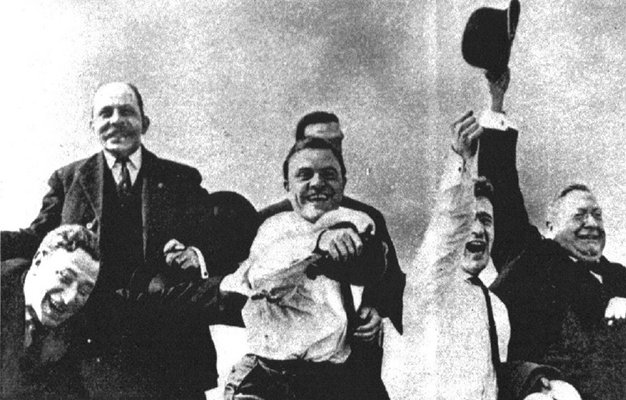
B&W photo of six men laugh and cheering and waving their hats in the air

Enthusiastic men, c. 1912; the man in center with outstretched fist is singer Billy Murray; the others are unidentified

16 January 2026

The meanings of words change over time. Sometimes words become more specialized; the Old English deor was used to refer to any kind of wild beast, but by the end of the thirteenth century had started to be used specifically to refer to the creature we now call a deer. Other words become more general over time; one such is enthusiasm.

Enthusiasm comes into English from Greek ἐνθουσιασμός and the Latin enthusiasmus, where it refers to the state of being possessed by a god. It was a religious term for a state of divine ecstasy or frenzy. This Latin and Greek meaning was the sense of the word when it was first used in English, but the earliest uses in English are in reference to heretical Christian sects who were thought to be falsely inspired by supposed divine influences. Here is one such use, in the form enthusiast, in a 1536 translation of Philip Melanchthon:

And it is profitable also as much as may be, to garnishe the ministration of the worde with al maner prayse agaynst mad men, whiche dreame that the holy ghoste is gyuen nat by the worde, but for certaine preparatio[n]s of theyr owne, if they syt ydle holdynge theyr tonges in darke places, lokyng after illumination / lyke as they dyd in olde tyme whiche were called enthusiastes whiche fayned them selues to be inflate and inspired by the diuine influence and power, and as these Anabaptistes do at this day.

Toward the end of the century, enthusiasm was being used in reference to being filled with a different kind of spirit. From a 1593 translation of François Rabelais’s Orthœpia Gallica:

In vvine is truth, that is to say, In vvine is truth.

Harke my friend, I vvill tell thee a thing in thine eare, tell no body if thou loue me, it shall rest secret betweene vs two: it is, that I find the vvine better and more pleasant to my tast then I vvas vvoont: more then I vvas wont I feare the meeting of a bad cup of vvine, and to tell you the plaine truth, the odour of vvine how much more it is delicious, smirking and surpassing, by so much more celestiall and delicate is it then oile, That is spoken like a man of learning. I vvill tell other stories. Tarry a little that I deduce a dram out of this bottell: Lo here my very and sole Helicon. See here my Fountaine Caballine. This is mine onely Enthusiasmos.

And by the beginning of the seventeenth century the word was being used to refer to poetic inspiration, being metaphorically possessed by one’s muse. From a 1605 translation of Du Bartas’s Divine Weeks and Works we see the French equivalent left untranslated:

For yet (besides my vaines and bones bereft
Of blood and marrow, through thy secret theft)
I feele the vertue of my spirit decayd,
Th’Enthousiasmos of my Muse allaid.

And on the title page of Thomas Dekker’s 1620 Dekker His Dreame we see enthusiasm used in a non-translation context:

Dekker his Dreame.

In which, beeing rapt with a Poeticall Enthusiasme, the great Volumes of Heauen and Hell to Him were opened, in which he read many Wonderfull Things.

And by the early eighteenth century we see enthusiasm being used in the sense we’re most familiar with today, that of a passion or intensity of feeling for some cause, principle, or activity. Here we see it in a 16 March 1717 letter by English bishop White Kennett on the subject of a planned invasion of England by Sweden which never happened:

And yet amidst these divisions at home we are daily threatened with invasion from abroad, though certainly we are so well prepared against it, that the King of Sweden, who was so desperate to project it, must have much more enthusiasm in him to put it in execution.

And in the early nineteenth century we start to see the backformation to enthuse. It is originally an Americanism, but its earliest recorded use is by the Scottish botanist David Douglas in a 9 July 1827 letter about the results of his trip to the Pacific Northwest. Douglas was a Scot, but he had spent several years in North America and picked up some of the idioms spoken there:

In Botany my expectations have not been realized, but at the same time, being in possession of several not included in the American Flora, many interesting and but partially known species, with some additional knowledge as to the geographical range of plants, an enquiry of the greatest importance, I have no reason to regret the journey At all events, my humble exertions will I trust convey and enthuse, and draw attention to the beautifully varied verdure of N. W. America.

While originally an Americanism, enthuse can now be found on both sides of the Atlantic. It is found primarily in an informal register, and there are many who criticize its use. But it quite clearly a well-established word, and while perhaps it is best to avoid its use in formal writing, in less formal contexts it is perfectly fine.

That’s quite a journey in a mere four centuries, from religious ecstasy and boozing it up to acquiring a sometimes-derided backformation.

Discuss this post


Sources:

Du Bartas, Guillaume de Salluste. Bartas His Deuine Weekes & Workes. Joshua Sylvester, trans. H. Lownes, 1605, 341. ProQuest: Early English Books Online (EEBO).

Dekker, Thomas. Dekker His Dreame. London: Nicholas Okes, 1620, title page. ProQuest: Early English Books Online.

Douglas, David. Letter, 9 July 1827. In Athelstan George Harvey. Douglas of the Fir: A Biography of David Douglas Botanist. Cambridge: Harvard UP, 1947, 148. Cornell University Library: Core Historical Literature of Agriculture.

Kennett, White. Letter to Dr. Blackwell, 16 March 1716/17. In Henry Ellis, ed. Original Letters Illustrative of English History, second series, vol. 4. London: Harding and Lepard, 1827, 306. HathiTrust Digital Library.

Melanchthon, Philip. “The Apologie or Defense of the Confessyon of the Prynces of Germany.” Richard Taverner, trans. In The Confessyon of the Fayth of the Germaynes. London: Robert Redman, 1536, sig. N6v. ProQuest: Early English Books Online (EEBO).

Merriam-Webster.com, 27 November 2025, s.v. enthuse, v.

Oxford English Dictionary Online, September 2018, s.v. enthusiasm, n., enthuse, v., enthusiast, n.

Rabelais, François. Orthœpia Gallica. Eliots Fruits for the French. John Eliot, trans. London: Richard Field for John Wolfe, 1593, 41. ProQuest: Early English Books Online (EEBO).

Photo credit: Unknown photograph, c. 1912. Wikimedia Commons. Public domain image.

blitz / blitzkrieg

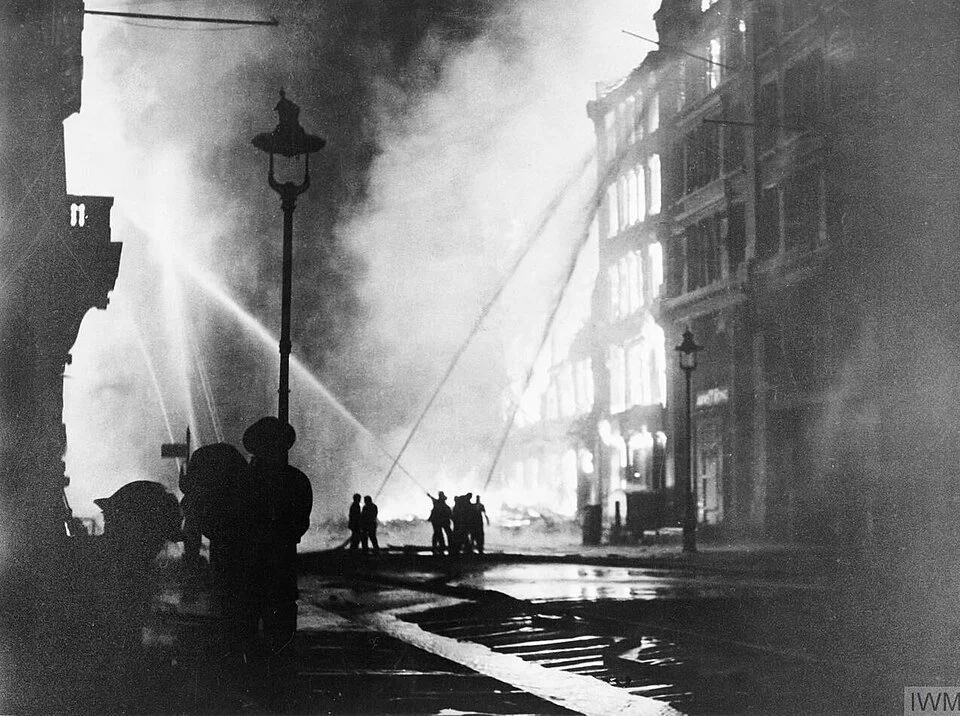
Nighttime B&W photo of firefighters battling a large fire in a city

London firefighters trying to extinguish a blaze during the Blitz, 10–11 May 1940

14 January 2026

Blitz is a clipping of Blitzkrieg, the German word meaning lightning war, which referred to the high-speed, offensive tactics made famous by the German army in the opening months of World War II. In English, blitz can refer to a sudden, violent military attack, especially one by air, or metaphorically to any fast or sudden movement or change.

The earliest use of blitzkrieg in English that I’m aware of is in a translation of a German military document regarding the German strategy for intervening in the Spanish Civil War that was printed in several American newspapers in March 1938:

Interventionists in Spain have visions of paralyzing or even cutting the lines of communications so vital to France in transporting her colonial forces.

Such an eventuality might become decisive in the first phase of the Blitzkrieg (lightning war) against France, that scheme so dear to the military chiefs of National Socialist Germany.

And the earliest use I know of that is not a translation of a German text is in an article about a spike in the price of gold in the 20 August 1938 issue of the Times of Malaya. The timing is that of the crisis over the Sudetenland, which would result in the infamous Munich Conference the next month:

They are convinced, too, that the war scare now so evident on the Continent will diminish as soon as the historically fateful month of August is passed, since even the most nervy of men realise that dictators are unlikely to strike during late autumn or in winter, because good and settled weather conditions are considered essential to the success of the blitzkrieg plan!

It might seem odd that such an early use of the term would be in a Malaysian newspaper, but it is probable that the copy was written by a London correspondent for an English audience in the then-British colony. A few months later we get a similar use in the Malay Mail of 8 April 1939:

A symptom of the quickening tempo in Germany is the new finance plan which is purely a short-term expedient. The plan leads to the assumption that its adoption was inspired by “Blitzkrieg” philosophy.

And there is this rather prophetic analysis of how the coming war would play out in London’s Picture Post of 22 April 1939:

Hitler’s success so far, following the precepts of Mein Kampf, has lain in a series of isolated lightning attacks, not one of which has been sufficient to bring in Britain or France. He might still win a “Blitz-Krieg”—a lightning war against either the West or Russia. But owing to the lack of materials he could not win a protracted war. His one chance is to divide.

And shortly after the start of the war, we get a metaphorical, non-military use of blitzkrieg as a verb. From an article about the Golden Gate International Exposition in the San Francisco Chronicle of 9 October 1939:

On this page you can see for yourself, just in case you’re one of the two or three people who didn’t get to Treasure Island yesterday, how the mass of humanity moved in and blitzkrieged the Exposition. All the central points of interest were jam-packed.

Also in 1939 we start to see widespread use of the clipped form blitz referring to a variety of fast or speedy things. Fears of the coming war and a German military strike were clearly making an impact on the language. There is this telephonic use of Blitz call from London’s Listener of 26 January 1939. I am not sure, however, whether Blitz call was a jargon term in German, and therefore simply a reference to lightning and not the military tactic, or if it was coined in English by the reporter:

After Marshal von Hindenburg’s impressive funeral at Tannenberg, right away in a remote part of East Prussia, for example, one American news agency correspondent rushed to the only telephone in the neighbourhood, asked for a Blitz call to his office—that is to say a call at nine times the normal rate—and only discovered when he had dictated his very expensive story that he had accidentally been put through to the wrong number and had dictated it to a rival agency.

There was also a British racehorse named Blitz that had great success that year. Early uses of colloquial terms often appear in the names of racehorses. From London’s Daily Mirror of 15 March 1939:

Turkhan, a son of Theresina, is about the most forwards of the Bahrams at present, but on appearance he gives nothing to Blitz, a colt by Blenheim—Friar’s Lady.

And for further evidence that blitz was very much in the English Zeitgeist of the time, the British comic strip Pip, Squeak and Wilfred also featured a dog named Blitz.

After the start of the war, we see blitz used in this poem from the Daily Mail of 9 December 1939, during the period of the “Sitzkrieg,” where Germany was technically at war with Britain and France but there were no significant hostilities on land:

It seems that our No. 1 Fritz
Is fed to the teeth with his Blitz.
     There’s so little krieging
     He finds it fatiguing,
And worries because Churchill twits.

And the 1 January 1940 European edition of the New York Herald Tribune reported on a blitz flu that had struck England:

A new form of influenza, termed “blitz flu” because it lasts only forty-eight hours, has made its appearance in England.

Like ordinary flu its symptoms are cold shivers, headache and pains in the muscles. Thousands of persons in all parts of the country are suffering from “blitz flu,” but fortunately the malady is of a mild character.

Of course, the Blitz (with the definite article) was the German bombing campaign of London and other British cities between the defeat of the Luftwaffe in the Battle of Britain and the German invasion of the Soviet Union. The Blitz lasted from September 1940 to May 1941.

There are lots of other metaphorical uses of blitz that flow from the World War II term. Blitz chess makes its appearance by 1942, as reported in the 5 April 1942 Hartford Courant:

Postal number two tells of the fourth annual banquet of the Deep River Chess Club […] After dinner, the evening was devoted to “blitz” chess interrupted for twenty minutes by a blackout test.

And of course there is its use in American football, where a blitz is a play where defensive backs charge the opposing quarterback in an effort to disrupt a pass play. From the San Diego Union of 27 December 1962:

I guess Green Bay is a pleasant place but I’d hate to live in a town where football is the only topic of conversation. Even the women in Green Bay are so knowledgeable about the sport they amuse themselves at cocktail parties drawing up draft lists for the Packers; and they casually toss off such trade terms as “red dog” and “blitz.” A violinist or chess player wouldn’t have much to talk about in Green Bay.

So while the meaning of blitz has evolved somewhat over the years, it still remains close to its violent roots.

Discuss this post


Sources:

Avery, G. E. “Conn. Chess League and Club Notes.” Hartford Courant (Connecticut), 5 April 1942, A5/1. ProQuest Newspapers.

Bartlett, Vernon. “Foreign Correspondent.” Listener (London), 26 January 1939, 189/2. Gale Primary Sources: The Listener Historical Archive, 1929–1991.

“‘Blitz Flu’ Hits England, Mild Variety of Malady.” New York Herald Tribune (European Edition, Paris), 1 January 1940, 3/2. Gale Primary Sources: International Herald Tribune Historical Archive, 1887-2013.

Bouverie. “Newmarket’s Wealth of Racing Talent.” Daily Mirror (London), 15 March 1939, 28/2. Gale Primary Sources: Mirror Historical Archive, 1903–2000.

“European Climax in 12 Months.” Malay Mail (Kuala Lumpur), 8 April 1939, 3/4. Gale Primary Sources: British Library Newspapers.

“German Officer’s Secret War Papers Deride Hitler’s Spanish Objective.” New York Post, 9 March 1938, 1/1. Readex: America’s Historical Newspapers.

Green’s Dictionary of Slang, accessed 4 December 2025, s.v. blitz, n., blitz, v.2, blitzed, adj.

Hulton, Edward. “Resist German on Both Fronts.” Picture Post (London), 22 April 1939, 53/3. Gale Primary Sources: Picture Post Historical Archive, 1938-1957.

“London Rush to Buy Gold and Gold Shares.” Times of Malaya, 20 August 1938, 12/4. Gale Primary Sources: British Library Newspapers.

Murphy, Jack. “Who Wants to Live in a Town Where Football Is the Only Topic?” San Diego Union (California), 27 December 1962, a-15/1. Readex: America’s Historical Newspapers.

Oxford English Dictionary Online, 1972, s.v. blitzkrieg, n., blitz, n.

“Pardon Our Pride, but San Francisco Does Know How!” San Francisco Chronicle (California), 9 October 1939, 10/4. Readex: America’s Historical Newspapers.

“You Never Can Tell.” Daily Mail (London), 9 December 1939, 2/5. Gale Primary Sources: Daily Mail Historical Archive.

Photo credit: London Fire Brigade photographer, 10–11 May 1940. Imperial War Museum, image HU 1129. Wikimedia Commons. Public domain image.